
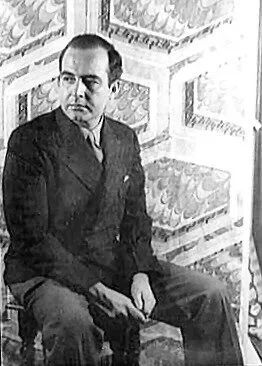
Samuel Barber
Human Design Chart
Biography
In his late teenage years he met fellow Curtis Institute of Music schoolmate Gian Carlo Menotti, who became his partner in life as well as in their shared profession. In 1943, Barber and Menotti purchased a house in Mount Kisco, New York.
Barber spent many years in isolation, suffered from depression, and was also beset by alcoholism. He died of cancer on 23 January 1981 in New York City at the age of 70.
Human Design Analysis: Samuel Barber as Manifesting Generator 1/3
Manifesting Generator 1/3 — Design at a Glance
Samuel Barber's design features a hybrid energy foundation: the lightning-fast implementation power of a Manifestor paired with the constant sacral life force of a Generator. This configuration marks him as someone who not only reacts to impulses but also transforms them into action at such speed that he can skip steps and quickly draw things into his life.
However, this ability for swift action carries a specific risk: The tendency towards multitasking and skipping necessary intermediate steps could lead to frustration – the central non-self theme of the manifesting Generator. If he pursued multiple projects simultaneously without his inner authority and strategy being 'on board', initial creative enthusiasm would easily tip into exhaustion or dissatisfaction.
The solution to this internal conflict for Samuel Barber lay in strictly reacting to life rather than initiating it himself. Only with clear sacral confirmation – that inner 'yes' – did he apply his energy. When this resonance was present, he could work on various tasks simultaneously without becoming frustrated. In this state, he entered a 'play mode', which allowed him deep satisfaction and lasting fulfillment from his creations. His effectiveness thus depended less on linear planning than on the constant review of whether his current activity still aligned with his inner approval.
Emotional Authority
Samuel Barber exhibited an internal decision-making structure that required inevitable time delays to gain clarity. His inner authority was emotional authority, carried by the defined emotional center. This meant that his perception of the world was always marked by a wave movement of emotions: something could appear absolutely right in one moment and completely wrong in another. However, these fluctuations were not final truths but transient moods.
The mechanics of his authority dictated that immediate reactions to these emotional peaks often led to misjudgments. Instead of succumbing to the first impulse, Samuel Barber had to go through a process of waiting. He needed the distance of time for intense feelings to subside and emotional detachment to arise. Only then did true calm set in, enabling a grounded decision.
This waiting was not passive delay but an active filtering process. By repeatedly 'sleeping on' important questions, he could distinguish between transient enthusiasm or rejection and his deeper, stable truth. Only after this ripening process, when the emotional wave had ebbed, did he gain access to clear, unclouded insight. This mechanism protected him from getting entangled in short-term moods and ensured that his long-term life decisions were based on solid ground, not fleeting emotional impulses.
The 1/3 Profile — Investigator / Martyr
Samuel Barber's design tends towards acquiring knowledge not just theoretically but through direct experience and mistakes. As a researcher and experimenter (Profile 1/3), he oscillated between the need for thorough preparation and the urge to practical experimentation. Line 1, marked by Gate 22, promotes self-awareness, courtesy, and attentiveness. However, this energy could lead to hesitation when the feeling of 'not knowing' prevailed; fear of not being adequately prepared held back action. Simultaneously, Line 3, determined by Gate 26, drives towards action. Here it's about trial and error as well as overcoming ego through rejection. Samuel Barber thus learned through doing and the resulting setbacks. This synthesis of theoretical examination and practical testing created a high level of credibility in his judgments. If he deemed something good, it had stood up both intellectually and practically. His expertise only emerged after personal experience with mistakes, making his assessments particularly well-founded. Life revolved around this cyclical process of learning and experimenting, where Line 3 helped recognize and overcome vulnerability through rejection.
Single Definition — Defined & Open Centers
Samuel Barber's design inclined towards reliable expression and deep emotional reflection. His defined Throat allowed him to carry messages clearly into the world, while his defined Sacral Center provided a vast reservoir of vital energy that could only be activated through reactions to external impulses – not by initiatives from the mind. This mechanism required patience: he had to wait for life to speak to him in order to use his strength efficiently and avoid frustration.
His emotional authority resided in his defined Solar Plexus. Here, truth revealed itself over time. Samuel Barber tended to refrain from making impulsive decisions in the moment but waited until the emotional wave was clear. This protected him from hasty judgments and allowed for a deeper, more sensitive perception of connections. Additionally, his defined Spleen Center gave him spontaneous, intuitive warning signals at the moment of occurrence – an innate protective system he could trust without having to rationalize it. Furthermore, his defined Root Center propelled him with constant inner pressure, using stress as a continuous drive for survival and task completion.
In contrast, Samuel Barber appeared in the open centers Head, Ajna, G, and Heart as receptive to external influences. His open Head and open Ajna Center meant that he did not have fixed mental opinions or constant inspiration. Instead, his mind was a flexible classroom that took in ideas but was also prone to confusion and doubt if it did not identify them as foreign. He tended to question whether he knew the "right" answer, though his strength lay in flexibility.
His open G Center implied that identity and direction did not stem from within him but were initiated by the right place and fitting environment. If he felt out of place somewhere, the connection there was also incorrect. Finally, lacking a defined Heart Center meant that Samuel Barber lacked consistent willpower; he was not designed to make promises or prove his worth in competition. Any temptation to have to prove himself through performance led only to exhaustion and self-doubt in his design, as the energy for this simply did not exist. His strength lay in using these gaps as space for wisdom beyond other egos rather than trying to compensate for them.
Channels for powerful action, emotional depth, intuition, impulse and growth.
Samuel Barber's Design inclined towards emotional authenticity in expression. His impact strictly depended on his inner mood: only when he felt like it did his magnetic openness come to the surface. The Channel of Openness 22-12 connected the Solar Plexus Center with the Throat Center. Gate 22 steered the emotional wave, while Gate 12 as the Gate of Caution brought necessary restraint. This combination limited his social interaction to moments of highest resonance and mutative potential. Force led to harshness; patience allowed him to deeply touch or transform others through the quality of his voice. He thus created a receptive environment for new awareness, not out of social obligation but from individual passion.
Alongside this primary driving force, other mechanisms were at work. The Channel of Wavelength 48-16 connected intuitive depth with technical skillfulness. Here Gate 48 sought life-critical information while Gate 16 experimented and perfected possibilities. This fostered the refinement of skills to mastery, often in exchange between master and apprentice. The Channel of Charisma 34-20 brought the urge to act through sacral reaction. Gate 34 delivered raw physiological energy which was expressed in the present moment by Gate 20. This required self-reinforcement and focus on satisfying activities to avoid obsession.
The Channel of Recognition 30-41 connected Root Pressure with emotional fantasy. Gate 41 initiated a desire for new experiences while Gate 30 recognized feelings for it. This generated restlessness and an intense need to feel life deeply, balanced by the necessity of patience. Finally, the Channel of Maturation 53-42 promoted the cyclical process of learning. Gate 53 started new beginnings while Gate 42 enabled growth and reflection. Each experience had to be brought to a satisfying conclusion to gain wisdom for future cycles. These channels collectively shaped Samuel Barber's path of experience and expression.
Collective Circuitry — Circuit Signature
Samuel Barber's design combined emotion and expression into a pulsating, acoustic power. The Knowledge Circuit (Channel 12-22) channeled emotional waves from the Solar Plexus Center directly to the Throat Center. This created a unique identity that transformed new insights through his own individual path and contributed them to the collective.
Parallel to this, the Understanding Circuit (Channel 16-48) came into play. It connected the Throat Center with the Spleen Center. Here it was about focused, rational sharing of logical insights, free from emotional conditioning. This connection allowed for clear and visual communication of strategic insights, separate from the emotional wave of the Knowledge Circuit.
A third aspect was the Meaning-making Circuit. Through Channels 42-53 (Maturation) and 30-41 (Recognition), it connected Sacral, Root, and Solar Plexus Centers. This energy reflected past experiences cyclically. It served to learn from the past and share these felt insights with others to find meaning together.
Finally, the Integration Circuit (Channel 20-34) ensured survival. It linked Throat and Sacral Centers. Here power was gained from reacting to life and acoustically manifested in the present moment. This connection strengthened his highest individuality through proper behavior and intuitive knowledge.
As Samuel Barber had a Simple Definition, these energies flowed as one continuous group. Throat, Solar Plexus, Root, Sacral, and Spleen Centers formed a continuous stream. This shaped his essence as someone who united emotional depth, rational clarity, and vital power in an integrated expression.
Right Angle Cross of Rulership 1
Samuel Barber's Human Design configuration bore the imprint of the right cross of Governing. This configuration established a foundational stance oriented towards authority and responsibility. It was not arbitrary power but rather a structural ability to create order and make decisions that others would follow.
In Human Design, this cross describes a specific energy distribution that links leadership competence with the necessity of actually exercising this role. Samuel Barber revealed himself as someone who was naturally destined not just to think or feel but actively to take control of the steering wheel. The mechanics of this design support individuals in setting clear directions and maintaining structures without constantly seeking approval from others.
This characteristic shaped his way of interacting with his environment. He was designed to bring clarity into situations where uncertainty prevailed. The right cross of Governing bestows an inner security that allows one to take responsibility without being dependent on external expectations. Samuel Barber lived this dynamic by using his own authority as a tool to achieve goals and guide processes. It was a continuous process of acting in harmony with this internal structure, which helped him remain stable in complex environments and lead others through their example or decisions.
Saturn Return · Uranus Opposition · Chiron Return · 2nd Saturn Return — Life Cycles
Samuel Barber's design was marked by a cyclic validation from external institutions that acted as mirrors reflecting inner maturation. This structure indicated that recognition did not occur randomly but corresponded to profound developmental phases.
In 1941, at the age of 31, he was elected into the American Academy of Arts and Letters. This coincided precisely with his first Saturn return. In Human Design mechanics, this cycle often marks a transition from searching to solid anchoring; years of groundwork condenses here into visible results recognized by the outside world. The election confirmed his positioning within the artistic community as the fruit of this maturation phase.
Another instance of this dynamic was in 1961 when he was elected, at age 51, into the American Academy of Arts and Sciences. This aligned with his Chiron return. This period is not a healing process in a medical sense but rather a fulfillment cycle of 'blooming'. Those who have lived according to their strategy and authority experience now a deepening of their purpose. His admission into the academy of sciences underscored this unfolding: his life's work found new, expanded resonance during this phase that made visible the meaning of his previous paths. Both events illustrate how external validation in Samuel Barber's design was closely linked with inner developmental cycles.
Manifesting Generator · Emotional Authority — Synthesis
Samuel Barber's design reveals a central continuity between deep inner experience and the drive to carry this outwards through creative expression forms. The combination of manifesting generator strategy – reacting rather than initiating – with emotional authority points towards a process where impulses are first filtered through an emotional wave and then implemented with powerful energy. This dynamic is reinforced by the connection between Root and Sacral centers, providing a constant source for life force that always awaits authentic reactions. An open Head and Heart also signal high sensitivity to external influences and the ability to transform these into creative work – a continuous exchange between inner and outer world shapes his creation.
At the same time, the design reveals a central paradox: the tension between the need for internal clarity and rapid manifestation power. Emotional authority requires time for decisions to mature while the manifesting generator component tends to react swiftly to impulses. This leads to an internal struggle between waiting for clarity and the urge for immediate implementation – this is further intensified by open centers – a constant negotiation between inner process and outer manifestation.
5 Defined Channels
Incarnation Cross - Right Angle Cross of Rulership 1
Solar Return
The Solar Return shows the moment when the sun returns to its exact birth position - your personal solar year.
Life Cycles
Discover the life cycles with a detailed triple view (birth chart, cycle chart, composite).
Human Design Profile
- Strategy
- To respond - wait for something to respond to
- Authority
- Emotional Authority
- Profile
- 1/3 - Investigator / Martyr
- Definition
- Single Definition
- Incarnation Cross
- Right Angle Cross of Rulership 1
- Date of Birth
- 09.03.1910 00:05
- Place of Birth
- West Chester, PA, United States
Frequently Asked Questions
What was Samuel Barber's Human Design type?
What Profile did Samuel Barber have in Human Design?
Which Authority guided Samuel Barber's decisions?
What incarnation cross was assigned to Samuel Barber?
When was Samuel Barber born?
Discover your own Human Design
Are you also a Manifesting Generator? Find out in a personal reading how to unfold your multi-talents and direct your energy wisely.
More Personalities
Back to overviewAaliyah

Aldair

Alexia

Alizée

Angèle

Angeli
