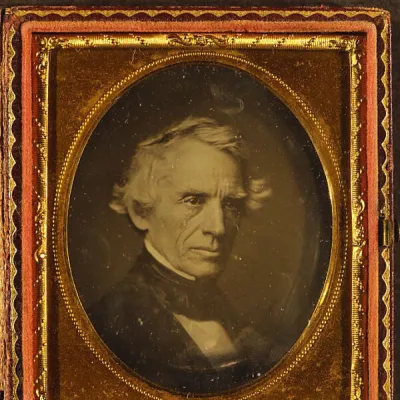
Samuel F. B. Morse
Human Design Chart
Biography
Samuel F. B. Morse as a Manifesting Generator 6/2 in Human Design
Manifesting Generator 6/2 — Design at a Glance
Samuel F. B. Morse exhibited hybrid energy: the constant power of a generator paired with the ability to act swiftly. His design allowed him to skip steps and quickly draw things into his life. However, this speed was a double-edged sword; often, his impulses were so rapid that important intermediate steps were skipped. In such cases, he had to backtrack and make up for the missing stages, which could easily lead to frustration – his specific non-self theme.
Furthermore, Morse tended to pursue multiple projects simultaneously in response to various impulses. Without clear inner approval, this creative drive quickly turned into overextension. The key for him was not to initiate himself but to react to life. Only when his Sacral Center gave a clear “yes” should he start. Regular checks to see if the projects still had his approval were essential.
When this strategy was followed, Morse drew deep satisfaction from his work. Then it was no problem for him to work on different tasks simultaneously; in fact, variety and playful mode were necessary to keep his creative power going. The demand to finish one thing before starting another would have slowed down his natural pace rather than supported it.
Emotional Authority
Samuel F. B. Morse showed a basic stance of emotional waiting: he did not decide based on the first impulse but let feelings subside before acting. This resulted from his inner authority – the defined Emotional Center. Regardless of other defined centers in his design, this center carried responsibility for all important life decisions. His perception was always marked by an emotional wave, a permanent up and down of moods. What excited him one moment could appear negative the next. However, this immediate reaction was only a snapshot, not yet his deeper truth. Quick, spontaneous decisions based on fleeting emotion would often have had negative consequences for Samuel F. B. Morse. Instead, his design required patience and conscious delay. He needed to take time to let a decision mature – often through multiple nights of reflection. Only when the intense feelings subsided and emotional distance was gained did clarity set in. This process of calm after the initial wave’s abatement was crucial for long-term realignments that significantly influenced his life path. Samuel F. B. Morse learned not to seek his inner truth in the first surge of feeling but in the peace that followed emotional turbulence.
The 6/2 Profile — Role Model / Hermit
Samuel F. B. Morse showed himself in his youth as someone who learned through intense experimentation. His profile as a role model and natural talent (Line 6/2) shaped this phase: before the age of thirty, the line appeared like a Three, making trial and error the driving principle. Mistakes here did not serve as failure but as necessary retreat points for new approaches.
Around thirty years later, his attitude fundamentally changed. The activation of the Six Line led him to withdraw to look at accumulated experiences with distance. This period served healing and deep self-knowledge. From this isolation emerged a wisdom that would become accessible to others later on.
This process was closely linked to themes of care and service. Line 6 (Gate 27) promoted altruism and protected against the misuse of generosity by establishing fairness. At the same time, Line 2 (Gate 19) demanded selectivity in the use of personal resources. An exchange between giving and taking developed that only worked if it was based on trust. Samuel F. B. Morse had to learn to trust himself and others to be able to help productively. His path led from the impulsive youth experimentation through a phase of introspective clarification to the role of a wise model guiding others into the ability for deep self-reflection.
Split Definition — Defined & Open Centers
Samuel F. B. Morse revealed himself as someone with a fixed, reliable identity and a clear sense of direction, supported by his defined G Center. This inner security allowed him to lead others onto new paths without needing their consent. His energy source was the defined Sacral Center, which provided constant vital power; he responded to life rather than initiating actions, which brought deep satisfaction when applied correctly. His defined Solar Plexus functioned as an emotional authority: He needed time to wait out the waves of his feelings before gaining clarity and taking action. Similarly, his defined Spleen Center delivered spontaneous, intuitive warning signals in the present moment, while the defined Root Center generated necessary pressure for material survival and progress. The defined Throat Center served as a pivot point to translate these internal processes into clear communication and action.
In contrast, his open Head and Ajna Centers revealed an openness to mental confusion and the pressure to find answers to questions that were not his own. He tended to be influenced by others' doubts or interpret intellectual concepts as personal truth rather than using them merely as temporary inspiration. His open Heart Center lacked consistent willpower; he was vulnerable to trying to prove his worth through promises and competition, often leading to frustration when these commitments did not arise from his strategy. This constellation shaped a person who relied on inner emotional and intuitive clarity to drown out the noise of an unstable mind and ego pressure.
Channels for reflection, mysticism, charisma and preservation.
Samuel F. B. Morse revealed himself as someone looking deeply into the past to recognize patterns and sort them patiently before communicating them. This attitude resulted from the Lost Son Channel 13-33, which connected his G Center with his Throat Center. Through Gate 13 he gathered information and secrets, while Gate 33 urged him to withdraw to reflect on these experiences and uncover deeper truths. He was a natural listener and keeper of what was heard, filing life stories to bring continuity and stability to the development of his environment. His challenge lay in timing: he had to wait until lessons fully revealed themselves rather than acting prematurely or withdrawing so much that no one benefited from his insights.
Parallel to this, the Charisma Channel 34-20 connected his Sacral Center with his Throat Center, giving him powerful, manifesting energy dependent on sacral reaction. Gate 34 pressed for action in the present moment while Gate 20 channeled this energy into concrete forms of expression. His vitality was best shown when he engaged in self-absorbed activities that resonated internally rather than tapping his energy for others. Without this inner guidance, his driving force could lead to obsession or chaotic outbursts.
The Synthesis Channel 19-49 connected his Root Center with his Solar Plexus Center and fostered a sensitive awareness of his position in the social fabric. Gate 19 urged belonging while Gate 49 rejected anything not aligned with the highest ideals, creating an emotional glue that determined who belonged to the community and who did not. Morse sought balance between feasibility and fairness, where loyalty and resource protection were central needs.
The Preservation Channel 27-50 connected his Sacral Center with his Spleen Center. Gate 27 brought care and selfless interest in others while Gate 50 stood for traditional values and laws that protected the tribe. Morse naturally attracted trust and took responsibility for those unable to provide for themselves. He intuitively understood he had to first take care of himself to effectively nourish and support others.
Additionally, Gates like 28 (Present Risks), 55 (Emotional Awakening), and 3 (Mutation and Change) contributed to his complex dynamics by pushing him towards adaptation to global changes and recognition of personal purpose.
Tribal Circuitry — Circuit Signature
Samuel F. B. Morse revealed himself through a split energetic structure where two independent fields existed parallel without directly merging, creating a life of different, side-by-side focuses rather than one continuous flow.
In a group, he connected Throat, Identity, and Sacral Centers with the Spleen Center via the channel 'The Lost Son' (33-13). This linked voice to deepest essence, leading to processing and sharing emotional waves from the past. This experience was cyclical: feelings rose, peaked, then fell again to create meaning. Simultaneously, the Protector Circuit via the Preservation Channel (27-50) ensured a connection between life force and intuition for instinctive protection and preservation of core self and immediate surroundings, an ancient need for safety and care.
The second completely separate group included only Solar Plexus and Root Centers. Here the Ego Circuit operated through the Synthesis Channel (49-19). This link connected emotional reactions with pressure for immediate action or release. It was about creating resources in a social context, where energy came in waves unpredictably – sometimes intense, sometimes calm – necessitating rest periods between efforts.
Another aspect in the first group was the Integration Circuit via the Charisma Channel (20-34). This connected the Throat region directly with sacral energy. It allowed drawing power from life reactions and making it effective through words or actions here and now. Thus, Samuel F. B. Morse lived in these two separate spheres: one deeply protective and meaning-making processing of past and instinct, the other impulsive emotional interaction with his environment for resource acquisition.
Left Angle Cross of Alignment 1
Samuel F. B. Morse carried the design of the left cross of Alignment 1, which characterized a specific internal tension between the desire for clear orientation and the necessity to adapt to external circumstances. This configuration suggests that his path was not defined by rigid planning but rather through a continuous search for the right moment and direction.
In Human Design, this alignment describes a dynamic in which inner authority – the feeling of “Yes” or “No” – often interacts with environmental perception. For Samuel F. B. Morse, this likely meant that decisions rarely came from an isolated impulse but were clarified through dialogue with given circumstances. He showed himself to be someone who learned to interpret signals from his environment to find his own orientation rather than fighting against the current or blindly moving forward.
This mechanism fostered a stance of adaptability paired with inner stability. It was not about being flexible in terms of formlessness but maintaining the firm conviction that the right path only reveals itself through experiencing and reacting to concrete situations. Samuel F. B. Morse lived this tension by adjusting his internal compass needle to real circumstances, which helped him not lose orientation during complex or unclear phases but gradually gain it.
Saturn Return · Uranus Opposition · Chiron Return · 2nd Saturn Return — Life Cycles
Samuel F. B. Morse was someone whose professional recognition and technical breakthroughs were closely linked with specific astrological cycles. In 1832, at the age of 41, he became the first professor for art history at New York University. This fell during the Uranus opposition phase, a period often marked by sudden changes or new career opportunities that challenge and expand the status quo.
Another crucial point occurred in 1840 when Morse received the patent for his device from the United States Patent Office. At age 49, he was experiencing the Chiron return, a fulfillment cycle where one’s personal life purpose increasingly unfolds and becomes experiential – provided that one has lived according to their inner strategy beforehand. This was not a moment of healing old wounds but rather a blooming period in which his incarnation task took concrete form.
Later, in 1848 at the age of 57, Morse received an honorary doctorate from Yale College. This happened during the second Saturn return, a phase often leading to consolidation of long-term work and official confirmation of achieved status. These events illustrate how his design cycles marked concrete milestones in his career and technical success without speaking of general manifestation but rather effective developments arising from planetary influences.
Manifesting Generator · Emotional Authority — Synthesis
Samuel F. B. Morse lived a life characterized by a deep-rooted need for connection and the desire to collect experiences and transform them into something meaningful. The combination of sacral energy (Manifesting Generator) and emotional authority points to someone who could act quickly, yet whose decisions were filtered through intense emotional processing. This interplay of quick action and profound reflection formed the basis for his ability to drive innovation while simultaneously considering the complexity of human experience – a pattern that showed in recurring successes (verified event).
A central paradox in his design lay in the tension between the urge for rapid initiation and the need for emotional maturity. As a Manifesting Generator, he possessed the ability to quickly initiate things, yet his defined emotional center required time to process feelings and gain clarity. This internal conflict between speed and depth led him to collect experiences (Channel 13-33), withdraw to reflect on them, and ultimately share wisdom from this distance – a cyclical process evidenced by Uranus oppositions and Saturn returns in his life.
4 Defined Channels
Incarnation Cross - Left Angle Cross of Alignment 1
Solar Return
The Solar Return shows the moment when the sun returns to its exact birth position - your personal solar year.
Life Cycles
Discover the life cycles with a detailed triple view (birth chart, cycle chart, composite).
Human Design Profile
- Strategy
- To respond - wait for something to respond to
- Authority
- Emotional Authority
- Profile
- 6/2 - Role Model / Hermit
- Definition
- Split Definition
- Incarnation Cross
- Left Angle Cross of Alignment 1
- Date of Birth
- 27.04.1791 10:30
- Place of Birth
- Boston, Massachusetts, United States
Frequently Asked Questions
What was Samuel F. B. Morse's Human Design type?
What profile did Samuel F. B. Morse have in Human Design?
What authority guided Samuel F. B. Morse?
What incarnation cross was assigned to Samuel F. B. Morse?
When was Samuel F. B. Morse born?
Discover your own Human Design
Are you also a Manifesting Generator? Find out in a personal reading how to unfold your multi-talents and direct your energy wisely.
More Personalities
Back to overviewAldair

Alizée

Angeli

Arletty
Artus

Balthus