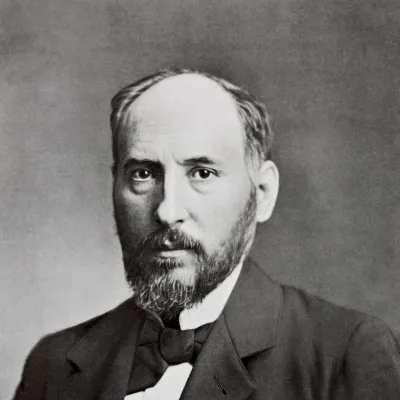
Santiago Ramón y Cajal
Human Design Chart
Biography
He was awarded the Medicine Nobel Price (with Camillo Golgi), 1906.
He died on 17 October 1934, Madrid, Spain.
Santiago Ramón y Cajal as a Projector 5/1 in Human Design
Projector 5/1 — Design at a Glance
Santiago Ramón y Cajal was someone with a dense, focused aura that directly engaged his surroundings. As a projector, he did not have an intrinsic energy source from the sacral center but worked in phases of high intensity followed by necessary rest periods to prevent burnout. His design tended to immediately identify systemic errors or weaknesses in others – like a bright flashlight shining into darkness.
This direct perception could be perceived as unpleasant if it occurred without consent. The optimal strategy for him was to wait for respectful and honest invitations from others. By living harmoniously himself and 'shining', he attracted people who actively sought his insights. This avoided conflicts that arise when criticism is unsolicited.
If Santiago Ramón y Cajal lived according to this invitation-based strategy, his path was rewarded with success. Ignoring this principle and acting autonomously or pushing his insights led sooner or later to his non-self theme: bitterness. His Human Design thus underscored the necessity of using his clarifying effect only when it was sought after and valued from outside.
Self-Projected Authority
Santiago Ramón y Cajal showed himself as a projector with rare authority in self. This configuration marked an extreme openness that made him vulnerable to distraction by external motoric energies. The greatest danger lay in losing himself in this irritability and constantly seeking external energy. His inner truth, however, lay in his identity. Decisions arose through two paths: self-conversations or dialogues with others when invited. Crucial was listening to himself and distinguishing between the spontaneous expression of true essence and thoughts of the mind. This spontaneous expression allowed him to make his uniqueness recognizable to others. Alternatively, a physical feeling led him into a specific direction. He felt drawn geographically or thematically towards or away from things. If he followed this inner orientation faithfully, he could become a guide for others. There lay his specific potential for success. This mechanism required him not to react to external impulses but to use the silent voice of self and physical pull as a compass. Thus, his initial vulnerability through overstimulation transformed into clear, authentic leadership, guiding others through their specific radiance without exhausting himself.
The 5/1 Profile — Heretic / Investigator
Santiago Ramón y Cajal was shown through his 5/1 profile as a hero and researcher who used deep knowledge to help others solve problems. This configuration gave him a magnetic aura; people actively sought the solutions he offered. It aligned with the nature of Line 5, which tends to be perceived as an authority, especially in crisis times or towards strangers. Simultaneously, Line 1 with its empathic quality formed the foundation for his listening and empathy. He absorbed stories and secrets from various sources, enabling him to engage indiscriminately with people. This openness was not without motives and could feel burdensome if clear boundaries were not set. Similar to a scientist who answers questions for hours and feels drained afterward, Santiago Ramón y Cajal faced the challenge of optimally using his gifts without exhausting himself. The process also involved the courage to acknowledge past mistakes – a confession about previous ignorance that could serve as justification. By learning to say no, he maintained balance between research for himself and supporting others. His ability to develop empathy and use listening as a basis significantly shaped his interactions.
Single Definition — Defined & Open Centers
Santiago Ramón y Cajal was marked by a defined G Center, which gave him a firm inner identity and a clear sense of direction for his life. He had the ability to lead others onto new paths without being dependent on their expectations. This reliable self-love formed the core of his personality. This was complemented by a defined Throat Center, serving as a pivot point to translate messages from his inner world into clear communication and action. His voice thus spoke not impulsively but from this stable source of identity, allowing him to express his truth with honesty and clarity.
At the same time, his design revealed high susceptibility to external influences through several open centers. His open Head Center made him vulnerable to mental pressure and the temptation to get entangled in questions that were not his own. He tended to feel compelled to find answers for others' doubts rather than remaining a detached observer of his thoughts. The open Ajna Center amplified this flexibility of mind; he could absorb myriad concepts but risked identifying with opinions or pretending to be more certain than he was, to gain acceptance.
His open Heart Center lacked consistent assertiveness in a competitive sense. There was the danger of getting caught in a cycle of promises and disappointment to prove his worth rather than trusting his inner authority. The open Sacral Center left him without constant generative energy; he relied on taking energy from others, which could overwhelm him if he did not learn to set boundaries and rest. Additionally, his open Solar Plexus absorbed the emotions of the environment, causing him to fluctuate between moods without always recognizing them as his own. Finally, his open Spleen Center reflected fears about survival and well-being, leading him to cling to secure structures rather than making spontaneous decisions. His open Root Center also took on environmental stress, which could lead to a feeling of pressure that he did not generate himself.
Channels for withdrawal, reflection and gathering memories.
Santiago Ramón y Cajal experienced life not just passively but by patiently collecting, reflecting upon, and only then communicating experiences once their deeper truth had become clear. This attitude resulted from the Lost Son Channel 13-33. It connected his G Center with his Throat Center: Gate 13 listened and stored secrets as well as memories while Gate 33 withdrew to ponder these contents. Santiago Ramón y Cajal patiently waited for connections to reveal themselves beneath the surface before formulating them verbally. This created continuity in his development; he learned from the past and understood that life ultimately makes sense, even if immediate results often did not match expectations. His challenge lay in timing: ensuring that his insights were shared at the right moment without prematurely revealing or completely withdrawing.
Additionally, further energetic patterns shaped his inner world. Gate 24 in the cross brought a rhythm of mental mutation and renewal; it was about seeking knowledge with personal significance and inner silence amidst new, unformed thoughts. In the same area, Gate 44 worked with its vigilance and receptiveness. It emphasized that transformation through proper interaction without preconditions succeeds and stored these experiences in cellular memory, requiring willpower.
On the personality side, Gate 7 projected leadership perspectives and hierarchies; it saw patterns for the future to be tested by experiments. At the same time, Gate 12 in his Throat Center called for restraint in the face of temptations. It linked emotional mood with communication and emphasized the transformative quality of expression often through poetry or love. Finally, Gate 56 enabled abstraction of mental processes into visual representations. It told stories from beginning to end and helped make complex thoughts understandable through visual metaphors. This combination of patient reflection, inner renewal, and figurative storytelling shaped Santiago Ramón y Cajal's way of perceiving and understanding the world.
Collective Circuitry — Circuit Signature
Santiago Ramón y Cajal's design inclined him towards emotional reflection on past experiences. He was someone who not only logically analyzed experiences but understood them in wave-like emotional movements seeking meaning behind what had already occurred. This attitude resulted from the active Perception Circuit, whose energies were oriented toward emotions and memories rather than future-oriented logic.
In his case, this circuit was activated by the channel 'The Lost Son', connecting his Throat Center with his Identity Center. Since both centers lay in the same group, energy flowed directly between them: feelings and insights from the past were processed in the Solar Plexus and then articulated through the Throat Center. This process was cyclical – each emotional wave had a clear beginning, middle, and end. The resulting insights served to be shared with others to learn collectively from history. As Santiago Ramón y Cajal was simply defined, these connected centers formed a coherent, stable flow without interrupted or parallel energetic systems. His way of grasping the world was thus strongly marked by this visual and emotional processing of the past which he put into words and passed on.
Left Angle Cross of Incarnation 1
Santiago Ramón y Cajal's Human Design configuration established a tendency towards a profound inner connection with life and his own existence. He was someone whose focus lay on the immediate experience of reality, less abstract or theoretical but rather tactile and present. This attitude stemmed from the left cross of incarnation 1.
This cross linked energies that fostered trust in one's body and intuitive perception. It wasn't about intellectual analysis but a direct, almost childlike curiosity about how things work here and now. Santiago Ramón y Cajal lived this mechanism through a constant openness to new impressions without pre-judging or rigidly categorizing them. His energy flowed where life pulsed, whether in nature, interpersonal encounters, or concrete projects.
The structure of his design allowed him to adapt quickly and respond to changes without losing touch with his own center. He did not seek ultimate truths in a metaphysical sense but found meaning in everyday occurrences. This ability to take life as a continuous flow of experiences shaped the way he encountered the world. It was an attitude of acceptance and going along, which helped him see challenges not as obstacles but as part of natural processes. His energy thus always directed itself towards what was real and tangible.
Saturn Return · Uranus Opposition · Chiron Return · 2nd Saturn Return — Life Cycles
Santiago Ramón y Cajal showed a life span where structural consolidation and professional establishment played central roles. His design pointed to cycles marked by planetary transits reflecting concrete career development. In 1877, at the age of 25, he received his doctorate from the University of Complutense Madrid. This corresponded to his first Saturn return, a time when years of groundwork often condenses into a solid result and lays the foundation for future responsibility.
The structure of his design foresaw that with advancing age new authority structures would become active. In 1892, at the age of 40, he moved as a professor of histology and pathology to the University of Complutense Madrid. This step fell into the Uranus opposition, a phase often accompanied by necessary changes in social or professional position to meet an altered inner demand.
The second Saturn return marked 1906, at the age of 54, with the receipt of the Nobel Prize for Physiology or Medicine. This cycle confirmed his long-term orientation and brought cumulative work into public recognition. Santiago Ramón y Cajal's path illustrated how specific astro-biological transits served as contextual frameworks in which his professional expertise and institutional positioning crystallized.
Projector · Self-Projected Authority — Synthesis
He was a projector whose life was marked by a deep need to recognize patterns and impart knowledge (Profile Leader/Researcher, Channel of the Lost Son). This ability to grasp potential and flaws within systems went hand in hand with an inner authority based on self-dialogue and listening to his own inner voice. Through definition in the Throat Center, he could express these insights, always focusing on experiences from the past (Soul-Seeking Circuit). He thus lived a process of continuous learning and sharing, driven by a deep understanding of cyclical patterns and maturation processes.
A central paradox in his design was the tension between the need to project – pointing out improvement potential (Projector) – and the risk of being distracted by external influences or losing oneself in openness. The ability to accumulate profound knowledge (Line 1) clashed with a G Center that tended towards withdrawal (Gate 33). He was thus a knower whose deep insights often only became accessible through phases of isolation and reflection. This dynamic shaped his path, compelling him to develop strategies to use his energy effectively while maintaining personal integrity.
1 Defined Channel
Incarnation Cross - Left Angle Cross of Incarnation 1
Solar Return
The Solar Return shows the moment when the sun returns to its exact birth position - your personal solar year.
Life Cycles
Discover the life cycles with a detailed triple view (birth chart, cycle chart, composite).
Human Design Profile
- Type
- Projector
- Strategy
- Wait for the respectful invitation
- Authority
- Self-Projected Authority
- Profile
- 5/1 - Heretic / Investigator
- Definition
- Single Definition
- Incarnation Cross
- Left Angle Cross of Incarnation 1
- Date of Birth
- 01.05.1852 21:00
- Place of Birth
- Petilla de Aragon, Spain
Frequently Asked Questions
What is Santiago Ramón y Cajal's Human Design type?
Which Profile did Santiago Ramón y Cajal have?
What Authority did Santiago Ramón y Cajal have?
What incarnation cross did Santiago Ramón y Cajal carry?
When was Santiago Ramón y Cajal born?
Discover your own Human Design
Are you also a Projector? Find out in a personal reading how to unfold your leadership qualities and recognize the right invitations.
More Personalities
Back to overviewSissy Spacek

Alain-Fournier

Anémone

Ann-Margret

Bourvil
Hergé