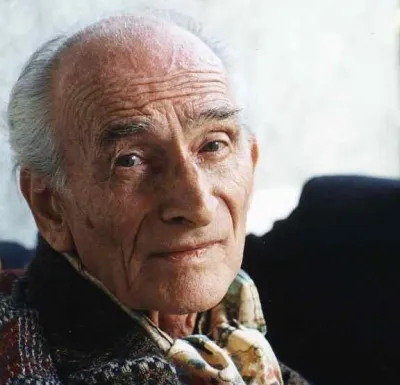
Sigurd Janssen
Human Design Chart
Biography
He died on 6 May 1968 in Freiburg im Breisgau, aged 77.
Human Design Analysis: Sigurd Janssen as Manifesting Generator 5/1
Manifesting Generator 5/1 — Design at a Glance
Sigurd Janssen was revealed as someone who worked with hybrid energy: he had the constant power of a Generator paired with the lightning-fast effect of a Manifestor. His design had a tendency to quickly pull things into his life, often skipping steps in the process. This speed was a double-edged sword. If he moved too quickly, he often had to backtrack to fill in missing steps, which could lead to frustration – the specific non-self-experience of this type. Additionally, Sigurd Janssen tended to pursue multiple projects simultaneously, driven by various impulses. Without clear internal consent, he risked his creative drive turning into exhaustion.
The mechanics of his 'Manifesting Generator' required a specific strategy: not initiating but reacting to life. Only when his defined Sacral Center gave a clear 'yes' should he act. This inner resonance was the key to utilizing his speed effectively. With correct application – that is, by constantly checking if the projects were still enjoyable and his inner authority was in agreement – he found deep satisfaction. For him, the linear advice of 'finishing one thing first' was counterproductive. Instead, he thrived best in a 'play mode', where variety and parallel work fueled his energy, as long as he listened to his inner signals and did not go against them.
Emotional Authority
Sigurd Janssen was revealed as someone whose inner guidance was marked by an emotional wave. His inner authority lay in his defined Solar Plexus Center. This configuration meant that his feelings were subject to constant ups and downs. The world appeared to him always colored by his current mood: a moment full of excitement could turn into deep negativity in the next. For Sigurd Janssen, however, the immediate feeling was only a snapshot, not yet the final truth. Quick, spontaneous decisions made directly from such an emotional peak often proved problematic. The mechanics of his design required patience. By letting decisions rest and reviewing them multiple times, he gained the necessary emotional distance. Only when the intense feelings subsided did clarity and calm set in. This process of ripening was essential for him, especially in long-term life decisions. Emotional authority always took precedence over other defined centers in his chart. Regardless of which other energies were active in his design, he had to listen to the rhythm of his feelings and wait until clarity emerged from the depths of his emotional center. This protected him from misjudgments that would arise from the immediate, yet unprocessed emotion.
The 5/1 Profile — Heretic / Investigator
Sigurd Janssen was revealed as someone who gathered deep knowledge to offer others for problem-solving. His design as a 5/1 profile gave him almost magnetic appeal: others actively sought his solutions. This often led to overload, however, if he did not set clear boundaries. Like a scientist who is exhausted after long conferences because his inbox is full of questions, Sigurd Janssen had to learn to say 'no' to maintain the balance between his own research (Line 1) and service to others (Line 5).
His inner self was marked by specific energies. Gate 30, Line 5, brought irony and realism regarding expectations. He recognized the transience of goals and offered practical solutions to move forward despite setbacks. Jupiter supported trust in progress, while Pluto brought frustration over the limits of the life cycle. Simultaneously, Gate 34, Line 1, acted as a survival mechanism. Here it was about the indiscriminate use of power, not out of principle, but for protection. Sigurd Janssen studied the nature of power and occasionally displayed it to protect himself or intimidate others when necessary. Saturn amplified this energy through the expression of frustration via power. He could be surprised by his own strength and how he used it. This combination of the desire to share knowledge and the need to protect himself through power shaped his way of interacting with the world.
Split Definition — Defined & Open Centers
Sigurd Janssen revealed himself as someone whose expression and actions were driven by a constant inner energy source. His design indicated a tendency to move through reactions to life rather than through initiated plans. This resulted from his defined configuration: The Sacral Center was defined, which gave him immense vital energy and the ability to persist in work, provided he listened to the inner "yes" or "no" response. His Throat Center was also defined, which shaped his communication style: He spoke and acted from a reliable source, not from an impulsive thought stream. Additionally, his Solar Plexus Center was defined, making him an emotional authority; he needed time to go through the emotional wave before gaining clarity. The defined Root Center provided the constant pressure to move forward in the world.
In contrast, the Head, Ajna, G, Heart, and Spleen Centers were open. These open centers made Sigurd Janssen vulnerable to conditioning. The open Head Center could pull him into mental confusion and a need for constant inspiration, while the open Ajna Center tended to adopt foreign opinions as his own truth. His open G Center meant he had no fixed identity but reflected through the environment and relationships; he often sought the right place and direction rather than determining them himself. The open Heart Center meant he did not need to prove himself through willpower but risked making promises he could not keep to show value. The open Spleen Center made him sensitive to health and well-being but tended to make spontaneous decisions out of fear or false security. Sigurd Janssen lived this dynamic by learning to use his defined energy and recognize the pitfalls of the open centers.
Channels for powerful action and emotional visions.
Sigurd Janssen revealed himself as someone marked by immense, almost insatiable life force, driving him to be constantly active and making it difficult for him to arrange himself with rest or stillness. This tendency resulted from the Channel of Charisma 34-20, a configuration that channeled raw physiological energy from the Sacral Center directly into the expressive power of the Throat Center. This channel connected the urge to manifest with the need to respond to external stimuli, creating a charismatic presence that was effective only when guided by inner leadership. Without this alignment, the energy tended to become chaotic or obsessive, often leading Sigurd Janssen to fully immerse himself in activities that satisfied him, while appearing less available to others.
Parallel to this, the Channel of Recognition 41-30, linking the pressure of the Root Center with the emotions of the Solar Plexus, created in Sigurd Janssen a deep desire for new experiences and restlessness that had to be steered by the emotional wave. The combination of the urge to expand boundaries (Gate 41) and the intensity of feelings (Gate 30) meant that he did not make decisions impulsively but waited for the clarity of his emotional cycles to leap from inexperience into experience.
Additionally, further Gates shaped his design: Gate 29 demanded a clear "yes" to challenges, while Gate 45 emphasized attraction to resources and community. Gate 38 set boundaries to preserve integrity, and Gate 19 sought secure territory and spiritual connection. Gates 35, 5, and 16 added aspects of change, rhythmic habit, and experimental mastery, making Sigurd Janssen a person defined both by intense action and emotional depth, as well as a striving for mastery in his fields. His energy was geared towards acting in the moment and learning through experience, with the balance between the urge to manifest and the patience of emotional authority crucial to his path.
Individual Circuitry — Circuit Signature
Sigurd Janssen revealed himself through a split definition, which created two independent energetic poles in his design. This separation meant that he did not function as a continuous, connected flow but rather possessed two parallel, independent energy fields that did not communicate directly with each other.
One pole connected the Solar Plexus Center with the Root Center through the circuit "Purpose". Here, emotions and past experiences flowed in wave-like patterns. Sigurd Janssen went through emotional cycles with a beginning, a peak, and an end. His task was to reflect on the meaning behind past events and share these felt insights with others to collectively learn from the past.
The second, completely separate pole connected the Throat Center with the Sacral Center through the circuit "Integration". This area served to secure individual survival. Sigurd Janssen drew strength from reacting to life and channeled this energy through intuitive knowledge and proper behavior. The manifestation of this power occurred in the present moment.
Since these two groups – emotion/past on one hand and survival/action on the other – were not connected, they existed as separate systems. Sigurd Janssen did not have to experience these different energies as a single flow but could use them as distinct, side-by-side forces without the emotional wave directly influencing the action-oriented energy or vice versa.
Left Angle Cross of Industry 1
Sigurd Janssen was marked by a profound, relentless inner drive that compelled him to immerse himself with dedication and perseverance in his tasks. His design showed a clear tendency towards persistent, industrious work, which he felt as an inner necessity rather than an external duty. This aligned with the mechanics of the left cross of diligence, a configuration that provides a continuous, often quiet energy to carry things through to completion.
For Sigurd Janssen, this meant finding his strength in persistence. He was someone who did not strive for quick, flashy results but valued substance and meticulous execution. This energy source was steady and reliable, driving him to continue even when others grew tired or wandered off. It was a kind of diligence that was not loud but had lasting impact.
His Human-Design chart revealed this structure as a central aspect of his inner dynamics. The associated energy helped him to handle complex or lengthy processes by granting him the necessary patience and perseverance. Sigurd Janssen lived this quality out by fully engaging in his projects, driven by this specific inner rhythm of work and dedication.
Saturn Return · Uranus Opposition · Chiron Return · 2nd Saturn Return — Life Cycles
Sigurd Janssen was someone whose life structure was marked by phases of condensation and structuring. This tendency is reflected in the Saturn returns, which in Human-Design mechanics are cycles of maturation and consolidation. At the age of 30 in 1921, he completed his state examination and finished his doctoral thesis at the Heidelberg Pharmacological Institute. This point marked the first Saturn return, where years of intellectual groundwork condensed into a solid, institutionally recognized result.
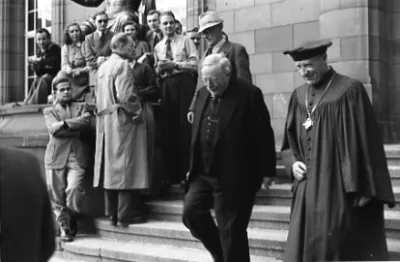
Another turning point occurred in 1933 when the Uranus opposition was active. This aspect often signals a break with established patterns or a sudden impulse to change perspective. In this year, Sigurd Janssen undertook a paddling trip on the Danube with Martin Heidegger. This event underscores the mechanical dynamics of the Uranus opposition: a moment of detachment from the pure routine, the search for a new orientation, or the connection with others on a less formal level.
The second Saturn return in 1949, at the age of 58, brought structure and confirmation once more. In this year, the institute was handed back to its purpose. This illustrates how the second Saturn return often supports long-term stabilization and the return to core competencies or the original mission. Sigurd Janssen's design thus followed a rhythm where intensive phases of work and learning were complemented by moments of realignment and eventually institutional anchoring.
Manifesting Generator · Emotional Authority — Synthesis
Sigurd Janssen lived a life marked by a deep connection between action and inner perception. As a Manifesting Generator, he possessed a constant sacral energy (Sacral Center) that propelled him to react swiftly to opportunities (Channel Charisma). However, this energy was modulated by emotional authority, which required a process of letting decisions mature – a process that enabled him to use the depth of his knowledge (Line 5) for problem-solving for others (Profile Hero/Researcher). He was a person who tended both to initiate and react, with the inner wave guiding him to direct his strength correctly.
A central paradox in Sigurd Janssen's design lay in the tension between the urge to act quickly and the need to emotionally digest decisions. The ability to draw things rapidly into his life clashed with the emotional wave that required time for reflection and weighing different perspectives. This tension field was evident in cycles where professional successes (Saturn returns) were accompanied by phases of confrontation and reflection (Uranus opposition), which repeatedly forced him to process past experiences and learn from them (Perception Circuit).
2 Defined Channels
Incarnation Cross - Left Angle Cross of Industry 1
Solar Return
The Solar Return shows the moment when the sun returns to its exact birth position - your personal solar year.
Life Cycles
Discover the life cycles with a detailed triple view (birth chart, cycle chart, composite).
Human Design Profile
- Strategy
- To respond - wait for something to respond to
- Authority
- Emotional Authority
- Profile
- 5/1 - Heretic / Investigator
- Definition
- Split Definition
- Incarnation Cross
- Left Angle Cross of Industry 1
- Date of Birth
- 17.02.1891 16:45
- Place of Birth
- Düsseldorf, Germany
Frequently Asked Questions
What was Sigurd Janssen's Human Design type?
What profile did Sigurd Janssen have in Human Design?
What authority did Sigurd Janssen have?
What incarnation cross did Sigurd Janssen have?
When was Sigurd Janssen born?
Discover your own Human Design
Are you also a Manifesting Generator? Find out in a personal reading how to unfold your multi-talents and direct your energy wisely.
More Personalities
Back to overviewAldair

Alizée

Angeli

Arletty

Artus

Balthus