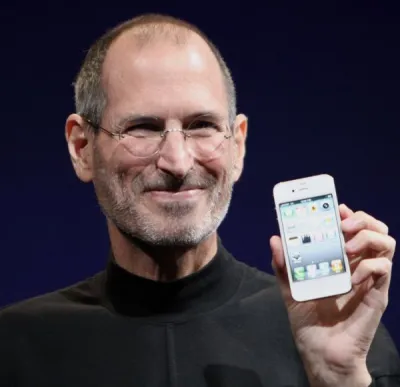
Steve Jobs
Human Design Chart
Biography
Human Design Analysis: Steve Jobs as Generator 6/3
Generator 6/3 — Design at a Glance
Steve Jobs was a Generator. His design set a high, enduring sacral energy that made him work like a draft horse – strong and steady as long as he had the energy for his task. This configuration determined his basic functioning: initiating actions wasn't the primary focus; rather, reacting to impulses from the environment was key.
The mechanics of his design required Steve Jobs to wait for signals before acting. When his sacral core sent a clear "yes", he responded with action. This was the key to his effectiveness. If he lived in harmony with this strategy – that is, by responding rather than pushing forward – using this energy led to deep satisfaction and a sense of fulfillment. No one could stop him when he followed this inner rhythm.
However, his design carried two specific risks. The first stumbling block was persistently doing things where his internal enthusiasm was lacking. In such cases, he wasted his energy and tended towards burnout. The second danger arose if he was prevented from working on his heart project even though he still wanted to continue with full power. If this energy was suppressed or misdirected – for example, by constantly initiating rather than responding – it resulted in ongoing frustration and a noticeable lack of energy. His life force was thus closely tied to the quality of impulses he responded to.
Emotional Authority
Steve Jobs' design set a tendency towards emotional fluctuation that significantly shaped his decision-making process. He was subject to an inner authority carried by the defined Solar Plexus Center. In Human Design mechanics, this emotional authority always takes precedence over all other defined centers, regardless of further configurations in the chart. This meant for Steve Jobs that his perception of the world was always colored by a permanent emotional wave – a constant up and down of moods.
At one moment he could show himself totally enthusiastic, in the next negatively evaluate the same situation. His immediate feeling was however only a temporary coloring, not the deeper truth. Quick, spontaneous decisions made from this emotional heat were therefore risky and could have negative consequences. The mechanics required him to be patient: He had to take time for his decisions to mature. Often it was necessary to sleep on an issue several times and let himself be delayed until the intense feelings subsided.
Only when this process was completed and emotional distance gained, clarity and calmness set in. Then he had fully grasped the situation's scope. This need for temporal distancing mainly concerned long-term decisions with a significant impact on his life course. Steve Jobs thus showed himself to be someone whose inner truth only became accessible through the subsiding of the first emotional wave, not through the initial impulsive impression.
The 6/3 Profile — Role Model / Martyr
Steve Jobs lived his first three decades as an intense experimenter. His design foresaw a phase full of self-experiments marked by Line 3 of the Explorer. This structure meant he didn't orient himself to ordinary standards but sought an extraordinary life. The mechanics describe this as a time of many (self-)experiments, where errors and small details – like at Gate 9, Line 3 – often tipped the scales. A tiny drop could make the barrel overflow; from these failures, he learned to ensure future security.
After about thirty years, this dynamic changed through the integration of Line 6. From the accumulated experiences developed a stance of wisdom and responsibility. Steve Jobs became an exemplar that combined humor and foresight with his never-ending experimental nature. The inner conflict between the desire for the extraordinary and the search for perfection was not resolved by stasis but through the synthesis of experience and duty consciousness. He remained an old soul who could internally seem restless because he forever sought the right thing. Yet, instead of mere individuality or material abundance – aspects connected with Gate 55 – he used his unusual paths to serve others as a wise guide. Line 3 remained present throughout; experimenting never truly stopped but was channeled and deepened by the adult perspective of Line 6.
Split Definition — Defined & Open Centers
Steve Jobs revealed himself as someone with a persistent mental structure and clear expression, driven by deep vital energy. His defined Ajna Center provided continuous, specific conceptual thinking that he conveyed directly to the world through his also defined Throat Center. This connection allowed him to articulate his thoughts consistently and reliably without being easily influenced from outside. However, his actions were not primarily initiated from the mind but stemmed from his defined Sacral Center. This center supplied a powerful energy source for his work, which was only fully available when he responded to life – such as with an internal "yes" or "no" – rather than initiating mentally.
This energetic foundation was modulated by two additional defined centers: The Solar Plexus Center brought emotional wave motion that acted as inner authority and required decisions to be made after waiting for emotional clarity. Additionally, the defined Root Center served as a constant existential pressure that propelled him forward and helped transform stress into productive movement.
In contrast, his open centers shaped high environmental receptivity. His open G Center meant he did not have a fixed, unchanging identity but adapted situational contexts and was influenced by the energy of his environment. He tended to seek direction by trying out different environments rather than having an internal compass. His open Heart Center made him vulnerable to the pressure of needing to prove his worth or make promises, even though he lacked the consistent energy for this task. Furthermore, through his open Spleen Center, he lacked spontaneous intuitive knowledge; he was dependent on others to provide correct conditioning regarding health and well-being rather than having innate intuitive security. His open Head Center also made him receptive to mental inspirations from the environment, which he could not treat as his own truth but had to filter as external input.
Channels for logical acceptance, focus and emotional clarity.
Steve Jobs revealed himself as someone whose emotional landscape was marked by extreme volatility. The Sun in Gate 55 of the Solar Plexus Center generated a deep emotional awakening and signified a genetic mutation that heralded the new age. On an individual level, this energy expressed itself through intense mood swings and instability; dealing with this wave was crucial, such as eating only when he felt like it.
This emotional intensity met with immense concentric power. Channel 52-9 connected the Root Center to the Sacral Center via the Gate of Non-doing (52) and the Gate of Focusing (9). This created a quiet pressure to remain still and avoid distractions in order to assess details precisely. As format energy, this channel carried qualities of understanding: logic had to maintain its focus to challenge, correct, and perfect patterns. Steve Jobs was constantly engaged with examining aspects he had committed to, hating it when this powerful energy disappeared through multitasking.
At the same time, his mind organized information mentally. Channel 17-62 connected the Ajna Center to the Throat Center via the Gate of Opinions (17) and the Gate of Details (62). This allowed for recognizing visual patterns and translating them into logical structures through words. Anything he could not integrate into his inner picture, he did not understand; thus there was a constant pressure to communicate detailed opinions as soon as listeners were receptive.
The emotional wave was further fueled by Channel 30-41, which connected the Root Center to the Solar Plexus. The Gate of Limitation (41) generated a desire for new experiences while the Gate of Feeling Recognition (30) emotionally charged this longing. This led to an intense need to immerse oneself in new situations, where patience was necessary to wait out the emotional wave to gain clarity before making decisions.
Collective Circuitry — Circuit Signature
Steve Jobs was known for his clear and rational thinking, aimed at creating logical structures for the future. His design connected the Ajna Center with the Throat Center (Channel of Concentration), enabling focused visual perception and direct expression of these clear insights. Simultaneously, the Acceptance Channel linked his Sacral Center to his Root Center, translating strategic planning into concrete action impulses. These two groups formed separate energetic streams within his split definition: on one hand, a cool, emotionless ratio for improving societal structures, and on the other, the driving force for action. Since the Solar Plexus Center was not part of this circuit, this logic remained free from emotional conditioning. Additionally, the Meaning-Finding Circuit operated through the Recognition Channel between the Solar Plexus and Root Centers. Here, Steve Jobs processed past experiences and emotions in waves to derive meaningful lessons for the collective. While the left chart half formed future-oriented strategies, the right side reflected on past events. Both aspects shaped his personality: one impulse was to share rational visions and build structures, while another need was to understand and convey emotional experiences from the past. This configuration created a stable foundation for his work, where logical clarity and emotional reflection coexisted without directly overlapping.
Left Angle Cross of Spirit 1
Steve Jobs' design carried the signature of the left cross of Spirit. This configuration established a fundamental orientation where inner essence and spiritual dimension were at the center. In Human Design, this category describes not only religious beliefs but also the deepest identity of a person – the core of what one understands as 'spirit' or soul. For Steve Jobs, it served as a driving force for his self-perception and life path.
This alignment means that the search for meaning and connection to the transcendent were not secondary interests, but rather the foundation of his existence. It was about questioning who one is at the deepest level, beyond roles or external achievements. This spiritual orientation shaped how he saw the world and positioned himself within it. It created an inner compass aimed at authenticity and a connection to something greater than everyday life. For his design, this identification with Spirit was central; it determined the quality of his energy and the direction in which he sought his life's purpose. It was an essential dimension that permeated his entire experience and helped him understand his own nature.
Saturn Return · Uranus Opposition · Chiron Return — Life Cycles
Steve Jobs' life followed a clear rhythmic pattern of consolidation, radical change, and existential testing. In 1983, at age 28, he entered the first Saturn return. This cycle often marks the transition from an experimental phase to structural identity consolidation. Indeed, he was recruited by John Sculley for the position of CEO at Apple – a step that cemented his professional role and institutionalized responsibility.
Ten years later, in 1995 at age 40, he experienced the Uranus opposition. This aspect often demands a radical break or an opening after previous stagnation. In this year, he saw the success of Toy Story and the stock market listing that made him a billionaire. It was not just a financial gain but a fundamental shift in his status and possibilities, driven by the energizing power of this planetary configuration.
The third key cycle was the Chiron return in 2004 at age 49. In Human Design mechanics, this is not a moment of suffering for healing's sake, but rather a fulfillment cycle where one’s incarnation cross unfolds and meaning becomes tangible – provided one lives according to strategy and authority. For Steve Jobs, however, it also manifested as a physical challenge: he underwent surgery to remove an island cell tumor. The confrontation with his own mortality served here as a catalyst to focus the remaining time on essentials and fulfill individual purpose until the end.
Generator · Emotional Authority — Synthesis
He was a Generator whose life was marked by a deeply rooted drive to bring energy into the world (Sacral Center). This power manifested in the ability, through focused attention and format energy (Channel 52/9), to shape and improve things – a tendency rooted in the Understanding Circuit. He seemed constantly to seek ways to recognize others' potential and turn it into measurable results, with the defined Mental Center helping him develop and implement concepts. This goal-oriented energy was always accompanied by an emotional wave (Emotional Authority) that slowed decisions and required a deep engagement with one's feelings.
A central paradox in his design lay in the interplay between the experimenter (Line 3 in Profile) and the wisdom that came with age. He was driven to break conventions and forge new paths, yet simultaneously seemed to strive for an extraordinary, perfect outcome beyond mere innovation. The recurring crises (Chiron Return) and successes (Uranus Opposition), as well as career decisions (Saturn Return), indicated that this internal conflict accompanied him and shaped his development.
3 Defined Channels
Incarnation Cross - Left Angle Cross of Spirit 1
Solar Return
The Solar Return shows the moment when the sun returns to its exact birth position - your personal solar year.
Life Cycles
Discover the life cycles with a detailed triple view (birth chart, cycle chart, composite).
Human Design Profile
- Type
- Generator
- Strategy
- To respond - wait for something to respond to
- Authority
- Emotional Authority
- Profile
- 6/3 - Role Model / Martyr
- Definition
- Split Definition
- Incarnation Cross
- Left Angle Cross of Spirit 1
- Date of Birth
- 24.02.1955 19:15
- Place of Birth
- San Francisco, United States
Frequently Asked Questions
What was Steve Jobs' Human Design type?
What Profile did Steve Jobs have in Human Design?
What Authority did Steve Jobs have in Human Design?
What incarnation cross did Steve Jobs have in Human Design?
When was Steve Jobs born?
Discover your own Human Design
Are you also a Generator? Find out in a personal reading how to use your sacral energy correctly and discover deep satisfaction.
More Personalities
Back to overviewAaliyah

Alexia

Angèle

Anne-Marie

Arcángel

Arno