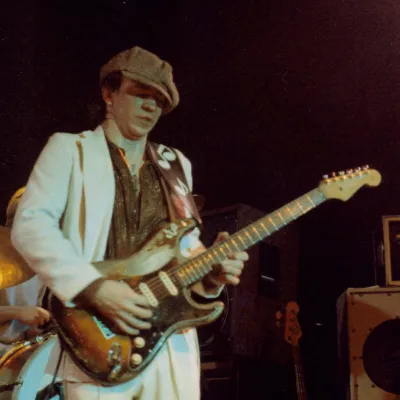
Photo: Wikimedia Commons
Stevie Ray Vaughan
Human Design Chart
Biography
He was the younger brother of guitarist Jimmie Vaughan.
He died in a helicopter crash on 27 August 1990 between 12:45 AM and 1:00 AM at Alpine Valley Ski Resort, La Fayette Township, Wisconsin. He was 35.
What does Projector 1/3 mean for Stevie Ray Vaughan?
Projector 1/3 — Design at a Glance
Stevie Ray Vaughan revealed himself as a Projector, whose design was characterized by a specific kind of perception and interaction. His chart indicated a tendency to focus his energy on his environment, much like a bright flashlight illuminating spots that were still in the dark in the counterpart. This mechanism meant that he quickly recognized where systems or people were lacking. Directly addressing these weak spots would often provoke resistance, as the intense light could blind the other. Instead, his design worked most effectively through an attractive presence: when he radiated harmony and clarity, people sought him out for advice. The strategy was to wait for an honest invitation rather than initiating himself. Since Projectors do not have a defined Sacral Center, Stevie Ray Vaughan lacked a constant, intrinsic energy source. Instead, he experienced phases of high activity, followed by necessary rest periods to prevent burnout. Living by this rhythm and strategy rewarded him with success. Ignoring this structure led to the non-self theme of bitterness, a state resulting from frustration over unrecognized leadership or forced initiatives. His design thus demanded patience and the ability to offer insights only when explicitly requested and valued.
Splenic Authority
Stevie Ray Vaughan revealed himself as someone who did not make decisions through prolonged deliberation but based on an immediate, physical impulse. His design featured authority in the Spleen, a defined center that functioned as a health and alarm system. With his open Emotional and Sacral Centers, he possessed a pronounced survival intelligence that manifested as spontaneous inner knowledge about whether a situation or environment was right for him. His instinct and physical well-being served as reliable indicators.
This Spleen voice, however, was a very fine impulse that only came once in the moment and could easily be drowned out by other influences. Therefore, his decision-making required high vigilance; sometimes a retreat helped to hear this first, spontaneous impulse that directly served his health. He was capable of rigorously shielding himself against harmful influences and taking good care of himself.
Since he could only know what was right for him in the moment, his plans often changed short-term. Long-term commitments were difficult for him; he needed a lot of space and flexibility in life to accommodate this spontaneous nature.
The 1/3 Profile — Investigator / Martyr
Stevie Ray Vaughan lived as a Researcher and Experimenter, a person who did not just collect knowledge theoretically but tested it through hard practice. His design as Profile 1/3 drove him to study the basics first before moving into action. This dynamic often created an internal conflict: the urge of Line 1 to understand everything perfectly clashed with the impulse of Line 3 to simply try and learn from mistakes. Vaughan showed himself as someone who only considered his judgments valid if he had worked them out and tested them thoroughly.
The Line 1 in his chart emphasized the necessity of depth and time. It taught him that true meaning only arises when something is practically feasible and stands on solid foundations. At the same time, Line 3 demanded responsibility through trial and error. It did not see mistakes as failure but as an essential part of a mutation process that often required self-sacrifice. Vaughan used this energy to break clichés and develop spontaneous pattern recognition. His life path was marked by the constant balance between the desire for secure knowledge and the willingness to plunge into uncertain experiments to gain new insights.
Single Definition — Defined & Open Centers
Stevie Ray Vaughan showed himself to be someone who steered his own resources and will with self-determination. His defined Heart Center gave him a natural willpower and the desire to be his own boss. He recognized his value and kept promises, which strengthened his self-confidence. This energy drove him to be successful and provide for his family as long as he followed his inner guidance.
Parallel to this, he possessed a defined Spleen Center, which gave him a sharp, spontaneous intuition. He acted in the present, trusted his body instincts, and stayed healthy by paying attention to these subtle warning signals. His defined Root Center also provided a constant, adrenalized pressure that propelled him forward and helped him deal with stress to rise materially and survive.
However, his open centers shaped him just as strongly. His open Head Center made him vulnerable to mental confusion; he tended to engage with others' questions and sought inspiration to relieve the inner pressure. The open Ajna Center led to him taking on concepts and opinions of others without identifying them as his own truth, making him intellectually flexible but also vulnerable to false identifications.
His open Throat Center made him feel the pressure to attract attention, even though he actually had to wait to be invited. The open G Center meant that he had no fixed identity but adapted to his environment and was initiated into the right direction by others. Furthermore, his Sacral Center was open, making him sensitive to the energy of others; he risked exhaustion if he did not stop as if it were his own strength. Finally, his open Solar Plexus absorbed the emotions of the environment, making him appear emotionally unstable if he did not let go of these foreign feelings.
Channels for instinctive devotion, meaningful struggle and steady transformation.
Stevie Ray Vaughan showed himself to be someone who instinctively recognized what his environment needed before others knew it themselves, and implemented this insight with stubborn determination. This attitude was fueled by the Channel of Devotion 44-26, which connected the Spleen Center with the Heart Center. This connection gave him the ability to use historical memories and tribal needs to be convincing and offer improvements. He had a fine sense of how to win others over for his visions, but acted not as a mere office worker, but as an entrepreneur who generated resources and supplied his team. His instinct was his compass; if he could not smell something right, he let it go.
At the same time, the Channel of Life Struggle 38-28 drove him to find a deep meaning in the conflicts of his existence. Through the Gate of the Fighter (38) and the Gate of the Player (28), he did not only seek survival but the fight for his individual integrity against external distractions. This channel gave him the energy to stubbornly follow his own path, even when the odds were against him, and transformed inner tensions through movement and resistance into clarity.
Additionally, the Channel of Transformation 54-32 shaped his drive for advancement and recognition. Driven by the ambition of Gate 54 and the continuity-fostering fear of Gate 32 of the tribe's failure, he worked harder than others to prove his worth. He sought confirmation from the tribe to realize his talents and secure financial prosperity, recognizing that true transformation only had lasting power through mutual support and loyalty.
In the background, other energies were at work: Gate 48 promoted the recognition of deeper patterns and logical connections, while Gate 21 awakened the desire for control over material things and respect in the community. Gate 39 brought selective analysis and provocation necessary for mutations, and Gate 52 demanded concentrated pauses for pattern correction to relieve stress and maintain focus.
Tribal Circuitry — Circuit Signature
Stevie Ray Vaughan showed himself through an energetic structure aligned with cooperation and the joint creation of resources. His design connected the Heart, Spleen, and Root Centers in a continuous flow, indicating a nature that became strong through togetherness. This connection allowed him to communicate through devotion (Channel 26-44) and initiate changes through transformation (Channel 32-54), always in service of the whole.
Parallel to this, a separate, independent impulse from the Knowledge Circuit was at work. Here, he connected the Spleen with the Root Center through the Channel of Life Struggle (28-38). This shaped him through a pulsating, acoustic energy aimed at following his own path and forming new, unique identities. Although both circuits shared the Spleen and Root Centers, they did not form a single continuous experience due to the simple definition but existed as two adjacent force fields: one for tribal support, one for individual, transformative realization.
As his design was simply defined, these energies flowed directly and without internal fragmentation. The combination of the ability to mediate and the drive for individual mutation created a dynamic in which he could be effective both in the collective and in his personal expression, driven by the instinctive intelligence of the Spleen Center, which was part of the consciousness stream of instinct.
Right Angle Cross of Tension 3
Stevie Ray Vaughan was marked by the energy of the right cross of tension 3, which manifested as a deep, often painful sensitivity to life. This configuration combined intense emotional depth with the impulse to process these experiences through art or expression. It was not about superficial feelings, but an existential struggle with suffering and joy that he infused into his creative force. The mechanics of this cross describe a process in which internal tensions and emotional turbulence were not suppressed but used as raw material for creative or spiritual transformation. Stevie Ray Vaughan carried this burden of sensitivity by transforming it into something tangible, giving his expressive forms an authentic, raw quality that stemmed directly from this inner processing. The tension generated by this cross served as a catalyst for his development; it forced him to confront pain rather than ignore it. This created a connection between personal experience and universal resonance. His design suggested that true strength did not lie in defensive behavior, but in the ability to accept the full spectrum of human emotions and pour them into a coherent expression. This path was often challenging, but it offered him the opportunity to develop deep integrity through confrontation with his own vulnerability. The energy of this cross demanded a constant balance between experiencing intensity and the ability to channel it constructively, which shaped his entire being.
Saturn Return — Life Cycles
Stevie Ray Vaughan lived as a Generator, whose design required a deep, intuitive resonance with his environment. His energy was not meant for superficial interactions but sought substance that he could answer through his actions. This configuration shaped a lifestyle in which he waited for inner confirmation before acting, allowing him to use his strength efficiently and sustainably.
In 1982, at the age of 28, his first Saturn Return occurred. This cycle often marked the point where years of often invisible groundwork condensed into a stable, visible result. For Vaughan, this was evident in his appearance at the Montreux Jazz Festival, where he achieved his breakthrough. This event was no coincidence but the logical consequence of a design geared towards long-term development and the achievement of milestones through consistent alignment with his own authority. The Saturn Return confirmed here that the previously invested energy was now bearing fruit and a new level of recognition and stability in life became effective.
Projector · Splenic Authority — Synthesis
Stevie Ray Vaughan lived a deeply rooted drive to understand and improve the functioning of things. His design showed a researcher and experimenter (Profile 1/3) who did not just accumulate theoretical knowledge but tested it through practical application. This line of learning and testing, fueled by the defined willpower (Heart Center) and the instinctive knowledge of the Spleen Authority, created the ability to recognize patterns and find solutions – a
3 Defined Channels
Incarnation Cross - Right Angle Cross of Tension 3
Solar Return
The Solar Return shows the moment when the sun returns to its exact birth position - your personal solar year.
Life Cycles
Discover the life cycles with a detailed triple view (birth chart, cycle chart, composite).
Human Design Profile
- Type
- Projector
- Strategy
- Wait for the respectful invitation
- Authority
- Splenic Authority
- Profile
- 1/3 - Investigator / Martyr
- Definition
- Single Definition
- Incarnation Cross
- Right Angle Cross of Tension 3
- Date of Birth
- 03.10.1954 03:40
- Place of Birth
- Dallas, TX, United States
Frequently Asked Questions
What was Stevie Ray Vaughan's Human Design type?
What profile did Stevie Ray Vaughan have?
What was Stevie Ray Vaughan's authority?
Which incarnation cross was Stevie Ray Vaughan assigned to?
When was Stevie Ray Vaughan born?
Discover your own Human Design
Are you also a Projector? Find out in a personal reading how to unfold your leadership qualities and recognize the right invitations.
More Personalities
Back to overviewSissy Spacek

Aaliyah

Alain-Fournier
Alexia

Alizée

Anémone