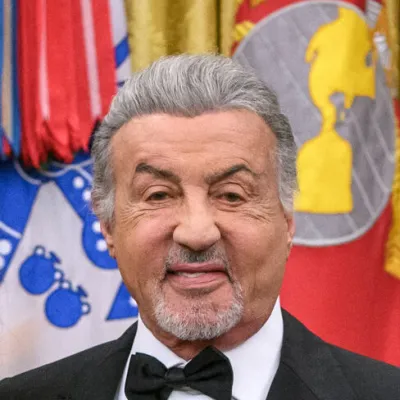
Sylvester Stallone
Human Design Chart
Biography
Struggling as an actor for a number of years upon moving to New York City in 1969, Stallone found gradual work in films such as The Lords of Flatbush (1974). He achieved his greatest critical and commercial success starting in 1976 with his iconic role as boxer Rocky Balboa in the first film of the successful Rocky franchise, which he also wrote. In 1977, he became the third actor in history to be nominated for two Academy Awards for Best Original Screenplay and Best Actor. He portrayed the PTSD-plagued soldier John Rambo in First Blood (1982), a role he would play across five Rambo films (1982–2019). He received a star on the Hollywood Walk of Fame in 1984. From the mid-1980s to the late 1990s, Stallone would go on to become one of Hollywood's highest-paid actors acting in action films such as Cobra (1986), Tango and Cash (1989), Cliffhanger (1993), Demolition Man (1993), and The Specialist (1994).
The Human Design of Sylvester Stallone: Manifestor 6/2
Manifestor 6/2 — Design at a Glance
Sylvester Stallone's design established the foundational structure of a pioneer and visionary. His energy is geared towards guiding the world into a new future, not through his own laborious struggle in detail but by setting clear directional guidelines. One can imagine this principle as an emperor: he has the vision for the empire but delegates battles to others so they are won for him. This superior foresight, however, leads to a specific challenge: Sylvester Stallone polarized. Because he often thought ahead of his surroundings, he was loved and followed by some, while others misunderstood or even hated him due to his big dreams.
To overcome this split and find the right followership, informing became key. By timely and accurately informing others about his intentions and visions, he could choose who wanted to follow him. This wasn't mere politeness but a strategic necessity for reducing friction. When Sylvester Stallone followed this strategy of informing, he was rewarded with a deep sense of inner peace. If he lived against this design and acted without prior information, sustained, deep anger emerged as a natural reaction of his system. Thus, the dynamic between unavoidable polarization through his vision and the conscious choice to inform shaped his path towards inner balance.
Emotional Authority
Sylvester Stallone's design established a tendency toward emotional maturation in decision-making; spontaneous judgments proved misleading. His inner truth only became clear after the emotional wave subsided, marked by an ongoing up-and-down of feelings. He saw the world colored by his current mood: at one moment totally excited, then the same thing negatively evaluated next. This feeling was merely a snapshot, not a secure foundation.
This mechanism stems from emotional authority. Whenever the Emotional Center is activated, it functions as inner authority—regardless of what else might be defined in the design. Every type except the Reflector can carry this authority. They are subject to wave dynamics; the first impression isn't necessarily the truth. Quick, spontaneous decisions based on emotions could have negative consequences.
The strategy lies in allowing time. The more Sylvester Stallone let a decision mature, the deeper he could see. This required patience and repeatedly reconsidering questions. He should be reluctant to act. Over time, intense feelings subsided, emotional distance gained strength, clarity and calmness emerged. This process was particularly important for long-term decisions that significantly influenced his life path. Emotional authority takes precedence over other defined centers; it is the central mechanism, not a side issue.
The 6/2 Profile — Role Model / Hermit
Sylvester Stallone's design featured a clear developmental line: in youth, an impulsive experimenting phase dominated, marked by trial and error. This period of active life experience served to learn through personal experiences, with retreats after mistakes as necessary corrections. Only upon transitioning into the third decade did this dynamic fundamentally change. The energy shifted from external action to inner distancing. Sylvester Stallone then showed a tendency towards withdrawal, looking back at past experiments from great heights. This period of isolation was not escape but a process of intense reflection and healing that enabled deep self-awareness. From this cave emerged eventually a wise stance that attracted others to learn from his introspection.
Central to this structure was also a specific problem-solving ability intended altruistically to enable the right spirit for others. However, this gift often provoked reactions and wasn't long accepted in its current state due to its need for time to prove itself. The connection of willpower and the necessity of withdrawal when ego was threatened underscored the importance of only responding to correct calls. Thus, a pattern emerged where early action later turned into wise distance while his actual gift for supporting others found full recognition only after long periods.
Single Definition — Defined & Open Centers
Sylvester Stallone's Human Design profile indicates a tendency towards constant, insatiable mental creation that is immediately translated into speech and action. His defined Ajna Center generates persistent concepts and theories, while the connection to his defined Throat Center articulates these thoughts directly. This creates an ongoing flow of ideas that do not remain in the mind but are expressed outwardly. However, these impulses move through an emotional wave cycle, determined by the defined Solar Plexus Center as inner authority. Here lies the need for time to clarify; decisions made during emotional highs or lows were often impulsive and later led to regret, while patience allowed for deeper insights.
In contrast, situational active areas without internal constants stood out. His open G Center meant that identity and direction were not fixed entities but arose through resonance with the environment; Sylvester Stallone tended to question whether he was in the right place rather than having a firm inner compass. The lack of consistent willpower in his open Heart Center made promises or commitments, often stemming from a need for recognition, unreliable and led to frustration as the energy required was not consistently available. Similarly, his open Sacral Center was prone to 'borrowed' energy; there were no fixed boundaries to vital force, leading to overloading by the environment and risking exhaustion rather than relying on self-regeneration. The open Spleen and Root Centers further amplified vulnerability to external stress signals and security fears that could not be interpreted as personal intuition but served as mirrors of the environment.
Channels for inquisitive curiosity and emotional change.
Sylvester Stallone is driven by provocative analysis and a quest for new experiences, an impulse stemming from Gate 39, whose energy triggers mutation through challenge and adrenaline. He combines this driving force with Channel Curiosity 11-56. This channel links Ajna Center to Throat Center: ideas from Gate 11 are transformed into stories that educate or entertain others. It's less about dry facts than engaging abstract connections in a way that appeals to imagination and emotions. His narratives offer new perspectives – 'Look what I've discovered.'
Simultaneously, Channel Transience 35-36 is at work. This channel connects Solar Plexus Center with Throat Center, driving an emotional search for the new. Gate 35 wants change to manifest while Gate 36 perceives inexperience as inadequacy and thus creates crises to set things in motion. This creates a restless yearning for emotional depth. Sylvester Stallone uses this mechanism to gather experiences from which he gains wisdom. His stories are parables emerging from these intense, often crisis-ridden learning processes. The combination of the analytical provocation from Gate 39, the narrative linkage of Channel 11-56, and the emotional urgency of Channel 35-36 shapes a character who inspires others through sharing hero tales and confronting transience. He learned to accept emotions as transient and advised others to seize the moment.
Collective Circuitry — Circuit Signature
Sylvester Stallone's Human Design profile indicates a tendency towards wave-like emotional processing that heavily relies on reflecting past experiences. This structure is characterized by someone seeking meaning behind events, not through cold logic or rational future planning but through intuitive reenactment of emotions and memories.
This orientation results from the active Seeker circuit. While other mechanisms often look to the future, this circuit focuses on the past. Energy flows here in waves – with a beginning, middle, and end – meaning that emotional insights for Sylvester Stallone were not linear or always logically traceable but emerged as felt truths.
Specifically, his Seeker circuit connects Ajna Center (visual imagination), Solar Plexus Center (emotional waves), and Throat Center (expression). Through Channel Curiosity (Gate 11-56), visual perception is directly linked to expression while Channel Transience (Gate 35-36) brings emotional depth into play. Since all three centers are connected in a single group, this energy flows as a cohesive stream: visual impressions and past emotions are processed before being shared. The aim of this mechanism was to share personal, often inexplicable emotional insights with the collective so others could learn from them. It's less about teaching facts than conveying a felt truth from the past.
Left Angle Cross of Individualism 1
Sylvester Stallone's design lays a deep, often unconscious motivation: the search for an independent path that consciously separates from collective constraints and general expectations. This pattern shapes his life through a fundamental need for self-determination and the development of a unique identity. It is not about rebellion for its own sake but rather about preserving one’s integrity so as not to be lost in the crowd.
This structure is known as the Individualism 1 left cross. It defines an archetypal life task centered on individual autonomy. The inner drive pushes towards finding personal authenticity and living independence, even if it means distancing from established norms. It is a continuous process of separating oneself from the collective to hear one’s own voice clearly.
For Sylvester Stallone, this configuration means that his behavior is marked by the urge to take up a unique position. The mechanics show that true fulfillment lies in not fitting into pre-fabricated roles but instead walking a personal path that aligns with one's nature. This leads to a life determined by the continuous search for personal truth, far from external guidelines or pressure to conform. The energy of this cross supports separating from the general in favor of the individual.
Saturn Return · Uranus Opposition · Chiron Return · 2nd Saturn Return — Life Cycles
Sylvester Stallone's Human Design profile establishes a tendency towards recurring phases of recognition and success as central life rhythms. This structure does not manifest as a linear ascent but rather as cyclical confirmation of his position through external successes.
In 1976, at the age of 30, his first Saturn return occurred. This cycle often marks the moment when years of groundwork condenses into a solid result. Indeed, "Rocky" became a huge surprise hit at the box office—a concrete example of how this planetary transition transformed Stallone's potential into visible success.
The dynamics continued: in 1985, at age 39, he reached the peak of his popularity with "Rambo II" and "Rocky IV" during his Uranus opposition. This aspect often brings sudden changes or peak moments that break through the status quo. Here it manifested as maximum cultural influence and commercial triumph.
His Chiron return around the age of 51 (1997) completed this arc of confirmation. In Human Design, this is a fulfillment cycle in which one's incarnation cross unfolds and meaning becomes experiential—not healing old wounds but rather a blossoming of essence. Sylvester Stallone impressed audiences and critics with his performance in "Cop Land." This success underscores the mechanics: through proving himself in previous cycles, his deeper authority became visible, leading to recognized artistic maturity. His life rhythms are thus defined by these planetary markers, each initiating a new level of confirmation.
Manifestor · Emotional Authority — Synthesis
A central red thread runs through this design: the dynamic interaction between inner perception and the urge to carry it outward (Channel of Curiosity). The emotional authority paired with the defined mental center (Ajna) points to a profound internal processing of experiences that does not remain isolated. Instead, what is experienced is formulated into stories and concepts through the connection to the Throat Center and passed on to others – a pattern that repeats across life phases and culminates in moments of sharing and mediation (Soul Purpose Circuit). The Line 6 in the Profile intensifies this process through a phase of intense inner reflection, which ultimately leads to wise insights.
The design reveals a central paradox between being a Pioneer as a Manifestor and the necessity for emotional maturity. On one hand, there is the vision and drive to initiate something (Manifestor Type), on the other hand, the emotional center requires time and wave movements to gain clarity. This tension manifests in a lifestyle marked by an experimental spirit, followed by phases of withdrawal and deep self-reflection (6/2 Profile). Documented events show that this cycle is accompanied by successes when inner insights are carried outward.
2 Defined Channels
Incarnation Cross - Left Angle Cross of Individualism 1
Solar Return
The Solar Return shows the moment when the sun returns to its exact birth position - your personal solar year.
Life Cycles
Discover the life cycles with a detailed triple view (birth chart, cycle chart, composite).
Human Design Profile
- Type
- Manifestor
- Strategy
- To inform others before acting
- Authority
- Emotional Authority
- Profile
- 6/2 - Role Model / Hermit
- Definition
- Single Definition
- Incarnation Cross
- Left Angle Cross of Individualism 1
- Date of Birth
- 06.07.1946 19:20
- Place of Birth
- New York, New York, United States
Frequently Asked Questions
What is Sylvester Stallone's Human Design type?
What Profile does Sylvester Stallone have in Human Design?
Which Authority guides Sylvester Stallone's decisions?
What incarnation cross is defined for Sylvester Stallone?
When was Sylvester Stallone born?
Discover your own Human Design
Are you also a Manifestor? Find out in a personal reading how to use your initiation power peacefully and dissolve resistance.
More Personalities
Back to overviewSissy Spacek

Anémone

Ann-Margret

Arletty

Arno

Artus