
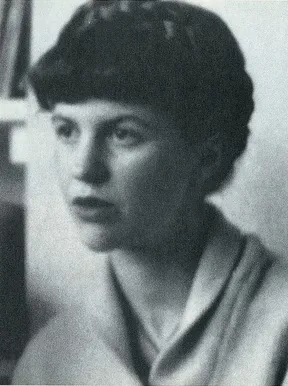
Sylvia Plath
Human Design Chart
Biography
Plath was a sensitive, studious child, born to a college professor and his educated, cultured wife. In November 1940, when Sylvia was just 8 years old, her father died from complications of diabetes. An intense student, she worked hard to achieve good grades. The following year, in August 1941, one of Plath’s poems was published in a Boston, MA newspaper. By age 18, she had won awards for her poetry and, with her excellent grades and obvious talent, she won a scholarship to Smith College. During her junior year, she spent the summer in New York as a guest editor for Mademoiselle, a fashion magazine. While still a student at Smith, she had a nervous breakdown, attempted suicide by swallowing sleeping pills and was given shock treatments. Despite such upheaval, she graduated in 1955 and went to Cambridge, England on a Fulbright scholarship.
One night at a party in Cambridge, February 25, 1956, she met Ted Hughes, and their romance began in a blaze of passion. She wrote, "He kissed me bang smash on the mouth, And when he kissed my neck, I bit him long and hard on the cheek and, when we came out of the room, Blood was running down his face." The handsome gifted pair married four months later, on June 16, 1956.
The couple had two children, Frieda in 1960 and Nicholas in 1962. During their time together, the brilliant and tortured Plath mined her own anguish, writing obsessively of her depression, her jealousy, her marriage and her father, the strict, formal professor who had abandoned her by his premature death. Her first book, "The Colossus" was released in 1960.
Sylvia Plath — Manifesting Generator with Profile 3/5
Manifesting Generator 3/5 — Design at a Glance
Sylvia Plath's design inclined towards rapid, hybrid action capability. As an Manifesting Generator, she possessed the constant energy source of the sacral center combined with the ability to skip steps in the process. This allowed her to quickly draw things into her life and push multiple projects forward simultaneously.
However, this configuration carried specific risks: The speed often led to overlooking important intermediate steps, necessitating backtracking and catch-up work. Additionally, she tended to react to many different impulses at once and start several undertakings in parallel. Without a consistent alignment with her inner authority and the strategy of waiting for a clear impulse before acting, this creative drive quickly turned into frustration – the non-self theme of her type.
Her design was most effective when she reacted rather than initiated and regularly checked whether her inner voice still supported her current projects. In this state, what is known as a "play mode," she drew deep satisfaction from her work. The requirement to complete one thing before starting another conflicted with her nature; variety and parallel work were beneficial for her energy flows, provided they responded to genuine resonance.
Emotional Authority
Sylvia Plath's design indicated a tendency towards emotional wave movements that significantly shaped her perception of the world. She was someone whose view of situations was always colored by her current mood; enthusiasm could quickly turn into negative evaluation and vice versa. This dynamic resulted from her emotional authority, which resided in her defined Emotional Center. In Human Design mechanics: When this center is activated, it always takes on the role of the inner decision-making authority, regardless of other defined areas in the chart.
This mechanism meant for Sylvia Plath that her immediate feelings were only snapshots – first impressions that did not necessarily reflect her deepest truth yet. Spontaneous decisions arising directly from this emotional heat carried the risk of proving false. Her design's strategy therefore required patience and time. By allowing herself to let decisions rest and sleep on them multiple times, she could wait until the intense emotional currents subsided. Only then would she gain the necessary emotional distance that enabled clarity and calmness. This process was essential for long-term direction-setting in her life, as it ensured that her choices were not based on fleeting moods but on a mature, more comprehensive understanding.
The 3/5 Profile — Martyr / Heretic
Sylvia Plath's design inclined her towards the role of an experimenter who gathered knowledge through personal trial and error to later use it as a hero or savior for others. As a 3/5 profile, she lived out of the necessity to experience things firsthand before trusting them. Line 3 pushed her to take risks and show adventurous spirit, often without preconceived plans. She learned from these experiences – including failures – building up a treasure trove of practical insights.
This self-acquired wisdom was attractive in her environment. Others projected onto her the qualities of line 5: leadership, righteousness, and the ability to guide the collective. Thus, Sylvia Plath was often pushed into a hero role, although her inner drive was less ambitious and more experience-based. The tension between private experimenting (line 3) and public expectations for leadership (line 5) shaped her interactions. Failure in the public sphere could be painful as it shattered the projected perfection. Her path involved making rational assessments of risks – supported by Saturn's influence on Gate 28 – to become more selective, placing value on personal goals over mere expansion. In this way, she transformed raw life experience into a form of leadership grounded not in claims of power but in lived practice.
Split Definition — Defined & Open Centers
Sylvia Plath's design indicated a tendency towards constant mental tension paired with profound emotional wave dynamics. The defined Head and Ajna Centers created an ongoing internal pressure to question and form concepts – a process of inspiration that lacked direct motoric energy for implementation. This mental flow moved into the also defined Throat Center, making her thoughts and doubts always articulable, often as expressions of what her mind conceived.
At the same time, she had a defined Sacral Center, the source of her vital energy and generative potential. As a Generator, her strategy was to wait and respond to external initiatives to use her energy correctly. However, the open Heart Center lacked consistent willpower; here she tended to commit herself through promises or attempts to prove her worth, for which she could not sustainably provide energy. This often led to frustration and exhaustion when mental decisions overshadowed her sacral response.
Her emotional authority lay in the defined Solar Plexus Center. Truth did not reveal itself immediately but only after going through the emotional wave. Patience was essential to gain clarity; impulsive action in emotional highs or lows resulted in chaos and later regret.
The open G Center meant a flexible yet vulnerable identity. She had no fixed inner direction but adopted the identities of her environment. In the wrong place or with the wrong people, she felt lost; in the right place, she flourished as she reflected the correct energy there. The open Spleen Center amplified fears about survival and well-being, while the open Root Center absorbed external stress. This combination of high mental pressure, emotional depth, and the necessity to respond rather than initiate significantly shaped her inner landscape.
Channels for logical doubt, intimacy, emotional openness and abstraction.
Sylvia Plath's design inclined towards analytical skepticism and emotional intensity. Her mind sought patterns while her emotions yearned for fusion. The Channel of Logic 63-4 connected the Head Center with Ajna Center through Doubt (Gate 63) and Formulation (Gate 4). This doubting mind constantly filtered out patterns for consistency; only verifiable, consistent facts were considered logical. Unstable patterns generated mental pressure until a pressing question arose. Without room for unfounded belief, she had to provide evidence to validate answers. Parallel to this, the Channel of Abstraction 64-47, also between Head and Ajna Centers, operated through Confusion (Gate 64) and Understanding (Gate 47). This experience-based mind sifted everything through mental images, searching for stories and perspectives. It was unsuitable for personal problems but ideal for discovering inspiring narratives or new viewpoints once clarity emerged over time.
Emotionally, two channels shaped her relationships. The Channel of Partnership 59-6 connected the Sacral Center with Solar Plexus Center through Sexuality (Gate 59) and Friction (Gate 6). This was the power of intimacy rooted in sacral and emotional energy. It quickly penetrated others' auras, fostering confidentiality and fertility. However, her emotional wave determined timing; waiting was necessary to check if a connection truly existed, as intensity could otherwise be misunderstood. Complementing this, the Channel of Openness 22-12 between Solar Plexus Center and Throat Center operated through Openness (Gate 22) and Caution (Gate 12). This individual expression depended on the ebb and flow of her mood. It allowed her to emotionally touch or transform others through voice and words, but only when she felt like it. Forced social interaction at the wrong moment led to harshness or isolation. Her mechanics required patience: logical experimentation for the mind, emotional clarity for intimacy, and mood-guided openness for communication.
Collective Circuitry — Circuit Signature
Sylvia Plath's design indicated a tendency towards emotional directness and instinctive attachment. Her defined centers formed two separate groups that did not flow directly into each other: on one hand, the Head Center and Ajna Center; on the other hand, the Solar Plexus Center, Sacral Center, and Throat Center. This separation meant that rational impulses from the Head and Ajna areas (Understanding Circuit) as well as abstract patterns (Meaning Circuit) existed as isolated fragments without direct access to her emotional or physical expression abilities.
In the second cluster, the Knowledge Circuit connected the Throat with the Solar Plexus Center through the Channel of Openness. This allowed Sylvia Plath to express emotional waves immediately and acoustically without first filtering them cognitively. Parallel to this, the Protector Circuit was at work: The Channel of Union linked the Sacral with the Solar Plexus Center. Here, primal survival energies and emotional intensity flowed directly into life force energy, fostering a deep instinctive connection and a drive to protect and preserve those close to her.
This split definition thus created a tension: While her feelings and expression channel (Throat/Solar Plexus) were closely intertwined with her life energy (Sacral), the logical or abstract-thinking aspects of her design remained energetically isolated. She appeared as someone whose emotional and physical reactions were strong and direct, while cognitive processes often seemed separate and not fully integrated impulses.
Right Angle Cross of the Unexpected 3
Sylvia Plath's design indicated a tendency towards unexpected and often abrupt turning points. She was someone who did not seek logical explanations in moments of uncertainty or confusion but rather responded intuitively to what was present – even if it seemed contradictory. This attitude stemmed from the right cross of the Unexpected 3: a configuration that does not offer predictable life lines, but instead requires constant adaptation to changing circumstances. Rather than following a fixed plan, she lived with the flow of events, her strength lying in finding spontaneous new paths out of seemingly chaotic situations. The mechanics of this cross do not imply arbitrariness but rather a high sensitivity for the present moment and the ability to act without rigid expectations. For Sylvia Plath, this was not a choice but an inherent strategy: she had to learn that security does not arise from control but through trust in her own capacity to integrate the unexpected. Her design challenged her to not resist against the current of unforeseen developments but rather to swim with it – even if this meant starting anew and letting go of old structures repeatedly. This dynamic shaped her way of dealing with challenges: not through analysis, but through direct, often surprising action in the here and now.
Saturn Return — Life Cycles
Sylvia Plath's design indicated a tendency towards intense inner condensation that discharged itself in concrete creative phases. She published *The Colossus And Other Poems* in 1960 at the age of 28. For her Human Design, this was a typical moment: the first Saturn Return. This cycle often marks the point where years of groundwork and internal structuring become tangible results. Rather than just holding potential, her energy condensed into a firm form that came to the fore.
The mechanics of the first Saturn Return describe a process of maturation and consolidation. What was previously perhaps fluid or experimental gains substance and durability. Sylvia Plath showed herself as someone whose creative expression through this planetary phase transitioned into a new quality of constancy. The publication did not stand in isolation but represented the cumulative power of her previous development. Her design promoted no spontaneous, unbridled outpouring but rather work that needed time to crystallize. The Saturn Return functioned here as a catalyst making this inner work visible and giving it weight. It was less a sudden breakthrough than reaching a natural maturation point where her artistic identity became clearly defined and durable.
Manifesting Generator · Emotional Authority — Synthesis
Sylvia Plath lived a life marked by a profound drive for knowledge and expression. The combination of sacral energy (Manifesting Generator) and emotional authority led to intense reactions to stimuli, which she transformed into creative work – yet always with the necessity to let decisions mature over time to gain inner clarity. The defined Head Center (with the Channel of Logic) reinforced this process by constantly generating pressure to question patterns and seek answers. This search for truth and meaning was a central aspect of her existence, manifesting in her need to try experiences (Line 3) and then make them accessible to others (Line 5).
A fundamental paradox characterized Sylvia Plath's design: the apparent discrepancy between the impulse towards quick action as a Manifesting Generator and the necessity for emotional maturation. Her sacral center demanded reaction, while her emotional authority required patience. This tension often left her in a state of internal turmoil – between the desire for immediate implementation and the realization that deeper understanding requires time. The right cross of the Unexpected suggests that this inner dynamic was further intensified by unforeseen events, leading to a life marked by intense highs and lows.
4 Defined Channels
Incarnation Cross - Right Angle Cross of the Unexpected 3
Solar Return
The Solar Return shows the moment when the sun returns to its exact birth position - your personal solar year.
Life Cycles
Discover the life cycles with a detailed triple view (birth chart, cycle chart, composite).
Human Design Profile
- Strategy
- To respond - wait for something to respond to
- Authority
- Emotional Authority
- Profile
- 3/5 - Martyr / Heretic
- Definition
- Split Definition
- Incarnation Cross
- Right Angle Cross of the Unexpected 3
- Date of Birth
- 27.10.1932 14:10
- Place of Birth
- Boston, MA, United States
Frequently Asked Questions
What is Sylvia Plath's Human Design type?
What Profile did Sylvia Plath have in Human Design?
Which Authority did Sylvia Plath have in Human Design?
What incarnation cross did Sylvia Plath have?
When was Sylvia Plath born?
Discover your own Human Design
Are you also a Manifesting Generator? Find out in a personal reading how to unfold your multi-talents and direct your energy wisely.
More Personalities
Back to overviewAlain-Fournier

Aldair

Alizée

Angeli

Arletty

Artus
