
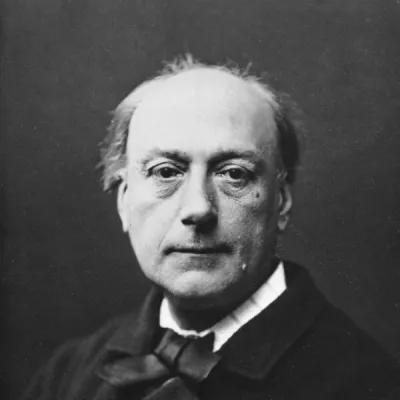
Théodore de Banville
Human Design Chart
Biography
Théodore de Banville died on 13 March 1891 at age 67 in Paris.
The Human Design of Théodore de Banville: Projector 1/4
Projector 1/4 — Design at a Glance
Théodore de Banville had a focusing aura that shone like a bright flashlight, revealing system errors in others immediately. However, this direct confrontation often provoked rejection as he inadvertently shined his light into the face of his counterpart. His more effective strategy was to attract through harmonious self-expression, leading others to seek his advice. As a Projector, he waited for an honest invitation rather than initiating himself.
With his undefined Sacral Center, he lacked a constant energy source and moved in phases of high activity that required mandatory rest periods for regeneration to prevent burnout. Conventional work life often ignored this rhythmic need. When Théodore de Banville lived according to his design, he was rewarded with success. Deviating from it led him to experience bitterness as an expression of his non-self. His path lay in patiently waiting for recognition and protecting his limited energy reserves through targeted rest.
Emotional Authority
Théodore de Banville's design inclined towards emotional detachment when making decisions; spontaneous impulses proved misleading within his mechanics. He was someone who recognized the necessity of sleeping on decisions to distinguish between fleeting mood and deeper clarity.
This stance stemmed from his emotional authority. With a defined emotional center, he was subject to a constant wave of feelings that showed in an ongoing up-and-down pattern. His perception of the world was always colored by his current mood: at one moment he could be totally enthusiastic, the next view the same situation negatively. However, his feeling in the moment was merely a snapshot, a first impression that did not necessarily reflect truth yet. Quick, spontaneous decisions based on such an emotion could thus have negative consequences.
The more time he took to let a decision mature, the deeper and broader he could perceive something. This required patience and repeatedly sleeping on questions. Through this process of letting things simmer and asking multiple times, intense feelings subsided over time. He gained emotional distance, leading to clarity and calmness. Only then had he gone through the process. This mechanism was particularly relevant for long-term decisions that could greatly influence his life course.
The 1/4 Profile — Investigator / Opportunist
Théodore de Banville appeared as someone who sought deep, individual knowledge but whose aura strongly depended on the quality of his social environment. His design created a tension between the drive for thorough exploration (Line 1) and the need for a familiar community (Line 4). Line 1 described his approach to resistance and crisis as foundational for progress; he had to penetrate uncertainties to understand them. Simultaneously, Line 4 ensured that he could only effectively share his knowledge when in a loving, trust-based environment. Without this security, fear of exposure and heartache towards loved ones inhibited his authority. Only within a protected network could he unfold his ability to communicate ideas and inspire others through deep understanding. This configuration meant Théodore de Banville had the potential to become an authority figure in his field through networking, but only under the condition that he felt emotionally secure. His path did not lead through isolated research but rather the connection of deep comprehension with sharing within a circle of trusted individuals where fear of rejection could fade and insights find space.
Split Definition — Defined & Open Centers
Théodore de Banville was characterized by a fundamental inner stability marked by defined identity (G Center), constant willpower (Heart) and emotional depth (Solar Plexus). His G Center endowed him with a reliable self-image and the ability to love others without becoming dependent. He had a clear internal compass for his life direction. The defined Heart Center gave him consistent willpower for resource control; he preferred being his own boss, stabilizing his self-esteem by keeping promises. His emotional authority lay in the Solar Plexus: He waited patiently for the wave cycle before making decisions, which granted him deep clarity instead of impulsiveness. The defined Root Center provided the necessary existential pressure to overcome material challenges.
In contrast, his mental centers (Head and Ajna) as well as the Throat, Sacral, and Spleen Centers were open. This openness meant that inspiration and conceptual answers were not constant but situational, taken in from the environment. He tended to identify with passing thoughts or speaking pressure rather than waiting for a genuine invitation. His vital energy (open Sacral) was fluctuating; he had to learn not to claim borrowed energy as his own performance to avoid exhaustion. The open Spleen Center made him vulnerable to spontaneous survival decisions and the search for external security. Instead of acting impulsively or identifying with the fear of failure, it was crucial for him to recognize these conditioned patterns as non-self and trust in his defined inner structure.
Channels for pioneering spirit, impulse and emotional vision.
Théodore de Banville emerged as a being who achieved breakthroughs through competitive expansion and surpassing creative boundaries. This dynamic was significantly shaped by Channel Initiation 51-25. It connects the competing energy of Gate 51 with the universal love of Gate 25, representing a natural competitiveness aimed at 'being first', coupled with the ability to inspire others through an initiatory shock towards individualization and recognition of their unique qualities. For Théodore de Banville, this initiation was a mystical process requiring authenticity; it had to find him rather than the other way around.
Simultaneously, he was driven by a deep, often painful longing for intense new experiences that could only be processed in emotional rhythms. This stemmed from Channel Recognition 41-30. Here, the Root pressure of Gate 41 – an intense emotional restlessness and endless hunger for novelty – combined with the emotional wave of Solar Plexus (Gate 30). This mechanism generated a strong impulse to close the gap between inexperience and experience. However, clarity for Théodore de Banville did not arise through immediate action under this pressure but through patience: Waiting out the emotional wave allowed him to consciously choose his desires and precisely describe the resulting insights and nuances of emotions. Thus, his design tended towards a pursuit of priority and the mutative shock of initiation in tandem with a reflective, emotionally guided search for profound life experience.
Individual Circuitry — Circuit Signature
Théodore de Banville was someone with a firm, courageous inner strength and strong personal convictions. His design linked Identity with Heart Center (Channel 25-51). This connection created an inwardly directed energy of self-worth: 'I am who I am'. However, since this circuit did not connect to the Throat Center, these firm beliefs often remained hard to verbalize; confirmation of his individuality was more silent than loud.
Parallel to this existed a separate energetic structure: The Split Definition separated this central identity power from another group that linked Solar Plexus with Root Center (Channel 30-41). This sense-making circuit facilitated cyclical processing of emotional waves and experiences from the past. While one side of his design relied on individual confirmation, the other served to reflect past feelings and gain insights that could be shared with the collective.
Both systems ran alongside each other without direct energetic flow between them. Théodore de Banville thus navigated between the silent, inwardly directed strength of his identity and the wave-like, emotional insights from earlier life phases. The missing verbal bridge to the outside world did not mean a lack of depth but another form of expression: His convictions were felt and processed more through feeling than defined by words, less through spoken knowledge of his central centers and rhythmic processing of his emotional history.
Right Angle Cross of Eden 1
Théodore de Banville's Human Design profile indicated a tendency towards deep inner integrity, characterized by the Right Cross of Eden 1. He was someone whose identity and self-expression were strongly rooted in authenticity. This configuration pointed to a fundamental connection with his essence; his expression did not stem from adaptation but rather from a strong internal truth.
For Théodore de Banville, this meant that trust in his own path was central. The mechanics of this cross emphasized independence from external validations for his identity. Rather than defining himself through external recognition, he oriented towards an internal compass needle. This created a foundation where actions and expressions sprang directly from the core of his personality without filtering through societal expectations or the desire for validation by others.
The challenge lay in consistently living this inner truth even when it was misunderstood externally. The Right Cross of Eden 1 conveyed the necessity to accept and express one's existence as a whole. For Théodore de Banville, this was not a theoretical concept but the structural foundation of his being. His life reflected this orientation towards the essential: Being before appearance, inner coherence over external applause. This attitude profoundly shaped his interactions and decisions by drawing a clear line between drawing from the inner source and responding to external stimuli.
Projector · Emotional Authority — Synthesis
Théodore de Banville lived a life deeply marked by the ability to recognize patterns and grasp the essence behind things. This was evident in an acute sensitivity for subtle nuances – both in the realm of emotions as well as perception of surroundings. Through the connection between Heart Center and open Root Center, he seemed to combine inner directionality with a constant drive to explore new experiences, allowing him to gain profound insights and express them in unconventional ways. The ability to recognize potential in others and set impulses for change through words or actions was a central element of his work.
At the same time, a fundamental tension revealed itself between the need for individuality and vulnerability to external influences. The undefined Spleen Center points towards an ongoing search for security and validation, while the open Throat Center presented the challenge of communicating authentically without being led by expectations. This discrepancy might have led to internal resistance against conventions and a deep longing for self-realization that manifested in art and expression but also required constant confrontation with personal boundaries.
2 Defined Channels
Incarnation Cross - Right Angle Cross of Eden 1
Solar Return
The Solar Return shows the moment when the sun returns to its exact birth position - your personal solar year.
Life Cycles
Discover the life cycles with a detailed triple view (birth chart, cycle chart, composite).
Human Design Profile
- Type
- Projector
- Strategy
- Wait for the respectful invitation
- Authority
- Emotional Authority
- Profile
- 1/4 - Investigator / Opportunist
- Definition
- Split Definition
- Incarnation Cross
- Right Angle Cross of Eden 1
- Date of Birth
- 14.03.1823 21:30
- Place of Birth
- Moulins, France
Frequently Asked Questions
Which Human Design Type was Théodore de Banville?
Which profile did Théodore de Banville have?
What authority did Théodore de Banville have?
Which incarnation cross did Théodore de Banville have?
When was Théodore de Banville born?
Discover your own Human Design
Are you also a Projector? Find out in a personal reading how to unfold your leadership qualities and recognize the right invitations.
More Personalities
Back to overviewSissy Spacek

Alain-Fournier

Anémone

Angeli

Ann-Margret

Bourvil
