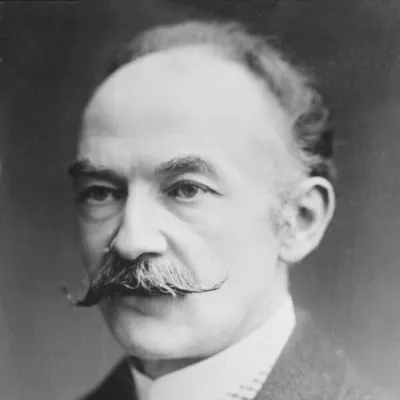
Thomas Hardy
Human Design Chart
Biography
While Hardy wrote poetry throughout his life and regarded himself primarily as a poet, his first collection was not published until 1898. Initially, he gained fame as the author of novels such as Far from the Madding Crowd (1874), The Return of the Native (1878), The Mayor of Casterbridge (1886), Tess of the d'Urbervilles (1891) and Jude the Obscure (1895). During his lifetime, Hardy's poetry was acclaimed by younger poets (particularly the Georgians) who viewed him as a mentor. After his death his poems were lauded by Ezra Pound, W. H. Auden and Philip Larkin.
Many of his novels concern tragic characters struggling against their passions and social circumstances, and they are often set in the semi-fictional region of Wessex; initially based on the medieval Anglo-Saxon kingdom, Hardy's Wessex eventually came to include the counties of Dorset, Wiltshire, Somerset, Devon, Hampshire and much of Berkshire, in south-west and south central England.
The Human Design of Thomas Hardy: Manifestor 1/3
Manifestor 1/3 — Design at a Glance
Thomas Hardy revealed himself as a pioneer and visionary whose nature was geared towards leading the world into a new future. His design contained the energy of a leader who, much like an emperor in ancient Rome, pursued grand plans but did not implement them solely through physical strength; instead, he motivated others to realize his visions. This constellation often led him to be misunderstood and polarizing: While some loved and followed his far-reaching thoughts, others rejected or even hated them due to their magnitude. To minimize friction and find the right followership, it was crucial for him to inform others timely and precisely about his intentions. This strategy of informing formed the core of his ideal way of living. When he adhered to this guideline, his system rewarded him with a sense of inner peace. Conversely, if he lived against this design, he felt instead a persistent, deep-seated anger within himself. His path was thus characterized by the necessity to communicate his vision clearly in order to reduce resistance and act harmoniously rather than fighting against the tide of misunderstanding.
Emotional Authority
Thomas Hardy's design featured an emotional wave movement tendency that significantly shaped his perception and decision-making process. As a carrier of Emotional Authority, he was subject to constant ups and downs of his feelings, with the defined Solar Plexus Center carrying this function in his system. In this configuration, Emotional Authority always takes precedence over other defined centers; it is the primary instance for decisions, regardless of further configurations in the chart.
His worldview was always colored by his current mood. What appeared inspiring at one moment could seem negative in the next. These fleeting impressions were not final truths but merely initial reactions. Quick, spontaneous decisions from such an emotional state often proved disadvantageous to him. Instead, his design required patience and time to gain clarity.
Thomas Hardy had to let decisions mature, which often meant sleeping on them multiple times. Only when intense feelings subsided and emotional distance was established did calmness set in. This process was particularly crucial for long-term life decisions. By waiting for the emotional wave to subside, he could gain deeper insights and act from a position of inner peace rather than being driven by transient mood swings.
The 1/3 Profile — Investigator / Martyr
Thomas Hardy's design inclined towards exploratory experimentation. As a 1/3 profile – researcher and experimenter – he was someone who not only gathered knowledge theoretically but also tested it through active experimentation. His life revolved around the process of trial and error. The Line 1 in him brought the humility of an evolutionary line; it taught him to accept rejection and change as necessary steps towards maturity. He learned to understand life itself as a form of art by reflecting on experiences and growing from them. Simultaneously, the energy of Line 3 propelled him: It urged him to dive into things to find answers to his questions. This dynamic created a balance between Jupiter, which fosters new beginnings with persistence, and Saturn, which exerts pressure to dispel doubts through concrete results. When Thomas Hardy made a judgment, it was based on having thoroughly examined the matter both intellectually and practically. His authority did not stem from mere theory but from tested experience. He had to learn to use the impulse of Line 3 rather than getting stuck in the fear of incomplete knowledge (Line 1). Only through actual experimentation and learning from mistakes could he validate his insights. His design demanded seeking self-earned truths that stood up to the harsh test of reality.
Single Definition — Defined & Open Centers
Thomas Hardy's design points towards a tendency for clear, resolute communication that stems from a firm inner identity and emotional depth. His defined Throat Center is linked to the G Center; he spoke not only with his mind but also from his higher self – with a clear 'I' that knew its direction. This connection was reinforced by his defined Willpower in the Heart Center: He knew what he wanted, and had the energy to keep promises and see projects through. His emotional authority lay in the Solar Plexus; decisions were not made impulsively but after riding out an emotional wave, giving him a deep, delayed clarity. This was complemented by his defined Spleen Center: He possessed a reliable instinct for 'now', an intuitive sense of health and well-being that guided him in the moment. His defined Root Center provided the necessary pressure to advance in the material world and master existential challenges.
At the same time, Thomas Hardy was prone to mental confusion. His open Head and Ajna Centers meant he lacked a constant source for inspiration or conceptual answers. He tended to identify with others' questions or spiral into mental loops of doubt when not trusting his inner authority. Additionally, his Sacral Center was open; he did not have a consistent reserve of generative life energy. This made him vulnerable to exhaustion if he absorbed the energy from his environment and tried to work like a generator rather than listening to his own strategy. He had to learn to set boundaries and rest before fatigue set in, as his body was not designed for continuous stress.
Channels for emotional waves, inspiration, devotion, change and community.
Thomas Hardy's design points towards an exemplary public presence. The Channel of Inspiration 1-8 connects his G Center with the Throat Center, drawing others' attention through living his individual identity and creative truth. This effect did not come from mere explanation but by demonstrating a unique direction that inspired others to express their own uniqueness.
Parallel to this, his design showed an instinctive ability to persuade and 'sell' ideas or products. The Channel of Devotion 44-26 connects the Spleen Center with the Heart Center. This gave him a sense of what the group needed – often before people knew it themselves – and the willpower to convey this convincingly. He used historical memories and instinctive awareness to offer improvements, acting as an entrepreneur or promoter who generated resources and supplied the team.
Emotionally, Thomas Hardy was driven by a restless search for new experiences. The Channel of Transience 36-35 connects Solar Plexus with Throat Center. He sought adventures to gain emotional depth and shared these intense, often crisis-filled experiences with others. His wisdom grew from experiencing these highs and lows; he learned to trust the emotional wave rather than being overwhelmed by it, advising others to seize the moment.
In interpersonal contexts, he sought correct agreements within a community. The Channel of Community 37-40 connects Solar Plexus with Heart Center. He built bridges between individuals to create a harmonious group where everyone had an honorable place. This was not about hierarchy but mutual support and loyalty towards a larger unit.
Furthermore, his design featured a pulsating emotional moodiness. The Channel of Emotions Unleashed 39-55 connects Root with Solar Plexus Center. He provoked the spirit of his environment to tease out the right mood or 'spirit'. This allowed him to unfold a profound, mutative power through authentic living in the alchemy of joy and melancholy, opening others up to new perspectives.
Individual Circuitry — Circuit Signature
Thomas Hardy's design points towards emotional reflection and communal exchange. As a person with simple definition, his energy was unified into one continuous flow encompassing Throat, Identity, Solar Plexus, Heart, Spleen, and Root Centers.
In the Knowledge Circuit, two separate segments were at work: The first connected the Throat to the Identity Center (Channel 1-8), providing inspiring impulses for expressing individuality. The second segment linked Solar Plexus with Root Center (Channel 55-39) through wave-like emotional cycles contributing to transformation.
The Meaning Circuit connected his Throat and Solar Plexus Centers (Channel 35-36). This was about sharing felt insights from the past, learning together from them.
In the Ego Circuit, Heart, Solar Plexus, and Spleen Centers formed a unit (Channels 26-44 as well as 37-40), promoting cooperation, mutual support, and resource creation in the collective, with rest periods necessary for regeneration.
Right Angle Cross of Consciousness 2
Thomas Hardy's Design inclines towards inner clarity and the ability to view complex situations from a detached perspective. This configuration, known as the Consciousness Right Cross 2, fostered an approach that allowed him to disengage from emotional turbulence and instead focus on logical connections. In his life, this was evident through a remarkable ability to maintain calm in chaotic times and make clear decisions.
The mechanics of this cross emphasized the importance of consciousness and self-reflection as tools for navigating life's challenges. Thomas Hardy utilized this trait to gain deep insights into human behavior and societal structures. His works often reflected his capacity to look beneath the surface and reveal hidden truths.
Without specific events in the raw content, the description remains general but clearly illustrates how Thomas Hardy's Design shaped him. His approach was characterized by a clear perspective that enabled him to address both personal and universal themes with depth and nuance. This contributed to making his works not only entertaining but also enlightening.
Saturn Return · Uranus Opposition · Chiron Return · 2nd Saturn Return — Life Cycles
Thomas Hardy's Human Design profile indicated a tendency towards cyclical, structural turning points that were closely tied to his literary career. These patterns did not appear as random events but rather as expressions of inner developmental spurts marked by planetary cycles.
In 1871, at the age of 31, the novel *Desperate Remedies* was published. This fell during his first Saturn Return, a phase where years of groundwork often condenses into a solid outcome and early professional structures are established.
Seven years later, in 1878 when he was 38, *Return of the Native* came out. Here, the Uranus Opposition was at play: a time that frequently resolves internal tensions and allows for new, unexpected perspectives or creative breaks to break free from old patterns.
Another peak occurred in 1891 when Hardy was 51 years old and published *Tess of the d'Urbervilles*. This marked his Chiron Return, a fulfillment cycle ("Blossoming") where one's incarnation cross unfolds and personal meaning in life becomes experiential – provided that the individual lives according to their strategy.
Finally, in 1898 at age 58, during his second Saturn Return, he published his first collection of poetry. This cycle often deepens an already established structure and integrates new creative areas into the existing body of work, which for Hardy facilitated a shift towards lyricism.
Manifestor · Emotional Authority — Synthesis
Thomas Hardy lived a life path marked by a profound inner tension between the drive for innovation and a strong emotional foundation. As a Manifestor (Design) with Emotional Authority (Authority) and the Profile of an Investigator/Explorer (Profile Role), he constantly sought new insights, yet required time to filter and verify these through his emotions. This combination led him both to boldly venture into new paths – as indicated by the Channel of Inspiration (Channels/Gates) – while remaining deeply rooted in his own experiences. Repeated documented events related to publications (Cycles) attest to a pattern of waiting and careful refinement before he presented his creative results to the public.
A central paradox lay in Hardy being conceived as someone who should give impulses and initiate changes (Manifestor, Knowledge Strategy), yet experiencing an emotional wave that made quick decisions difficult (Authority). This tension was evident in a constant interplay between the desire for expression and the necessity of processing emotions. The energy of the G Center, connected with the Throat Center (Channels/Gates), pointed to a natural talent for creative expression, but Emotional Authority required a longer maturation process to ensure that this expression was authentic and profound.
5 Defined Channels
Incarnation Cross - Right Angle Cross of Consciousness 2
Solar Return
The Solar Return shows the moment when the sun returns to its exact birth position - your personal solar year.
Life Cycles
Discover the life cycles with a detailed triple view (birth chart, cycle chart, composite).
Human Design Profile
- Type
- Manifestor
- Strategy
- To inform others before acting
- Authority
- Emotional Authority
- Profile
- 1/3 - Investigator / Martyr
- Definition
- Single Definition
- Incarnation Cross
- Right Angle Cross of Consciousness 2
- Date of Birth
- 02.06.1840 08:00
- Place of Birth
- Upper Buckhampton, United Kingdom
Frequently Asked Questions
What was Thomas Hardy's Human Design type?
What Profile did Thomas Hardy have in Human Design?
What Authority did Thomas Hardy possess?
What incarnation cross did Thomas Hardy have?
When was Thomas Hardy born?
Discover your own Human Design
Are you also a Manifestor? Find out in a personal reading how to use your initiation power peacefully and dissolve resistance.
More Personalities
Back to overviewAlain-Fournier

Angeli

Christian-Jaque
Juninho

Kesha

Lucebert