
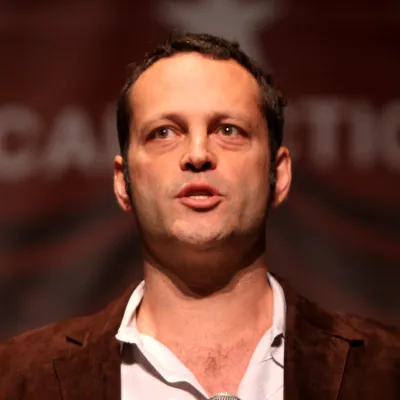
Vince Vaughn
Human Design Chart
Biography
Born in Minneapolis, Vaughn grew up in a suburb of Chicago. His father, a salesman, and his mother, a real estate broker who made a great deal of money in the stock market, lived in a wealthy area with their children, Vaughn and his two older sisters, Victoria and Valerie. He was a hyperactive child who didn’t do well in school, spending a lot of time waiting to see the principal. In his last year of high school, he decided he wanted to graduate but really didn’t want to spend his time studying. He laid out a plan to get elected president of the senior class, hoping that the school officials would allow him to graduate if he was a class officer. He carried out an extensive campaign, ultimately winning the election and graduating in 1988. He had been interested in acting since he was about seven years old, and after finishing school, he did some work in improvisational theater around Chicago. As well, he appeared in a nationally televised commercial for Chevrolet in 1989 and thought he "had it made." His parents divorced in 1991, but by that time, Vaughn was in Hollywood, pursuing an acting career fulltime.
His first seven years as an actor were difficult ones although he made guest appearances on television series like "China Beach" and "21 Jump Street." He appeared in the film "Rudy," 1993, but it was Steven Spielberg who finally cast him in a role in "Lost World: The Jurassic Park," 1997. Soon afterward, offers began pouring in. He appeared in a number of films over the next two years including "The Locusts," 1997, "Return to Paradise," 1998, and the remake of "Psycho," 1998.
The Human Design of Vince Vaughn: Generator 5/1
Generator 5/1 — Design at a Glance
Vince Vaughn's design shows a tendency towards great endurance and strength. As a Generator, he had plenty of sacral energy that drove him like a strong workhorse—provided he had the power for his task. However, his life force was not released through independent initiatives but primarily by reacting to impulses from the environment. The motto was: Not initiate, but react.
This mechanism contained two central pitfalls. On one hand, there was the risk of frustration and energy loss if he did things that didn't give him inner pleasure and only wasted his strength. This could lead to burnout with continued misalignment. On the other hand, conflict potential arose when he was prevented from working on his heart project, even though his inner self still brimmed with power and wanted to continue.
His successful strategy involved waiting for signals from life and then acting only when the sacral center gave a clear "yes." This gut reaction was the key to effectiveness. When he followed this inner resonance, he was rewarded with a deep sense of satisfaction. If he lived against this design and constantly tried to initiate things, sooner or later he would encounter persistent frustration and a lack of energy. His strength lay in his ability to pick up impulses and answer them through sustained action.
Sacral Authority
Vince Vaughn's design inclines towards spontaneous and physical responsiveness. As a Generator, he possesses Sacral Authority, which also serves as his strategy and simplifies the decision-making process. This inner guidance manifests not in the Head Center but as a direct physical response to external stimuli – often audible as grunting or an affirming "Mhm." When his sacral motor kicked in, he felt vital and alive; energy and enthusiasm were available to him so that he could engage in activities with joy without being bound by strict purpose.
Additionally, an activated Spleen Center acted as a supporting authority. This endowed him with quick, instinctive perception and enabled spontaneous decisions based on immediate physical well-being. With the Emotional Center open, Sacral Authority remained the primary instance for everyday life. Thus, Vince Vaughn demonstrated someone who acts through listening to his body sounds: if he responded positively with an energy surge, he followed this impulse and immersed himself in his work. This configuration describes a lifestyle driven by inner resonance, where instinct and energy together guide the way rather than being blocked by rational planning or emotional waiting periods.
The 5/1 Profile — Heretic / Investigator
Vince Vaughn's design created a tendency towards a magnetic presence that drew other people subconsciously to him in search of solutions. As a 5/1 – the Hero and Investigator – he used his deeply rooted knowledge base (Line 1) to offer it to others for problem-solving. This process of learning and facing challenges was not only personally enriching for him, but also created an almost magnetic dynamic: Others felt compelled to lift the treasures of his understanding.
However, this configuration brought a specific risk with it. Without clear boundaries, the constant demand for advice or help could lead to exhaustion, similar to an expert succumbing at the end of the day under the flood of questions and criticism. Line 5 emphasized the necessity of hierarchies and mutual dependence; refusing to acknowledge this structure led to tensions. At the same time, the energy of Line 1 worked through intuitive understanding of conflict (Gate 38). It demanded an aggressive reaction to influence and a sharp eye for opposition in order to recognize and defend one's own life value at the right moment. The balance lay in switching between the private space of research and the public role as problem solver, by learning to say no once in a while.
Split Definition — Defined & Open Centers
Vince Vaughn's design points towards an inner stability and clear direction. His defined G Center gives him a reliable sense of self-identity and the feeling of being lovable without relying on others. He has a natural compass for his life mission and can show others new perspectives as long as he doesn't try to direct them uninvited. This inner security forms the foundation of his presence.
At the same time, he possesses an enormous vital energy source through his defined Sacral Center. This center generates daily energy that manifests as a constant hum or restlessness. For him, it was essential to respond to questions rather than initiate; only with an enthusiastic 'yes' response did full power become available. Attempts to make mental decisions over this sacral reaction inevitably led to frustration and exhaustion. His defined Spleen Center complemented this through spontaneous intuition and body awareness. He could make trustworthy judgments in the present moment and protect his well-being by following subtle signals from his body without having to rationalize them.
These firm inner resources contrast with his open centers. His open Head Center has no consistent way of processing mental information. He tends to get stuck in doubts and confusion that actually belong to others, or seeks inspiration for questions that are not his own. The open Ajna Center means he takes on concepts and opinions but cannot hold them as personal truth; he risks feeling unsure if he can't appear logical.
His open Throat Center attracts attention without him actively working towards it. Trying to open his mouth to be noticed often led to unpredictable expression and stress. Instead, invitations to speak had to be waited for. His open Heart Center lacks a consistent willpower for competitions; he tends to want to prove himself through promises, which could lead into a cycle of self-disapproval if he failed. Finally, his open Solar Plexus absorbs the emotions of the environment. He could swing between happiness and depression by amplifying and personalizing foreign feelings rather than recognizing them as not his own and letting go.
Channels for rhythm, logical scrutiny and meaningful struggle.
Vince Vaughn's design points towards innovative, mutative energy paired with a sharp analytical eye for patterns and a stubborn will to individualize. This configuration shows someone who drives new directions through material resources and logical correction while simultaneously seeking meaning in their battles.
Beat 14-2 connects the Sacral Center with the G Center. Gate 14 focuses on the availability of material resources as driving force for mutation, while Gate 2 directs movement through space and time as driver of higher knowledge. This tantric channel brings innovation, unusualness, and a powerful resource for creative life force that strengthens a change in direction. Vince Vaughn could bring innovative perspectives into the status quo by trusting his sacral reaction and openly meeting life, which helped others find their own direction.
Judgment 58-18 connects the Root Center with the Spleen Center. Gate 58 drives love for life and the urge for 'better and more', while Gate 18 of correcting checks what is healthy or in balance. This channel nourishes the art of mastery through logical pattern checking. Vince Vaughn showed a capacity to question and perfect patterns, using his critical assessment most effectively when invited to find solutions for societal problems rather than seeking faults uninvited.
The Life Battle 38-28 also connects the Root Center with the Spleen Center. Gate 38 of the Fighter preserves individual integrity against external distractions, while Gate 28 of the Player recognizes which battles have value and are worth it. This channel gives stubborn determination to go one's own way and find meaning in difficulties. Vince Vaughn was designed to fight for his individualization, needing to be spurred by strategy to choose battles that made sense to him rather than being led by reason.
Additionally, Gates of succession and logical organization (17), selective provocation for mutation (39), sacral experience and completion ability (42), individual power integration (34), genetic acceptance of limitations (60) as well as caring artery maintenance (27) were at work. These gates supported logical teaching for the future, analytical re-evaluation through adrenaline, ending processes to new commitment, great sacral power, transformation through melancholy and magical care by fitting into channels.
Individual Circuitry — Circuit Signature
Vince Vaughn's design points towards pulsating, acoustic creativity paired with a strong drive for individual confirmation. The Knowledge Circuit shaped this attitude: It directly connected his Identity and Sacral Centers in him. This connection created a continuous flow between the will to express (Sacral) and the question 'Who am I?' (Identity). The energy of Channel 2-14 ('The Beat') promoted innovative, rhythmic impulses while Channel 28-38 ('Life Battle') emphasized establishing oneself through one's own achievements. Parallel to this, there was a separate connection between Spleen and Root Centers in the same circuit, linking intuitive stimulus perception with immediate stress reaction – two existing forces without direct energetic exchange for identity.
Another aspect was Judgment: The Understanding Circuit also connected Spleen and Root Centers over Channel 18-58. This reflected an ability to make rapid, logical assessments instinctively (Spleen) supported by inner urgency (Root). Since Vince Vaughn had a Shared Definition, these two groups – Identity/Sacral and Spleen/Root – existed as separate, not directly connected systems. The emotional wave of Solar Plexus remained outside; the ratio in Understanding Circuit thus worked more focused and visually, free from disturbing fluctuations. His energy showed itself as a combination of pulsating self-assertion and quick, instinctive logical assessment, each running in their own energetic paths.
Left Angle Cross of Upheaval 1
Vince Vaughn's design indicated a tendency towards profound and often sudden transformation processes. He was someone whose life did not follow linear stability or gradual adaptation but rather developed through decisive breaks and new orientations. This configuration corresponds to what is known as the 'left cross of revolution'. In Human Design mechanics, this pattern does not mark a gentle evolution but an archetypal structure that points towards the destruction of old, no longer sustainable structures in order to make room for fundamental renewal. It represents a cyclical impulse that tends to radically question and break through established patterns. For Vince Vaughn, this meant that his inner compass was not aimed at preserving the status quo but rather at initiating necessary changes – even if they felt disruptive or unsettling. His chart describes a life dynamic where growth happens less through continuous optimization than by overcoming crisis points and letting go of outdated identities. The energy of this cross acts as a catalyst for transformation, ensuring that old shells are shed whenever they block further development. Vince Vaughn was structurally prepared for such phases of upheaval in which the old must give way to make room for the new.
Saturn Return · Uranus Opposition · Chiron Return — Life Cycles
Vince Vaughn's design indicated a tendency towards impulsive and often surprising career leaps. This dynamic peaked in 1997, when he was 27 years old: Steven Spielberg cast him as a photographer in 'Jurassic Park'. For his design, this was a typical moment of the first Saturn return, where years of groundwork often condense into a sustainable result. This cycle marks the transition from an experimental phase to structural anchoring in life. The sudden offer of such a prominent role shows how his internal timing aligned with external opportunities without him having to actively pursue them. Instead of linear planning, here accumulated energy discharged at a precise point and opened new doors. It was less a conscious step than the result of maturation where the right conditions came together at the right moment. This experience shaped his understanding that external opportunities must meet internal readiness to have lasting impact. The focus was not on control but on recognizing and accepting the right impulse when it presented itself.
Generator · Sacral Authority — Synthesis
A central red thread runs through the design: a deep, sacral energy (sacral authority, defined G center) that reacts with strength and endurance to external stimuli. This energy is, however, inseparable from the need for continuous learning and the ability to deepen knowledge (5/1 profile, Beat channel: Gate 2 & 14). A pattern of engaged activity emerges from inner vitality as long as it is driven by authentic interests – an energy ready to take others along and explore new paths (knowledge circuit).
The design reveals a paradox between the need for deep exploration of knowledge (5/1 profile) and the potential overburdening through constant demands on this knowledge (5/1 dilemma, defined G center). The sacral reaction to stimuli can lead to relentless engagement while line 5 creates a magnetic attraction towards questions and problem-solving for others. This carries the risk of being trapped in constant activity rather than focusing on one's own direction and heart project (generator pitfalls).
3 Defined Channels
Incarnation Cross - Left Angle Cross of Upheaval 1
Solar Return
The Solar Return shows the moment when the sun returns to its exact birth position - your personal solar year.
Life Cycles
Discover the life cycles with a detailed triple view (birth chart, cycle chart, composite).
Human Design Profile
- Type
- Generator
- Strategy
- To respond - wait for something to respond to
- Authority
- Sacral Authority
- Profile
- 5/1 - Heretic / Investigator
- Definition
- Split Definition
- Incarnation Cross
- Left Angle Cross of Upheaval 1
- Date of Birth
- 28.03.1970 20:12
- Place of Birth
- Minneapolis, MN, United States
Frequently Asked Questions
What is Vince Vaughn's Human Design type?
What Profile does Vince Vaughn have in Human Design?
Which Authority guides Vince Vaughn's decisions?
Which incarnation cross is active for Vince Vaughn?
When was Vince Vaughn born?
Discover your own Human Design
Are you also a Generator? Find out in a personal reading how to use your sacral energy correctly and discover deep satisfaction.
More Personalities
Back to overviewSissy Spacek

Aaliyah

Alexia

Anémone

Angèle

Ann-Margret
