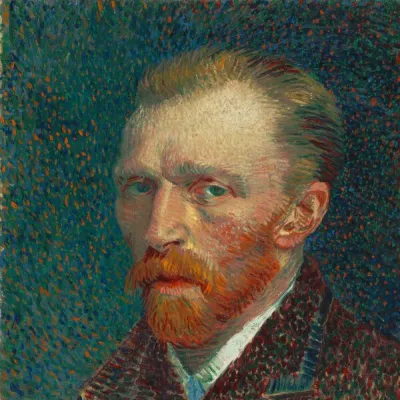
Vincent Van Gogh
Human Design Chart
Biography
Born into an upper-middle-class family, Van Gogh drew as a child and was serious, quiet and thoughtful, but showed signs of mental instability. As a young man, he worked as an art dealer, often travelling, but became depressed after he was transferred to London. He turned to religion and spent time as a missionary in southern Belgium. Later he drifted into ill-health and solitude. He was keenly aware of modernist trends in art and, while back with his parents, took up painting in 1881. His younger brother, Theo, supported him financially, and the two of them maintained a long correspondence.
Van Gogh's early works consist of mostly still lifes and depictions of peasant labourers.
Vincent Van Gogh as a Manifesting Generator 1/3 in Human Design
Manifesting Generator 1/3 — Design at a Glance
Vincent van Gogh's design tends towards rapid, parallel action based on fundamental responsiveness. As an Manifestor Generator, he had constant sacral energy, meaning his power was unleashed not by personal initiative but through responding to external impulses. This created a specific tension: His nature pushed him to skip steps and achieve results quickly, while the strategy required waiting until an internal 'yes' was felt.
Living in harmony with this authority led to a playful mode of creation. In this state, his hybrid nature of Manifestor speed and Generator energy allowed him to pursue multiple projects simultaneously without losing dynamism. Variety here was not a barrier but fuel for deep satisfaction.
If this alignment is not achieved, his design tended to overlook important intermediate steps or get scattered by too many parallel impulses. This often led to the need to backtrack and catch up on missing foundations – a source of frustration as it contradicted natural speed. The challenge lay in using inner confirmation as a filter for his complexity rather than fighting against the urge for immediate implementation. Only when strategy and authority worked together did his potential transform into sustainable satisfaction instead of an exhausting battle with his own pace.
Sacral Authority
Vincent van Gogh's decision-making process ran through direct physical resonance. As a Generator, his strategy was identical to his inner authority: sacral authority. This configuration simplified his process as he didn't need to weigh different instances but waited for clear signals.
These signals appeared in response to external stimuli. They showed up as gut feelings or physical surges of energy. Vincent van Gogh reacted through bodily sounds like grunts, hums, or groans and loud affirmations such as 'Mhm' or 'Hmm'. When his sacral motor engaged with something, he felt vital and alive. He then had inexhaustible energy to tackle tasks with great enthusiasm. His design promoted a life in joy and satisfaction, fully immersed in activities without obsessive purposefulness.
Additionally, the Spleen Center acted as a supportive instance. Being activated and possibly directly connected to the Sacral Center allowed Vincent van Gogh particularly quick and spontaneous reactions. He had immediate access to his physical well-being and instinctive perception. This connection enabled him to make decisions rapidly and reliably guided by this inner compass, shaping his everyday action capability.
The 1/3 Profile — Investigator / Martyr
Vincent van Gogh's design established a fundamental stance where theoretical understanding and practical experimentation were inseparable. As a Researcher and Experimenter, he lived the process of learning through trial and error. There was an internal tension within him between the urge to know or control everything beforehand – a characteristic of Line 1 – and the necessity to act despite uncertainty. Line 1 brought themes like guidance, respect, and self-determination; violence was only seen as a last resort in the absence of influence. Simultaneously, Line 3 demanded active experimentation and learning from mistakes. It warned against egoistic alliances that weaken partners and instead emphasized vitality through genuine collaboration. Vincent van Gogh's judgment was considered absolutely trustworthy because it was tested both theoretically and practically on heart and gut. His insights did not come from mere speculation but from direct experience. When he deemed something right, he had previously intensively researched and tested it in life. This duality shaped his essence: He gathered knowledge like a scientist yet acted with the courage of an adventurer ready to make mistakes to reach truth. Self-earned insights formed the foundation of his actions.
Split Definition — Defined & Open Centers
Vincent van Gogh's design established a stable foundation of reliable identity, personal will, and vital endurance. His defined G Center gave him a clear sense of his own direction and the feeling of being lovable independent of external validation. This worked in conjunction with his defined Heart Center, which gave him control over his resources and strong willpower; he determined when to work and how to apply himself. This inner structure was fueled by his defined Sacral Center, an engine of constant energy that pushed him toward active fulfillment. His communication, guided by the defined Throat Center, emerged as a consistent voice in the world expressing these internal forces reliably.
At the same time, Vincent van Gogh was strongly influenced by several open centers from his environment. His open Head and Ajna Centers made him vulnerable to mental pressure and confusion; he tended to engage with questions that were not his own or desperately sought inspiration to fill inner gaps. The open Solar Plexus Center allowed him to absorb and amplify the emotions of his surroundings, often leading to feelings of being emotionally out of control or needing to avoid confrontational situations. Additionally, his open Root Center absorbed external stress, which could drive him into a cycle of restlessness to escape this pressure. Finally, his open Spleen Center was marked by deep survival anxiety that made him cling to uncertain situations just to experience a false sense of well-being and security. This openness contrasted with his inner stability and shaped his interaction with the world.
Channels for willpower, rituals and extreme life span.
Vincent van Gogh's design set a tendency toward a continuous, magnetic life rhythm in conflict with a will-driven claim on control. The Rhythm Channel 5-15 connected his Sacral Center to his G Center. Gate 5 held onto fixed habits while Gate 15 integrated the diversity of society into the flow of life. This universal magnetism drew others impersonally into his energy flow and determined the course for groups. Vincent van Gogh was carried along by the current of life; his timing was dictated by this inner rhythm, making everything effortless as long as he did not act against his nature.
At the same time, the Personality Design presented the Money Line Channel 21-45 between Heart and Throat Centers. Gate 21, the Hunter, sought control to secure material survival capability, while Gate 45, the Collector, was an authoritative voice for resource distribution. This channel demanded hard work and independence to master the material plane. The tension lay in: the natural flow of the Rhythm Channel wanted effortless ease, whereas the Money Line required willpower and control. The risk was disrupting his own rhythm through excessive control claims or delegation incapability.
Additional Gates like Gate 48 (Depth, Pattern Recognition) and Gate 38 (Pressure, Resistance to Preserve Individual Integrity) underscored complexity. Gate 39 introduced provocation as a means of mutation. Vincent van Gogh thus showed himself in the balance between being drawn through collective magnetism and pressing for personal authority on the material plane. His design required respecting the natural rhythm while simultaneously taking responsibility for his material existence without interrupting the flow or braking himself with control compulsion. The challenge was to harmonize these two forces – the magnetic current and the willful claim – rather than pitting them against each other.
Tribal Circuitry — Circuit Signature
Vincent van Gogh's design revealed two separate, coexisting systems: rational future thinking and pragmatic resource exchange. This separation shaped his experiential world as parallel forces without direct energetic flow between them.
The Understanding Circuit connected his Identity with the Sacral Center in him. This created a logical, emotionless ratio free from Solar Plexus influence. The energy focused on visual grasping and strategic structuring to improve things or lead into a better future. Vincent van Gogh shared here rational insights driven by the Rhythm Channel (15-5), providing formative energy for future-oriented analyses.
Completely independently, the Ego Circuit worked, connecting his Throat with his Heart Center. This circuit belonged to the Root Group and regulated cooperation as well as resource accumulation. Through the Money Line (45-21) it was about material wealth and pragmatic exchange in a social context. Since this system lacked connection to the Sacral Center, it lacked constant life force; Vincent van Gogh therefore needed necessary rest pauses for regenerating resources for the community.
The tension lay in the coexistence of these two worlds: on one side the cool, visual analysis of the future, and on the other the traditional give-and-take here and now. Both systems provided different impulses – one for strategic clarity, the other for social support – without merging into a single, cohesive experience.
Right Angle Cross of Tension 1
Vincent Van Gogh's design indicated a tendency towards intense inner tension characterized by the right cross of tension 1. This configuration described a state where external stimuli and internal impulses met without immediate resolution. It was not a problem but rather a specific way of energy processing: The tension served as a motor for deep reflection and creative processing.
In Human Design, this cross marks an area in which conflicts or challenges were not avoided but had to be understood as necessary processes. Vincent Van Gogh showed himself to be someone who did not just endure these tensions but used them to develop new perspectives. The mechanics behind this pattern suggest that true clarity often only emerges after going through uncertainty.
Without the constant struggle with these inner counterforces, his way of experiencing would have been less intense. The right cross of tension 1 demanded an active stance towards life: Not waiting for calm but staying in motion. This shaped his entire being – he did not live despite the tensions but through them. His energy was directed at making something out of every moment, even if that moment was difficult or unclear. Thus, the tension became a tool for his development, not a burden.
Saturn Return — Life Cycles
Vincent Van Gogh's design indicated a tendency to break away from family structures, which reached its first major peak at age 28. This was the time of his first Saturn Return cycle, a phase in which years of internal work often condenses into a solid result and independent identity formation begins.
In 1881, Vincent left his parents' home after an argument with his father and moved to Den Haag. For his design, this step marked the beginning of separation from original bonds, a typical moment in the first Saturn Return when the search for one's own identity becomes concrete. The mechanics of this cycle describe a time of maturation, where old patterns are questioned and new independent paths are taken. Vincent showed himself to be someone who was forced but also needed to complete this breakaway to find his own structure. The Saturn Return functioned here as a catalyst for the step out of parental protection into independence. This configuration underscores that the phase of separation should not be understood as loss, but rather as a necessary prerequisite for developing a stable independent identity. Vincent lived through this dynamic by physically and emotionally breaking with his family of origin, which was in line with the described mechanics.
Manifesting Generator · Sacral Authority — Synthesis
He was an entity marked by an unusual combination of initiating power and reactive energy. The connection between sacral vitality (Sacral Center) and the ability to skip steps led to a life where he quickly embraced new impulses but also had to return repeatedly for refinement (Manifesting Generator). This pattern of action, strengthened through the channel of rhythm (Gates 5 & 15), shaped his approach to everything new: an ongoing swing between trying out and the necessity to refine one's own insights (Profile Researcher/Experimenter). He thus lived a process of continuous learning through experience.
A central paradox in his design lay in the tension between the need for expression (defined Throat Center) and inner authority that sprang from gut feeling (sacral authority). While he had the urge to communicate and implement his visions, he was simultaneously dependent on paying attention to his body's internal reactions. This led to an inner conflict: the desire for rapid progress clashed with the necessity of adapting to the natural flow of life – a tension field that showed early in a phase when he left the parental household after disputes (Saturn Return).
2 Defined Channels
Incarnation Cross - Right Angle Cross of Tension 1
Solar Return
The Solar Return shows the moment when the sun returns to its exact birth position - your personal solar year.
Life Cycles
Discover the life cycles with a detailed triple view (birth chart, cycle chart, composite).
Human Design Profile
- Strategy
- To respond - wait for something to respond to
- Authority
- Sacral Authority
- Profile
- 1/3 - Investigator / Martyr
- Definition
- Split Definition
- Incarnation Cross
- Right Angle Cross of Tension 1
- Date of Birth
- 30.03.1853 11:00
- Place of Birth
- Zundert, Netherlands
Frequently Asked Questions
What is Vincent Van Gogh's Human Design type?
What Profile did Vincent Van Gogh have in Human Design?
What Authority did Vincent Van Gogh have?
What incarnation cross did Vincent van Gogh have?
When was Vincent Van Gogh born?
Discover your own Human Design
Are you also a Manifesting Generator? Find out in a personal reading how to unfold your multi-talents and direct your energy wisely.
More Personalities
Back to overviewAldair

Alizée

Angeli
Arletty
Artus

Baekhyun