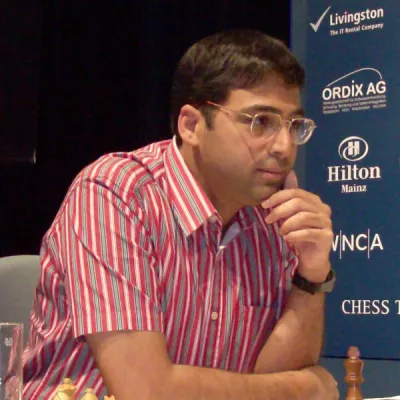
Viswanathan Anand
Human Design Chart
Biography
In April 2006 Anand became the fourth player in history to pass the 2800 Elo mark on the FIDE rating list, after Garry Kasparov, Vladimir Kramnik and Veselin Topalov. He occupied the number one position for 21 months, the 6th longest on record.
He was also the first recipient of the Rajiv Gandhi Khel Ratna Award in 1991–92, India's highest sporting honour. In 2007, he was awarded India's second highest civilian award, the Padma Vibhushan, making him the first sports person to receive the award.
What does Generator 3/5 mean for Viswanathan Anand?
Generator 3/5 — Design at a Glance
Viswanathan Anand's design established a foundation of enduring reaction. His mode as a Generator means he has abundant sacral energy that is released exclusively in response to external impulses, not through independent initiatives. This mechanism functions like a workhorse: strong and reliable so long as it has the energy for its task.
The central strategy was to remain passive and wait until life sends a signal. Only when his sacral center responded with a clear 'yes' did he have the energy available to react through action. This stance was necessary for things in his life to materialize.
Initiating independently, without waiting for an external impulse, inevitably led to frustration and a lack of energy. His design had two specific pitfalls: first, squandering his strength on tasks for which he did not feel internal approval, fostering burnout. Second, suppressing his heart project when external circumstances prevented it, even though his energy was still ready.
Living in harmony with this reactive strategy made Viswanathan Anand untouchable in terms of endurance. The reward for correctly using his sacral energy was a deep sense of satisfaction and fulfillment. Deviating from this principle resulted in persistent dissatisfaction and exhaustion, as the energy source was not properly engaged.
Sacral Authority
Viswanathan Anand's design inclined towards instinctive, physical decision-making. His inner authority carried the defined Sacral Center, meaning this instance always took precedence over other defined centers. As a Generator, his strategy was to react to external stimuli rather than initiate from the Head. This fundamentally simplified his decision process: he did not respond through intellectual planning but with an immediate bodily reaction.
This reaction manifested as gut feelings or bursts of energy, often audible as grunts, hums, or affirming 'hm's'. Such signals marked vitality and enthusiasm. When his sacral motor responded to a stimulus, he had inexhaustible energy and accomplished tasks with great joy, entirely without purposefulness.
Additionally, the Spleen Center activated supportive authority. This gave him the ability to react especially quickly and spontaneously. He possessed direct access to his instinctive perception and physical well-being, which he reliably followed. The combination of Sacral and Spleen Centers enabled Viswanathan Anand to make decisions not only energetically but also lightning-fast and intuitively, driven by a deep inner sense of wellbeing rather than external expectations or logical deliberations.
The 3/5 Profile — Martyr / Heretic
Viswanathan Anand's design inclined towards gaining knowledge through direct practice, often risky, rather than theory. His Profile 3/5, that of the experimenter and hero, described a path based on trial and error: he had to try things himself to gain wisdom, rather than relying on existing doctrines. Line 3 demanded enduring rejection and public failures as necessary parts of the learning process to overcome vulnerability and earn real influence.
The resulting attractiveness of his character stemmed from the richness of these practical experiences. Line 5, the Hero Line, used these self-learned strategies to offer concrete solutions for others during crises. Viswanathan Anand showed himself as someone who did not abstractly discuss problems but reacted with a treasure trove of proven methods. However, this status of rescuer or cool storyteller was painfully linked to the necessity of experimenting in public. The ego had to be ready to fail so that later offered solutions could be authentic and helpful. His strength lay in his ability to draw general lessons from personal failures and provide these harmoniously to the 'tribe' without being personally influenced by suppression or criticism.
Split Definition — Defined & Open Centers
Viswanathan Anands Human Design profile points to a tendency towards constant mental activity and conceptual clarity, paired with deep intuitive bodily intelligence. The defined Head Center and Ajna Center created an ongoing internal pressure to question and develop concepts – not as solutions but as an inspiring source for others. This was combined with the defined G Center, which offered a reliable self-identity and the capacity for unconditional love without dependency. As a Generator with a defined Sacral Center, he possessed immense vital energy that was only available through reactive responses; initiation led to frustration here. The defined Spleen Center ensured spontaneous intuition and existential health in the 'now'.
At the same time, his design was marked by several open centers harboring specific pitfalls. The open Throat Center naturally drew attention when he waited; attempts to communicate actively or control expression resulted in stress and unpredictable outcomes. The open Heart Center lacked consistent willpower; promises or proving value through competition ended in frustration – wisdom lay in not having to make any promises. The open Solar Plexus absorbed external emotions; identifying with them caused emotional instability, while letting go brought clarity. Finally, the open Root Center took on external stress; attempts to escape this pressure through overactivity led to burnout. His mechanics thus required patience with mental processes, trust in sacral reactions, and releasing foreign emotions as well as external pressure situations.
Channels for care, logic, intuitive form and abstraction.
Viswanathan Anands Human Design profile points towards a tendency for analytical skepticism paired with intuitive spontaneity. The Logic Channel 63-4 continuously filtered patterns to find logically verifiable answers through doubt; this active mind served as the primary filter for perception and interaction. This stood in contrast to the Abstraction Channel 64-47, which generated mental confusion and played with possibilities without offering clear solutions – a source of uncertainty that should not be used for one's own life path. Instead, the Perfect Form Channel 57-10 acted as an intuitive level of survival in the present moment based on self-love and spontaneous action. The Preservation Channel 27-50 further defined the role of the Provider, preserving tribal values and taking responsibility for others. Personality was central through Gate 26, selling innovation and bringing the conservative tribe to accept new paths, flanked by the energetic hierarchy of Gate 45 and the open mutation of Gate 22. Additional nuances were provided by Gate 9 with its detail-oriented taming power in the Sacral Center as well as Gate 18, which discriminated between life-critical corrections. In the design, Gate 48 acted as deep pattern recognition knowledge, Gate 11 for visual assessment and Gate 24 for mental renewal in pulse rhythm. Gate 46 promoted engagement and body love while Gate 14 enabled skilled power preservation. This configuration created a person who logically scrutinized, intuitively acted, and preserved traditional values, with mental abstraction serving as background noise ignored in favor of clear, verifiable logic and spontaneous intuition.
Collective Circuitry — Circuit Signature
Viswanathan Anands Human Design profile establishes a clear distinction between cool strategy and primal instinct. Two separate circuits worked parallel without direct energetic exchange. The Understanding Circuit connected his Head Center and Ajna Center through the Logic Channel (Gates 63-4). This created a rational, future-oriented thought process free from emotional coloring as the Solar Plexus Center was not involved. Energy focused on logical structuring and societal improvement.
Parallel to this, the Protector Circuit worked through the Preservation Channel (Gates 27-50), connecting Sacral and Spleen Centers. This prepared instinctive energies for protection, care, and preservation of one's genetics or family – timeless survival impulses of nurturing and defending.
Additionally, the Integration Circuit showed a connection between Identity and Spleen Center (Perfect Form Channel, Gates 10-57), linking intuitive guidance with individual confirmation. The Meaning Finder Circuit was also active (Abstraction Channel, Gates 64-47) and reconnected Head and Ajna Centers, emphasizing cognitive processing of the past.
As Viswanathan Anand had a Split Definition, these forces existed in separate groups: on one side rational thinking (Head/Ajna), on the other instinct-driven centers (Sacral/Spleen/Identity/G Center). The mechanics thus required conscious integration of logical strategy with deep protective instincts as no internal bridge between these poles existed.
Right Angle Cross of Rulership 4
Viswanathan Anand's design shows a tendency towards strategic authority based on internal clarity. He is someone who makes decisions not from impulsive reactions but from a position of deep calm and careful consideration. This attitude is characteristic of the right-hand cross of Governing 4, a configuration aimed at effectively exercising influence or 'governing'.
The mechanics of this design focus on obtaining inner composure before important steps. It's not about reacting quickly to external circumstances but rather maintaining an overview and strategically assessing the situation. Only from this centered position can actions be effective in establishing desired leadership or control. The design thus supports a form of authority that arises through deliberation and clear vision of the big picture, rather than through loud imposition of will. Viswanathan Anand used this inner structure to not lose sight of the thread in complex situations and make decisions with a calm determination that fostered respect and emulation.
Saturn Return · Uranus Opposition · Chiron Return — Life Cycles
Viswanathan Anand's design is characterized by clear phases of confirmation and mastery corresponding to specific astrological cycles. His first Saturn return marked the transition from preparatory work to stable structure. In 2000, at age 31, he became FIDE World Champion after winning the final match against a Spanish opponent – a moment when years of development condensed into a solid success.
The Uranus opposition brought a phase of restructuring and proving under changed conditions. Here, the ability to not only maintain established positions but actively defend them was shown. In 2008, at age 39, he defended his World Champion title against Kramnik in Bonn. This underscored the design's resistance to external challenges and pressure to secure existing achievements.
The Chiron return signaled a blooming phase where the incarnation cross unfolds and purpose becomes experiential – provided strategy and authority were observed. It wasn't about healing but completing one's own purpose. In 2017, at age 48, he won the tiebreak against Wladimir Fedoseev to become Rapid Chess World Champion. This success confirmed the continued effectiveness of his inner mechanics in a new life phase, far removed from the first breakthrough yet equally authentic and goal-oriented.
Generator · Sacral Authority — Synthesis
Viswanathan Anand's design reveals a central thread of reactive competence. As a Generator with sacral authority, he is designed to react to impulses from life and find fulfillment through action (Design View). This ability is reinforced by definitions in Head, Ajna, and G Centers – constant mental filtering of possibilities combined with a deep sense of direction and self-worth (Centers). The connection via channels like Logic (63/4) and Perfect Form (57/10) points to an innate ability to recognize patterns, refine experiences, and use these as a basis for actions. The profile of the Explorer/Hero (Profile Role) underscores this process: gathering knowledge through trial and error and making it accessible to others.
A central paradox lies in the tension between the need for reaction and inner complexity. While the Sacral Center demands an immediate response, Head and Ajna Centers continuously filter information (Circuit). This combination generates mental pressure that can be inspiring but also leads to confusion if not aligned with sacral reaction. Open centers Heart, Root, and Solar Plexus amplify this dynamic: external influences and emotions must be consciously processed to avoid conditioning (Centers). Success documented in events like winning World Champion titles seems to arise from this balance between inner reflection and outer reaction.
4 Defined Channels
Incarnation Cross - Right Angle Cross of Rulership 4
Solar Return
The Solar Return shows the moment when the sun returns to its exact birth position - your personal solar year.
Life Cycles
Discover the life cycles with a detailed triple view (birth chart, cycle chart, composite).
Human Design Profile
- Type
- Generator
- Strategy
- To respond - wait for something to respond to
- Authority
- Sacral Authority
- Profile
- 3/5 - Martyr / Heretic
- Definition
- Split Definition
- Incarnation Cross
- Right Angle Cross of Rulership 4
- Date of Birth
- 11.12.1969 10:00
- Place of Birth
- Mayiladuthurai, India
Frequently Asked Questions
What is Viswanathan Anand's Human Design type?
What Profile does Viswanathan Anand have in Human Design?
Which authority determines Viswanathan Anand's decision-making process?
Which incarnation cross is assigned to Viswanathan Anand?
When was Viswanathan Anand born?
Discover your own Human Design
Are you also a Generator? Find out in a personal reading how to use your sacral energy correctly and discover deep satisfaction.
More Personalities
Back to overviewAaliyah

Aldair

Alexia

Angèle

Anne-Marie

Arcángel