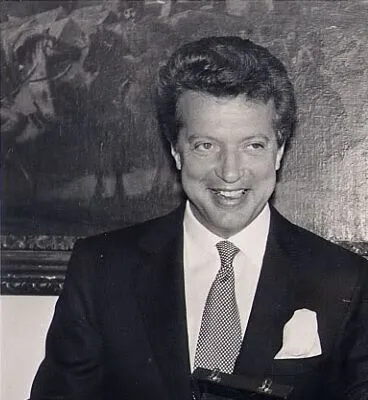
Vittorio Cecchi Gori
Human Design Chart
Biography
He has produced numerous films, most notably Il Postino (1994), which received an Academy Award nomination for Best Picture and Life Is Beautiful (1997) which received an Academy Award for Best Foreign Language Film.
He was also a senator from the Italian People's Party.
He owned the football club ACF Fiorentina from 1993 to 2002, as well as the private television channel La7.
On 3 June 2008, he was arrested in Rome for bankruptcy and on 25 July 2011 again.
What does Projector 5/1 mean for Vittorio Cecchi Gori?
Projector 5/1 — Design at a Glance
Vittorio Cecchi Gori revealed himself as someone who immediately recognized where errors occurred in systems or where processes were getting stuck. His aura acted like a focused flashlight, pointing out weaknesses in the environment. However, this direct confrontation with the 'Dark' in others could quickly be perceived as unpleasant or critical when he spoke his observations without being asked.
As a projector, he did not have a constant, intrinsic energy source. Instead, he worked in phases of high intensity, followed by necessary rest periods to prevent burnout. The best strategy for him was to wait for an honest invitation from his environment. Instead of aggressively radiating light himself, it was more effective if he attracted others through his own harmony and competence. Then, others would come to him on their own to seek advice.
If he lived by this principle, he was rewarded with success. However, if he ignored the need for invitation and rest, this would lead sooner or later to his non-self theme: Bitterness. His design suggested that his true strength did not lie in constant action, but in precise, requested leadership, which he should only exercise when asked.
Self-Projected Authority
Vittorio Cecchi Gori showed himself through extreme openness, making him vulnerable to distraction by external motoric energies. The greatest danger lay in getting lost in this sensory overload and constantly seeking energy. His inner truth was anchored in identity, which required a specific decision-making process. He could gain clarity through self-dialogues or dialogues, provided he was invited. Crucial was active listening to distinguish the spontaneous voice of self from the rational mind. This unmediated expression revealed his uniqueness to others. Alternatively, a physical feeling guided him thematically or geographically in a specific direction. By following this inner pull, he became a direction-giver for others. This specific potential formed the basis for his success. The authority in the self, which only occurs in projectors, defines this mechanism. It requires distinguishing between authentic impulse and mental construction. By following these intuitive or verbal signals, he avoided the trap of energy hunting and allowed for clear orientation.
The 5/1 Profile — Heretic / Investigator
Vittorio Cecchi Gori revealed himself as someone who used deep, specialized knowledge to offer practical solutions to others in critical situations. His design as a 5/1er – the hero and researcher – gave him almost a magnetic aura: people actively sought his expertise to solve their own problems. This aligned with Line 5, which effectively manages foreign resources and makes one capable in crisis times. At the same time, Line 1 provided the necessary depth; it anchored his actions in individual uniqueness and the understanding of mutual dependencies.
This configuration, however, brought a specific challenge: the risk of overload. Like a master, who answers questions for hours only to be exhausted at the end, there was a danger for Vittorio Cecchi Gori that his mailbox – metaphorically for requests and expectations – would overflow if clear boundaries were not set. Gate 27 in Line 5 emphasized the ability to manage crises and resources, but warned of power loss and reputation damage through fraud or failure in responsibility. Gate 19 in Line 1, on the other hand, demanded the recognition of individual differences and a healthy approach without loss of identity.
The balance lay in learning to say 'no'. Only then could Vittorio Cecchi Gori maintain the beneficial tension between researching for himself and problem-solving for others. His design suggested that his success depended on how well he protected his boundaries to avoid being burned out by others' expectations, but rather to use his gifts sustainably and authentically.
Split Definition — Defined & Open Centers
Vittorio Cecchi Gori was characterized by a constant, inner mental activity. His design featured defined Head and Ajna Centers, generating a perpetual pressure towards inspiration, questioning, and conceptual thinking. This state did not mean he could immediately implement answers, as these centers do not have their own energy for manifestation. Instead, his mind was used to structure concepts and inspire others to think. His defined Throat Center allowed him to reliably translate these mental processes into communication, while his defined G Center provided a firm self-identity and a clear sense of direction. He knew where he stood and could convey this security to others without controlling their paths.
At the same time, his design was marked by several open centers, making him vulnerable to external conditioning. His open Heart Center lacked consistent willpower; he tended to question himself in the non-self if he was doing enough or keeping promises to prove his worth, often leading to a cycle of overburdening. His open Sacral Center lacked a constant energy flow. He absorbed the life force of his environment, leading to phases of high productivity followed by exhaustion, as he did not always recognize when he needed rest. His open Solar Plexus Center amplified foreign emotions, putting him at risk of identifying with moods that were not his own and avoiding confrontation out of fear of rejection. Additionally, his open Spleen Center was marked by a fundamental survival fear, causing him to cling to situations or people that gave a false sense of security or well-being rather than trusting his inner intuition. Finally, his open Root Center absorbed external stress, putting him under pressure to hurry to escape this unpleasant feeling, even though this pressure did not come from himself.
Channels for inner reflection and mental abstraction.
Vittorio Cecchi Gori was someone who collected experiences to transform them into a coherent narrative later. His design indicated a tendency towards reflective memory before taking actions or making statements.
This trait was influenced by the Lost Son Channel 13-33. It connected the G Center with the Throat Center: Gate 13 listened and stored information, while Gate 33 withdrew to think about these data. This created a process of maturation, rewarding patience by revealing deeper truths from the past. The challenge lay in timing – speaking too early meant missing the lesson; too much silence left the knowledge unused.
Parallel to this, the Abstraction Channel 64-47 between Head and Ajna Centers was at work. Gate 64 brought mental confusion and constant questioning, while Gate 47 sought understanding. This channel pushed Vittorio Cecchi Gori to sift through each experience through a kaleidoscope of mental images until a meaningful pattern emerged. Here, the mind was not an author but a tool for pattern recognition, finding clarity only through patience.
Additionally, Gates like 27 (Care) and 28 (Risks in the Here and Now) shaped his approach. Gate 27 provided genetic warmth and self-preservation, while Gate 28 conveyed the ability to take risks based on the present moment. Gate 19 connected him to resources and community, placing his actions in a context of security and partnership.
The combination of these mechanisms described a person who did not act impulsively but spoke or acted only when the collected information (13-33) and mental patterns (64-47) had taken a clear, narratable form. His strength lay in creating a comprehensible structure from the complexity of experiences, offering orientation to others.
Collective Circuitry — Circuit Signature
Vittorio Cecchi Gori showed a tendency to emotionally process past experiences and share derived insights with others. His design featured a shared definition, meaning his energy worked in two separate, non-directly connected blocks.
The Meaning Circuit shaped this dynamic. Within this circuit, there were two isolated segments in him. The first connected the Head to the Ajna Center through the Abstraction Channel. This created a visual, often abstract perception, but it was not directly linked to his identity or expression. The second segment connected the Throat to the Identity Center through the Lost Son Channel. This was about sharing felt insights and learning from the past. Since these two groups were energetically separate, the visual abstraction and emotional sharing existed as parallel, side-by-side forces without a common, continuous flow. The energy flowed in a wave-like pattern, typical of the Solar Plexus influence on emotions, with a clear beginning, middle, and end. Vittorio Cecchi Gori used this structure to find meaning behind past events and share these emotional waves with the collective, while the visual component and expressive identity operated independently.
Left Angle Cross of Alignment 1
Vittorio Cecchi Gori demonstrated a fundamental attitude that was strongly influenced by the search for inner clarity and the necessity to find oneself. His design indicated a tendency not to act immediately outwardly but to first examine his own alignment before taking steps into the world. This corresponds to the mechanics of the left cross of alignment 1, which in Human Design is understood as a phase of inner collection and orientation.
This configuration describes a process where the energy is initially directed inward. It is about defining one's own values and personal truth, rather than orienting oneself towards external expectations or the pressure of the environment. Vittorio Cecchi Gori thus acted as someone who based his actions on a deep, personal conviction. The strength of this design lies in the ability to develop a firm inner compass despite external uncertainty.
The energy of this cross supports a stance of patience and trust in one's own process. It is not a path of quick, impulsive reactions, but one of thoughtful, step-by-step development. Vittorio Cecchi Gori used this structure to clarify his identity and role in the world before fully engaging in projects or relationships. This inner work formed the foundation for all his later decisions and actions.
Saturn Return · Uranus Opposition · Chiron Return · 2nd Saturn Return — Life Cycles
Vittorio Cecchi Gori showed himself to be someone who in the second half of his life anchored his deepest life mission concretely in the world. This is reflected in the Chiron Return, a cycle between the ages of 49 and 51, which does not represent the healing of old wounds but marks the bloom of one's own incarnation purpose. In 1993, at the age of 51, Cecchi Gori began the ownership period of the football club AC Florence. This was no coincidence, but the material expression of this fulfillment cycle: The abstract potential of his design became tangible reality.
Later, with the second Saturn Return around the age of 55, this groundwork solidified into a sustainable, public result. Saturn demands structure and stability; its second round often confirms that the built foundation holds. In 1997, at the age of 55, the film 'Life is Beautiful' won the Oscar for best foreign language film. This success was the logical consequence of the phase initiated by the Chiron Return. Cecchi Gori's design suggested that his greatest effectiveness did not lie in early experiments but in the mature, structural anchoring of his purpose. The mechanics show: First, the inner alignment to the meaning of life (Chiron), then the external confirmation through structural success (Saturn).
Projector · Self-Projected Authority — Synthesis
A central red thread runs through the design: the ability to recognize patterns and bring light into the dark (Projector Type, Gate 13). This pairs with a deep knowledge base (5/1 Profile), which serves not only for personal understanding but waits to be shared and used for problem-solving. The defined mental pressure (Head-Ajna Center) intensifies this impulse to constantly ask questions and seek answers to understand the underlying mechanisms. Decisions are made from within, through inner conversations and spontaneous expressions (Self-Authority), creating a unique authenticity.
The design reveals a central paradox between the need for connection and the resulting pressure, as well as the tendency towards isolation. The Projector Aura 'projects' and analyzes, quickly finds faults (Gate 13), but carries the risk of irritating others. At the same time, the Channel of the Lost Son (Gate 13-33) pulls back for reflection and withdrawal to process experiences, while the Sense Finder Circuit emphasizes sharing insights from the past. This tension between the desire to understand and communicate and the wish for inner peace shapes the essence.
2 Defined Channels
Incarnation Cross - Left Angle Cross of Alignment 1
Solar Return
The Solar Return shows the moment when the sun returns to its exact birth position - your personal solar year.
Life Cycles
Discover the life cycles with a detailed triple view (birth chart, cycle chart, composite).
Human Design Profile
- Type
- Projector
- Strategy
- Wait for the respectful invitation
- Authority
- Self-Projected Authority
- Profile
- 5/1 - Heretic / Investigator
- Definition
- Split Definition
- Incarnation Cross
- Left Angle Cross of Alignment 1
- Date of Birth
- 27.04.1942 09:00
- Place of Birth
- Florence, Italy
Frequently Asked Questions
What is Vittorio Cecchi Gori's Human Design type?
What are Vittorio Cecchi Gori's Profiles?
What authority does Vittorio Cecchi Gori have?
What is Vittorio Cecchi Goris' incarnation cross?
When was Vittorio Cecchi Gori born?
Discover your own Human Design
Are you also a Projector? Find out in a personal reading how to unfold your leadership qualities and recognize the right invitations.
More Personalities
Back to overviewSissy Spacek

Alain-Fournier

Anémone

Ann-Margret

Bourvil
Christian-Jaque