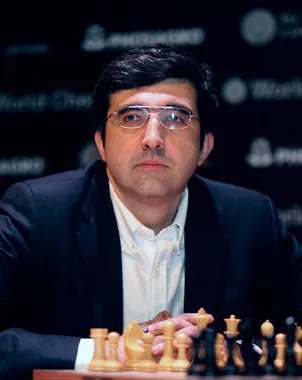
Vladimir Kramnik
Human Design Chart
Biography
In 2000, Kramnik defeated Garry Kasparov and became the Classical World Chess Champion. He defended his title in 2004 against Peter Leko, and defeated the reigning FIDE World Champion Veselin Topalov in a unification match in 2006. As a result, Kramnik became the first undisputed World Champion, holding both the FIDE and Classical titles, since Kasparov split from FIDE in 1993.
In 2007, Kramnik lost the title to Viswanathan Anand, who won the World Chess Championship 2007 tournament ahead of Kramnik. He challenged Anand at the World Chess Championship 2008 to regain his title, but lost. He remained a top player, playing in four more Candidates tournaments between 2012 and 2018, very nearly winning in 2013. Kramnik publicly announced his retirement as a professional chess player in January 2019 to focus on projects relating to chess for children and education.
Kramnik reached a peak rating of 2817 in October 2016, which makes him the joint-eighth-highest-rated player of all time. He is widely recognized for his contributions to opening theory.
Kramnik has been diagnosed with ankylosing spondylitis, an uncommon form of arthritis. It causes him great physical discomfort while playing. In January 2006, Kramnik announced that he would skip the Corus Chess Tournament in Wijk aan Zee to seek out treatment for his arthritis. He returned from treatment in June 2006, playing in the 37th Chess Olympiad. He scored a +4 result, achieving the highest rating performance (2847) of the 1307 participating players.
On 30 December 2006 Kramnik married French journalist Marie-Laure Germon at the Alexander Nevsky Cathedral in Paris. They have two children, daughter Daria, and son Vadim Vladimirovich. They reside in Geneva.
The Human Design of Vladimir Kramnik: Manifesting Generator 6/2
Manifesting Generator 6/2 — Design at a Glance
Vladimir Kramnik's Design featured a tendency towards hybrid dynamics: He had the constant energy source of a Generator but also possessed the ability to skip steps in action and quickly draw results into his life. This configuration as an expressing Generator meant that while he needed to respond to impulses to use his power correctly, once in motion, he operated at a speed that pure Generators could not match.
However, this speed brought specific risks with it. If Kramnik advanced too quickly, he sometimes skipped necessary intermediate steps, which could lead him to have to backtrack and fill these gaps later – a process that could cause frustration for him as it aligned with his non-self theme. Additionally, his system tended to pursue multiple things simultaneously, driven by responding to various impulses at the same time.
When his inner authority and sacral center were engaged – meaning he was sure that a path said "yes" – this multitasking ability could lead to deep satisfaction. Instead of focusing on just one thing, Kramnik found his true creative power in switching and what is called the Play Mode. Handling various projects simultaneously was not for him a sign of distraction but rather a prerequisite for his energy not stagnating and for him to unleash his characteristic efficiency without internal resistance.
Sacral Authority
Vladimir Kramnik's Design inclines him to make decisions not through prolonged contemplation but rather through immediate physical resonance. As a Generator, his strategy aligns perfectly with his inner authority: the Sacral Authority. This significantly simplifies his decision-making process, as he can respond to environmental stimuli with a direct "gut feeling." This reaction manifests as an energy surge or a loud affirmation like a grunt or a hum-hm. Crucial to this is the prerequisite of an open Emotional Center; emotions must not overshadow the clear impulse from the Sacral Center.
When his sacral motor engages with something, Vladimir Kramnik feels vital and alive. He then possesses seemingly inexhaustible energy and tackles his work with great enthusiasm. His Design envisions him moving through life with joy and satisfaction, fully immersed in his activities without a rigid sense of purpose. Additionally, his activated Spleen Center acts as an auxiliary authority to the Sacral Center. This enables him particularly quick and spontaneous reactions and decisions. He has immediate access to his physical well-being and instinctive perception, which he can rely on for guidance. This combination of sacral energy and spleen-supported intuition shapes his way of reacting to the world: directly, powerfully, and intuitively secure.
The 6/2 Profile — Role Model / Hermit
Vladimir Kramnik's design inclines towards experimental learning through trial and error. Before the age of 30, line six acted as the third line, meaning that early experiences were often marked by setbacks after which he withdrew to start anew. This defensive process served to identify weaknesses and eliminate them – an evolutionary mechanism supported by humility.
Around age 30, the full dynamics of line six activated. Kramnik then showed a need to withdraw to reflect on his earlier experiments from a distance. This phase was time for intensive reflection, healing, and deep self-awareness. From this "cave," he developed wisdom that could attract others.
Parallel to this, the discernment ability of line two from Gate 17 was active. It projected outward and posed the question of whom to serve or rule over. Kramnik's design demanded recognizing the highest value in every situation. A polarity emerged: shyness could flip into its opposite. Thus, the capacity for deep introspection became the central tool to resolve these inner tensions between serving and ruling, enabling him to serve as a role model for authentic self-awareness to others.
Single Definition — Defined & Open Centers
Vladimir Kramnik's Human Design profile indicated a tendency towards clear, identity-driven action. His defined G Center provided him with a firm sense of direction and self-love, while the also defined Sacral Center supplied a constant source of vital energy. This combination shaped him as someone capable of working persistently if he responded to questions rather than initiating them himself. The defined Root Center supported this structure by providing a steady internal pressure to move forward and master existential challenges. The connection of these centers to his also defined Throat Center allowed him to reliably and authentically convey his messages into the world without impulsively wasting energy.
At the same time, Vladimir Kramnik was vulnerable through his open centers to certain conditioning patterns. His open Head and Ajna Centers made him susceptible to mental inspirations from the environment, which could lead him to lose himself in doubts or foreign questions rather than trusting his inner authority. The open Heart Center tended to feel the pressure to prove his worth through promises or competition, despite not having a constant supply of energy for it. Additionally, his open Solar Plexus absorbed the emotions of others, making him emotionally vulnerable and prone to false identifications with foreign moods. Finally, his open Spleen Center was susceptible to survival fears and the need to cling to people or situations that provided a deceptive sense of security and well-being, even if they were not healthy for him. These open areas required conscious distancing from external influences to maintain clarity and inner peace.
Channels for maturation, rhythm, presence, self-expression and charisma.
Vladimir Kramnik's Human Design profile indicated deeply rooted habits paired with a magnetic presence that drew others into his personal rhythm. This configuration came from the Rhythm Channel 5-15, connecting the Sacral Center with the G Center. Gate 5 held onto firm rituals while Gate 15 integrated the diversity of society into life flow through its love for extremes. This created a universal pulse not steered by intellect or emotional waves but rather established a natural, logical connection to life.
Parallel to this, Vladimir Kramnik showed a strong need for self-confirmation and authentic expression. The Awakening Channel 10-20 connected the G Center with the Throat Center. Here, Gate 20 transformed individual knowledge into correct action in the present moment, supported by Gate 10's principles for successful interaction. This allowed him to act as a voice of individual leadership and inspire others through his clarity to be themselves without needing to consciously steer it.
This self-love was reinforced by the Exploration Channel 34-10. Gate 34 provided inner strength to hold onto personal convictions, while Gate 10 initiated behavior from the deepest inner self. Together they fostered a mastery of self that allowed Vladimir Kramnik to act independently and demonstrate full self-acceptance through his reactions.
Additionally, the Charisma Channel 34-20 shaped how he carried energy into the world. The generative power of Gate 34 met with Gate 20's expression in the present moment, creating a drive for immediate manifestation. However, this required him to only react to things that truly mattered to him to direct his charismatic power correctly and not slip into obsession or chaos.
The Maturity Channel 53-42 rounded out this profile. It connected the Root Center with the Sacral Center and emphasized that every experience had to be run through to completion. Gate 53 started new cycles while Gate 42 ensured growth. Only through complete reflection could Vladimir Kramnik gain wisdom from experiences and make them useful for future steps without falling into frustration due to unfulfilled expectations.
Individual Circuitry — Circuit Signature
Vladimir Kramnik appeared as a person with a strong individualistic orientation, drawing strength from inner confirmation and logical structuring. His design united the Sacral Center (life energy) directly with the Identity Center (self-worth). This connection, carried by the Centering Circuit through the Exploration Channel, fostered firm convictions and courage for independence. Parallel to this, the Understanding Circuit worked through the Rhythm Channel, also connecting Sacral with Identity Centers. This gave his energy a focused, rational quality aimed at improving things through logic and strategy – free from emotional influence.
Another characteristic was his ability to learn from past experiences. The Meaning Circuit connected through the Maturity Channel the Sacral Center with the Root Center (survival). Here it was about cyclic processing of emotions and finding meaning in past events to generate collective knowledge.
Finally, the Integration Circuit secured his survival through highest individuality. The Awakening and Charisma Channels linked Throat Center (expression), Sacral, and Identity Centers into a coherent flow. This allowed him to draw strength from reacting to life, guide it through intuitive knowledge, and make it effective in the present moment. Despite lacking connection to Solar Plexus in rational circuits, his energy remained overall strong on self-affirmation and integration of instinct with expression.
Left Angle Cross of Prevention 1
Vladimir Kramnik's Human Design shows a tendency towards strategic caution and protection against unnecessary risks. This attitude stems from the configuration of the left cross of prevention, which is considered an archetypal structure in Human Design for anticipating dangers.
People with this expression tend to recognize potential threats or sources of error early on and take preventive measures before problems escalate. It's not paranoia but a fine sensitivity towards stability and security. The energy of this cross promotes a deep understanding of how systems can break down, motivating one to strengthen these weak points or circumvent them.
For Vladimir Kramnik, this manifested as an inner discipline aimed at avoiding chaos. Instead of acting impulsively, he carefully weighed options to exclude negative consequences. This mechanism supports a lifestyle where control over the environment and clear structures are prioritized to ensure a secure foundation. The preventive energy acts as a filter that identifies and rejects unclear or dangerous paths before they are taken, creating a space of predictability and reducing stress from unexpected crises.
Saturn Return · Uranus Opposition · Chiron Return — Life Cycles
Vladimir Kramnik's Human Design shows a tendency towards strategic adaptability that was realized during life transitions. In 2003, at the age of 28, he won the Linares tournament alongside Péter Lékó ahead of Garry Kasparov and the world elite. This marked his first Saturn Return, a cycle in which years of groundwork often condenses into a solid result and strengthens one's structure.
Later, his chart showed openness to new forms of competition. In 2015, at age 40, during the Uranus Opposition, Kramnik became sixth in the World Rapid Chess Championship and won the bronze medal at the Blitz Chess World Championship. This configuration often favors breaking away from established patterns in favor of innovative approaches or faster tempo adjustments, as seen here in his chess success.
The Chiron Return around age 49 is a fulfillment cycle where one's inner purpose increasingly unfolds. In 2024, at age 49, Daniel Naroditsky described Kramnik as 'worse than dirt' in connection with his accusations. This conflict reflects the intense confrontation that often occurs when one's life mission becomes fully apparent and old identities must be questioned.
Manifesting Generator · Sacral Authority — Synthesis
A central red thread in this design is a dynamic interaction between inner authority and the drive for rapid implementation. Sacral energy (Sacral Center, Channel of Rhythm) provides constant propulsion, but through the manifesting component (Manifestor Generator type, defined Throat Center), it tends towards accelerated actions. This leads to a life marked by impulsive reactions, with natural flow and deep connection to the present moment taking precedence – followed by phases of reflection and adaptation (6/2 Profile). The ability to draw energy directly from the Sacral Center and communicate this through the throat amplifies this cycle of action and withdrawal.
The central paradox lies in the tension between the need for rapid progress and the necessity for inner reflection. While the design allows for quick implementation of ideas (Channel of Rhythm, Manifestor Generator), the Profile line 6 points to a later retreat to process experiences and gain wisdom. This creates a field of tension between immediate action and deep reflection, with both successes (2003, 2015) and crises (2024) part of this dynamic process.
5 Defined Channels
Incarnation Cross - Left Angle Cross of Prevention 1
Solar Return
The Solar Return shows the moment when the sun returns to its exact birth position - your personal solar year.
Life Cycles
Discover the life cycles with a detailed triple view (birth chart, cycle chart, composite).
Human Design Profile
- Strategy
- To respond - wait for something to respond to
- Authority
- Sacral Authority
- Profile
- 6/2 - Role Model / Hermit
- Definition
- Single Definition
- Incarnation Cross
- Left Angle Cross of Prevention 1
- Date of Birth
- 25.06.1975 06:15
- Place of Birth
- Tuapse, Russia
Frequently Asked Questions
Which Human Design type is Vladimir Kramnik?
What Profile does Vladimir Kramnik have in Human Design?
What authority does Vladimir Kramnik possess?
Which incarnation cross is assigned to Vladimir Kramnik?
When was Vladimir Kramnik born?
Discover your own Human Design
Are you also a Manifesting Generator? Find out in a personal reading how to unfold your multi-talents and direct your energy wisely.
More Personalities
Back to overviewAldair

Alizée

Angeli

Arletty

Artus
Balthus