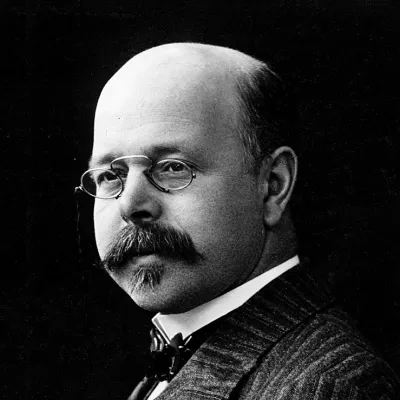
Walther Nernst
Human Design Chart
Biography
The Nernst heat theorem, which he formulated in 1906, was used to develop the third law of thermodynamics, and his atom chain reaction theory followed in 1916. Nernst’s other important accomplishments included inventing the Nernst lamp and developing the ‘Neo-Bechstein-Flügel’ electric piano. His later career was dedicated to astrophysics and other aspects of electroacoustics.
Nernst was an outspoken opponent of Hitler and the Nazi party. This criticism effectively meant the end of his career once the Nazis came to power in 1933.
He receiving many prizes over his career, including the Nobel Prize in Chemistry in 1920.
He died 18 November 1941, Zibelle, Germany.
Walther Nernst — Manifesting Generator with Profile 6/2
Manifesting Generator 6/2 — Design at a Glance
Walther Nernst revealed himself as a person with a hybrid energy structure. As an Manifestor Generator, he possessed the constant power of a Generator but also had the ability to skip steps and quickly draw results into his life. This combination of endurance and speed significantly shaped his work style.
His strategy was not to initiate action himself but rather to respond to internal impulses. Only when his Sacral Center – the motor of his energy – clearly signaled a “yes,” did he act effectively. If he fought against this inner resistance or ignored it, it quickly led to frustration, the typical non-self theme of his type.
Especially characteristic was his tendency to push multiple projects forward simultaneously. Unlike pure Generators who often work linearly, Nernst could handle various tasks at once due to his Manifestor qualities. However, this worked smoothly only if he remained in a playful mode and sought variety. If the environment forced him into strict focus on one thing alone, his creative power suffered. When he listened to his impulse and felt inner approval, he drew deep satisfaction from his multifaceted work. The danger lay always in moving too quickly and overlooking important intermediate steps, which could force him to backtrack and make up for lost ground. His strength showed where he combined this speed with the patience of waiting for the right impulse.
Emotional Authority
Walther Nernst displayed a decision-making approach that did not rely on spontaneous impulses but rather on the patience to let feelings settle. His inner authority lay in his defined Emotional Center – a mechanism that always took precedence over all other defined centers. This meant he was subject to constant emotional waves: What seemed absolutely right at one moment could prove deceptive in the next. His colored view of the world was always a snapshot, not an ultimate truth.
Therefore, Walther Nernst avoided quick, spontaneous judgments as these often led to negative consequences from temporary mood states. Instead, he let decisions mature. He took time to think through and sleep on important questions multiple times. Only when initial emotional frenzy subsided and inner distance was gained did clarity set in for him. This process of calmness was essential for him, especially regarding long-term decision-making that significantly influenced his life course. Through this conscious delay, he filtered out the noise of passing feelings and made decisions from a deeper, more comprehensive understanding.
The 6/2 Profile — Role Model / Hermit
Walther Nernst showed himself to be someone whose life path was marked by a clear transformation. In his youth, the joy of experimentation dominated; he learned through trial and error, with setbacks often leading to temporary retreats. This phase served as a period of collecting personal experiences without the claim for immediate final answers.
Around age thirty, his inner orientation changed fundamentally. His 6/2 line activated the ability for deep detachment and reflection. Walther Nernst metaphorically withdrew during this time to look back at his earlier attempts with great clarity. This process was not just a pause but a phase of intense healing and self-discovery. He used this distance to recognize weaknesses in his previous approaches and to erode them – an aspect of self-defense and humility central to the sixth line.
Simultaneously, he developed a fine discernment ability. The second line of his configuration projected this clarity outward. Walther Nernst learned to identify what had the highest value in a situation and understood the polarity between serving and ruling: To exercise true authority, he needed to be ready to serve others.
When he finally emerged from this introspective phase, it was with gained wisdom. Other people sought his advice not only for his expertise but because they valued his ability for deep self-awareness and his clear, experience-informed perspective. He became a role model showing how mature insight arises from early mistakes.
Split Definition — Defined & Open Centers
Walther Nernst was someone whose inner foundation was characterized by a constant mental structure and clear identity. His defined Ajna Center ensured a continuous, trustworthy thought process; concepts and theories emerged in him consistently, unaffected by external opinions. This mental stability flowed directly into his defined Throat Center: He spoke what he thought, making his communication a reliable manifestation of his intellectual work. At the same time, his defined G Center provided a firm sense of direction and self-love, while his defined Sacral Center supplied a constant source of vital energy. This combination of mental clarity, identity-forming orientation, and generative power shaped his role as a Generator who waited for stimuli to effectively deploy his energy.
At the same time, Walther Nernst was vulnerable to specific conditioning through open centers. His open Head Center led him to absorb external mental pressure; he tended to engage with questions that were not his own concern and sought inspiration to escape this pressure. His open Heart Center made him sensitive to the need to prove his worth through willpower or promises – a cycle often ending in frustration due to the lack of consistent energy for it. Additionally, his open Root Center absorbed stress from the environment, leading to feelings of adrenal tension that did not match his own pace. These opennesses challenged him to distinguish external noise and instead rely on his inner authority – here the emotional wave of his defined Solar Plexus Center as well as the intuitive Spleen – to find clarity and wellbeing.
Channels for rhythmic structure, intuitive form and emotional change.
Walther Nernst was someone who propelled new directions with powerful, mutative energy. This fundamental attitude stemmed from Channel Beat 14-2, connecting the Sacral Center with the G Center. Gate 14 facilitated the skillful handling of material resources for driving innovations, while Gate 2 as a driver steered higher insight through space and time. This configuration gave him the ability to trust his generative reaction to provide an innovative confirmation without predicting the exact outcome.
Parallel to this, he moved existentially unburdened through the world, guided by deep intuitive impulses. Channel Perfect Form 57-10 connected the Spleen Center with the G Center. Gate 57 offered acute sensitivity to the quality of his environment, while Gate 10 steered self-behavior. This allowed him to act spontaneously and appropriately to perfect his physical wellbeing and identity in the here and now without being driven by unfounded future anxieties.
His intellectual work was marked by spontaneous breakthroughs that he clearly articulated. Channel Structuring 23-43 connected the Ajna Center with the Throat Center. Gate 43 received insights as sudden mental flashes, which were then assimilated and translated into understandable terms by Gate 23. This allowed him to formulate unique perspectives that promoted efficiency, provided he waited for the right timing to express them.
Emotionally, Walther Nernst was driven by a search for new experiences. Channel Transience 36-35 connected the Solar Plexus with the Throat Center. Gate 36 perceived inexperience as crisis, driving him through Gate 35's need for change to create new situations. This restless longing served his emotional maturation and the accumulation of wisdom through direct experience.
Additionally, Gates like 1 (Uniqueness), 12 (Retreat/Poetry) and 48 (Pattern Recognition/Depth) influenced his personality, while Design Gates such as 28 (Present Moment Risk Assessment), 37 (Organic Community) and 45 (Clan Energy) shaped his behavioral patterns.
Individual Circuitry — Circuit Signature
Walther Nernst was marked by separate, parallel energetic streams. With his Split Definition, two non-connected groups existed: one linked Identity, Sacral Center, and Spleen; the other Throat Center, Ajna, and Solar Plexus. This separation meant these areas stood as independent forces alongside each other without direct exchange.
In the Knowledge Circuit, he had two isolated segments. The first connected Ajna with Throat Center via Channel Structuring (Gates 43/23), translating mental concepts into clear expression. The second segment linked Identity and Sacral Centers through 'The Beat' (Gates 2/14), merging inner confirmation with rhythmic life energy. Both parts remained energetically separate.
The Meaning Circuit activated Channel Transience (Gates 35/36) in him, connecting Throat with Solar Plexus Center, leading emotional waves and past experiences to directly flow into communication. It was about sharing felt insights from history.
Furthermore, the Integration Circuit featured Channel Perfect Form (Gates 10/57). This connected Identity with Spleen Center, guiding intuitive perception and correct behavior to direct personal power. This connection served to secure individual survival through precise reactions to the present.
Left Angle Cross of Prevention 1
Walther Nernst's Human Design shows a tendency towards preventive action, which is evident through the left cross of Prevention 1. This configuration combines a strong need for security with the ability to recognize potential dangers early and avoid them. It shaped an approach where preventing damage was prioritized before problems could even arise. Walther Nernst thus acted proactively rather than reactively, ensuring stability and protection. The mechanics of this cross emphasized the importance of preparation and foresight to prevent negative developments. Rather than focusing on resolving acute crises, it aimed at blocking their occurrence from the outset. This energy fostered a calm yet resolute form of engagement that targeted long-term reliability. Walther Nernst used this inner structure to create order and predictability in his environment by minimizing risks before they materialized. His approach was characterized by the belief that true strength lies in foresight and the consequent implementation of preventive measures.
Saturn Return · Uranus Opposition · Chiron Return · 2nd Saturn Return — Life Cycles
Walther Nernst showed himself to be someone whose life path was marked by clear structural milestones. His first Saturn Return around the age of 28 signalled the transition from education to a stable social anchoring; in 1892 he married Emma Lohmeyer, taking on this phase of stabilization and responsibility.
The Uranus opposition at the age of 41 often brings a fundamental realignment or a break with previous structures. For Nernst, this occurred in 1905 when he switched to become a full professor of physical chemistry at the University of Berlin – a step that radically changed his professional positioning and created new freedoms.
The Chiron Return around the age of 50 is a cycle of fulfillment in Human Design, where the Incarnation Cross unfolds and meaning becomes experiential. In 1914, Nernst developed the "Ni-Step"; this was not a moment of healing but rather the concrete expression of his purpose in the material world, making his insights applicable.
His second Saturn Return around the age of 57 condensed this preparatory work into a credible authority and institutional affirmation. In 1921, Nernst became rector of the University of Berlin. This position represented the full integration of his professional expertise into a leadership role that provided structure and order for others – the result of a life consistently lived through its cyclical phases of stabilization, transformation, and fulfillment.
Manifesting Generator · Emotional Authority — Synthesis
Walther Nernst lived a life marked by profound inner dynamism. His design as an Manifestor Generator (with defined Sacral Center) points to someone who constantly had energy available and could quickly initiate things, but also had to navigate through emotional waves. This combination of quick initiating power and emotional maturity shaped his path: he intensely experimented (6/2 Profile) to gather experiences that were later processed in deep reflection – a pattern that repeated over decades and eventually positioned him as a wise advisor. The defined Ajna Center strengthened this tendency to develop and implement concepts, while the Beat Channel (14/2) drove innovation and a unique direction.
A central paradox in his design lay in the interplay of speed and patience. He was able to react quickly to impulses and initiate changes, yet emotional authority required letting decisions mature, sleeping on them to gain clarity. This likely led to an internal tension between the desire for immediate implementation (Sacral Center) and the necessity of emotional alignment (emotional center). The recurring turning points in his career – shifts at universities, technological developments, assuming rectorships – appeared as results of this dynamic, where quick initiatives were prepared by longer phases of reflection and integration.
4 Defined Channels
Incarnation Cross - Left Angle Cross of Prevention 1
Solar Return
The Solar Return shows the moment when the sun returns to its exact birth position - your personal solar year.
Life Cycles
Discover the life cycles with a detailed triple view (birth chart, cycle chart, composite).
Human Design Profile
- Strategy
- To respond - wait for something to respond to
- Authority
- Emotional Authority
- Profile
- 6/2 - Role Model / Hermit
- Definition
- Split Definition
- Incarnation Cross
- Left Angle Cross of Prevention 1
- Date of Birth
- 25.06.1864 00:15
- Place of Birth
- Briesen (Westpreussen), GER
Frequently Asked Questions
What was Walther Nernst's Human Design type?
What Profile did Walther Nernst have in Human Design?
Which Authority guided Walther Nernst's decisions?
What incarnation cross determined the life path of Walther Nernst?
When was Walther Nernst born?
Discover your own Human Design
Are you also a Manifesting Generator? Find out in a personal reading how to unfold your multi-talents and direct your energy wisely.
More Personalities
Back to overviewAldair

Alizée

Angeli

Arletty

Artus

Balthus