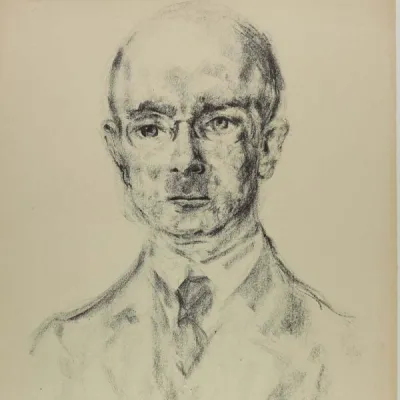
Wilhelm Abegg
Human Design Chart
Biography
Wilhelm Abegg died on 18 October 1951 in Baden-Baden, aged 75.
The Human Design of Wilhelm Abegg: Generator 1/3
Generator 1/3 — Design at a Glance
Wilhelm Abegg had high, enduring sacral energy that made him comparable to a workhorse in terms of strength and reliability. However, this power did not manifest through independent initiation but rather through reacting to internal impulses. His life mechanics followed the principle: Do not initiate, but react.
For Wilhelm Abegg, successful strategy lay in responding to signals from life. When his sacral center sent a clear 'yes' - an intuitive gut feeling of letting go - it led him to deep satisfaction and a sense of fulfillment. Conversely, deviating from this pattern resulted in persistent frustration or energy depletion.
Two specific pitfalls marked his potential for burnout. First, he wasted energy on tasks he had no interest in performing over the long term; despite his high creative potential, this could lead to burnout. Second, he struggled when prevented from working on his heart project, even though he still felt full of power and wanted to continue. Wilhelm Abegg could not be stopped as long as he used his energy in accordance with this design and acted from the gut rather than against his inner resistance.
Emotional Authority
Wilhelm Abegg's design inclined towards patient decision-making. He was someone who did not immediately recognize internal clarity but achieved it after navigating through emotional waves. His inner authority carried the defined Emotional Center, meaning that his feelings were subject to constant ups and downs; the current mood was merely a snapshot colored by fleeting enthusiasm or negativity. This initial emotional response did not yet represent his truth. Quick, spontaneous decisions based on this immediate emotion were risky for him and could have negative consequences. Instead, his design required time to let a decision mature. He had to practice patience and sleep on it multiple times. Only when the intense feelings subsided and an emotional distance was gained would true clarity and calm set in. This process of waiting was crucial for long-term life decisions as only then did deeper, comprehensive insight become accessible. Emotional authority always took precedence over other defined centers in his chart regardless of further configurations. Wilhelm Abegg lived in a rhythm that created distance from immediate emotional reactions to make well-founded judgments.
The 1/3 Profile — Investigator / Martyr
Wilhelm Abegg's design inclined towards accumulating knowledge not just theoretically but through practical experimentation and mistakes. As a researcher and experimenter (Profile 1/3), his life path was an ongoing interaction between the deep need for learning and the urge to apply it. Line 1, rooted in Gate 40, intensified theoretical engagement with the world, often creating fear of not knowing enough to proceed into implementation. Simultaneously, this line required mandatory rest phases to regenerate willpower and ego - akin to moon phases where recovery preceded new work.
The counter-movement was provided by Line 3 (Gate 16). It stood for independence through self-developed talent. This was not about prescribed paths but waiting for the right moment when energy became available for action. Wilhelm Abegg had to learn to trust this inner dynamics: His judgments were reliable as they were both intellectually and experientially tested. The need for validation from others could sow doubt, yet only a combination of thorough preparation and bold experimentation enabled him to effectively deploy his skills without relying on external expectations.
Single Definition — Defined & Open Centers
Wilhelm Abegg was someone who self-determinedly steered his own willpower and resources. His defined Heart Center gave him the ability to consistently keep promises and work responsibly; he preferred being his own boss, following his inner rhythms of work and rest. This stable energy base was fueled by his defined Sacral Center, which generated a massive source of vital energy. As a Generator, his strategy wasn't to initiate but to respond to questions to ensure that his energy was actually available.
However, his decision-making was subject to the authority of his defined Solar Plexus Center. This meant he had to wait for an emotional wave before acting. He avoided impulsive reactions to highs or lows in his mood; instead, he sought emotional clarity, which often only came after a night of reflection. This patience protected him from poor decisions and strategically used the seductive power of his emotions.
At the same time, Wilhelm Abegg was situationally open and vulnerable to conditioning through several open centers. His open Head Center meant he didn't have constant mental pressure or inspiration; instead, he tended to be overwhelmed by doubts or questions from others rather than having his own steady thought streams. Similarly, his open Ajna Center led to no fixed conceptual thinking but rather the absorption of ideas from the environment and flexible processing, sometimes under pressure to find answers that weren't truly his.
His open G Center meant a lack of firm identity or life direction; he adapted himself to people and places to figure out what was right for him instead of taking on a predefined role. Additionally, his open Root Center absorbed stress from the environment, leading to feelings of pressure not generated by himself. His open Spleen Center made him vulnerable to fears and spontaneous impulses often based on conditioned reactions rather than true intuition. Through trusting in his Sacral response and emotional clarity, he could use these open areas as learning fields instead of being controlled by them.
Channels for intimacy, emotional warmth and communal connection.
Wilhelm Abegg's design created a complex dynamic that fluctuated between intense, sacral intimacy and the need for structured belonging. This tension resulted from the synchronous activation of two core channels: Channel of Partnership 59-6 and Channel of Community 37-40.
Channel of Partnership 59-6 connects the Sacral Center to the Solar Plexus through Gates of Sexuality (59) and Friction (6). This mechanism rooted Wilhelm Abegg in a powerful quantum energy described as intimacy. The combination of sexual attraction and the emotional wave of pleasure and pain fostered personal, penetrating, and potentially fruitful relationships. His drive was to merge; his availability for intimacy allowed him to quickly enter others' aura. However, Gate 6 determined timing: the emotional wave drew him in or pushed him away. Without patience and waiting for this clarity, misunderstandings or unwanted consequences like failed ventures were possible. It was healthier for him to cultivate friendship before delving into deeper realms.
Simultaneously, Channel of Community 37-40 connected Solar Plexus with Heart Center through Gates of Friendship (37) and Solitude (40). This was about building bridges within a group based on mutual benefit and willpower. Gate 40 sought reward for his work while Gate 37 strove for recognition and its place in the whole. This channel required Wilhelm Abegg to wait until emotional clarity arrived before entering binding 'business' or commitments. A good deal couldn't be made spontaneously but had to be carefully formulated to benefit both sides.
The challenge lay in distinguishing between spontaneous attraction and long-term stability. Both channels shared a common denominator: the Solar Plexus's emotional wave as inner authority dictating timing for intimate release and agreement closure. Through patience, Wilhelm Abegg could discern if a connection was sustainable or if the wave would reunite him later. This mechanism shaped his actions: he sought an honorable place in the community, built bridges through direct personal contacts, secured connections with clear agreements, always guided by the need to allow time for emotional maturation.
Tribal Circuitry — Circuit Signature
Wilhelm Abegg's design inclined towards cooperative resource building driven by the principle of reciprocal fairness. He acted within a community and created material and social goods through mutual support. This attitude stemmed from his Ego Circuit activated via Channel 37-40 'Community'. This channel connected his Heart Center to Solar Plexus Center, meaning a balance between giving and taking: 'Today I give you, tomorrow you give me.' Since this circuit lacked connection to the Sacral Center, he lacked constant life force. Instead, his energy flowed in waves; phases of high activity had to be followed by rest periods for regeneration to produce new power for the tribe. His style was conservative and traditional, timeless in its focus on essentials.
Parallelly, the Archer Circuit worked through Channel 6-59 'Partnership'. This connected his Sacral Center directly to Solar Plexus. Here flowed instinctive energies of Spleen (though not directly in the channel, spleen is part of the larger context of the Archer Circuit) - corrected based on facts: The channel 6-59 connects Sacral and Solar Plexus. This brought primal survival energy into play, focused on protecting and preserving family and genetic continuity. The emotional wave at Gate 6 colored this dynamic life force of the sacral. Both circuits shaped his actions: one side cooperative, resource-oriented with necessary pauses, the other deeply rooted protective instinct level sustained by constant energy.
Right Angle Cross of Planning 3
Wilhelm Abegg's Human Design configuration emphasized a tendency towards strategic orientation and long-term vision as a central life theme. His internal logic of action followed a pattern of conscious preparation and structuring; decisions did not arise impulsively but within the context of a larger plan. This approach stemmed from the configuration 'The right cross of planning 3'. This aspect described an energy that did not strive for immediate implementation, but recognized the value of patience and precise pre-planning. Wilhelm Abegg was someone who always weighed actions in light of their future consequences. The mechanics of this cross promoted a deep understanding that true efficiency often lies in careful analysis before taking the first steps. It was not about hesitation, but rather a conscious strategy to bundle resources and forces so they could provide maximum benefit. Wilhelm Abegg lived these principles through constant alignment towards long-term goals. His design marked him as a creator of structures intended to endure beyond the immediate moment. The ability to oversee complex interconnections and derive coherent strategies from them was his decisive advantage. He did not act through spontaneous impulses but by consistently pursuing a well-thought-out path. This approach secured stability in uncertain times and allowed him to pursue projects with clarity often overlooked by others. His actions were always embedded in a broader understanding of the connections, making his decisions sustainable and goal-oriented.
Saturn Return · Uranus Opposition · Chiron Return · 2nd Saturn Return — Life Cycles
Wilhelm Abegg's life followed a clear structure marked by three defining turning points, indicated by Saturn and Chiron returns. These cycles served as critical tests of his personality.
In 1903, at age 27, he experienced his first Saturn return. During this phase of the first major maturity test, he published his dissertation 'The Prescription of Objections According to Roman and Common Law' in Göttingen. This event condensed years of academic groundwork into a solid professional foundation and established him professionally.
A quarter-century later, in 1925 at age 49, the Chiron return occurred. This cycle signaled the bloom of his incarnation purpose: Wilhelm Abegg published 'Tasks and Structure of the Police'. Here his life mission unfolded fully; he formulated central societal structures, marking the pinnacle of his meaningful work.
His second Saturn return in 1933 at age 57 brought an existential crisis. In March of that year, Wilhelm Abegg emigrated to Switzerland. This step marked the end of a life phase and required a radical realignment of external circumstances driven by the political conditions of the time. The three events illustrate the mechanism of human development: building up, fulfillment, and necessary transformation under pressure.
Generator · Emotional Authority — Synthesis
Wilhelm Abegg's life was characterized by a deep inner dynamic between the need for connection and the ability to develop independently. As a Generator with emotional authority, his sacral center required a reaction to impulses to release energy, yet the emotional wave demanded patience and waiting for clarity before decisions could be made. This interplay between reactive life force and internal decision-making process shaped his approach to tasks and relationships – a tendency to fully engage only when inner consent was given. The combination of an open G Center and defined heart and sacral centers points to someone who, while not having a fixed identity, possessed strong willpower and endurance to pursue their goals once committed.
A central paradox in Wilhelm Abegg's design lies in the tension between the need for community and the ability for independent judgment. The defined ego circuit emphasized the importance of cooperation and sharing resources, while the open G Center implied a constant search for belonging. This constellation led to an internal tension between wanting to lose oneself in relationships and the necessity to maintain one's own direction – a dynamic that prompted him to always seek authentic connections supporting his individual development.
2 Defined Channels
Incarnation Cross - Right Angle Cross of Planning 3
Solar Return
The Solar Return shows the moment when the sun returns to its exact birth position - your personal solar year.
Life Cycles
Discover the life cycles with a detailed triple view (birth chart, cycle chart, composite).
Human Design Profile
- Type
- Generator
- Strategy
- To respond - wait for something to respond to
- Authority
- Emotional Authority
- Profile
- 1/3 - Investigator / Martyr
- Definition
- Single Definition
- Incarnation Cross
- Right Angle Cross of Planning 3
- Date of Birth
- 29.08.1876 03:00
- Place of Birth
- Berlin, Germany
Frequently Asked Questions
What was Wilhelm Abegg's Human Design type?
What profile did Wilhelm Abegg have?
Which authority guided Wilhelm Abegg?
What incarnation cross did Wilhelm Abegg have?
When was Wilhelm Abegg born?
Discover your own Human Design
Are you also a Generator? Find out in a personal reading how to use your sacral energy correctly and discover deep satisfaction.
More Personalities
Back to overviewAaliyah

Alexia

Angèle

Anne-Marie

Arcángel

Arno