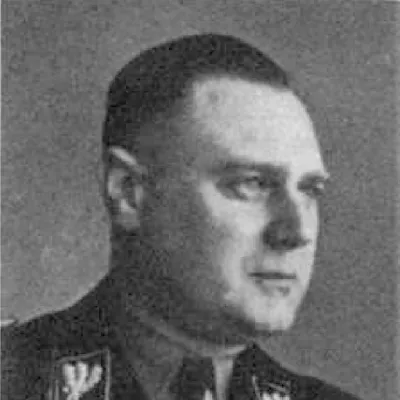
Wilhelm Koppe
Human Design Chart
Biography
He died 2 July 1975.
The Human Design of Wilhelm Koppe: Manifesting Generator 3/5
Manifesting Generator 3/5 — Design at a Glance
Wilhelm Koppe revealed himself as someone carrying hybrid energy: the constant power of a Generator paired with the lightning-fast assertiveness of a Manifestor. As a manifesting Generator, he had defined connections from Motor Centers to Throat Center, allowing him to skip steps and quickly draw things into his life. This speed was, however, a double-edged sword. Often, he tended to pursue multiple projects simultaneously in response to many different impulses. If his inner authority did not clearly support this approach, the initial creative enthusiasm would quickly turn into frustration – his specific Non-Self theme.
His strategy involved not initiating but waiting and responding to life. He should only act when his Sacral Center clearly said "yes." Additionally, it was crucial for him to regularly check whether ongoing projects still had his approval. When applying these principles correctly, Wilhelm Koppe found deep satisfaction in his work. He needed variety and a playful approach to tasks; the compulsion to finish one thing before starting another went against his nature. His energy unfolds best in play mode, where parallelism is experienced as enrichment rather than distraction.
Emotional Authority
Wilhelm Koppe exhibited a fundamental disposition marked by strong emotional waves: His inner compass lay in the defined Emotional Center. As an emotional authority, he was subject to constant ups and downs of feelings; the world appeared colored by his current mood. What seemed inspiring at one moment could turn negative the next. This intensity did not mean that the first impression hit the truth. Quick, spontaneous decisions made from such emotion often proved problematic as they only reflected a snapshot in time.
The mechanics of his authority required patience and time. Wilhelm Koppe had to let decisions mature to reach deeper clarity. Revisiting important questions multiple times was not hesitation but a necessary process: Only when the intense feelings subsided and emotional distance emerged did calmness set in. Then, the inner process was complete. This strategy held regardless of which other centers were defined in his design; the Emotional Center always took precedence in decision-making. Especially for long-term steps that influenced his life course, this need to wait revealed itself as a central mechanism of his internal guidance.
The 3/5 Profile — Martyr / Heretic
Wilhelm Koppe revealed himself as someone who gained knowledge not from books but through direct experimentation and later provided these practical experiences to others. His design followed the pattern of an experimenter and hero: he had to test everything himself first in order to understand how the world works. This learning path was marked by trial and error. Through Gate 12 on Line 3, he went through a process of self-analysis in a social context. Since this line did not yet have full oversight, it often led to uncertainty or the feeling of needing to explain oneself. Mistakes were inevitable and could lead to self-doubt but formed the foundation for his later understanding.
The second half of his development, represented by Gate 36 on Line 5, transformed these personal experiences into a resource for others. Wilhelm Koppe became an accompanier in crisis times, offering concrete, life-saving solutions. His appeal lay precisely in this: he had already overcome the hurdles and knew what worked. This role as a helper flattered his self-image but also cast him back when he failed or became nervous in front of others. The combination of necessary personal error (Line 3) and the resulting ability to solve practical problems for the community (Line 5) shaped how he moved through the world – as someone who learned through experience and then shared this knowledge with others.
Single Definition — Defined & Open Centers
Wilhelm Koppe revealed himself as someone whose inner architecture is based on a tension axis between constant mental activity and the necessity of emotional patience. His defined Ajna Center ensured reliable independent thinking; he processed data and concepts always according to a fixed pattern, regardless of external influences. This mental stability flowed directly into his defined Throat Center, allowing him to articulate his thoughts clearly and continuously. He spoke what he thought, making communication a natural expression form of his cognitive structure.
At the same time, Wilhelm Koppe had a defined Sacral Center, the source of immense daily vitality. As a Generator, he relied on reacting to initiatives rather than taking the first step himself. His energy was only available when an inner confirmation – often perceived as a tone or feeling in the gut – existed. This connected with his defined Solar Plexus Center, which gave him emotional authority. He was not made to impulsively decide at the peak of an emotional wave; instead, he had to wait for his feelings to clarify to gain deep clarity.
These stable inner resources contrasted strongly with his open centers. His open Head Center made him vulnerable to mental pressure and doubt when trying to find answers to questions that were not his own business. He tended to get lost in the confusion of others or seek inspiration where none existed. Similarly, his open G Center: Without a fixed identity or direction, he often adapted to the environment and sought security through "borrowed" roles rather than waiting for initiation by the right people and places. His open Heart Center drove him to prove his worth through promises and competition, although he lacked constant willpower for this. Additionally, his open Root Center absorbed external stress, making him vulnerable to overloading when he did not trust his inner authority.
Channels for intimacy, search drive and emotional change.
Wilhelm Koppe revealed himself through a basic attitude of curiosity and storytelling. The Channel of Curiosity 11-56 connected his Ajna Center with the Throat Center; he absorbed abstract ideas, filled in gaps, and formed stories or parables from them to inspire others. His focus was less on dry facts than on how these information illustrated human experiences and could be passed on.
His design also included the Channel of Union 59-6, linking his Sacral Center with the Solar Plexus. This connection of sexual energy (Gate 59) and emotional wave (Gate 6) shaped his need for intimacy and merging. He easily penetrated into others' aura, fostering confidentiality. Since his emotional wave determined timing, waiting was crucial to gain clarity about the depth of a connection; spontaneous actions without respect for this emotional fluctuation could cause confusion.
Another aspect was the Channel of Transience 35-36 between Solar Plexus and Throat Center. Driven by Gate 35 (Change) and Gate 36 (Crisis), he sought new experiences to gain emotional depth. He learned through living out situations, even if they were unstable or included crises. This restless search for the new served to gather wisdom through experience and make it accessible to others, accepting that feelings are transient.
Additionally, individual Gates played a role: Gate 29 in his Sacral Center emphasized persistence and saying yes correctly to challenges. Gate 45 gathered energy on tribal level and expressed willpower. Gate 33 promoted reflection and withdrawal for processing memories. Gate 55 brought emotional awareness with mood swings. Gate 42 required completing processes through experience to take on new commitments. Gate 16 enabled mastery through experimenting and identifying skills. Gate 30 steered the recognition of feelings and a longing for positive experiences, while Gate 43 communicated spontaneous insights often accompanied by fear of rejection.
Collective Circuitry — Circuit Signature
Wilhelm Koppe was marked by a clear and coherent energetic structure. His design connected the Ajna, Throat, and Solar Plexus Centers in one stream. This configuration promoted a style of thinking and expression that was strongly influenced by emotional wave movements. Instead of arguing purely logically, he sought meaning behind past experiences. His insights were often visually or emotionally grounded and followed a cyclical pattern: they needed time to clarify before they could be shared.
Parallel to this, there was a second independent energy between his Sacral and Solar Plexus Centers. This area concerned instinctive life force and the need for pairing as well as protection. It involved ancient genetic impulses for preserving one's lineage and survival. This power was timeless and not cyclical like the emotional wave in another part of his design.
Although both areas shared the Solar Plexus, they did not form a continuous unit from mind to life force. Instead, there existed two separate focal points side by side: on the one hand, reflective, meaning-making communication about the past; on the other hand, the direct, instinctive drive for connection and protection. Wilhelm Koppe lived with these two parallel forces without them merging into a single simple flow. His way of being was marked by this tension between reflecting on the past and immediate action for personal survival.
Right Angle Cross of Eden 2
Wilhelm Koppe carried the design of the right cross of Eden. This configuration shaped his inner stance through a deep connection to spiritual or transcendent truths, which he sought not only for himself but also actively wanted to bring into the world. In Human-Design, this cross marks a specific energy flow: It connects the Center of Identity with that of Will and culminates in the realm of manifestation and external effect. For Wilhelm Koppe, this meant a lifelong task of integrating hidden or higher insights and making them visible so others could benefit from them. His energy was directed at building bridges between the invisible and the everyday. He did not act out of mere curiosity but from a deep conviction that certain truths must be shared to fully unfold their impact. This created a dynamic tension in his life: On one hand, the need for inner clarity and authenticity; on the other, the drive to carry this clarity outward. Wilhelm Koppe lived the role of a messenger whose message pointed beyond the purely personal. His design challenged him not only to bear this spiritual or ideal burden but also to pour it into concrete forms that became tangible in his surroundings.
Saturn Return · Uranus Opposition · Chiron Return · 2nd Saturn Return — Life Cycles
Wilhelm Koppe was marked by a structure that worked through phases of extreme expansion and structural upheaval. This corresponded with the influence of an Uranus opposition, which often comes with sudden changes in social or professional environments. In 1936, at age 40, this dynamic aspect manifested in his career: He was promoted to SS-Gruppenführer. This appointment marked a significant step upward within the hierarchical order and demonstrated the ability to quickly adapt to new power structures or use them.
Later followed another crucial cycle: the Chiron Return. In Human-Design mechanics, this period around age 49 often signals a phase of bloom and fulfillment of individual purpose if one's strategy is observed. For Wilhelm Koppe, this development manifested in 1944 at age 48 through his promotion to General of the Waffen-SS. This success was not only an external status gain but reflected the inner alignment that could fully unfold its power during this life stage. The combination of early impulsive dynamics and later purpose-oriented confirmation characterized his path through the system, with both events marking clear milestones in his personal and professional development.
Manifesting Generator · Emotional Authority — Synthesis
Wilhelm Koppe lived a life marked by a deep inner drive to experience and subsequently share these experiences. His design as a Manifestor (with defined sacral center) points to someone who could quickly set things in motion but primarily waited for life circumstances to react – an ongoing shift between inner initiative and following the flow. The connection of emotional authority and the profile as experimenter/hero strengthened this trait: He had to try things himself (Line 3), then provide his knowledge to others (Line 5), with the emotional wave forcing him to let decisions mature over time.
Central for Wilhelm Koppe was the tension field between the urge to act and the need for emotional clarity. His design showed a person capable of acting lightning-fast (Manifestor) but simultaneously slowed down by emotional waves that required patience. This paradox intensified through the right cross of Eden 2, which points towards an intense confrontation with the meaning behind past experiences – a constant weighing between spontaneous action and reflection on consequences. The events at ages 40 and 48 reflect this inner conflict: Career advancements achieved through quick grasping of opportunities but also requiring deep engagement with the repercussions of these decisions.
3 Defined Channels
Incarnation Cross - Right Angle Cross of Eden 2
Solar Return
The Solar Return shows the moment when the sun returns to its exact birth position - your personal solar year.
Life Cycles
Discover the life cycles with a detailed triple view (birth chart, cycle chart, composite).
Human Design Profile
- Strategy
- To respond - wait for something to respond to
- Authority
- Emotional Authority
- Profile
- 3/5 - Martyr / Heretic
- Definition
- Single Definition
- Incarnation Cross
- Right Angle Cross of Eden 2
- Date of Birth
- 15.06.1896 11:30
- Place of Birth
- Hildesheim, Germany
Frequently Asked Questions
What was Wilhelm Koppe's Human Design type?
Which Profile did Wilhelm Koppe have in Human Design?
Which Authority guided Wilhelm Koppe?
What incarnation cross characterized Wilhelm Koppe?
When was Wilhelm Koppe born?
Discover your own Human Design
Are you also a Manifesting Generator? Find out in a personal reading how to unfold your multi-talents and direct your energy wisely.
More Personalities
Back to overviewAldair

Alizée

Angeli

Arletty

Artus
Balthus