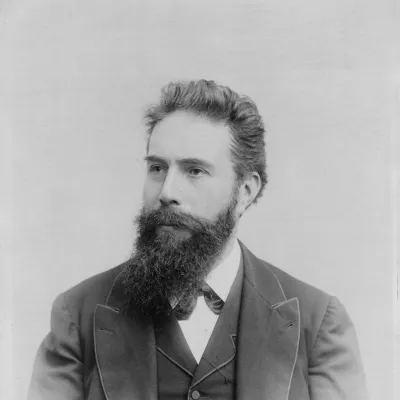
Wilhelm Röntgen
Human Design Chart
Biography
A professor of physics and Director of the Physical Institute at Wurzburg, he was a meticulous experimentalist who preferred to work alone. On that day in 1895 while experimenting with a Crookes tube, he found changes in crystals with new rays emitting. His further intensive study established the x-rays lines.
Röntgen was married to Anna Bertha Ludwig for 47 years until her death in 1919 at age 80. In 1866 they met in Zürich and got engaged in 1869 and wed in Apeldoorn, Netherlands on 7 July 1872; the delay was due to Anna being six years Wilhelm's senior and his father not approving of her age or humble background. They raised one child, Josephine Bertha Ludwig, whom they adopted at age 6 after her father, Anna's only brother, died in 1887.
Wilhelm Röntgen died on 10 February 1923 from carcinoma of the intestine, also known as colorectal cancer, in Munich, Germany. He was 77.
What does Manifesting Generator 4/6 mean for Wilhelm Röntgen?
Manifesting Generator 4/6 — Design at a Glance
Wilhelm Röntgen revealed himself as someone who possessed hybrid energy: the constant power of a Generator paired with the lightning-fast alignment of an Manifestor. His design suggested that he could skip steps and quickly pull results into his life. This ability, however, carries two central risks. On one hand, he tended to overlook important processes, often leading him back later to catch up on missing foundations, which created frustration, a specific non-self theme of his type. On the other hand, he reacted to multiple impulses and started several projects simultaneously. Without strict focus, this creative drive quickly tipped into overextension.
The solution lay in the Generator strategy: Reacting instead of Initiating. Wilhelm Röntgen had to wait for external triggers and seek the “yes” from his Sacral before acting. Only through this confirmation did deep satisfaction arise. With correct application, parallel work transformed from a distraction into an enrichment. He entered a “play mode,” where variety fed his energy rather than depleting it. The advice to finish one thing before starting another contradicted his nature; instead, he needed validation for each ongoing endeavor to stay in flow and avoid frustration.
Emotional Authority
Wilhelm Röntgen's decision-making followed the rhythm of emotional waves. His inner authority lay in a defined Solar Plexus Center, meaning that his perception was always marked by constant ups and downs of feelings. The world appeared colored by the current mood; a project could seem highly relevant at one moment but completely unattractive the next. This fluctuating perspective required specific patience. Spontaneous reactions to first impressions risked reflecting only a fleeting snapshot rather than deeper truth. Therefore, it was crucial for him not to make decisions immediately but to let them mature. The process of “sleeping on it” served to gain the emotional distance needed for clarity and calmness. Only when intense feelings subsided did his true reality set in. This strategy protected him from misjudgments arising from impulsive mood reactions. For long-term, life-relevant questions, waiting for emotions to subside was indispensable to take grounded and sustainable steps.
The 4/6 Profile — Opportunist / Role Model
Wilhelm Röntgen emerged as someone who acted experimentally during the first three decades of his life. In this phase, Line 6 of his profile worked similarly like a Line 3: he tried much out, especially in dealing with other people and friendships. This early period was marked by an active attempt to find himself without yet bearing the full weight of later expectations.
As life progressed, an inner conflict surfaced that shaped his design: the tension between Heart and Head. The Line 4 of his profile, the so-called Personal Ship, gave him the ability to recognize deeper motivations in others and organize them into a clear order. This helped him assign people their rightful place but always carried the risk of being perceived as manipulative since this line is fixed and tries to impose its own perspective. Simultaneously, Line 6 of his Head pulled him towards distance and wise reflection on the meaning of life.
This contradiction between the desire for community belonging (Line 4) and the need for lofty detachment (Line 6) required time to resolve. The mechanics of Line 6 demand development through trial and error up to self-sacrifice in service to society. In his later years, Wilhelm Röntgen was expected to meet the high standards of a wise role model. His large heart remained cautious about opening up to the wrong people while standing out through cooperation with others and bringing his insights into a sustainable structure.
Split Definition — Defined & Open Centers
Wilhelm Röntgen's design showed a tendency towards immense inner substance and reliable expression. His defined centers – Sacral, G Center, Root, Solar Plexus, Spleen, and Throat – created a stable core of vital energy (Sacral), clear identity (G), and constant pressure (Root). This allowed him to communicate and manifest consistently through the Throat Center. He did not speak from mental planning but rather from his sacral response or emotional clarity. His authority lay in waiting for the emotional wave (Solar Plexus) as well as intuitive spontaneity (Spleen), enabling him to make decisions that brought lasting satisfaction instead of generating resistance based on mental constraints.
In contrast, Head and Ajna were open. This meant Wilhelm Röntgen did not have a constant mental guidance. He was vulnerable to conditioned pressure to provide answers or penetrate concepts that did not come from him. Instead of getting lost in endless doubt, he used this openness as flexibility for inspiration without mistaking it with his truth. His Heart Center was also open. He lacked a consistent willpower or ego structure, protecting him from falling into the cycle of promises and self-proof. Instead, he reflected others' egos and learned whom to trust without needing to prove himself valuable. His mechanics showed someone who acted from inner peace rather than the need to intellectually or willfully dominate.
Channels for inspiration, judgment, charisma and emotional recognition.
Wilhelm Röntgen appeared as a personality whose influence worked through an authentic role model function while simultaneously correcting patterns with logical rigor. This dual nature resulted from the connection of inspiration and judgment in his design. The Channel of Inspiration 1-8 connected his G Center to the Throat Center. Through the Gate of Self-expression (1) and the Gate of Contribution (8), he lived out his individual direction. His impact did not arise merely through words but by acting as an individual, thereby drawing attention to himself. This inspired others to unfold their own uniqueness provided he cultivated patience for the right timing.
Parallel to this, the Channel of Judgment 58-18 shaped his approach to problems. It connected Root with Spleen Center via the Gate of Vitality (58) and the Gate of Correction (18). This channel drove an insatiable urge to question and perfect any patterns. Logic had to prove it offered the best answers. Wilhelm Röntgen used this energy to assess what was in balance or needed correction, ensuring his critical assessment was only introduced when explicitly requested to avoid unnecessary conflicts and offer solutions others were open to.
Additionally, other energies worked: The Channel of Charisma 34-20 connected Sacral with Throat Center and endowed him with a powerful, manifesting presence that relied on sacral reaction. The Channel of Recognition 30-41 between Root and Solar Plexus Centers enhanced his imagination and desire for new experiences. Individual Gates like Gate 17 (logical teaching), Gate 52 (focus on pattern correction) and Gate 14 (skillful handling of power) rounded out his profile by bringing structure, focus, and direction to his individual processes.
Individual Circuitry — Circuit Signature
Wilhelm Röntgen's design unfolded as two separate energetic poles: one for acting in the present moment, the other for emotional reflection on the past. This split required active bridging between doing and feeling.
The first block united Throat and Identity Center through the Knowledge Circuit (Channel 1-8). This gave him the ability to translate inspired ideas directly into expression and manifest his unique individuality acoustically in the present moment. This was complemented by the Integration Circuit (Channel 20-34), which connected Throat with Sacral Centers, resulting in pulsating charisma that drew strength from reacting to life and intuitively made it effective in the current moment.
Parallel existed a second isolated block: Spleen, Root, and Solar Plexus Centers. The Understanding Circuit (Channel 18-58) linked Spleen with the Root Center. This created a rational strategy based on focus and logical judgment – free from emotions, directed towards future improvements. Simultaneously, the Sense-making Circuit (Channel 30-41) connected Solar Plexus with the Root Center, generating cyclical emotional waves aimed at making sense of the past and processing these experiences visually and emotionally.
Since there was no direct connection between these two groups, rational strategy and emotional reflection operated parallel to impulsive expression. Wilhelm Röntgen had to switch contexts to connect logic with feeling or inspiration with structure. His strongest source of expression lay in directly translating inspiration and charisma into the outside world.
Right Angle Cross of Service 1
Wilhelm Röntgen's design established a foundational disposition that was less about individual self-assertion and more about dedication to something greater. His existential path was marked by the right cross of service, an archetypal structure that provided the backdrop against which all other mechanisms of his character operated. This did not mean subservience or a lack of independence but rather an intrinsic orientation where the well-being of others or a cause took precedence. The cross functioned as a quiet, often unconscious driving force that consistently directed his actions towards support and care. This energy was constant and formed the basis of his motivation, independent of situational fluctuations through open centers. Wilhelm Röntgen thus revealed himself to be someone whose purpose did not lie in the ego center but rather in the readiness to serve others. This deeper motivation shaped his life as an ongoing process of giving and helping, with the structure of service providing the framework for his interactions with the world. It was a stance that conveyed stability and directed his focus on the well-being of his surroundings without needing explicit communication.
Saturn Return · Uranus Opposition · Chiron Return · 2nd Saturn Return — Life Cycles
Wilhelm Röntgen's life path followed a clear structure of anchoring, experimental intensification, and ultimately healing discovery. In 1872, at age 27, he married Anna Bertha Ludwig. This marked his first Saturn return, a cycle of maturity in which personal foundations stabilize and long-term commitments often become established.
The Uranus opposition around 1884 brought a period of change and intellectual provocation. At the age of 39, Röntgen published works on the influence of pressure on fluid viscosity as well as new experiments on heat absorption by steam. This cycle promoted the need to question established patterns and adopt new, often unconventional perspectives in research.
The Chiron return around 1895 marked the peak of this development. At age 50, he discovered X-rays at the Physical Institute of the University of Würzburg. In Human Design mechanics, this cycle does not signify healing from injuries but rather a bloom period where one's essence and life purpose fully unfolds. Röntgen's discovery was an expression of this inner fulfillment and sense-making.
Finally, in 1901 at age 56, he received the Nobel Prize for Physics during his second Saturn return. This cycle confirmed previous work through external recognition and institutional anchoring, completing the cycle from personal foundation to public validation of his scientific achievements.
Manifesting Generator · Emotional Authority — Synthesis
He was a Generator who, by connecting with the Throat Center, possessed a particular speed and drive towards direct implementation of impulses (Manifesting Generator). However, this ability to quickly initiate things was always tempered by his emotional authority; decisions matured within an internal wave, leading to a constant interplay between swift action and the need for thorough deliberation. The Line 4 in Profile indicated a deep longing for belonging, which was countered simultaneously by Line 6 – the role model – with detachment and a desire for independent reflection (Networker/Role Model).
This interplay of speed and inner maturation, social engagement and detached observation formed a central red thread. The Channel of Inspiration (1-8) amplified creative expression and the need to bring something new into the world – yet always filtered through the emotional depth of the heart (Knowledge Circuit). Events throughout his life demonstrated how this dynamic unfolded: from early connections to recognition for groundbreaking discoveries.
4 Defined Channels
Incarnation Cross - Right Angle Cross of Service 1
Solar Return
The Solar Return shows the moment when the sun returns to its exact birth position - your personal solar year.
Life Cycles
Discover the life cycles with a detailed triple view (birth chart, cycle chart, composite).
Human Design Profile
- Strategy
- To respond - wait for something to respond to
- Authority
- Emotional Authority
- Profile
- 4/6 - Opportunist / Role Model
- Definition
- Split Definition
- Incarnation Cross
- Right Angle Cross of Service 1
- Date of Birth
- 27.03.1845 16:00
- Place of Birth
- Lennep, GER
Frequently Asked Questions
What was Wilhelm Röntgen's Human Design type?
What Profile did Wilhelm Röntgen have in Human Design?
What Authority guided Wilhelm Röntgen?
What incarnation cross did Wilhelm Röntgen have?
When was Wilhelm Röntgen born?
Discover your own Human Design
Are you also a Manifesting Generator? Find out in a personal reading how to unfold your multi-talents and direct your energy wisely.
More Personalities
Back to overviewAldair

Alizée

Angeli

Arletty

Artus
Balthus