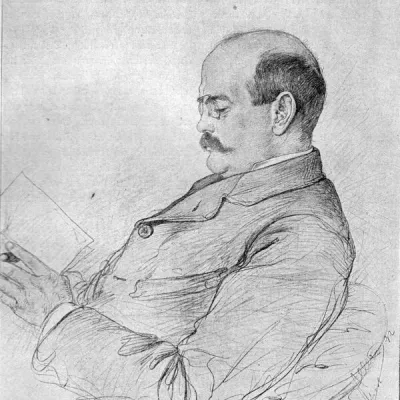
Wilhelm von Bismarck
Human Design Chart
Biography
Human Design Analysis: Wilhelm von Bismarck as Projector 2/4
Projector 2/4 — Design at a Glance
Wilhelm von Bismarck was characterized by a focusing aura that immediately revealed system errors. His design acted like a bright flashlight, directing light to areas others left in the dark. This ability to identify weaknesses in systems was typical of the Projector type. However, directly addressing these flaws was often perceived as unpleasant, akin to shining a direct beam into someone's face. Instead, Wilhelm von Bismarck attracted others through his harmonious self-light; people naturally came to him for advice.
His strategy involved waiting for an honest and appreciative invitation. This prevented bitterness, the non-self theme of Projectors when they do not live according to their design. Since Projectors lack a defined Sacral Center, they have no constant intrinsic energy source. Wilhelm von Bismarck experienced phases of high productivity followed by necessary rest periods to avoid burnout. Traditional school and work systems often did not account for this need for recovery. Living in accordance with his nature rewarded him with success. The combination of sharp observational skills and the necessity of energy management significantly shaped his interactions with the environment.
Emotional Authority
Wilhelm von Bismarck exhibited a decision-making stance influenced by emotional wave movements. His inner authority lay in the defined Solar Plexus Center, meaning his perception was always mood-driven and subject to constant ups and downs. The world appeared colored by his current emotional state; what seemed inspiring at one moment could appear negative the next. Since these immediate feelings were merely snapshots, spontaneous decisions often led astray and did not reflect his deeper truth.
Wilhelm von Bismarck's strategy involved taking time. He needed to let decisions mature so he could distinguish between transient mood swings and true clarity. This required patience and consciously “sleeping on” important questions. Over time, intense emotions subsided, allowing him to gain emotional distance. Only then did calmness set in, revealing what truly mattered. This process was particularly crucial for long-term decisions that significantly influenced his life trajectory. By waiting out the emotional cooling period, he ensured that his actions were based on a solid foundation and not just reactions to fleeting impulses.
The 2/4 Profile — Hermit / Opportunist
Wilhelm von Bismarck was marked by an internal tension between a deep desire for withdrawal and simultaneous yearning for familiar community. His design as Profile 2/4, the “Natural Talent / Networker,” required him to constantly oscillate between two poles: Line 2 with its urge toward seclusion and Line 4 with its orientation towards networking. This configuration demanded clear communication of his presence and retreat phases. Only by making it clear when he sought company and when he wanted solitude could he leverage the benefits of both aspects. During isolated phases, Wilhelm von Bismarck processed external inputs internally. This withdrawal served reflection and strength-building typical for Line 2. Here, he created clarity and internalized experiences. Once this inner need was satisfied, he emerged from his “cave.” Then, he actively sought contact with a close circle of trustworthy individuals defined by the fourth line. In this community, he absorbed knowledge from his network. The key mechanism involved Wilhelm von Bismarck reflecting on these external impressions during subsequent alone time and evaluating them. Through alternating between isolation for idea development and exchange within the familiar circle, he generated unique insights. The ability to consciously steer and communicate this interplay was central to the effectiveness of his design.
Single Definition — Defined & Open Centers
Wilhelm von Bismarck revealed himself through an inner emotional authority that required patience: His truth did not reveal itself in the moment but only after experiencing the emotional wave. This defined Solar Plexus Center made him a carrier of a deep, time-unfolding sensitivity, while his equally defined Root Center provided a constant, adrenaline-driven pressure that propelled him forward and helped process stress. This configuration shaped a lifestyle where emotional clarity served as a decisive foundation – impulsive action was avoided by waiting for the wave movement to prevent confusion.
At the same time, his design featured six open centers lacking consistent self-energy; instead, they reflected their environment. The open Head Center lacked continuous mental inspiration; Wilhelm von Bismarck tended to engage with foreign questions or doubts rather than relying on clear personal impulses. His open Ajna Center meant that conceptual thinking was flexible but not a fixed truth – he took in ideas without always holding them as personal convictions. The open Throat only drew attention when he waited; the intrinsic pressure to make himself noticed was missing.
His open G Center lacked a set identity or direction; Wilhelm von Bismarck relied on relationships and places to initiate him rather than prescribing his own path. The open Heart Center lacked consistent willpower – he did not seek competition or prove his worth through promises. Finally, the open Sacral Center lacked continuous vital energy; instead, it absorbed others' life force, which could lead to exhaustion if boundaries were not set. Similarly, the open Spleen Center offered no spontaneous intuition for health or safety but made him vulnerable to fears and dependencies on the comfort frequency of his environment. This openness required constant adaptation to external influences while defined centers provided an inner compass from emotion and pressure.
Channels for mystical synthesis of claim and principle.
Wilhelm von Bismarck secured the cohesion of his inner community through emotional clarity and loyalty. His design was significantly influenced by Channel 19-49, Synthesis, connecting the Root Center with Gate 19 (Claims) and the Solar Plexus Center with Gate 49 (Principles). This channel acted as an emotional glue for relationships: It determined through waves of acceptance or rejection who belonged to the
Tribal Circuitry — Circuit Signature
family
Right Angle Cross of the Four Ways 2
Wilhelm von Bismarck carried the imprint of the Right Cross of Four Paths. This design laid a deeper, fateful orientation: the integration of intellect and emotion through life itself. It was not a path of purely theoretical knowledge acquisition but one of transformation through direct experience. Here, wisdom was forged in the fire of life, not just understood in the mind.
The central dynamic within him existed between the Head Center seeking definition and clear intellect, and the Heart Center knowing emotional energy and wave movements. The challenge of this pattern lay in calming his often restless mind and navigating emotional currents. Only thus could he reach true wisdom. It was about letting go of rigid, intellectual definitions in favor of a flowing, experience-based truth.
Wilhelm von Bismarck lived out this tension. His design challenged him to not remain at the level of analysis but to feel and integrate life's lessons directly. Wisdom arose for him where thinking and feeling met and mixed in everyday life rather than remaining separate. This process required patience and the willingness to adapt to the unpredictable waves of fate, rather than trying to control them through mere logic alone. His inner development thus unfolded as an ongoing synthesis of understanding and experience.
Saturn Return · Uranus Opposition — Life Cycles
Wilhelm von Bismarck's professional career was marked by two decisive structuring moments that emerged from his astrological design. In 1881, at the age of 29, he moved to the Imperial Chancellery. This step marked his first Saturn Return, a phase in which long-term commitments and structural foundations for further life are laid down. Taking up this position signaled the transition into an era of greater responsibility and institutional anchoring.
Eight years later, in 1889 at age 37, he was appointed Regierungspräsident of Hanover. This event fell on his Uranus Opposition. This transit often demands a break from existing structures or a radical shift in perspective to meet one's own development. The new role in Hanover represented exactly such a turning point: A break with the previous chancellery work in favor of an independent leadership task elsewhere. Both phases – structural consolidation through Saturn and transformative realignment through Uranus – shaped his career not as a random sequence but as necessary steps of his personal evolution within the system.
Projector · Emotional Authority — Synthesis
Wilhelm von Bismarck was a Projector, whose life was characterized by the ability to recognize patterns and bring light into darkness for others (Gate 19/49). This gift manifested in an ongoing interplay between the need for alone time for reflection (Line 2) and the desire for exchange and community (Line 4), which led him to carefully choose relationships and consciously apply his energy. His emotional center required time to gain clarity, while his undefined Sacral Center made him vulnerable to the energies of his environment – a state that forced him to constantly reorient himself and pay attention to signals from his body (Gate 33/24).
A central paradox in his design lay in the tension between the need for recognition and the ability to act independently of external influences. Although he was vulnerable through his undefined Heart Center to conditioning, he possessed inner strength (Gate 58/39) to recognize patterns and defend against harmful influences. This field of tension led him always to strive for authenticity while simultaneously trying to find his place in the community – a balancing act that shaped his life and gave him a unique perspective.
1 Defined Channel
Incarnation Cross - Right Angle Cross of the Four Ways 2
Solar Return
The Solar Return shows the moment when the sun returns to its exact birth position - your personal solar year.
Life Cycles
Discover the life cycles with a detailed triple view (birth chart, cycle chart, composite).
Human Design Profile
- Type
- Projector
- Strategy
- Wait for the respectful invitation
- Authority
- Emotional Authority
- Profile
- 2/4 - Hermit / Opportunist
- Definition
- Single Definition
- Incarnation Cross
- Right Angle Cross of the Four Ways 2
- Date of Birth
- 01.08.1852 00:00
- Place of Birth
- Frankfurt am Main, Germany
Frequently Asked Questions
What was Wilhelm von Bismarck's Human Design type?
What Profile did Wilhelm von Bismarck have in Human Design?
What Authority guided Wilhelm von Bismarck?
What is the birth date of Otto von Bismark?
Discover your own Human Design
Are you also a Projector? Find out in a personal reading how to unfold your leadership qualities and recognize the right invitations.
More Personalities
Back to overviewSissy Spacek

Alain-Fournier

Anémone

Ann-Margret

Bourvil
Hergé