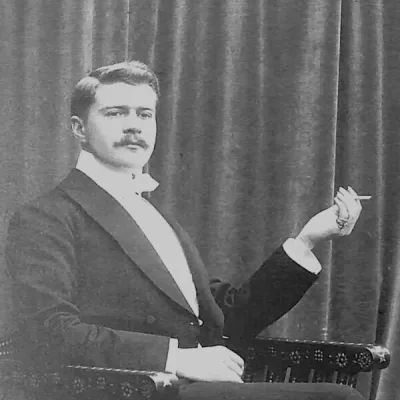
William Budzinski
Human Design Chart
Biography
From 1910 Budzinski's first designs as a freelancer were created for Bruno Pruschinski, whose company he took over in 1912. In 1930, the "luxury workshops Pruschinski" went bankrupt in the wake of the Great Depression. William Budzinski then sold his collection of 3,000 costumes to the Berlin Museum of Arts and Crafts.
William Budzinski died on 4 October 1950 in Berlin-Buch, aged 75.
Human Design Analysis: William Budzinski as Manifesting Generator 2/4
Manifesting Generator 2/4 — Design at a Glance
William Budzinski revealed himself as a Hybrid being, combining the constant energy of a Generator with the lightning-fast execution speed of a Manifestor. His design indicated a tendency towards high dynamics, allowing him to attract things into his life without having to go through the usual slow process of step-by-step development. This ability to skip steps fundamentally shaped his approach to work, though it also carried specific risks.
As a Manifesting Generator, he had a defined Sacral Center, giving him a steady energy source. His strategy involved reacting to impulses rather than initiating actions himself. However, if he acted too quickly, he would skip important intermediate steps, which could lead to having to go back later and make up for them. This could result in frustration as the feeling of efficiency was lost. Additionally, he tended to pursue multiple projects simultaneously, driven by various impulses.
William Budzinski's creative power unfolded best when he was in "play mode" and sought variety. The pressure to finish one thing completely before starting the next was at odds with his nature. Instead, he derived deep satisfaction from working on different tasks in parallel, as long as his inner authority and Sacral Center continued to approve the projects. His energy worked most effectively when he maintained a balance between quick execution and checking his own resonance, allowing him to use his versatility without falling into overloading or frustration.
Sacral Authority
William Budzinski followed a clear inner logic: His strategy and authority were identical, simplifying his decision-making process. As a Generator, he was the only type for which this alignment was possible. His inner guidance came from sacral authority, which manifested not in the mind but in the body.
This authority responded to external stimuli with an immediate physical reaction. William Budzinski received signals as a gut feeling or surge of energy, audible as grunts, hums, or a confirming "Mhm." These reactions were not mental deliberations but direct impulses. When his sacral motor kicked in, he felt vital and alive. He then had an inexhaustible supply of energy and tackled his tasks with great enthusiasm. His design called for him to go through life with joy and satisfaction, fully immersed in his activities without a rigid sense of purpose.
Additionally, his activated Spleen Center served as a supportive element. It enabled him to have quick, spontaneous reactions and immediate access to his physical well-being. This instinctive perception was reliable and complemented the sacral response. William Budzinski could trust this combination of physical energy and intuitive assurance, allowing him to make decisions in the flow rather than planning them. His system was designed to respond to what energized him and to use his life force efficiently and satisfyingly.
The 2/4 Profile — Hermit / Opportunist
William Budzinski revealed himself through a Profile 2/4, known as "Natural Talent / Networker". This design laid a constant tension between the need for withdrawal and the desire for community. Line 2, the Hermit, prompted him to regularly withdraw to gain inner clarity and process emotional issues. Without this isolated "me-time", he could not fully regenerate his energy. At the same time, Line 4, the Community, drove him to spend time with his closest confidants. His success depended on integrating these two poles: he used knowledge from his network during his alone time to reflect on it and develop brilliant ideas.
This shift between isolation and connection required clear communication. William Budzinski had to signal to others when he sought company and when he needed to be left alone. The mechanics of his lines underscored this: Gate 55 (Line 2) brought up themes of mistrust and indecision, as his emotional balance often depended on the perception of others. Attempts to actively prove trustworthiness often failed. In contrast, Gate 34 (Line 4) brought transpersonal intuition and power into play. Here, it was about self-love and respectful handling of one's power. If he respected individual survival and did not abuse power, it fostered the necessary trust. The absence of this respect led to mistrust. William Budzinski therefore lived in a rhythm that was only stable when he clearly communicated his boundaries and allowed the interplay between inner reflection and outer networking.
Single Definition — Defined & Open Centers
William Budzinski revealed himself as someone with a clear, reliable identity and a deep, physical intuition. His design was characterized by a defined G Center, which gave him a firm sense of self-worth and direction, as well as a defined Sacral Center, which provided him with an enormous source of vitality and endurance. However, this energy was only available to him when he responded to life rather than initiating action himself. His defined Throat Center allowed him to express this truth with clarity and honesty, while his defined Spleen Center enabled him to make intuitive, spontaneous judgments in the present moment that protected his well-being.
At the same time, William Budzinski was vulnerable to external conditioning through several open centers. His open Head Center made him susceptible to mental pressure and questions from others, which could easily confuse or distract him from his own focus. The open Ajna Center meant that his mental consciousness was flexible but tended to reflect concepts and opinions from the environment rather than holding them as his own truth. His open Heart Center made him sensitive to the need to prove his worth through willpower or promises, a trap that could lead him into a cycle of self-doubt and overcompensation. Additionally, his open Solar Plexus absorbed the emotions of his environment, making him emotionally vulnerable and causing him to feel others' moods as his own. Finally, his open Root Center took on the stress and adrenalized pressure of his environment, making him a target for others' pressure and leading to hyperactivity if he did not learn to separate this external stress from his own life rhythm.
Channels for reflection, charisma, intuition and individual power.
William Budzinski navigated between the necessity of reflecting on experiences and the urge to act immediately. His design tended towards deep inner processing before turning outward.
This tension arose from the interplay of several channels. The Lost Son Channel 13-33 connected the G Center with the Throat Center. Here, William Budzinski gathered information and secrets, then withdrew to sort and reflect on these experiences. This process of patience and waiting for deeper truths to reveal themselves shaped his way of preserving and passing on knowledge only after maturation.
At the same time, the Charisma Channel 34-20, connecting the Sacral Center with the Throat Center, endowed him with a powerful, generative energy aimed at immediate reaction and expression in the present moment. The raw physiological power of Gate 34 met the urge of Gate 20 to express itself in the moment, creating an impressive but also demanding vitality.
These two impulses were further refined by the Brainwave Channel 57-20 and the Power Channel 34-57. The Brainwave Channel 57-20 allowed him intuitive insights from the Spleen Center, communicated directly in the present moment, while the Power Channel 34-57 linked his survival intelligence with his sacral power. This created a high level of awareness and the ability to respond quickly and intuitively to dangers or opportunities.
Additionally, Gates like the Gate of Fulfillment 55 and the Gate of Genetic Strategy 59 contributed to his emotional awareness and bonding capacity. Thus, William Budzinski lived in a constant interplay between quiet observation and active, charismatic engagement with the world.
Individual Circuitry — Circuit Signature
William Budzinski revealed himself through a simple, coherent definition that connected his Throat, Sacral, Spleen, and G Centers into a single, continuous energetic flow. This structure marked him as someone who could directly translate his inner authority and intuition into words and actions without internal conflict.
The Knowledge Circuit worked through him via Channel 20-57 (Flash of Insight), linking his Throat Center with the Spleen Center. This endowed him with the ability to express intuitive, innovative insights from the Spleen immediately and creatively in the present moment. Parallel to this, the Meaning Circuit flowed through Channel 33-13 (The Lost Son), connecting his Throat and Identity Centers. This was about emotionally reflecting on the past to draw meaning from it and share these insights with his true identity.
Additionally, he integrated the Integration Circuit through two channels: 20-34 (Charisma) and 34-57 (Power). These directly linked his Throat, Sacral, and Spleen Centers. This allowed him to draw strength from reacting to life (Sacral), channel it through intuitive knowledge (Spleen), and manifest it in the present moment with charisma. Since all these circuits were part of the same large, connected energy block, William Budzinski's expression appeared as a seamless unity of intuition, emotion, identity, and life force.
Right Angle Cross of the Sleeping Phoenix 1
William Budzinskis design carried the signature of the right cross of the sleeping phoenix. This configuration combined a deep, often unconscious search for inner truth with the ability to translate these insights into outer reality. It was not a mere intellectual exercise but a lifelong process of integration between what lay dormant and what needed to be made visible.
The mechanics of this cross described a tension between withdrawal and expression. William Budzinski lived with an inner dynamic that pushed him to penetrate his own shadows and unconscious parts to develop an authentic voice. The term 'sleeping phoenix' pointed to a potential that could only fully unfold through confrontation with personal wounds and transformations. It was a path of alchemical transformation: clarity and creative energy emerged from the pain and confusion of the unconscious.
This structure shaped his way of moving through the world. He was not programmed to seek superficial harmony but had to traverse the depths to find his true nature. The challenge was to trust his inner compass even when external circumstances were confusing or chaotic. His design challenged him to bridge the gap between inner experience and outer manifestation by translating his personal truths into concrete actions or works. This was not a one-time act but a continuous rhythm of sinking and rising that permeated his entire life span.
Saturn Return · Uranus Opposition · Chiron Return · 2nd Saturn Return — Life Cycles
William Budzinski showed a structure aimed at long-term condensation and structural maturity. His design promoted an attitude where impulses only coalesced into durable forms through time and experience. This became evident in 1912, at the age of 37, when he took over the firm Bruno Pruschinski. This step marked the beginning of a phase where he assumed responsibility for existing structures and aligned them with his own principles.
His second Saturn return, which in Human Design mechanics marks the consolidation of life's work, occurred in 1930. At 55 years old, William Budzinski sold his costume collection to the Berlin Museum for Art and Design. This act was not just a sale but the logical conclusion of years of collection activity that now reached its peak and public recognition. The design suggested that his life's work took its final form in this phase and was integrated into the cultural context. The mechanics show how inner values and outer structures were harmoniously merged over time, leading to a sustainable anchoring of his contribution.
Manifesting Generator · Sacral Authority — Synthesis
William Budzinski lived a life path marked by an inner dynamic between activity and withdrawal. As a Manifestor Generator, he possessed the ability to quickly initiate and realize things, driven by sacral energy (Sacral Center defined). At the same time, his profile as a natural talent and networker required phases of isolation (Line 2) to gain inner clarity before reengaging with others (Line 4). This interaction between the need for exchange and the desire for solitude formed a central red thread in his life, evident in the maturation and reflection of his experiences (Channel 13-33).
A central paradox in his design lay in the combination of the ability to act swiftly and the necessity not to skip important steps. The connection of his G Center to the Throat Center (Channel of the Lost Son) pointed to a profound ability for reflection and learning from experiences, while his sacral authority urged him to respond to inner impulses. This led to a tension between the drive to create and transform (Knowledge Circuit) and the wisdom to take time for integration and understanding.
4 Defined Channels
Incarnation Cross - Right Angle Cross of the Sleeping Phoenix 1
Solar Return
The Solar Return shows the moment when the sun returns to its exact birth position - your personal solar year.
Life Cycles
Discover the life cycles with a detailed triple view (birth chart, cycle chart, composite).
Human Design Profile
- Strategy
- To respond - wait for something to respond to
- Authority
- Sacral Authority
- Profile
- 2/4 - Hermit / Opportunist
- Definition
- Single Definition
- Incarnation Cross
- Right Angle Cross of the Sleeping Phoenix 1
- Date of Birth
- 20.02.1875 03:30
- Place of Birth
- Berlin, Germany
Frequently Asked Questions
What was William Budzinski's Human Design type?
What profile did William Budzinski have?
What authority did William Budzinski have?
What incarnation cross did William Budzinski have?
When was William Budzinski born?
Discover your own Human Design
Are you also a Manifesting Generator? Find out in a personal reading how to unfold your multi-talents and direct your energy wisely.
More Personalities
Back to overviewAldair

Alizée

Angeli

Arletty
Artus

Baekhyun