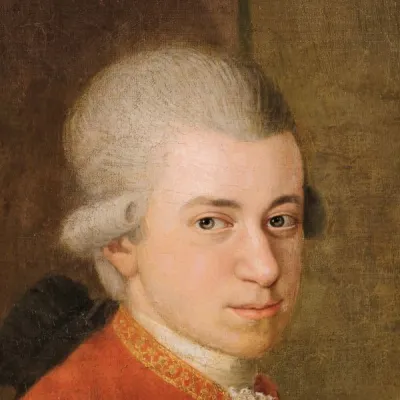
Wolfgang Amadeus Mozart
Human Design Chart
Biography
What does Generator 6/2 mean for Wolfgang Amadeus Mozart?
Generator 6/2 — Design at a Glance
Wolfgang Amadeus Mozart had immense sacral endurance, making him a powerful workhorse. His design suggested that he operated like a strong working horse: extremely resilient and energized if he had enough power for his tasks. However, this energy architecture was contingent on a specific condition. Success and deep satisfaction did not come from self-initiated action but solely through reacting to external signals.
His design's motto was "react instead of initiate." When he responded to impulses from his environment with an inner clear "yes," he could efficiently use this energy and materialize projects. Deviations from this pattern led to two characteristic pitfalls. Either he wasted his power on tasks that did not bring him internal joy, leading him despite his high potential towards exhaustion. Or he was hindered in continuing work on his heart projects even though he still had plenty of power.
Living in harmony with the strategy of reacting rewarded his system with a feeling of deep fulfillment. Initiating actions persistently from self-motivation or suppressing inner impulses led to persistent frustration and a lack of energy sooner or later. His fundamental architecture thus required him to wait for life to respond, rather than taking the first step himself.
Emotional Authority
Wolfgang Amadeus Mozart exhibited a decision-making structure that required time and emotional distance. His design indicated that quick reactions were risky as initial impressions rarely captured the truth. This stance stemmed from his emotional authority, carried by his defined solar plexus center. In Human-Design, this authority is dominant: whenever this center is activated, it dictates inner guidance, independent of other definitions in the chart.
Mozart was subject to a constant wave of ups and downs in his feelings. The world appeared colored by his current mood; still immersed in enthusiasm, he could view the same object negatively moments later. This feeling was only a snapshot, not a final truth. Spontaneous decisions made from this emotional heat often had negative consequences.
Instead, Mozart gained clarity through delay. The more time he gave to a decision, the deeper his understanding became. This process required patience and repeatedly "sleeping on" important questions. Through this deliberation and taking distance, intense feelings gradually subsided. Only when calmness set in and the emotional storm had abated did he know what was right. This mechanism ensured him a solid foundation for long-term life-defining decisions, free from fleeting mood swings.
The 6/2 Profile — Role Model / Hermit
Wolfgang Amadeus Mozart showed a pronounced inclination towards experimentation driven by a principle of trial and error before his 30th year. The sixth line of his profile acted like a third: he sought numerous personal experiences but withdrew after mistakes to process them. This phase of active exploration significantly shaped his early years.
Around age thirty, a structured transformation occurred. The activation of the sixth line triggered a tendency towards isolating withdrawal – metaphorically described as "cave on the mountain." During this time, he distanced himself from external experimentation and looked back with great distance at past experiences. This retreat served not for escape but for intense reflection, healing, and deeper self-knowledge. It was a phase of integration in which he condensed accumulated life experiences.
Later, Wolfgang Amadeus Mozart emerged as a wise mentor from this isolation. Others recognized his gained wisdom and sought him out to partake in his insights and learn the skill of deep introspection. His development illustrated the transition from an experimenting "role model" to a reflective "natural talent," gaining new superiority through distance and inner work, enabling others to benefit from his life wisdom.
Triple Split Definition — Defined & Open Centers
Wolfgang Amadeus Mozart revealed himself as someone who operated in a closed system: Eight of his nine centers were defined, creating an extreme internal consistency and autonomy. Only the Throat Center remained open. This configuration marked him as a Manifesting Generator with emotional authority. His design inclined towards constant mental activity; definitions in the Head and Ajna Centers created a permanent pressure to ask questions and find answers. However, lacking their own energy for implementation, direct action from the mind often led to frustration or hasty decisions. Instead, he had to learn to accept mental pressure as inspiration without immediately acting on it.
His identity and direction were clearly set by the defined G Center; he knew who he was and where he was going but could not control how the path looked. The Heart Center gave him willpower and the ability to keep promises, while the Sacral Center served as a motor providing his vital energy. As a Generator, his strategy was to wait for invitations and then react – only this way did full power become available to push through. Emotional authority in the Solar Plexus Center demanded patience: He had to wait out waves of emotion before acting, as immediate reactions often were impulsive. The Spleen Center provided intuitive safety in the present moment, and the Root Center supplied the necessary pressure to move forward.
The central conflict lay in the missing direct manifestation power over the throat. With his Throat Center open, he could not simply speak or act whenever he wanted. He tended to wonder if anyone noticed him and felt the urge to force attention. Yet his mechanics taught: By waiting for the right invitation, speaking came naturally at the right time. Without this discipline, he risked wasting energy or meeting resistance. His strength lay in channeling his immense internal energy through reacting and emotional clarity rather than burning it in a mental battle against the open Throat Center.
Channel 30-41: Recognition — Channels & Gates
Wolfgang Amadeus Mozart revealed himself as someone whose life was marked by a deep, natural flow. The Rhythm Channel 5-15 connected his Sacral Center with the G Center, giving him a unique inner rhythm. This magnetic life flow drew others into his orbit and determined the timing of his environment while he effortlessly moved forward.
His thinking followed not caprice but inspiration. The Awareness Channel 61-24 linked Head and Ajna Centers, enabling spontaneous knowledge. Insight came to him as sudden enlightenment, a mutative Satori that shattered old patterns. He did not need to seek; knowledge came to him when the moment was ripe.
A strong drive for new experiences propelled him forward. The Recognition Channel 41-30 connected Root pressure with Solar Plexus. This connection generated emotional restlessness and longing, which could only be integrated by waiting out the emotional wave. Clarity emerged after this inner movement.
Parallel to this, entrepreneurial intuition worked. The Devotion Channel 44-26 linked Spleen and Heart, giving him an instinctive sense of the tribe. He intuitively recognized needs and convincingly communicated them with ego strength. Survival intelligence complemented this: The Power Channel 34-57 connected Sacral and Spleen, making him permanently aware of danger and protecting his vitality through intuitive reactions.
Finally, his mind reflected experience. The Abstraction Channel 64-47 linked Head and Ajna, urging him to understand life as a story. His mind sought connections and told stories to draw meaning from the variety of impressions.
Collective Circuitry — Circuit Signature
Wolfgang Amadeus Mozart was marked by three separate yet parallel operating energetic streams. The Knowledge Circuit connected his Head and Ajna Centers through the Awareness Channel (24-61). This promoted creative flashes of insight and a drive for new knowledge to express his identity.
A second stream formed in the Understanding Circuit: Here, the Rhythm Channel (5-15) linked Sacral with Identity Center. This created a basis for logical structure and strategic thinking, separate from emotional fluctuations.
The Meaning-Finding Circuit worked in two isolated parts. On one hand, Abstraction (47-64) reconnected Head and Ajna, on the other, Recognition Channel (30-41) linked Solar Plexus with Root Center. This generated cyclical emotional waves from the past that needed to be processed.
Additionally, two more channels operated independently: The Devotion Channel (26-44) in the Ego Circuit connected Heart and Spleen, fostering cooperation and resource sharing. The Power Channel (34-57) in the Integration Circuit linked Sacral with Spleen to secure strength through reactions to life.
This triple definition did not mean a single flow but three distinct experience areas: creative intuition, rational structure, and emotional processing coexisted side by side without directly overlapping. Wolfgang Amadeus Mozart had to integrate these separate energies independently.
Left Angle Cross of the Alpha 2
Wolfgang Amadeus Mozart was marked by the left cross of Alpha 2, a configuration often associated with the role of a pioneer or trailblazer. This design points to a life task of forging new paths and creating structures that will be useful for subsequent generations. It wasn't about seeking personal recognition in the conventional sense but rather laying the groundwork for something greater that transcends one's own life.
The mechanics of this cross describe a process of building up and initiating. Those who carry this energy tend to operate in areas that are not yet established or lack clear guidelines. The goal is to create order out of chaos and take initial steps that others can build upon later on. For Mozart, this meant an inner orientation towards laying foundations, whether in his art or personal environment. He was called to set impulses as starting points for future developments. This tendency towards pioneering work significantly shaped his actions and decisions, always striving to bring something new into the world that promised stability and gave others direction.
Saturn Return — Life Cycles
In 1784, at the age of 28, Wolfgang Amadeus Mozart showed a clear trend toward structural self-determination: he compiled an inventory of his own works. For his design, this step marked the first Saturn Return, a milestone in career consolidation. During this period, years of groundwork coalesced into a solid result. The mechanics of the Saturn Return function as a phase of maturation and stabilization; it forces confrontation with one's achievements and demands clear positioning within the professional context. Mozart's actions – systematically recording his creations – perfectly met the demand for order and validation of the path taken. It was not mere documentation but an act of self-assurance and detachment from earlier dependencies or uncertainties. The Saturn Return served here as a catalyst for inner authority: what might have been fluid before now took shape and weight. By compiling the inventory, Mozart created a stable foundation for further development. This moment of consolidation allowed him to define his identity as a creator more clearly and represent his work independently. The structure he established then served as a basis for future decisions and underscored his claim to recognition of his individual achievement.
Generator · Emotional Authority — Synthesis
Wolfgang Amadeus Mozart lived deeply rooted in his sacral center (Generator type, Channel of Rhythm). This constant energy source shaped his character and created an extraordinary endurance for creative work. He followed an inner emotional wave (Emotional Authority), which led him through phases of intense enthusiasm and doubt but gave him time to let decisions mature and gain deeper insights. This combination of sacral drive and emotional depth formed the red thread of his life – a ceaseless generation of energy always connected with careful reflection on one's feelings.
Mozart also showed himself as someone who oscillated between experimenting and reflecting (Profile 6/2). In his youth, he actively sought new experiences before entering a phase of withdrawal and self-discovery. This reflected a paradox: the necessity to constantly create something new – fueled by the knowledge circuit and the defined Head Center with its mental pressure – combined with a deep need for peace and distance to process these experiences and gain wisdom.
6 Defined Channels
Incarnation Cross - Left Angle Cross of the Alpha 2
Solar Return
The Solar Return shows the moment when the sun returns to its exact birth position - your personal solar year.
Life Cycles
Discover the life cycles with a detailed triple view (birth chart, cycle chart, composite).
Human Design Profile
- Type
- Generator
- Strategy
- To respond - wait for something to respond to
- Authority
- Emotional Authority
- Profile
- 6/2 - Role Model / Hermit
- Definition
- Triple Split
- Incarnation Cross
- Left Angle Cross of the Alpha 2
- Date of Birth
- 27.01.1756 20:00
- Place of Birth
- Salzburg, Austria
Frequently Asked Questions
What was Wolfgang Amadeus Mozart's Human Design type?
What Profile did Wolfgang Amadeus Mozart have in Human Design?
What Authority did Wolfgang Amadeus Mozart possess?
What incarnation cross was assigned to Wolfgang Amadeus Mozart?
When was Wolfgang Amadeus Mozart born?
Discover your own Human Design
Are you also a Generator? Find out in a personal reading how to use your sacral energy correctly and discover deep satisfaction.
More Personalities
Back to overviewAaliyah

Alexia

Alizée

Angèle

Anne-Marie

Arcángel