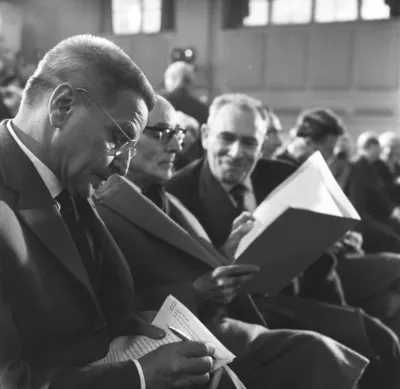
Wolfgang Langhoff
Human Design Chart
Biography
Three months later, in June 1934, he fled to Switzerland, just before the closure of the border. At the Schauspielhaus in Zurich, he found shelter and work as a director and actor.
Langhoff played Eilif in the first production of Bertolt Brecht's Mother Courage and Her Children, which opened at the Schauspielhaus Zürich on 19 April 1941. He also performed in the first production of Brecht's Life of Galileo, which also opened at the Schauspielhaus Zürich, on 9 September 1943.
He played Ernst Mehlin in Konrad Wolf's film Genesung (1956), von Geir in Nikola Korabov's Tyutyun (1962), and Professor Holt in Joachim Kunert's Die Abenteuer des Werner Holt (1965); he also appeared in Kurt Maetzig and Günter Reisch's Das Lied der Matrosen (1958). On television, he appeared in Hans-Joachim Kasprzik's mini-series Wolf Among Wolves (1965).
It is on the strength of his productions of classical texts at the Deutsches Theater in Berlin, a theatre which he led from 1946 to 1963, that Langhoff's fame as a director rests. His notable productions there include Goethe's Faust (1949 and 1954, productions in which he also played Mephisto) and Egmont (1951), Schiller's Don Carlos (1952), Shakespeare's King Lear (1957) and Lessing's Minna of Barnhelm (1960).
Wolfgang Langhoff was married to the actress Renata Edwina Malacrida, who bore him two children, Thomas (1938) and Matthias (1942). He died on 25 August 1966 in Berlin, aged 64.
Human Design Analysis: Wolfgang Langhoff as Manifesting Generator 4/6
Manifesting Generator 4/6 — Design at a Glance
Wolfgang Langhoffs design features a tendency towards hybrid energy: He has the constant power of a Generator but also possesses through specific connections the ability to skip steps and quickly draw results into his life. This configuration creates a tension between the necessity to respond to inner impulses and the urge for immediate implementation.
As an Manifestor Generator, his strategy is not to take initiative but rather to wait until life presents him with a question or stimulus before responding from his defined Sacral Center. Only when this internal resonance signals a clear "yes" should he act. This waiting period serves to ensure that the immense speed at which he initiates projects is based on genuine enthusiasm and not impulsive haste.
Without following this sequence, his design tends to skip important intermediate steps or start multiple initiatives simultaneously, quickly leading to frustration – his specific feeling of non-self. However, if he maintains the strategy of reaction and regularly checks whether his authority still supports the current path, he can use this speed to fall into a productive play mode. In this state, he draws deep satisfaction from his work as variation and parallel working then do not act as distractions but rather as sources of his vital energy.
Sacral Authority
Wolfgang Langhoff revealed himself as someone whose decision-making relied on direct physical resonance. His design indicated a tendency not to act through intellectual analysis but rather to trust inner signals. As a Generator, his strategy was identical to his inner authority: the Sacral Authority. This mechanism simplified his process since he did not need to consult external sources to find the right direction.
A prerequisite for this clarity was his open Emotional Center, ensuring that decisions were not made in emotional waves. Instead, Wolfgang Langhoff reacted to external stimuli with an immediate "gut feeling." This manifested as a surge of energy or spontaneous vocalizations like grunts or hums. Such positive reactions signaled that his Sacral Motor had kicked in; he then felt vital and possessed inexhaustible energy.
Additionally, his activated Spleen acted as a supportive authority. This connection allowed him to react particularly quickly and spontaneously. He had direct access to his instinctive perception and physical well-being. Wolfgang Langhoff was guided by this intuitive security, which enabled him to immerse himself fully in his activities. He acted with great enthusiasm and without aimlessness, driven by the joy of the activity itself. This configuration marked him as a person who moved through life listening to his bodily signals and using them reliably as a guide.
The 4/6 Profile — Opportunist / Role Model
Wolfgang Langhoffs design laid a tendency to define himself through intensive experimentation in the first three decades of his life. The Profile 4/6 initially acted like Line 3: He actively sought connections and learned from direct experiences, particularly in the social context of relationships and friendships. This phase served as the necessary trial period before the deeper structure of the profile matured.
With Saturn's return, his orientation fundamentally shifted. The internal conflict between Heart (Line 4) and Head (Line 6) became active. Wolfgang Langhoff now faced the tension of belonging to a community while maintaining distance to think about meaning. This duality shaped his later development into an role model.
His energy profiles showed specific patterns: The fourth line of Gate 48 connected talent with the risk of deep frustration in long-term goals. Short-term projects were preferred for him, as limitations were necessary to uncover new depth and prepare restructuring. Parallel to this, Line 6 of Gate 39 acted as altruistic problem-solving. This gift was designed to enable others the right spirit but was often perceived as provocative and took a long time to be accepted in his environment. Wolfgang Langhoff had to learn to patiently endure this mutation while finding his role in the collective through cooperation and wise leadership.
Triple Split Definition — Defined & Open Centers
Wolfgang Langhoff revealed himself as someone with an extremely stable inner structure. His design featured six defined centers, creating a rare density of consistent energy. The defined G Center gave him a firm identity and clear direction; he knew who he was and where he belonged without imposing this on others. Parallel to this, the defined Heart Center stood for reliable willpower: He could keep promises and determine his own resources, which strengthened his self-esteem.
His mental field was marked by the defined Ajna Center, in conjunction with the defined Throat creating a constant, trustworthy form of expression. He thought consistently and spoke out what he had processed conceptually – his voice was the direct translation of his mind. This mental clarity was reinforced by the defined Sacral Center with vital life force; as a generator, he possessed enormous endurance as long as he responded to external stimuli rather than initiating them. The defined Spleen Center provided spontaneous intuition and health in the present moment, while the defined Root Center supplied a steady push to move forward materially and existentially.
In contrast, two sensitive areas were revealed through his undefined centers. The open Head Center made him vulnerable to mental confusion; he tended to feel the pressure of finding answers to questions that did not belong to him, and could be trapped in doubt if he did not trust his authority. Similarly, the Solar Plexus was open: He absorbed and amplified the emotions of his environment, making him emotionally vulnerable. He had to learn not to personalize these foreign feelings to protect himself from exhaustion caused by emotional waves of others. His design required a balance between his strong inner stability and conscious distancing from external mental as well as emotional noise.
Channels for rhythm, structure, value and life meaning.
Wolfgang Langhoff's design tended to firmly establish the energy flow in his environment through his own, unmistakable rhythm. This primarily occurred via Channel of Rhythm 5-15, connecting the Sacral Center with the G Center. Gate 5 held onto fixed habits and rituals, while Gate 15 integrated the extremes of humanity into life's current. This combination generated a magnetic pull that drew others impersonally into his rhythm and directed them forward without being influenced by reason or emotional waves. His timing was intuitive and deeply logical; when he followed this inner flow, everything seemed effortless and promoted the well-being of those around him.
Parallel to this, there was a strong orientation towards the material plane and will formation through Channel of the Money Line 21-45. This channel connected Heart with Throat Center. Gate 21 of the Hunter aimed for control to protect his own heart and serve effectively, while Gate 45 of the Gatherer represented an authoritative voice deciding over resources and loyalty. For Wolfgang Langhoff, this meant a constant struggle for independence: He worked best when he was his own boss and controlled the framework of his activities himself, as delegation often felt like a burden.
His intellectual expression occurred through Channel of Structuring 23-43, connecting Ajna with Throat Center. Gate 43 provided spontaneous insights that Gate 23 assimilated and clearly articulated. This allowed him to formulate innovative perspectives promoting efficiency. However, this process required time; his knowledge worked like light-years ahead, making acceptance only possible at the right moment.
The driving force behind his actions came from Channel of Life Struggle 28-38 between Root and Spleen Center. Gate 38 exerted pressure to defend individual integrity against external distractions, while Gate 28 recognized which struggles had value. This gave him a stubborn determination to walk his own path and find deeper meaning in the difficulties of life, making him an example for others.
Individual Circuitry — Circuit Signature
Wolfgang Langhoff's design tended towards three separate, parallel functioning energetic focal points. This triple definition meant that these areas did not flow into each other but existed as independent fields of power. A first strand connected Ajna with Throat Center (Structuring) and Spleen with Root Center (Life Struggle). Here, the ability to clearly articulate thoughts and an instinctive reaction to dangers or challenges was shown separately from one another. A second, isolated stream flowed between Identity and Sacral Center (Rhythm), giving him a focused, strategic orientation with consistent life energy that did not directly communicate with the other areas. The third block connected Throat with Heart Center (The Money Line). Here it was about jointly creating resources and material well-being through contracts and mutual support. Although the Throat Center appeared in two different groups, these connections were energetically unlinked; they formed separate channels for expression on one hand and resource-oriented cooperation on the other. Overall, these three independent systems shaped his actions: strategic planning, instinctive structuring, and resource-aware partnerships worked alongside each other without forming a single continuous flow.
Right Angle Cross of Tension 3
Wolfgang Langhoffs design sets a tendency towards inner tension, marked by the right cross of tension 3. This configuration describes a life task where a constant struggle between the need for security and the urge for change is evident. It was not a static state but rather a dynamic force that pushed him to test boundaries and seek new paths.
The mechanics of this cross acted like an inner compass, guiding him towards challenges. Instead of passively waiting, he actively sought situations where he could prove his resilience. This led him to often find himself in phases of transformation that were both taxing and enriching. The tension arising from this configuration served as a motor for his growth and development.
Wolfgang Langhoff used this energy to continuously further develop himself. He showed himself to be someone who did not avoid difficulties but saw them as opportunities to look deeper within himself. This attitude shaped his life path significantly, allowing him to draw something valuable from every experience towards his personal maturity. The right cross of tension 3 was thus a central aspect of his personality, driving him always to seek more depth and authenticity.
Saturn Return · Uranus Opposition · Chiron Return · 2nd Saturn Return — Life Cycles
Wolfgang Langhoffs design points to a tendency towards structured and responsible roles that solidify during phases of maturity. His second Saturn return around the age of 57 marked a phase where long-term commitments and inner discipline came into full fruition – often leading to deeper engagement with existing paths rather than radical breaks. This was concretely evident in 1958 when he turned 57 and appeared as an actor in "Three Sisters." This event underscored the Saturn energy: his work was no longer experimental but a result of seasoned mastery and consistent dedication to his art.
Previously, during his Chiron return at age 49 in 1950, another dynamic became apparent. The Chiron cycle is not a healing process in the psychological sense within Human Design, but rather an achievement cycle – the "bloom" where one's incarnation cross becomes experientially meaningful if strategy and authority are observed. At this age, Langhoff directed "The Great Betrayal" and "The Inspector." These career-relevant steps were expressions of his inner compass now clearly translating into external actions. The combination of these two cycles illustrates a developmental trajectory: from the personal validation of the Chiron return to a stable structural anchoring in the Saturn cycle. Thus, his design did not promote impulsive changes but rather a cumulative deepening of his artistic identity through continuous practice and increasing authority in his field.
Manifesting Generator · Sacral Authority — Synthesis
Wolfgang Langhoff lived a life path characterized by an inner dynamic between sacral energy and mental definition. As a Manifesting Generator (MG), he had the ability to constantly react to impulses through his defined Sacral Center, quickly initiating things – a quality amplified by his connection to the Throat Center. Simultaneously, a defined mental center shaped his tendency to form concepts and pursue them with persistence. This flow of reaction and conceptualization, supported by the Rhythm Channel, created a lifestyle in which he lived both in the present moment and developed long-term visions.
A central paradox lay in the tension between the desire for connection and the need for individuality. The Profile as Networker/Role Model indicates a longing to be part of a community and stand out through cooperation, while the right cross of Spannung 3 signals an inner detachment and a drive for independent creation. This interplay between heart and head, community and individuality, led to a life in which he both nurtured relationships and sought his own path – a balance that was evident in key career moments.
4 Defined Channels
Incarnation Cross - Right Angle Cross of Tension 3
Solar Return
The Solar Return shows the moment when the sun returns to its exact birth position - your personal solar year.
Life Cycles
Discover the life cycles with a detailed triple view (birth chart, cycle chart, composite).
Human Design Profile
- Strategy
- To respond - wait for something to respond to
- Authority
- Sacral Authority
- Profile
- 4/6 - Opportunist / Role Model
- Definition
- Triple Split
- Incarnation Cross
- Right Angle Cross of Tension 3
- Date of Birth
- 06.10.1901 08:00
- Place of Birth
- Berlin-Charlottenb., Germany
Frequently Asked Questions
What was Wolfgang Langhoff's Human Design type?
What Profile did Wolfgang Langhoff have in Human Design?
What Authority did Wolfgang Langhoff have?
Which incarnation cross was active for Wolfgang Langhoff?
When was Wolfgang Langhoff born?
Discover your own Human Design
Are you also a Manifesting Generator? Find out in a personal reading how to unfold your multi-talents and direct your energy wisely.
More Personalities
Back to overviewSissy Spacek
Aldair

Alizée

Anémone
Angeli

Ann-Margret