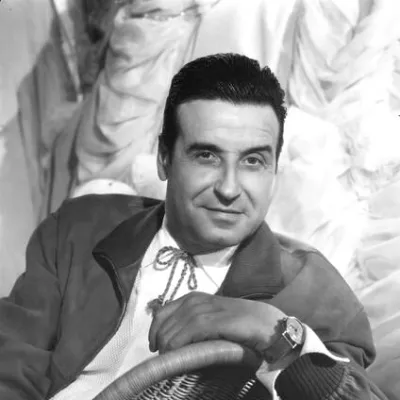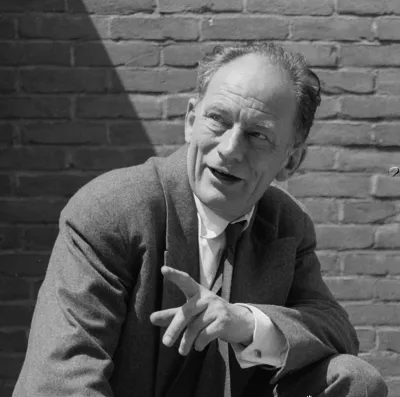
Wolfgang Staudte
Human Design Chart
Biography
His most important work came in the ten years following World War II, in which he worked with the DEFA in East Germany. The main focus of his work was to highlight the limits of German national pride.
Following 1956 he worked in West Germany. By the 1970s, his work was no longer considered particularly modern and he moved to television, on shows such as Der Kommissar and Tatort.
Death 19 January 1984.
What does Projector 6/2 mean for Wolfgang Staudte?
Projector 6/2 — Design at a Glance
Wolfgang Staudte revealed himself as someone who could identify weaknesses in systems and interpersonal dynamics with almost unerring sharpness. As a Projector, he did not have an intrinsic source of life energy like other types; instead, his aura was focused and dense, comparable to a bright light beam directed at dark, inefficient areas. This ability to immediately pinpoint flaws in the system could be perceived as aggressive when he openly addressed these deficiencies in direct confrontation mode. His optimal expression lay therefore in passive radiance of competence and clarity. By embodying harmonious structures himself, he attracted others who then actively sought his advice. His strategy was to wait for an honest invitation before sharing his knowledge. Without this recognition or under forced work conditions, he would enter phases of exhaustion due to his undefined Sacral Center not providing consistent energy. If he did not live by this principle, it led sooner or later to the experience of bitterness as an expression of his non-self. Success and reward were natural consequences when he took on the role of a Leader showing others the way rather than instructing them.
Splenic Authority
Wolfgang Staudte demonstrated decision-making based on a fine, immediate inner signal. His internal authority lay in the defined Spleen Center, which presupposed that both his Emotional as well as his Sacral Centers were open – a configuration only Projectors or Manifestors can carry. The Spleen functioned as a highly sensitive alarm system and health center. It did not provide long-term strategies but spontaneous survival knowledge: An intuitive impulse in the present moment indicated whether a situation, environment, or person was healthy for him or not. This first impulse was crucial; it served direct self-care and enabled him to rigorously distance himself from harmful influences. Since this signal was very subtle and only appeared once at the moment, Staudte needed high vigilance to not overlook it or have it drowned out by external advice. Plans were less relevant for him than immediate fit; long-term commitments often seemed obstructive as what was right only showed itself in the moment. Flexibility and free space were therefore not an option but existential necessity to follow this inner voice. A retreat helped him clearly perceive this fine impulse before acting.
The 6/2 Profile — Role Model / Hermit
Wolfgang Staudte's design indicated a tendency towards a two-phase life development: early experimentation followed by deep reflection. As a 6/2-Profile, the energy before his thirtieth year manifested like a 3-line, driven by trial and error. During this phase, he gathered numerous personal experiences, with retreats after mistakes forming the driving principle. The Line 2 projecting through Gate 53 outwardly propelled new beginnings, often leading to early success but also fostering impatience and unwise actions until a clear invitation was received.
After his thirtieth year, Line 6 activated metaphorically pulling him into distance to look back at his earlier experiments with great clarity. This phase of intense self-knowledge served healing and understanding of his depth. Gate 48 enabled him later to make this gained wisdom accessible to others. From his 'cave', he became a role model whose introspection could attract others to share in this life experience. The development led from the impulsive start towards shared, intuitive clarity and self-realization.
Split Definition — Defined & Open Centers
Wolfgang Staudte revealed himself as a person under constant mental pressure to question and understand connections. His defined Head Center and Ajna Center generated a continuous inspiration, but did not provide direct energy for implementation. This state often led to inner concern or confusion, as the mind was constantly active without immediate options for action. The challenge lay in not interpreting this pressure as a lack of willpower, but rather as a source of ideas that were available to others.
At the same time, Staudte had a defined Spleen Center, which gave him intuitive bodily intelligence. This allowed spontaneous judgments in the here and now, independent of rational thought. His defined Root Center also provided a fixed adrenergic pressure that propelled him forward and fostered existential awareness. This combination of mental questioning, intuitive perception, and physical drive shaped his fundamental approach.
In contrast, he had open centers in Throat, G Center, Heart, Sacral, and Solar Plexus areas. His undefined Throat Center tended to speak out the pressure or demand attention if not waiting for the right invitation. His open G Center meant a lack of fixed identity; he relied on relationships and places to initiate direction finding. The open Heart Center made him vulnerable to attempts to prove his worth through promises or competition, which often ended in self-doubt. Additionally, his open Solar Plexus absorbed foreign emotions while his undefined Sacral Center did not provide constant generative energy but was sensitive to the vitality of the environment. These opennesses required a constant boundary setting from conditioning influences to avoid exhaustion or emotional confusion.
Channels for critical analysis and ambitious transformation.
Wolfgang Staudte revealed himself as someone whose mind was marked by a constant, almost nervous scrutiny of reality. His design indicated a tendency to not simply accept patterns but to test them for their consistency through the Channel 63-4, connecting the Head Center with the Ajna Center and ensuring that doubt served as an essential tool to uncover logical errors. An answer was only considered true if it could be practically verified; unfounded belief had no place here. Staudte's mind continuously filtered information to determine whether an approach is sustainable or breaks down.
This skeptical fundamental attitude was driven by the Channel of Transformation 54-32, which linked ambition with persistent effort. Motivated by the fear of failure and a desire for recognition from his community, he worked hard to secure his position and use his talents to support the "tribe" – that is, his environment or audience. This channel demanded an exchange: support was only given if it proved useful.
Additionally, individual Gates with specific focuses came into play. Gate 48 promoted the recognition of deeper connections and patterns, often accompanied by a certain frustration when these could not be implemented. Gate 21 brought a drive for control over material things and a need for respect in service to the community. Gate 53 initiated new developmental cycles and allowed him to act as a pioneer leaving old paths behind, although incomplete closures could lead to depression. Overall, this configuration shaped a person who exerted his influence through logical rigor, social ambition, and pattern recognition skills, always seeking reliable structures in an ever-changing world.
Collective Circuitry — Circuit Signature
Wolfgang Staudte's design inclined towards clear and structured analysis. The Mind Circuit shaped this approach: it connected his Head Center with the Ajna Center via the Logic Channel. This configuration promoted the ability to logically process information and strategically use it for future solutions. It was pure reason, free from emotional coloring by the Solar Plexus Center, making decisions appear objective and focused.
Parallel to this, a separate stream emerged from the Ego Circuit. This connected the Spleen and Root Centers via the Transformation Channel. Here, individual identity was not at play but rather clan dynamics: the collective creation of resources through cooperation. Since there was no connection to the Sacral Center, constant life force was lacking; instead, rest periods were necessary to regenerate energy for these communal tasks.
The Split Definition meant that these two systems – cognitive strategy and clan-based resource building – did not directly overlap with each other. They existed as parallel forces alongside one another. Wolfgang Staudte therefore had to consciously switch between analytical planning for the future and practical, supportive cooperation in the present moment without these areas automatically forming a single, cohesive experience.
Left Angle Cross of Endeavour 2
Wolfgang Staudte revealed himself as someone whose inner drive was strongly shaped by the desire to achieve something through consistent effort and action. His design carried the signature of the "left cross of effort 2." This configuration did not describe a passive stance, but rather a deep conviction: that true understanding and real results could only be achieved through active engagement and the completion of tasks. He was not interested in mere theory or an abstract world of ideas; instead, he aimed to set things in motion and see them through to their conclusion.
The mechanics of this cross suggested that Staudte drew his strength from tackling challenges head-on. He likely sought ways to translate intentions into tangible reality. For him, it was crucial not just to think about the process but to experience and shape it. The "left cross" often pointed to a certain sense of urgency – a feeling that time is precious and that hesitation diminishes effectiveness. Staudte lived this dynamic by diving into projects that challenged his will to implement change. It mattered less whether the path was easy; what was crucial for him was to act and learn how his efforts influenced the outcome. This attitude shaped his way of interacting with the world: actively, engaged, and always grounded in the realm of the possible.
Saturn Return · Uranus Opposition · Chiron Return · 2nd Saturn Return — Life Cycles
Wolfgang Staudte's design presented a dynamic that became particularly evident during turning points in his life. In 1946, at the age of 40, he created the first post-war German film "The Murderers Are Among Us." This fell within his Uranus opposition, a cycle often marking radical breaks and new beginnings when old structures no longer seem sustainable.
In 1955, at the age of 49, Staudte definitively left DEFA and permanently settled in West Germany. This step marked his Chiron return. In this fulfillment cycle, one's incarnation cross unfolds increasingly in life; meaning and purpose become experiential if one has lived according to strategy and authority. It was not a healing of old wounds but a blossoming period of self-realization.
In 1960, he received the Federal Film Prize for "Roses for the Prosecutor," but declined it. At age 54, he was in his second Saturn return. This cycle often condenses years of groundwork into a solid result and demands a deep engagement with one's responsibility and legacy. The refusal of the prize underscored the inner integrity that spoke from this configuration: personal standards were valued higher than external recognition.
Projector · Splenic Authority — Synthesis
Wolfgang Staudte lived an internal continuity of observation and analysis. His Projector design, combined with the defined Head Center and Ajna Center (Channel of Logic), predisposed him to recognize patterns and penetrate the workings of complex systems. This ability to identify flaws in a system (Gate 63) was always accompanied by an inner pressure to formulate questions and seek answers – a constant filtering of information to ensure stability. The recurring successes, evidenced by awards and his first post-war film, were revealed during phases of deep reflection (Profile 6/2), from which he emerged with wisdom to inspire others.
A central paradox lay in the way Staudte shared his insights. As a Projector, he needed an invitation to share his knowledge, yet his Spleen Center demanded an immediate, instinctive reaction to his environment. This led to a tension between the desire to light the path and the risk of provoking resistance with his direct address. The career decision to leave DEFA (Chiron Return) and the refusal of the Federal Film Prize (Saturn Return) pointed towards a boundary – an expression of inner authority that placed his well-being above societal expectations.
2 Defined Channels
Incarnation Cross - Left Angle Cross of Endeavour 2
Solar Return
The Solar Return shows the moment when the sun returns to its exact birth position - your personal solar year.
Life Cycles
Discover the life cycles with a detailed triple view (birth chart, cycle chart, composite).
Human Design Profile
- Type
- Projector
- Strategy
- Wait for the respectful invitation
- Authority
- Splenic Authority
- Profile
- 6/2 - Role Model / Hermit
- Definition
- Split Definition
- Incarnation Cross
- Left Angle Cross of Endeavour 2
- Date of Birth
- 09.10.1906 00:30
- Place of Birth
- Saarbrücken (Saarland), GER
Frequently Asked Questions
What is Wolfgang Staudte's Human Design type?
Which Profile did Wolfgang Staudte have?
What Authority Did Wolfgang Staudte Have?
Which incarnation cross was active for Wolfgang Staudte?
When was Wolfgang Staudte born?
Discover your own Human Design
Are you also a Projector? Find out in a personal reading how to unfold your leadership qualities and recognize the right invitations.
More Personalities
Back to overviewSissy Spacek

Alain-Fournier

Anémone

Ann-Margret

Bourvil
Christian-Jaque