
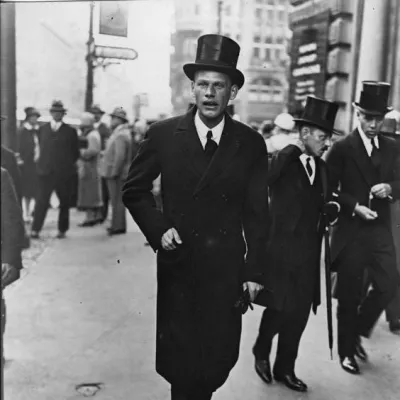
Wolfgang Stresemann
Human Design Chart
Biography
He was the son of the German statesman and Nobel Peace Prize laureate Gustav Stresemann and his wife Käte, born Kleefeld.
From 1939 to 1956 he had emigrated to the United States with his mother.
His daughter Christina (born 1957) is a Judge at the Federal Court of Justice of Germany.
He died on 6 November 1998 in Berlin, aged 94.
Wolfgang Stresemann — Manifesting Generator with Profile 2/4
Manifesting Generator 2/4 — Design at a Glance
Wolfgang Stresemann was someone who possessed a hybrid energy: the constant power of a Generator paired with the lightning-fast effect of a Manifestor. His design suggested that he could draw things into his life by skipping steps – a capability that came with two major pitfalls. First, he tended to be too quick, missing important stages, which forced him to backtrack and make up for lost time, leading to frustration, his non-self theme. Second, he reacted to many impulses simultaneously, starting multiple projects at once. Without the inner approval of his sacral center and authority, his creative drive easily tipped into overwhelm.
His strategy was clear: not to initiate but to react to life. Only when his sacral center gave a clear “yes” after an “antest” should he start. Regular checks to see if the projects were still fun were essential. With the correct application of this strategy, Wolfgang Stresemann drew deep satisfaction from his work. Parallel work then was not a problem but a source of his energy. He lived in a “play mode,” where variety fueled his strength rather than wore him down. His design challenged him to maintain this balance between speed and inner resonance to avoid frustration and to use his unique hybrid energy constructively.
Sacral Authority
Wolfgang Stresemann's decision-making process was marked by direct physical resonance. As a Generator, he had sacral authority, which also served as his strategy and inner guidance. This configuration simplified his choices, as he did not need to think but could listen to his body. His responses showed as spontaneous reactions to external stimuli: an inner “mhm” signaled agreement and energy, a “hm-hm” disagreement.
A prerequisite for this clear guidance was his open emotional center, ensuring he did not act impulsively but waited until the emotional wave had subsided. When his sacral center was engaged, he felt vital and alive. He then had an inexhaustible energy source that allowed him to dive fully into his activities. This happened without compulsion or purposefulness but purely out of enthusiasm.
Additionally, his activated spleen center acted as supportive authority. This connection gave him a quick, instinctive perception. He could immediately access his physical well-being and make decisions that felt intuitively right. This combination of sacral confirmation and spleen-based intuition allowed Wolfgang Stresemann to reliably guide himself from his inner compass. He showed himself as someone who moved through life by laughing at the signals of his body and finding energy where his innermost self said “yes”.
The 2/4 Profile — Hermit / Opportunist
Wolfgang Stresemann's design set a tendency for a pendulum rhythm between deep withdrawal and close social exchange. As a 2/4 profile, he constantly oscillated between the need of the hermit to be alone and the urge of the community line to spend time with chosen intimates. This configuration required clear communication of his boundaries: he signaled when he sought company and when he needed to remain undisturbed in his “cave.” In these phases of isolation, he immersed himself in internal processes, clarified his thoughts, and reflected on the collected knowledge of his network to develop new ideas.
This process was marked by specific energetic patterns. Gate 56 in his design represented connection and genius, with Uranus standing for an isolated genius who found continuity through recognition. Simultaneously, Gate 3 with its line of charisma was at work. This energy drew guidance through a magnetic, almost extrasensory attraction, and also helped to create order from the often resulting confusion. Neptune enhanced in this area tuned his body like an instrument that received external information. Wolfgang Stresemann used this combination to evaluate the impulses received in solitude and reintroduce them in his community as brilliant, orderly insights. His path was marked by this necessary balance: withdraw to understand, and emerge to connect.
Split Definition — Defined & Open Centers
Wolfgang Stresemann's design indicated a tendency towards consequent willpower and mental structure. His defined Heart Center provided a constant source for ego and resource control; he acted out of the need to keep promises and prove his own worth. This energy flowed through his defined Throat Center, which served as a pivot point for communication. Since his Throat was connected to the Ajna Center, he consistently spoke what his conceptual thinking conceptualized. His defined Mind worked tirelessly on theories and concepts, unaffected by external opinions, and transformed these into clear statements.
At the same time, as a Generator, he had a defined Sacral Center, which provided immense vital energy. However, this power was released not through initiatives but through reactions to life. His defined Root Center provided the necessary pressure to maintain this life impulse and move forward in the material world.
In contrast, his vulnerability was evident in the open centers. His open Head Center made him susceptible to external inspirations and the pressure to find answers to questions that were not his own. He tended to indulge in mental monologues influenced by others' doubts. His open G Center meant he did not have a fixed identity; he mirrored the direction and love of his environment and often sought a place where he felt belonging rather than upholding a rigid identity of his own. Additionally, his open Solar Plexus absorbed the emotions of others, prompting him to distinguish between foreign feelings and his own emotional clarity to avoid conditioning. His open Spleen Center made him sensitive to well-being but warned him against impulsive decisions based on fear or false security.
Channels for curiosity, transformation and material security.
Wolfgang Stresemann's design indicated a tendency towards evolutionary change, paired with a deep, often melancholic innerness. This attitude resulted from the Channel of Mutation 60-3, which connected the Root Center with the Sacral Center. Gate 60, the Gate of Limitation, required the acceptance of boundaries, while Gate 3, the Gate of Order, sought to realize new possibilities. This connection generated a pulsating energy that oscillated between chaos and order. Wolfgang Stresemann was seen in phases of silent development, waiting patiently for the next impulse rather than filling the inner void with rational explanations. The melancholy that appeared in the pauses of this energy was not a sign of weakness but part of the mechanical process that produced innovation.
Alongside this deep inner dynamics, the Channel of Curiosity 11-56, which connected the Ajna Center with the Throat Center, was influential. Gate 11, the Gate of Ideas, sought new perspectives, while Gate 56, the Gate of Inspiration, told these as stories. Wolfgang Stresemann used this ability not only to gather information but to transform it into captivating narratives that inspired others. His stories served to make complex connections understandable and to stimulate the imagination of listeners.
Another defining aspect was the Channel of the Money Line 21-45, which connected the Heart Center with the Throat Center. Gate 21, the Gate of the Hunter, sought control and independence, while Gate 45, the Gate of the Gatherer, ensured the authority and protection of resources. Wolfgang Stresemann showed a strong desire to master the material plane and take responsibility, often by acting independently to maintain his own rhythm.
Additionally, Gates like Gate 50 with its protective reflex and Gate 47 with its ability to draw meaning from past experiences contributed to his awareness. Gate 33 promoted reflection, while Gate 39 contributed to mutation through provocation and analysis. Gate 52 required focused pauses for pattern correction, and Gates like 23, 17, and 24 supported processes of communication, succession, and mental renewal.
Collective Circuitry — Circuit Signature
Wolfgang Stresemann's design indicated a tendency towards separate, parallel operating energy fields that did not act as a continuous flow but as distinct areas of his experience. This structure resulted from his Split Definition, which formed two isolated groups: one in the lower body and one in the upper.
In the lower area, the Knowledge Circuit connected his Sacral with the Root Center. Through the Channel of Mutation (Gates 3-60), here a pulsating energy was evident, aimed at following the unique path and transforming new knowledge through deviation from the known. This shaped a basis that relied on individual change and the creation of new realities.
Simultaneously, in the upper body, a separate field existed that connected the Ajna with the Throat Center. Here, the Meaning Circuit operated through the Channel of Curiosity (Gates 11-56). This connection served to reflect emotional waves from the past and find meaning behind past events, sharing these insights visually and cyclically with others.
A third, also isolated element was the Ego Circuit, which connected the Throat with the Heart Center. Through the Channel of the Money Line (Gates 45-21), this was about cooperation, the joint creation of resources, and a balanced relationship of giving and taking. Since there was no connection to the Sacral Center, this area required pauses for regeneration of energy for the collective. Wolfgang Stresemann thus lived with these three clearly delineated energetic focal points, each with its own tasks, without directly mixing.
Right Angle Cross of Laws 2
Wolfgang Stresemann's design was characterized by the right cross of Laws 2. This configuration, resulting from specific Gate combinations, established an internal tension between the pursuit of personal integrity and the necessity to integrate into existing systems or partnerships. In Human Design, the right cross of Laws 2 often symbolizes the challenge of maintaining one's own boundaries while simultaneously reacting to external authorities or established rules. Wolfgang Stresemann thus emerged as someone who defined his identity not in isolation but in dialogue with his environment. His life energy did not flow into unilateral imposition but into the negotiation of values and norms. This meant that he always navigated between the desire for autonomy and the adaptation to collective expectations. The mechanics of this cross suggest that true strength for him lay in not resolving this polarity but in using it as a driving force. He lived the dynamics that law and freedom condition each other. His path was marked by the constant testing of when to adapt and when to assert his own standards. This balance was not a static state but a continuous process of self-discovery through interaction.
Saturn Return · Uranus Opposition · Chiron Return · 2nd Saturn Return — Life Cycles
Wolfgang Stresemann's design showed a tendency towards structural anchoring and the establishment of sustainable systems that went beyond fleeting impressions. This configuration shaped his life through a focus on stability and institutional responsibility.
At the age of 49, in 1953, he married Mary Jean Athay in Munich. This point fell into the Chiron Return, a cycle of fulfillment and bloom. Here, the individual incarnation cross unfolds increasingly in life, provided one has lived according to strategy and authority beforehand. Meaning and purpose become experiential, not as a healing of wounds but as the realization of the deepest potential. The marriage thus marked a phase of personal fulfillment and stability.
Six years later, in 1959 at the age of 55, he became the director of the Berlin Philharmonic Orchestra. This corresponded to the second Saturn Return, a phase in which long-term groundwork condenses into durable results. The design promoted the assumption of leadership roles in established structures here. The combination of personal fulfillment in the Chiron cycle and professional consolidation in the Saturn Return underscores the life task of supporting and leading enduring institutions through discipline and dedication.
Manifesting Generator · Sacral Authority — Synthesis
Wolfgang Stresemann lived a life marked by an inner dynamics that was evident in the constant interaction between the need for independent thinking and the ability to draw energy from contact with others (Profile 2/4). His defined mental center (Ajna) enabled him to develop and refine concepts, while his sacral access (Manifesting Generator) propelled him to bring these ideas into the world – often at a speed that occasionally forced him to repeat steps. This combination of inner conception and sacral reaction formed the thread of his work, providing him both the vision and the energy to implement it.
Stresemann was a person who oscillated between the desire for isolation and the need for community. The defined Ajna center, which provided him with consistent thought patterns, was in tension with the impulse-driven energy of the sacral center and the channel of Mutation (3-60). This led to an inner paradox: on the one hand, the pursuit of clear concepts and a personal path, on the other hand, the willingness to embrace new possibilities and initiate changes – a dynamic interplay marked by melancholic phases and the acceptance of limitations (Gate 60).
3 Defined Channels
Incarnation Cross - Right Angle Cross of Laws 2
Solar Return
The Solar Return shows the moment when the sun returns to its exact birth position - your personal solar year.
Life Cycles
Discover the life cycles with a detailed triple view (birth chart, cycle chart, composite).
Human Design Profile
- Strategy
- To respond - wait for something to respond to
- Authority
- Sacral Authority
- Profile
- 2/4 - Hermit / Opportunist
- Definition
- Split Definition
- Incarnation Cross
- Right Angle Cross of Laws 2
- Date of Birth
- 20.07.1904 21:00
- Place of Birth
- Dresden, GER
Frequently Asked Questions
What was Wolfgang Stresemann's Human Design type?
What was Wolfgang Stresemann's Profile in his Human Design?
What Authority guided Wolfgang Stresemann's decisions?
Which incarnation cross characterized the life path of Wolfgang Stresemann?
When was Wolfgang Stresemann born?
Discover your own Human Design
Are you also a Manifesting Generator? Find out in a personal reading how to unfold your multi-talents and direct your energy wisely.
More Personalities
Back to overviewAaliyah

Aldair

Alexia

Alizée

Angèle

Angeli
