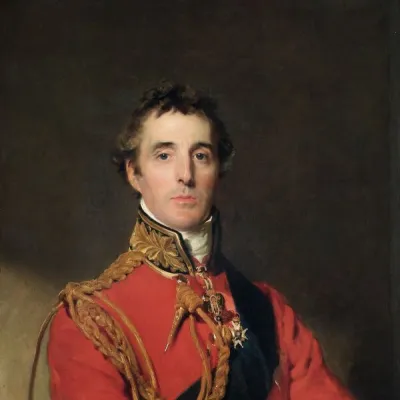
1st Duke of Wellington Arthur Wellesley
Human Design Chart
Biography
Wellesley was married by his brother Gerald, a clergyman, to Kitty Pakenham in St George's Church, Dublin on 10 April 1806. They had two children: Arthur was born in 1807 and Charles was born in 1808. The marriage proved unsatisfactory and the two spent years apart, while Wellesley was campaigning and afterwards. Kitty grew depressed, and Wellesley pursued other sexual and romantic partners.
Wellesley died after a stroke on 14 September 1852 at age 83 in Walmer Castle, Kent, England.
The Human Design of 1st Duke of Wellington Arthur Wellesley: Manifesting Generator 3/5
Manifesting Generator 3/5 — Design at a Glance
Arthur Wellesley's design revealed a hybrid nature that combined the swift manifestation ability of a Manifestor with the enduring energy of a Generator. This configuration allowed him to skip steps and achieve results quickly, but this speed came with risks: Often his actions were too rapid, causing important stages to be overlooked. Such gaps required remediation later on, which led to frustration – a typical non-self theme for this constellation. Additionally, his system tended to pick up multiple impulses simultaneously and start diverse projects in parallel. Without strict adherence to his inner strategy, such multi-tasking threatened to erode his creative drive.
The solution lay in reacting rather than initiating. Only when the sacral center – the source of his constant energy – responded with a clear 'yes' to an impulse did he act effectively. Regularly reviewing this internal validation was crucial to ensure that started paths continued to resonate. When this strategy was followed, deep satisfaction ensued. In this state, parallel work was no barrier but rather a source of vitality. His creative power flourished in the 'play mode', characterized by variety and spontaneous joy in action. Only under these conditions could his unique speed serve without overburdening him or driving him into ineffective haste.
Emotional Authority
The first Duke of Wellington demonstrated an underlying disposition where immediate judgments were recognized as misleading. His design suggested that true clarity does not lie in the initial impulse but emerges after intense emotions have subsided. This stems from his emotional authority: The defined solar plexus center carries the inner decision-making power. Regardless of other defined centers, this emotional wave always takes precedence. It generates a constant up and down of moods, coloring the world through the current feeling state. A moment of enthusiasm can shift to deep rejection in the next instant. Yet, this snapshot is not the final truth. Quick, spontaneous decisions based on such emotionality can have negative consequences. Instead, his design required patience and temporal distance. By repeatedly sleeping over questions, emotional distance was gained. Intense feelings subsided, calmness ensued. Only then had the process run its course and the decision matured. This mechanism primarily affected long-term decisions with significant influence on life's trajectory. The Duke needed to take time to ensure that the chosen path did not merely reflect a passing mood but was based on deeper insight.
The 3/5 Profile — Martyr / Heretic
1st Duke of Wellington Arthur Wellesley's design inclined him towards initially trying everything himself and exposing false knowledge through personal experience before authoritatively stepping in. As an explorer (Line 3), he trusted little to given advice; his path led through trial and error. This laid the groundwork for his role as hero and savior (Line 5), who acted on behalf of others or for them during crises.
The dynamics between these lines generated a specific tension: The necessary personal failure was a prerequisite for later being perceived as a competent leader. Line 3 enabled him to create new terminology through his own mistakes and expose irrationality. Simultaneously, Line 5 demanded readiness to sacrifice in emergencies, often linked with traditional rituals or a condescending attitude towards those who had not learned firsthand.
This configuration made him attractive to others seeking to learn from his experiences, as he embodied the wealth of practical life experience. The danger lay in public failure during the experimental phase. Only after knowledge was filtered through personal defeats could it be applied for the salvation of others without questioning his authority. His design thus described a path from skeptical experimenter to respected savior in crises.
Single Definition — Defined & Open Centers
Arthur Wellesley, 1st Duke of Wellington's Human Design profile indicated a tendency towards reliable expression and firm inner direction. His defined Throat Center ensured that messages were clearly communicated to the world, while his defined G-Center provided him with a stable self-image and a sense of life purpose. This combination created an identity that was not dependent on external polls but spoke from deep inner security.
The energy source of this system lay in his defined Sacral Center. However, this did not mean initiating power; instead, it was a motor activated only by reacting to external impulses. His vitality was available only when he waited and then responded with a clear yes or no. Initiatives without invitation led to energy loss and frustration.
His Inner Authority resided in his defined Solar Plexus Center. Decisions could not be made in the moment of emotional excitement but required patience for the emotional wave to subside. Only in the subsequent clarity lay the truth of a choice. The defined Root Center provided constant pressure and stress management, maintaining this process.
In contrast stood his open Centers: Head, Ajna, Heart, and Spleen. These areas were situational and susceptible to conditioning. His open Heart Center warned against the trap of making promises or projecting willpower to prove value. As he did not possess this energy consistently, forcing commitments often led to failure. The open Head and Ajna Centers reflected mental inspiration without their own conceptual truth; they tended to identify with foreign questions or doubts if not trusting emotional authority. His open Spleen Center mirrored environmental fears, making spontaneous decisions risky as these were often driven by conditioned fears rather than intuitive wisdom. Thus, the mechanics showed a person whose strength lay in waiting, reacting, and emotionally clarifying, far from mental overload or arbitrary spontaneity.
Channel 2-14: The Beat — Channels & Gates
Arthur Wellesley, 1st Duke of Wellington's Human Design profile indicated a tendency towards constant generative power through mutation. The Beat Channel 14-2 connected the Sacral Center to the G-Center via Gate 14 (skillfully handling power) and Gate 2 (higher knowledge). This configuration offered resources to open new directions by trusting reactions from the Sacral. It was a powerful resource for creative life force, reinforcing direction change without knowing where it would lead.
In contrast stood emotional moodiness due to openness. The Openness Channel 22-12 connected the Solar Plexus Center to the Throat Center via Gate 22 (openness) and Gate 12 (caution). Social interaction here depended on ebbs and flows of the emotional wave; it was possible only during suitable moods. Gate 12 regulated openness by limiting it to people with high mutative potential.
Additionally, an internal ambivalence through juxtaposition occurred. The Synthesis Channel 19-49 connected the Root Center to the Solar Plexus Center via Gate 19 (claims) and Gate 49 (principles). It urged tribal binding and loyalty but was governed by an emotional wave. This created tension between the need for belonging and the conditional nature of this bond.
The Lost Son Channel 13-33 connected the G-Center to the Throat Center via Gate 13 (listener) and Gate 33 (withdrawal). It described a reflective process where experiences were only later transformed into wisdom. One collected memories, withdrew to think about them before sharing.
Further influences came from Gate 24 (mental mutation), Gate 44 (awareness), Gate 45 (tribal level), Gate 52 (concentration), and Gate 54 (ambition). Additionally in the design were Gate 10 (complexity), Gate 15 (collective behavior), and Gate 38 (pressure).
Individual Circuitry — Circuit Signature
Arthur Wellesley, 1st Duke of Wellington's Human Design profile indicated a tendency towards pulsating acoustic creativity, evident in a tight connection between individual identity and collective resource formation. As someone with simple definition, his chart linked all active Centers – Throat, Solar Plexus, Identity, Sacral, and Root – into one continuous energetic flow. This unity shaped him as a person whose inner impulses could directly impact the outside world without internal blockages or isolated energy islands.
The Knowledge Circuit contributed to expressing new identity through transformation. Here two parts were active: He connected Throat and Solar Plexus Centers via the Openness Channel, translating emotional waves into direct expression. Parallel, Identity and Sacral Centers linked via 'The Beat', merging unique individuality with constant life force. Both groups pulsate acoustically now driven by the need to make their own innovations audible.
In the Meaning Circuit, the Lost Son Channel directly connected Throat and Identity Centers. This created a cyclical energy reflecting past experiences and sharing this insight with the collective. The emotional wave here is descending, meaning that finding meaning often occurred through navigating emotional lows.
Finally, the Ego Circuit shaped his ability to cooperate. The Synthesis Channel linked Solar Plexus and Root Centers. This generated rhythmic scissor-energy aiming at mutual support. As no Sacral channel was active in the Ego Circuit, this resource-building dynamics required necessary rest pauses for regeneration. The synthesis of individual creativity and traditional tribal dynamics marked his work: New knowledge wasn't developed in isolation but had to be validated and anchored materially through exchange.
Right Angle Cross of the Four Ways 1
Arthur Wellesley, 1st Duke of Wellington, had a design featuring the right cross of the four pathways. This structure established a specific energetic alignment that remains undefined in the provided data. There are no mechanical details available to derive concrete behavioral patterns or character traits from this configuration. Simply mentioning this cross-configuration does not allow for statements about how this energy manifested in daily life or what specific challenges and strengths were associated with it. Without a descriptive basis for the mechanics of this cross, it cannot be determined whether it represents a driving force in decision-making, a background factor influencing perception, or another dynamic element. The analysis therefore focuses solely on identifying the presence of this structure within the chart. General interpretations are avoided as they do not emerge from the raw content provided. The focus is exclusively on what is explicitly given: the existence of the right cross of the four pathways as part of the design, without further qualitative classification or behavior-specific specification. This ensures that no unfounded assumptions about the personality or destiny of Arthur Wellesley are made that cannot be directly derived from the facts presented.
Saturn Return · Uranus Opposition · Chiron Return · 2nd Saturn Return — Life Cycles
Arthur Wellesley, 1st Duke of Wellington, experienced two significant cyclical turning points that shaped his development. In 1808, at the age of 39, his son Charles was born. This event occurred during the Uranus opposition phase, a period often characterized by sudden and unexpected disruptions in personal life. Such moments break existing patterns and demand rapid adaptation to new realities, which here manifested through the birth of an infant.
Ten years later, in 1818, Wellington achieved his decisive victory over Napoleon at the Battle of Waterloo. This success marked the Chiron return cycle between the ages of 49 and 51. During this phase, one's incarnation cross increasingly unfolds in life; meaning and purpose become experiential if lived according to strategy and authority. It is a period when long-term efforts can lead to mastery. The victory at Waterloo thus represents the peak of this unfolding, where personal responsibility culminated in historical triumph. The mechanics show here the path from disruptive change through the Uranus opposition to full realization of purpose during the Chiron return.
Manifesting Generator · Emotional Authority — Synthesis
The central red thread in Arthur Wellesley's chart is the dynamic interaction between inner strength and the need to manifest this in external action. A defined G Center gives him a clear identity and direction, reinforced by a constant energy supply from his Sacral Center – a combination that enables him to take initiatives and use resources effectively (Channel 14-2). However, this internal strength is complemented by an open Head Center and undefined Spleen Center, making him receptive to external influences and requiring ongoing engagement with new information and potential threats. He is thus driven both by inner conviction and external pressure.
The central paradox lies in the tension between his manifesting Generator type, which drives action, and the open centers that simultaneously expose him to external stimuli. While he possesses the ability to move things quickly (Design), an undefined Spleen Center with its fear of threats and an open Ajna Center with constant intake of new information slow him down. This leads to a dynamic interplay between impulsive actions and the need for reflection, forcing him to use his emotional authority to find clarity in complexity.
4 Defined Channels
Incarnation Cross - Right Angle Cross of the Four Ways 1
Solar Return
The Solar Return shows the moment when the sun returns to its exact birth position - your personal solar year.
Life Cycles
Discover the life cycles with a detailed triple view (birth chart, cycle chart, composite).
Human Design Profile
- Strategy
- To respond - wait for something to respond to
- Authority
- Emotional Authority
- Profile
- 3/5 - Martyr / Heretic
- Definition
- Single Definition
- Incarnation Cross
- Right Angle Cross of the Four Ways 1
- Date of Birth
- 29.04.1769 23:59
- Place of Birth
- Dublin, Ireland
Frequently Asked Questions
What is the Human Design type of Arthur Wellesley, 1st Duke of Wellington?
What Profile does the 1st Duke of Wellington have in Human Design?
Which Authority guides Arthur Wellesley's decisions?
What incarnation cross is assigned to Arthur Wellesley?
When was Arthur Wellesley, 1st Duke of Wellington, born?
Discover your own Human Design
Are you also a Manifesting Generator? Find out in a personal reading how to unfold your multi-talents and direct your energy wisely.
More Personalities
Back to overviewAldair

Alizée

Angeli

Arletty

Artus

Balthus