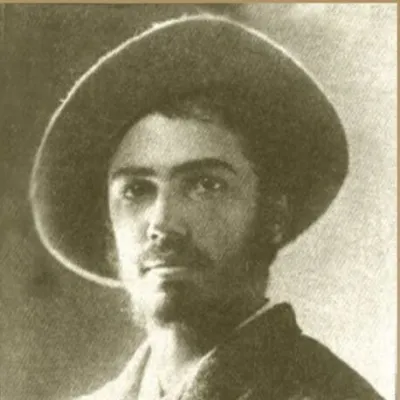
Adolphe Francois Appia
Human Design Chart
Biography
Died on 29 February 1928, Nyon, Switzerland
The Human Design of Adolphe Francois Appia: Generator 4/6
Generator 4/6 — Design at a Glance
Adolphe Francois Appia showed himself to be someone with tremendous endurance and a fundamental tendency towards reacting rather than initiating. His design indicated that his strength did not lie in driving projects forward but in the ability to respond to signals from life. As a Generator, he possessed a great deal of sacral energy – comparable to a workhorse – which only became effective through this reactive approach. The central mechanics of his design required him to wait for an impulse and then act when his inner self gave a clear "yes."
This approach was crucial for his satisfaction. When Adolphe Francois Appia listened to this inner confirmation, he experienced deep fulfillment. Conversely, two specific dangers loomed: either he wasted energy on tasks without inner desire, leading to exhaustion, or he was held back from his heart's project despite the power being present. If he lived against this principle and constantly tried to initiate rather than react, frustration and a lack of energy would ensue. His path therefore lay in responding to life from the gut, which allowed his tremendous capacity to truly come into play.
Emotional Authority
Adolphe Francois Appias Human-Design profile suggests a tendency towards cautious hesitation when making important decisions. His inner authority was the Defined Emotional Center, meaning he was constantly at the mercy of emotional waves. This wave motion manifested in a perpetual up and down of his feelings; the world appeared to him always colored by his current mood. At one moment something could deeply excite him, only for it to seem negative in the next. However, this immediate feeling was merely a snapshot, not a final judgment.
Quick, spontaneous decisions based on these transient emotions risked errors since they were made from an immature perception. For Adolphe Francois Appia, the process of waiting was crucial for clarity. He needed time to let a decision mature, often by consciously sleeping on it. This act of delaying and asking himself multiple times allowed intense feelings to subside. Only with emotional distance did calmness set in and true insight become visible. This patience was not a lack of determination but the necessary mechanism to correctly perceive deeper connections, especially when making decisions that would have long-term consequences for his life path.
The 4/6 Profile — Opportunist / Role Model
Adolphe Francois Appia was marked by a lifelong internal conflict between his emotional need for belonging and his intellectual drive for distance. In his first thirty years, the experimental energy of Line 4 of his Profile 4/6 (Networker/Roles Model) dominated. He actively sought contacts, seized opportunities in the network, and learned to protect his "big heart" from false bonds. This phase was characterized by a balance between willpower and necessary rest periods to avoid overload and burnout.
With the activation of Line 6, a tension arose: The desire to be part of a community clashed with the need to stand wise above things. Adolphe Francois Appia developed the ability to assess the expressive power of others and make judgments. This development led from initial gullibility to critical scrutiny of ideals. The risk was that he might fall into depression if high goals were not met, or fail in the network through quantity rather than quality. His design challenged him to integrate this polarization between heart and head to act as a role model without losing himself.
Triple Split Definition — Defined & Open Centers
Adolphe Francois Appia lived with a continuous, unchanging inner architecture: All seven centers were defined. This gave him a constant personality and stable vitality, free from the need to react to environmental impulses. His design generated a permanent mental pressure towards inspiration and concept formation (defined Head and Ajna Centers), but lacked direct energy for implementation. Instead, he had an immense source of generative vitality available (defined Sacral Center) that was activated by reacting to external impulses. His defined Heart Center provided willpower and ego, while the G Center offered a firm identity and direction. Emotional clarity required patience in the Solar Plexus Center, supported by the constant survival pressure of the Root Center.
Although all centers were defined, his open Throat Center made him vulnerable to the pressure to force attention or speak inappropriately when not invited. His open Spleen Center made him susceptible to survival fears and clinging to unhealthy situations out of a false sense of security. These open areas tended towards spontaneous decisions or feeling insecure due to external conditioning, contrasting with his otherwise inner constancy. The challenge was to accept the mental pressure without exhausting it, and to use sacral energy only upon correct reaction rather than taking initiative. Thus, he could maintain clarity and endurance despite the open centers by utilizing his stable nature.
Channels for focus, pioneering spirit, community and abstraction.
Adolphe Francois Appia showed a persistent, logical format-energy that wanted to perfect details and patterns. The Channel of Concentration 52-9 connected his Root Center with the Sacral Center; Gate 52 provided a passive urge to hold still, while Gate 9 focused on facts. This combination required calmness to keep distractions at bay and correct patterns step by step. Appia experienced this as a quiet pressure to apply his energy precisely rather than becoming distracted.
Tensions arose through juxtapositions in the Ego Circuit. The Channel of Initiation 51-25 connected the shock of Gate 51 with the spirit of self in Gate 25, generating a competitive impulse towards individualization aimed at reinforcing others' potential and proving himself first. Simultaneously, the Channel of Community 37-40 linked Gate 37 (Friendship) to Gate 40 (Solitude). Here, the need for contractual security and recognition in groups conflicted with individual initiative. Appia sought his place within the whole but also needed clear agreements to feel bound in communities.
Furthermore, the Channel of Abstraction 64-47 provided an active, experience-based mental processing. Gate 64 (Confusion) and Gate 47 (Understanding) compel one to sift through each experience via a kaleidoscope of mental images to gain narrative clarity from the past. Appia's mind constantly played with possibilities until an inspiring story or perspective emerged. This mental work served not to solve his own problems but to understand meaningful connections that he could then share. The combination of focused logic, competitive individualization and the pursuit of communal binding as well as mental sense-making shaped his unique dynamics.
Collective Circuitry — Circuit Signature
Adolphe Francois Appia showed a complex, triply divided structure where three isolated energetic blocks existed in parallel. This separation marked his experience as distinct impulses side by side without direct inner exchange between groups.
The Ego Circuit connected his Heart and Solar Plexus through Channel 37-40, creating a dynamic of giving and taking characterized by cooperation and traditional values. As there was no connection to the Sacral Center, this resource-oriented energy required mandatory rest pauses for regeneration, supported by the wave-like emotional ratchet.
Parallel to this, the Centering Circuit linked Identity and Heart Centers (Channel 25-51), fostering a solidified individuality and strong self-worth, isolated from other areas.
A third block formed through two additional circuits: The Understanding Circuit connected Sacral and Root Centers (Channel 9-52), enabling focused, logical future perspectives without emotional influence. Simultaneously, the Meaning-Finding Circuit linked Head and Ajna Centers (Channel 64-47). This directed focus on reflecting past experiences and finding meaning in them stood as an independent force alongside other groups.
Appia's design thus consisted of these three separate streams: cooperative resource building with pause needs, individual affirmation, and the combination of strategic logic and emotional reflection on the past – all existing side by side but not directly interweaving.
Right Angle Cross of Planning 3
Adolphe Francois Appias Human-Design profile emphasized a tendency towards strategic orientation and long-term vision. He was someone whose internal system was designed to translate complex relationships into clear structures. This configuration, the right cross of Planning 3, described the architecture of his thinking: inner strategies were not only reflected but actively implemented in external orders.
For his design, this meant that planning did not remain an abstract process but fulfilled a concrete function. It was about how ideas became tangible and how visions received a practical framework. His energy focused on structuring the path from intention to implementation. This shaped his approach to projects or life stages – not through spontaneous impulses, but through a well-thought-out, long-term perspective.
Without specific events in the raw content, no biographical confirmation can be woven in. The mechanics therefore remain at the level of potential expression: Adolphe Francois Appia possessed the ability to develop strategic goals and pour them into understandable plans. This was not by chance but a fixed characteristic of his Human-Design chart. His strength lay in reducing uncertainties through clear planning steps, thereby creating actionability.
Saturn Return · Uranus Opposition · Chiron Return · 2nd Saturn Return — Life Cycles
Adolphe Francois Appias work followed a clear rhythm of consolidation and renewal. In 1891, at the age of 29 during his first Saturn return, he condensed years of preparatory work into concrete results: He produced director's books and sketches for Wagner's *Ring des Nibelungen*, *Die Meistersinger* and *Tristan und Isolde*. This transit often marked the point where internal structures were carried outward.
Ten years later in 1903, at age 41, his Uranus opposition occurred. This phase demanded inner stability amid external breaks or necessary changes. Appia responded with practical implementation: He realized parts of Schumann's *Manfred* and Bizet's *Carmen* in the private theater of Countess Renée de Bearn. Here he demonstrated the ability to reinterpret established forms without losing his own center.
The Chiron return around 1910 (age 48) ushered in a phase of bloom, where his life purpose increasingly became experiential. This was not a moment of healing old wounds but the unfolding of his incarnation cross. Appia worked as an advisor for Dalcroze who founded a school for rhythmic gymnastics in Hellerau. His expertise here found its meaningful application within a broader pedagogical context. These three cycles shaped Appias career as a sequence of consolidation, transformation and purpose-driven integration.
Generator · Emotional Authority — Synthesis
Adolphe Francois Appia was a Generator with emotional authority and a Profile of the Networker\/Role Model. His life was marked by a deep ability to generate energy and bring it into the world through reactions to impulses (Sacral Center), combined with the need to emotionally clarify this energy over time (Emotional Center). This combination allowed him to recognize and perfect complex patterns – a process enhanced by his defined Head and Ajna Centers. He was designed to create connections within a community through his work (Channel 40\/37) by recognizing others' needs while simultaneously seeking his own expression. The recurring cycles of his career confirm this drive towards engagement and the desire to create something lasting.
A central paradox in Appias design lies in the interplay between emotional depth and the necessity to release energy through reaction. While the Sacral Center prompted him to act, his emotional authority required a phase of waiting and inner clarification. This led to a tension between the desire for immediate implementation and the need to let things ripen – a dynamic interplay that shaped his creative process and made him continually re-evaluate patterns (Channel 52\/9).
4 Defined Channels
Incarnation Cross - Right Angle Cross of Planning 3
Solar Return
The Solar Return shows the moment when the sun returns to its exact birth position - your personal solar year.
Life Cycles
Discover the life cycles with a detailed triple view (birth chart, cycle chart, composite).
Human Design Profile
- Type
- Generator
- Strategy
- To respond - wait for something to respond to
- Authority
- Emotional Authority
- Profile
- 4/6 - Opportunist / Role Model
- Definition
- Triple Split
- Incarnation Cross
- Right Angle Cross of Planning 3
- Date of Birth
- 01.09.1862 17:00
- Place of Birth
- Geneva, Switzerland
Frequently Asked Questions
What was Adolphe Francois Appia's Human Design type?
What Profile did Adolphe Francois Appia have?
What Authority did Adolphe Francois Appia have?
What incarnation cross did Adolphe Francois Appia have?
When was Adolphe Francois Appia born?
Discover your own Human Design
Are you also a Generator? Find out in a personal reading how to use your sacral energy correctly and discover deep satisfaction.
More Personalities
Back to overviewAaliyah

Alexia
Angèle

Anne-Marie

Arcángel

Arno