
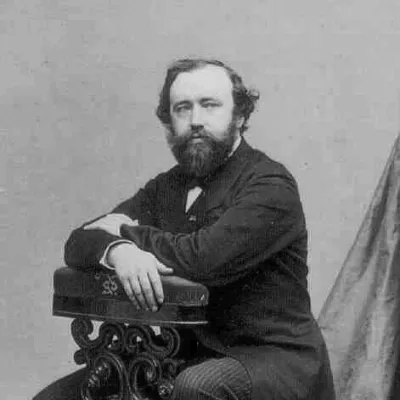
Adolphe Sax
Human Design Chart
Biography
The Human Design of Adolphe Sax: Generator 1/3
Generator 1/3 — Design at a Glance
Adolphe Sax was someone who possessed immense, enduring strength, comparable to a workhorse ready to go as long as it received the right task. His design as a Generator was characterized by a lot of sacral energy, which was activated not by his own initiative but by responding to impulses from the environment. His motto was not 'start,' but 'respond.' When life sent a signal and his inner center responded with a clear 'yes,' he could effectively use this energy to translate things into reality.
This mechanism brought two specific risks with it. First, there was the risk of exhaustion if he threw himself into tasks that did not resonate with him internally, thereby wasting his energy. Second, frustration arose when he was prevented from working on his heart projects, even though he was still full of drive. Living in harmony with this strategy – that is, reacting from the gut to real incentives – rewarded him with a deep sense of fulfillment. If he, on the other hand, constantly initiated things without waiting for an inner signal, he would eventually encounter persistent frustration and a lack of energy. His strength lay in reactive endurance, not in proactive control.
Sacral Authority
Adolphe Sax's decision-making process was characterized by a direct physical reaction to external stimuli. As a Generator, he possessed sacral authority, which also served as his strategy, simplifying the path to the right action. This inner guidance was not in the head but in the gut: in response to an external impulse, he felt an immediate physical resonance, often as a low grunting sound, a hum, or a confirming 'Hmm.'
It was crucial that his emotional center was open, meaning he did not have to wait for fluctuating feelings to decide but could rely on this clear, momentary physical confirmation. When his sacral motor kicked in, he felt vital and alive. A powerful surge of energy occurred, giving him seemingly inexhaustible strength. In these moments, he was fully immersed in his activities, driven by great enthusiasm and satisfaction, without the need for external purpose. He was born to walk through life with joy.
Additionally, his activated spleen center acted as a supporting authority. Likely directly connected to the sacral center, Adolphe Sax could react particularly quickly and spontaneously. He had immediate access to his physical well-being and instinctive perception. This connection allowed him to reliably be guided by these deep, physical signals, making his decisions precise and in harmony with his nature.
The 1/3 Profile — Investigator / Martyr
Adolphe Sax appeared as a researcher and experimenter whose life path was marked by learning, trial, and error. His design as Profile 1/3 combined the profound, patient theoretical engagement of Line 1 with the urgent need of Line 3 to practically test things and learn from mistakes. This configuration created a dynamic in which he constantly oscillated between the fear of not knowing enough and the impulse to simply act.
Line 1 brought the ability to create and the necessary patience to leave mutations and developments to their own laws, without forcing them through sheer will. At the same time, Line 3 challenged him to prove himself through personal experimentation. When Adolphe Sax evaluated a solution or instrument as good, he had previously tested it both theoretically and practically. His judgment was thus the result of a comprehensive, self-conducted examination.
Especially Line 3 in the seventh position contributed to his questioning of institutional orders. Over time, he learned to reject any kind of rigid leadership claim and continuously experimented to find roles where he could lead independently. This led to growing skepticism towards established structures; he sought ways that did not fit into pre-fabricated patterns. His life was thus a continuous process of testing to find the hidden truth in his work and validate these insights through his own experience.
Split Definition — Defined & Open Centers
Adolphe Sax's design revealed a tendency towards deeply rooted, unshakeable self-assurance. With a defined G Center, he had a clear inner identity and a firm sense of his own direction. He knew who he was and where he belonged, without needing external confirmation. This magnetic stability allowed him to show others new paths without having to direct them. However, his power source lay in his defined Sacral Center, a motor that generated vital energy daily. For Sax, it was essential to listen to this inner voice and only act when invited to do so. Through this reactive loop, he found satisfaction in his work; if he initiated from the mind, he encountered resistance and frustration. His defined Spleen Center also gave him a sharp instinct for the 'now.' He acted spontaneously and intuitively, trusted his body awareness, and immediately recognized what was healthy and correct. This existential focus, supported by the structural pressure of his defined Root Center, helped him to exist materially and pragmatically master challenges.
At the same time, his design revealed specific vulnerabilities. His open Head Center made him susceptible to mental confusion; he tended to engage with questions that were not his own and sought inspiration to alleviate this pressure. Similarly, his open Ajna Center led him to absorb concepts and opinions from his environment without identifying them as his own truth, making him a flexible thinker who had to learn not to claim every idea as his own. His open Throat Center brought the fear of not being heard, which led him to seek attention rather than waiting for an invitation to speak. His open Heart Center led him to seek to prove his worth through promises and performance, although he did not have the consistent energy to maintain these commitments long-term. Finally, his open Solar Plexus absorbed the emotions of others, making him appear emotionally unstable if he did not separate the moods of his environment from his own feelings. These open centers challenged him to always return to his inner authority rather than getting lost in the conditioning of the outside world.
Channels for ambition, continuity and rhythm.
Adolphe Sax showed himself to be someone who drove deep changes through material innovation. This attitude stemmed from the Beat Channel 14-2, which connected the Sacral with the G Center. Gate 14 provided the availability of material resources to drive mutation, while Gate 2 as the driver directed movement through space and time. This combination allowed him to establish new directions by trusting his inner reaction and transforming mutation impulses into concrete forms.
Parallel to this, the Transformation Channel 54-32, which linked the Root with the Spleen Center, was driven by Gate 54, the ambition, and Gate 32, the continuity. He aimed to improve his position through consistent effort. This channel motivated him to recognize talents and increase prosperity through hard work, with the Spleen's instinct determining when support was available. The drive of ambition and the fear of tribal failure pushed him to move up through competence.
Additionally, Gate 1 promoted uniqueness and creative mutation, while Gate 7 projected leadership and hierarchy. Gate 13 promoted meaning and continuity through reflection. In personality, Gate 53 acted as a pioneer for new cycles, Gate 9 for detail work and perfection, and Gate 50 as a conservative reflex for values. Gate 46 stood for dedication and presence, Gate 34 for individual power and integration. Gate 39 in his design triggered mutations through provocation and analysis, while Gate 5 secured the basic rhythm and energy build-up through habits.
Tribal Circuitry — Circuit Signature
Adolphe Sax's design inclined towards rhythmic constancy and deep transformation. It was a split definition, meaning that two independent energetic poles existed that did not directly flow into each other.
The Knowledge Circuit connected his Identity with the Sacral Center. Through the channel 'The Beat' (Gates 2 and 14), a pulsating, acoustic rhythm emerged. This connection supported the expression of a unique individuality through emotional waves that acted as an inner rhythm. It was about walking one's own path and transforming new insights, with creativity from the mind and life force from the Sacral Center working together.
Parallel to this, a second, separate pole existed: The Ego Circuit connected the Spleen with the Root Center. Here, the channel 'Transformation' (Gates 32 and 54) was at work. This area served cooperation and the joint creation of resources within a tribe. Since there was no connection to the Sacral Center, rest periods were necessary to regenerate energy. The Spleen provided intuitive perception, the Root for implementation under pressure. These two systems – the rhythmic expression of identity and the cooperative creation of resources – existed alongside each other without directly merging.
Right Angle Cross of the Sphinx 4
Adolphe Sax's design indicated a tendency towards deep spiritual insight, often characterized by a connection between inner stillness and wise guidance. This configuration, known as the right Sphinx Cross 4, described a life task of uncovering hidden truths and passing them on to others. It was not just intuition but a structural inclination to understand the invisible and communicate it in a way that others could truly grasp.
For his design, this was a central aspect: the search for what lies beneath the surface, combined with the need to convey insights in a way that would be accepted by the community. This mechanism shaped his way of seeing the world – not as a superficial appearance, but as a deeply rooted system that needed to be understood. Adolphe Sax was someone who not only recognized these hidden connections for himself but also made them accessible to others.
Without a specific documented event in the raw content, the description remains limited to this characteristic stance. The right Sphinx Cross 4 emphasized the role of the leader, who inspired others through his own understanding and ability to present complex ideas simply. It was a force that did not appear loud or dominant, but rather convinced through its depth and clarity. Adolphe Sax lived this dynamic by bringing his inner perceptions to the outside world, thereby creating a space where others could also learn to see the invisible.
Saturn Return · Uranus Opposition · Chiron Return · 2nd Saturn Return — Life Cycles
Adolphe Sax showed himself to be someone who entered new, often precarious environments with palpable determination to push through his ideas. This attitude was evident in 1842, at the age of 28, when he went to Paris without financial means and gained attention there. For his design, this was a typical moment of the first Saturn Return. This cycle often marks the point where years of internal groundwork and development condense into a tangible, external result. Arriving in Paris without support highlighted the need to solidify his own structure in reality. It was not just an adventure, but the concrete formation of a life phase where the foundation for his future career was laid. The Saturn Return functioned here as a catalyst, transforming the previous development into a concrete situation that offered both challenges and the chance for recognition. Adolphe Sax's path into this phase underscores how his chart indicated a tendency towards actively shaping his circumstances once inner maturity allowed the external step.
Generator · Sacral Authority — Synthesis
Adolphe Sax lived a thread of energetic connection between action and direction. As a Generator with sacral authority (and the Beat channel), he responded to external stimuli with an immediate surge of energy that set him in motion. This sacral reaction, coupled with a defined G-Center, gave him a strong sense of his own unique direction and the ability to drive innovations forward. The Profile as Researcher/Experimentator reinforced this drive to gain new knowledge through trial and error and expand the boundaries of the known – a process further energized by the Knowledge Circuit design. He drew on the steady flow of sacral energy as long as the activity aligned with his inner drive.
Simultaneously, a paradox emerged between the need for independent exploration and the necessity to share the results. The Knowledge Circuit design points to deep individuality and a desire to walk unique paths, yet the sacral energy found its highest expression in action, in generating something new that would also become effective in the world. This led to a tension between the melancholic loner and the pulsing desire to effect transformation through creative impulses, which was evident in a documented event when he went to Paris with little means to gain attention.
2 Defined Channels
Incarnation Cross - Right Angle Cross of the Sphinx 4
Solar Return
The Solar Return shows the moment when the sun returns to its exact birth position - your personal solar year.
Life Cycles
Discover the life cycles with a detailed triple view (birth chart, cycle chart, composite).
Human Design Profile
- Type
- Generator
- Strategy
- To respond - wait for something to respond to
- Authority
- Sacral Authority
- Profile
- 1/3 - Investigator / Martyr
- Definition
- Split Definition
- Incarnation Cross
- Right Angle Cross of the Sphinx 4
- Date of Birth
- 06.11.1814 23:00
- Place of Birth
- Dinant, Belgium
Frequently Asked Questions
What was Adolphe Sax's Human Design type?
What Profile did Adolphe Sax have in Human Design?
What Authority guided Adolphe Sax?
What incarnation cross did Adolphe Sax have?
When was Adolphe Sax born?
Discover your own Human Design
Are you also a Generator? Find out in a personal reading how to use your sacral energy correctly and discover deep satisfaction.
More Personalities
Back to overviewAaliyah

Alexia

Angèle

Anne-Marie

Arcángel

Arno
