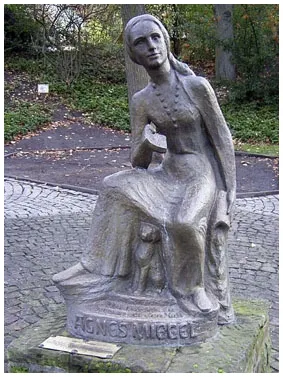
Agnes Miegel
Human Design Chart
Biography
During the Third Reich she revealed herself as an ardent supporter of the regime. She signed the Gelöbnis treuester Gefolgschaft, the 1933 declaration in which 88 German authors vowed faithful allegiance to Adolf Hitler. In the same year she joined the NS-Frauenschaft, the women's wing of the Nazi Party. In 1940 she joined the Nazi party itself. In August 1944, in the final stages of World War II, she was named by Adolf Hitler as an "outstanding national asset" in the special list of the most important German artists who were freed from all war obligations.
After World War II, Agnes Miegel mainly wrote poems and short stories about East Prussia, the land of her youth. She was considered the voice of the Heimatvertriebene, the German-speaking people who had lived before the war in Czechoslovakia and Poland and in parts of Germany annexed by Poland and the Soviet Union after the war, who had to leave when Nazi Germany was defeated.
She died on 26 October 1964, aged 85, in a hospital in Bad Salzuflen.
The Human Design of Agnes Miegel: Manifesting Generator 2/4
Manifesting Generator 2/4 — Design at a Glance
Agnes Miegel revealed herself as an individual with a hybrid energy structure that combined the endurance of a Generator and the lightning-fast impact of a Manifestor. Her design offered constant sacral energy, which allowed her to achieve deeper satisfaction from her work provided she responded to internal impulses rather than initiating action herself. This configuration enabled her to skip steps and bring things into her life with unusual speed. However, this potential also carried the risk of overlooking important stages or experiencing frustration through pursuing multiple projects simultaneously if her inner authority was not consistent.
Her strategy involved responding to life and only acting when her sacral center signaled a clear “yes.” When applied correctly, she found herself in a playful mode that sought variety and tackled several tasks at once. This ability to stay in the flow and advance various projects concurrently characterized her work style sustainably as long as inner confirmation was maintained. Thus, her natural speed transformed into a powerful resource rather than a source of exhaustion.
Emotional Authority
Agnes Miegel exhibited a decision-making approach marked by emotional wave movements. Her inner authority resided in the defined Emotional Center – a mechanism that always took precedence over other defined centers. This meant that her perception was always colored by her current mood: What appeared inspiring at one moment could turn negative in the next. Her immediate feeling was only a snapshot, not yet the final truth.
Quick, spontaneous decisions from such an emotional state would often have been detrimental to her. Instead, her design required patience and conscious hesitation. She needed to take time for decisions to mature – ideally through multiple nights of reflection. Only when intense feelings subsided and emotional distance was gained did clarity and calmness set in. This process of waiting was essential for long-term life decisions as it allowed access to deeper, comprehensive understanding. Agnes Miegel thus lived in a constant oscillation of emotions that served as a filter to distinguish between fleeting impulses and enduring truth.
The 2/4 Profile — Hermit / Opportunist
Agnes Miegel lived in a continuous tension between the deep need for withdrawal and the desire for connection. Her design as a 2/4 Profile shaped a rhythm: She needed phases of isolation to gain inner clarity before re-opening to her closest circle. This dynamic required clear communication of her boundaries – when she sought company and when she wanted solitude. In her “cave,” she reflected on what she had learned and developed new perspectives from it.
This process was influenced by specific lines. Line 2, associated with Gate 22, emphasized style and social adaptability. Here lay the risk of hiding essence behind a facade, which others could exploit. Simultaneously, Line 4 through Thor 26 employed censorship as a protective mechanism for the community, preserving the status quo through selective memory and information control. For Agnes Miegel, it was crucial to consciously forget certain things rather than processing censored parts. Thus, she protected her inner space and social bonds equally by choosing what to present externally and what to keep hidden.
Triple Split Definition — Defined & Open Centers
Agnes Miegel was marked by a constant mental activity resulting from the definition between Head Center and Ajna Center. This channel created a permanent pressure to ask questions, understand things, and process inspirations without being able to directly implement them with energy because there was no connection to an engine. Instead, her mind served as a reliable source for concepts that she provided others or pressured them to think independently.
Her willpower and ego were defined by a Heart Center. She had a dependable energy source to fulfill promises and determine herself, valuing control over her own life and recognition for her contribution. This structural firmness contrasted with her emotional nature: The defined Solar Plexus Center made her emotions an inner authority. She was designed to wait out the emotional wave to gain clarity rather than reacting impulsively to highs or lows.
At the same time, her design revealed specific vulnerabilities through open centers. Her undefined G Center meant she lacked a fixed identity or direction. She tended to blend with her environment and was prone to seeking a "borrowed" identity or feeling lost if not in the right place. Her task was to wait for initiation from the environment rather than actively chasing love or direction.
Additionally, her open Spleen Center shaped her relationship to health and well-being. Here, there was no spontaneous intuitive security; instead, she was prone to survival fears and often conditioned herself to the "well-being frequency" of others to feel safe. This could lead her to cling to unhealthy situations or make impulsive decisions just to ease fears of failure or rejection rather than trusting her inner authority from the Solar Plexus.
Channels for clarity, intimacy, value creation and emotional awareness.
Agnes Miegel revealed herself through a deep, often unspoken intensity in her basic attitude. The Channel of Union 59-6 connected her sacral energy with the Solar Plexus and created a strong desire for intimacy and merging. This combination of sexuality and emotional wave required patience; she learned to wait until clarity arose in her feelings before engaging in relationships or creative efforts.
Her approach to the material world was marked by a strong will. The Channel of the Money Line 21-45 linked her Heart Center with the Throat Center, driving her to take responsibility and exercise control over her resources. She sought independence to follow her own rhythm, as the need for autonomy was crucial to her success.
Mentally, Agnes Miegel was characterized by sudden insights. The Channel of Awareness 61-24 connected Head and Ajna Centers, enabling her to transform inspirations into rational answers. Her mind sought silence to experience the "mutation" or satori—a moment when knowledge simply existed without logical derivation.
Additionally, she felt a constant urge for new experiences. The Channel of Recognition 30-41 linked Root and Solar Plexus, generating restlessness amplified by emotional waves. She had to learn not to blindly follow this desire but use her emotional authority to make clear decisions.
Influences like Gate 22 promoted calmness and listening until the mutation, while Gate 47 helped draw meaning from past experiences. In her design, Gates such as 53 (Freedom for New Paths), 38 (Boundaries), and 43 (Breakthrough of Individual Insights) played roles. Gates like 26 (Innovation in the Stem), 36 (Crisis as Development), 27 (Care), 31 (Leadership through Transmission), and 8 (Contribution to Group) rounded out her Profile by bringing themes of care, leadership, and individual identity to the forefront.
Tribal Circuitry — Circuit Signature
Agnes Miegel was marked by three separate, parallel operating energy streams. The Knowledge Circuit connected her Head Center with the Ajna Center through the Channel of Awareness (24-61). This promoted innovative flashes of insight and the ability to transform new knowledge without being directly linked to emotional or physical expression channels.
A second, isolated stream formed the Purpose Circuit. Here, the Channel of Perception (30-41) connected the Solar Plexus Center with the Root Center. This configuration directed energy towards reflecting on past experiences and finding meaning in them, while emotional waves ebbed away rhythmically to learn from the past.
The third stream lay in the Ego Circuit, where the Line of Money Channel (21-45) linked her Heart Center with the Throat Center. This supported the joint creation of resources and material well-being through clear communication, yet without a direct connection to the constant life force of the Sacral Center, which made pauses necessary.
Additionally, the Archer Circuit operated through the Channel of Union (6-59), connecting the Sacral Center with the Solar Plexus Center. This brought primal energies of protection, care, and family preservation into play. As Agnes Miegel had a Triple Definition, these four circuits existed as independent energy fields: intellectual innovation, emotional purpose finding, resource-oriented cooperation, and familial protection worked alongside each other without forming a single continuous flow.
Right Angle Cross of Rulership 1
Agnes Miegel was marked by the presence of the right cross of Governing. This specific configuration in Human Design indicated a tendency towards a particular kind of authority and leadership that did not rely on domineering will but rather on a deep, often unconscious connection to the truth of her own nature. The right cross of Governing is not an active strategy like informing a Manifestor or responding as a Generator; it's a static energy that works in the background. It bestows upon the individual a kind of 'royal' or 'imperial' aura that commands respect without needing to be actively sought after. Agnes Miegel lived with this energetic structure, which inclined her towards showing a calm, almost detached presence in situations of decision-making or conflict resolution. Her authority did not arise from mere demand but from an inner certainty and natural claim for attention derived from the specific orientation of this cross. It was a passive form of governing where the environment often intuitively responded without Agnes Miegel having to give explicit instructions. This mechanism shaped her interactions with others by creating a boundary that was respected because it was carried by a fundamental inner order.
Saturn Return · Uranus Opposition · Chiron Return · 2nd Saturn Return — Life Cycles
Agnes Miegels design indicated a tendency towards cyclical condensations, in which internal structuring came to the fore. The first Saturn return often marked the transition from groundwork to tangible results; in 1907 at age 28, she published 'Ballads and Songs'. This aligned with mechanical logic: years of gathering culminated in a clear public form.
Later, a tension field between stability and change emerged. The Uranus opposition around her 41st year often brought unexpected career turns; from 1920 to 1926 Miegel worked as an editor for the feuilletons of the Ostpreußische Zeitung. Here the mechanics were at work: a well-established framework came under pressure, new paths had to be found without losing the core.
With her Chiron return around age 49, a phase of unfolding began where personal meaning increasingly manifested in life – provided strategy and authority were respected. In 1928 she published 'The Resurrection of Cyriakus'. This was no mere coincidence but the bloom time of her design: what had been prepared earlier now found its full expression and significance.
The second Saturn return around age 57 often brought a test of previous achievements; in 1936 Miegel received the first Agnes-Miegel-Plaque from the NS-Kulturgemeinde. This award fell into a period that can be seen as crisis-prone in her design: external recognition stood in conflict with inner integrity or structural resilience. The mechanics here showed how external validation does not always go hand-in-hand with inner well-being but can also become a test if it doesn't fit one's own strategy.
Manifesting Generator · Emotional Authority — Synthesis
Agnes Miegel lived a life marked by a deep internal tension between the need for withdrawal and connection. Her profile as a natural talent and networker (Line 2/4) revealed a constant oscillation between seeking clarity in isolation and the desire to exchange with chosen reference persons. This dynamic was reflected in her defined Head Center, which served as a steady source of questions and inspiration – an inner drive that intensified the need for reflection and solitude. The sacral energy (defined) created a constant readiness to respond, further accelerated by the manifesting Generator authority; it allowed her to seize opportunities quickly but also required the ability to distinguish internal impulses from external expectations.
A central paradox in Agnes Miegels design lay in the combination of emotional authority and the manifesting Generator type. While the emotional center demanded waiting and maturation for clarity, the Manifestor component enabled quick action and skipping steps. This led to an inner conflict between the need for emotional depth and a tendency towards rapid initiation – a tension that manifested in recurring career cycles but also culminated during crisis phases.
4 Defined Channels
Incarnation Cross - Right Angle Cross of Rulership 1
Solar Return
The Solar Return shows the moment when the sun returns to its exact birth position - your personal solar year.
Life Cycles
Discover the life cycles with a detailed triple view (birth chart, cycle chart, composite).
Human Design Profile
- Strategy
- To respond - wait for something to respond to
- Authority
- Emotional Authority
- Profile
- 2/4 - Hermit / Opportunist
- Definition
- Triple Split
- Incarnation Cross
- Right Angle Cross of Rulership 1
- Date of Birth
- 09.03.1879 01:15
- Place of Birth
- Königsberg/Ostpreussen, Germany
Frequently Asked Questions
What was Agnes Miegel's Human Design type?
What Profile did Agnes Miegel have in Human Design?
Which Authority guided Agnes Miegel?
What incarnation cross did Agnes Miegel have?
When was Agnes Miegel born?
Discover your own Human Design
Are you also a Manifesting Generator? Find out in a personal reading how to unfold your multi-talents and direct your energy wisely.
More Personalities
Back to overviewAldair

Alizée

Angeli

Arletty

Artus

Balthus