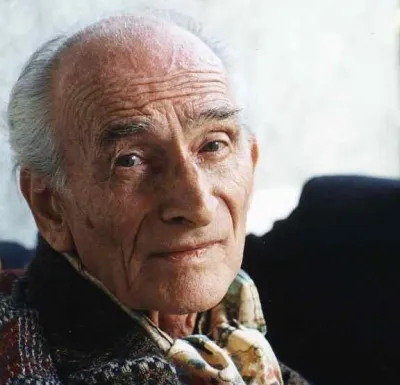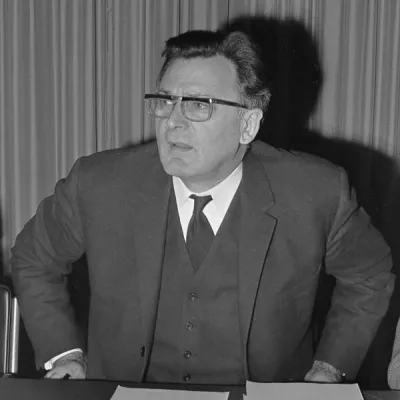
Albert Coppé
Human Design Chart
Biography
Coppé was a founding member of the CDV party and served in the European Commission as Commissioner for Social Affairs, Transport & Budget under the Malfatti & Mansholt Commissions. He also led an interim High Authority in the European Coal and Steel Community in 1967.
Coppé died in Tervuren, Belgium on 30 March 1999.
Albert Coppé as a Manifesting Generator 4/6 in Human Design
Manifesting Generator 4/6 — Design at a Glance
Albert Coppé revealed himself as someone who, through a hybrid energy configuration, combined the endurance of a Generator with the lightning-fast impact of a Manifestor. His design featured a defined Sacral Center, which provided him with constant life energy, as well as active connections of the Motor Centers to the Throat Center. This mechanism allowed him to skip steps and quickly draw things into his life, unlike pure Generators who act linearly.
However, this speed entailed specific risks: Albert Coppé tended to overlook important stages, forcing him to backtrack and make up for missing parts - a source of frustration. Additionally, he often reacted to multiple impulses simultaneously and started various projects in parallel. Without strict adherence to his strategy of waiting and responding to inner impulses before acting, his creative enthusiasm quickly turned into exhaustion.
His path to deep satisfaction lay in ensuring that his Sacral Center gave a clear 'yes' to each step. Once this inner resonance was established, he greatly benefited from variety. The compulsion to complete one thing before starting the next stood in opposition to his natural law. Instead, he immersed himself in a playful mode where parallel work and constant variation sustained his energy and provided him with lasting satisfaction from his efforts.
Emotional Authority
Albert Coppé was subject to an emotional wave that showed his experience in a constant up and down of feelings. His inner authority was carried by the defined Solar Plexus Center. In Human Design mechanics, this emotional authority always takes precedence over other defined centers, regardless of what else is defined in the chart. He saw the world colored by his current mood; at one moment, he could be totally enthused by something, in the next, he could completely negate the same thing. His immediate feeling was, however, only a snapshot, a first impression that did not necessarily represent his truth. Quick, spontaneous decisions based on such emotion could therefore have negative consequences. The more time he took to let a decision mature, the deeper and more comprehensive he could understand something. This required patience and the repeated consideration of decisions. He should take his time and ask himself multiple times. Over time, the intense feelings subsided, he gained emotional distance, and clarity and calmness set in. This process was particularly important for long-term decisions that could have a significant impact on his life course. By waiting for emotional clarity rather than the first impulse, he found his true answers.
The 4/6 Profile — Opportunist / Role Model
Albert Coppé appeared in his early life phase as someone who intensely experimented, particularly in the realm of interpersonal relationships. His Profile 4/6 initially acted like a pure Line 3 in the first three decades, before the return of Saturn. This promoted a tendency towards trying out and exploring social dynamics before the deeper patterns of the sixth line unfolded.
With the activation of Line 6, a characteristic inner conflict came to light: the contradiction between the deep desire for belonging (Line 4) and the need for distance to think about the meaning of life (Line 6). This tension between heart and mind shaped his inner development. The Gate 34, which embodies transpersonal intuition and power in the here and now, required delicate handling to avoid abuse and strengthen trust. At the same time, Gate 59 described a process of openness that only reached full maturity after the age of 30. This was about recognizing the consequences of unions and long-term commitments.
In his later years, Albert Coppé was expected to function as a wise role model. His life task was to integrate this inner conflict and stand out through cooperation with others. The large heart of Line 4 remained cautious to avoid opening up to the wrong people and getting hurt. The Venus elevation of Gate 59 supported the ability to recognize and enter into completed relationships when circumstances allowed.
Single Definition — Defined & Open Centers
Albert Coppé revealed himself through a design based on inner stability and direct action. His defined G Center gave him a clear sense of self-identity and a firm direction in life, while his defined Heart Center provided him with the willpower to shape his path independently and keep promises. This combination created a person who knew who they were and what they wanted without relying on others.
His energy source lay in his defined Sacral Center, which provided him with a constant vital force. However, this energy was released not through initiatives but through reactions to life. In conjunction with his defined Throat Center, Albert Coppé could express his messages and actions with great clarity and ease if he trusted his inner authority. His defined Solar Plexus served as an emotional authority; he needed time to go through the emotional wave before making decisions, which gave him a deep, albeit delayed, clarity.
At the same time, he was vulnerable to external influences through open centers. His open Head Center tended to suffer from mental questions not of his own making, driving him into a search for inspiration he could not generate himself. Similarly, his open Ajna Center reflected the thoughts and concepts of his environment, leading him to adopt foreign opinions as his own truth or feel uncertain if he lacked an immediate intellectual answer. This openness required him to carefully distinguish between his own essence and the mental content he absorbed to maintain his inner peace and the strength of his defined centers without being undermined by external confusion.
Channel 2-14: The Beat — Channels & Gates
Albert Coppé inspired others through his mere presence and authentic life rather than through mere words. This tendency resulted from the Inspiration Channel 1-8, which connected his G Center with his Throat Center. Here, the Self-Expression Gate (1) worked together with the Contribution Gate (8), allowing him to live as an individual and draw public attention. His impact lay in encouraging others through his exemplary life to creatively express their unique qualities.
This inspirational power was further amplified by the Beat Channel 14-2, which connected his Sacral Center with his G Center. Through the Gate of Handling Power (14) and the Gate of Higher Knowledge (2), he had the resources to transform mutative impulses into a material direction. He could bring innovative new directions by trusting the reaction from his Sacral, which allowed him to maintain his own creative efforts and support others materially in their direction.
Another defining aspect was the Mutation Channel 60-3, which connected his Root Center with his Sacral Center. Through the Gate of Limitation (60) and the Gate of Order (3), he suffered from mechanical mood swings and melancholy when the pulse of mutation was still. His key was to accept these moods and patiently wait for a new mutation to set in rather than rationalizing them away.
Additionally, the Pairing Channel 59-6, which connected his Sacral Center with his Solar Plexus Center, worked through the Gate of Sexuality (59) and the Gate of Friction (6), seeking intimacy and fusion. His emotional wave determined the timing of his release, requiring him to wait to gain clarity about the depth of his connections.
The Charisma Channel 34-20 connected his Sacral Center with his Throat Center through the Gate of Power (34) and the Gate of Now (20). This gave him the ability to manifest through sacral reaction guidance. However, he had to ensure that his energy was only given for things he truly enjoyed to maintain his self-empowerment.
The Brainwave Channel 57-20 connected his Spleen Center with his Throat Center through the Gate of Intuitive Insight (57) and the Gate of Now (20). This endowed him with the gift of speaking the truth in the moment and encouraging others to awaken their own inner survival intelligence.
The Devotion Channel 44-26 connected his Spleen Center with his Heart Center through the Gate of Awareness (44) and the Gate of Egotists (26). This allowed him to instinctively assess others and find suitable products or ideologies, acting as an entrepreneur generating resources.
The Preservation Channel 27-50 connected his Sacral Center with his Spleen Center through the Gate of Care (27) and the Gate of Values (50). This made him a natural provider taking responsibility to protect and maintain the clan.
The Power Channel 34-57 connected his Spleen Center with his Sacral Center through the Gate of Intuitive Insight (57) and the Gate of Power (34). This reinforced his intuitive capacity to survive through sacral reaction and be alert to danger.
Additionally, the Gate of Fulfillment (55) with emotional awareness, the Gate of Limitation (41) with evolutionary development, the Gate of the Player (28) with risks in the here and now, the Gate of Experience (46) with devotion, the Gate of Understanding (23) with assimilation, the Gate of Logic (62) with details, and the Gate of Collective Behavior (15) with natural rhythm were at work.
Individual Circuitry — Circuit Signature
Albert Coppé's design showed an integrated, pulsating energy focused on establishing and protecting his own identity and familial structures. As a person with a simple definition, he had a continuous energetic flow connecting Head, Heart, Throat, Sacral, Root, Solar Plexus, and Spleen Centers. This created a coherent life force that knew no internal breaks.
The Knowledge Circuit marked him through channels like the Flash of Insight (20-57) and the Mutation (3-60). These connected Throat, Identity, Sacral, Root, and Spleen Centers directly. Albert Coppé used this connection to develop new, individual insights and express them impulsively but with emotional depth. It was about the unique path and transformation through personal expression.
Parallel, the Archer Circuit worked. With channels like Preservation (27-50) and Pairing (59-6), it connected Sacral, Solar Plexus, and Spleen Centers. This gave him an instinctive, ancient power to protect and preserve the family. It was about energy-saving mechanisms to secure genetic continuity, supported by intuitive perception and emotional waves.
The Ego Circuit contributed with the Devotion Channel (26-44), which connected Heart and Spleen Centers. Here, it was not about egoistic I but about cooperation and the joint creation of resources within the group. Albert Coppé showed himself as someone who sought and gave support through devotion and trust in the community.
Finally, the Integration Circuit worked. Channels like Charisma (20-34) and Power (34-57) connected Throat, Sacral, and Spleen Centers. This allowed him to draw power from the reaction to life and manifest it in the moment through intuitive guidance and proper expression. Overall, a picture emerged of a person living their unique identity through creative expression, familial protection, and cooperative resource creation.
Right Angle Cross of the Sleeping Phoenix 4
Albert Coppé's design carried the signature of the Right Cross of the Sleeping Phoenix. This configuration marked a personality deeply rooted in the material world but with a strong inner desire for spiritual transcendence and understanding of cosmic laws. It was a tension between physical reality and the search for higher consciousness, often leading to a life that moved between practical implementation and metaphysical insight.
This cross connected the energy of the material world with intuition for the invisible. Albert Coppé thus showed himself as someone who did not just look at the visible surface but always strived to unravel the hidden principles that hold life and the universe together. The challenge lay in integrating these two poles: using the earth as a foundation to explore and live spiritual truths. His path was marked by the necessity to understand physical existence not as an obstacle but as a necessary tool for spiritual evolution. Through this specific energetic orientation, he sought a synthesis of science and mysticism, with the material world serving as a mirror for divine order.
Saturn Return · Uranus Opposition · Chiron Return · 2nd Saturn Return — Life Cycles
Albert Coppé's design fostered an attitude of structural anchoring and long-term institutional responsibility. His energy did not focus on spontaneous impulses but on creating stable conditions that should endure beyond individual preferences. This configuration promoted a life task in which authority was exercised through consistency and reliable order.
In 1952, at the age of 41, Albert Coppé became Vice President of the High Authority of the EEC. This event fell into the phase of the Uranus Opposition, a time when the design often experiences a conflict between the desire for change and the necessity of structuring. Here, his ability to integrate new political realities into existing administrative circumstances without endangering the stability of the system was evident.
Later, in 1967 at the age of 56, he rose to President of the EEC. This marked the second Saturn Return, a cycle in which years of groundwork and the acceptance of responsibility condensed into a position of highest institutional authority. For his design, this was a moment of affirmation: the previously established structures proved to be reliable, and he took the lead not through charismatic presence but through proven competence in managing and securing complex systems. His role was to ensure continuity and preserve institutional integrity.
Manifesting Generator · Emotional Authority — Synthesis
Albert Coppé lived a life marked by an inner dynamic between creative inspiration and emotional maturity. His design as a Manifesting Generator (with defined Sacral Center) indicated a natural ability to quickly initiate things and provide energy. This energy flowed through the channel of Inspiration (1-8), driving him to express his unique perspective and encourage others to find their path as well. Simultaneously, his emotional authority required careful consideration and the maturation of decisions, creating an internal tension between the impulse to act and the need for emotional clarity. The profile as Networker/Roles Model amplified this contrast, pulling him both into exchange with others and into introspective search for meaning and significance.
The central paradox in Albert Coppé's design lay in the union of speed and depth. He possessed the ability to act swiftly and initiate changes, yet his emotional wave required a thorough engagement with his feelings to make authentic decisions. This duality was evident in his career, where he experienced rapid ascents (1952 and 1967) as well as the responsibility to make complex decisions in the context of the European Community. He navigated between the need to live out his impulses and the desire to act wisely and reflectively.
9 Defined Channels
Incarnation Cross - Right Angle Cross of the Sleeping Phoenix 4
Solar Return
The Solar Return shows the moment when the sun returns to its exact birth position - your personal solar year.
Life Cycles
Discover the life cycles with a detailed triple view (birth chart, cycle chart, composite).
Human Design Profile
- Strategy
- To respond - wait for something to respond to
- Authority
- Emotional Authority
- Profile
- 4/6 - Opportunist / Role Model
- Definition
- Single Definition
- Incarnation Cross
- Right Angle Cross of the Sleeping Phoenix 4
- Date of Birth
- 26.11.1911 18:00
- Place of Birth
- Bruges, Belgium
Frequently Asked Questions
What was Albert Coppé's Human Design type?
What Profile did Albert Coppé have in his Human Design?
What Authority did Albert Coppé have?
What incarnation cross did Albert Coppé have?
When was Albert Coppé born?
Discover your own Human Design
Are you also a Manifesting Generator? Find out in a personal reading how to unfold your multi-talents and direct your energy wisely.
More Personalities
Back to overviewAldair

Alizée

Angeli

Arletty

Artus

Balthus