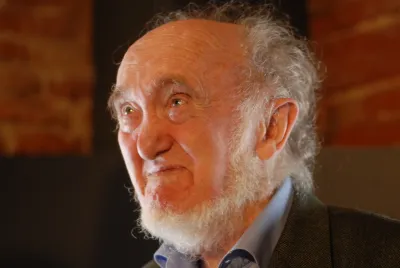
Albert Jacquard
Human Design Chart
Biography
Albert Jacquard as a Generator 4/6 in Human Design
Generator 4/6 — Design at a Glance
Albert Jacquard's design points to a tendency towards great endurance and energy, comparable to that of a workhorse. As a Generator, he had abundant sacral energy, but it was not released through self-initiated action; instead, it was activated exclusively by reacting to impulses from the environment. His strategy involved waiting for life to send a signal and then responding as soon as his inner sense – “from the gut” – gave approval.
This mechanism significantly determined his quality of life. When he engaged in tasks that resonated with him internally, nothing could stop him; he acted with such force that it led to deep satisfaction and a feeling of fulfillment. Conversely, his design was vulnerable to two specific pitfalls. First, he suffered from energy loss and frustration when doing things without inner resonance – a state that could lead to long-term exhaustion over time. Second, tension arose when he was prevented from pursuing his heart's project despite having full strength available.
The central challenge for him thus lay not in the lack of energy but in its proper channeling. By reacting rather than initiating, he utilized his full potential. Any deviation from this principle – such as constant pushing forward without an internal signal – resulted in frustration or a noticeable lack of energy. His design therefore demanded a consistent alignment with the inner “yes” to effectively and satisfyingly deploy his immense endurance.
Sacral Authority
Albert Jacquard's design points towards intuitive, body-based decision-making. As a Generator, he possessed sacral authority, meaning that his strategy and internal guidance were identical: waiting for stimuli and then responding from the gut. This simplified his process significantly as no cognitive weighing was necessary but rather a direct physiological reaction.
This authority manifested as an “inner voice” or surge of power – often audible through grunts, hums, or affirming “mm-hm”. Such signals marked moments when his sacral motor had kicked in. In these states, he felt vital and alive, equipped with seemingly inexhaustible energy. He then tackled his work with great enthusiasm, fully immersed in the tasks without compulsion or purposefulness. He was born to walk through life with joy.
Crucial for the reliability of this authority was the open state of his emotional center; this prevented emotional waves from overshadowing a clear sacral response. Additionally, his activated spleen center acted as a supportive instance. Through this connection, Albert Jacquard could react particularly quickly and spontaneously. He had an immediate access to his physical well-being and instinctive perception, which he relied on reliably for guidance. This configuration enabled him agile, reduced-to-the-essentials action capability in everyday life.
The 4/6 Profile — Opportunist / Role Model
Albert Jacquard's design points towards experimental behavior in early years followed by a later orientation toward wise leadership. As a 4/6 ("Networker/Role Model"), the Line 6 before his first Saturn return (around age 30) initially acted like a Line 3: This promoted curiosity and much experimentation, especially in relationships and friendships. Once Line 6 became active, an internal conflict emerged between the desire for community belonging (Line 4, the heart) and the need for distant meaning-seeking (Line 6, the head). This tension shaped his life as a balance between closeness and overview.
Gate 10 (Line 4) conveyed opportunism and unpredictable fixations until the next favorable opportunity for change. The strategy involved accepting one's behavior and waiting for changed circumstances. Gate 46 (Line 6) stood for integrity and the search for true wisdom through experience. Here he learned to say no and consciously take on commitments. This process culminated around age 50 in a role as a role model and teacher. Through clear perception of others' essence, he smoothed the way for his environment. He was expected to meet high standards of wisdom and step forward through cooperation. Meanwhile, his large heart (Line 4) remained cautious to avoid opening up to false people and getting hurt. His development followed the pattern from experimental adaptation towards integrated, overview-oriented leadership.
Single Definition — Defined & Open Centers
Albert Jacquard's Human Design profile anchored him in a clear, unwavering identity and a deep sense of his own direction. His defined G Center gave him a natural charisma that helped others find their life mission without him having to direct them. This inner security went hand in hand with his defined Heart Center willpower; he knew his worth and kept promises reliably, which strengthened his self-confidence. As a Generator, his defined Sacral energy drove him—a vital source that was activated only through reactions to life. His strength lay in waiting and then acting with full commitment when he felt inner approval.
At the same time, Albert Jacquard was open to the complex dynamics of the environment. His open Head Center made him receptive to inspiration, but it tended to get caught up in doubts or questions from others rather than imposing his own mental solutions. Similarly, his open Ajna Center allowed him to flexibly take on various concepts without holding them as absolute truth. His open Throat drew attention by speaking spontaneously when the situation required it, rather than constantly seeking approval. Emotionally, he remained a mirror of the environment through his open Solar Plexus; he absorbed moods to read the climate without identifying with foreign whims. His open Spleen was vulnerable to survival fears and the temptation to cling to unhealthy attachments, while his open Root took on external stress that he did not generate himself. This openness challenged him not to be led by external pressure or conditioned fears but to trust in his inner authority.
Channels for pioneering spirit, endurance and self-determined resolve.
Albert Jacquard's Human Design profile was characterized by a double dynamism: the driving force for individuation and a deep commitment to the process of discovery. This configuration shaped his life as someone who not only advanced himself but also initiated others towards their own potential.
Central was Channel 51-25, connecting the Heart Center through Gate 51 (Shock) with Gate 25 (Self Spirit). Here, competitive energy, always wanting to be first, merged with a universal love for the beauty of both animate and inanimate objects. This connection made Initiation an art: the ability to recognize a person's potential and – if invited – deliver the necessary "shock" that would initiate them into their individuality. This channel promoted natural competitiveness that was not destructive but rather encouraged humanity to move forward and develop deeper consciousness within the body. It was about mastering oneself and the world hand in hand. Each triumph brought high spirits and a mystical sense of uniqueness, making Albert Jacquard an inspiring example for others. Crucial was distinguishing between authentic living and forced initiation; the latter led only to bitterness, while true initiation emerged as a byproduct of an authentic life.
Parallel to this, Channel 29-46, connecting the Sacral Center with the G Center, played a role. Through Gate 29 (Yes) and Gate 46 (Self Will), he was able to be in the right place at the right time. This channel required letting go of all expectations. When Albert Jacquard fully immersed himself in the depth of his experiences, their significance only became clear later on. It wasn't about control but persistence and patience with processes that could take years. By saying "yes" correctly, he could stay true to his course even under extreme challenges. Only at the end of an experience did he discover through review and analysis what was worth repeating and then shared these insights with the collective.
Additionally, Gates like Gate 10 (Complexity, Integration) and Gate 9 (Detail Work, Perfectionism) shaped how he processed and formulated information. Gate 15 (Collective Behavior, Logic) supported him in fitting into societal currents while Gate 13 (Memory, Continuity) helped him reflect on experiences within a historical context. This combination enabled him to not only understand complex genetic and behavioral connections but also translate them into an understandable language that expanded collective consciousness.
Individual Circuitry — Circuit Signature
Albert Jacquard's Human Design showed a tendency towards inner strength and strong individuality. As a person with a simple definition, he had a continuous, coherent energetic flow that directly connected his core areas: the Heart Center (Willpower, Self-worth), the Sacral Center (Life Energy), and the Identity Center (Who-I-Am). This connection marked him as someone with firmly established beliefs.
The Manifestor Circuit operated through the Initiation Channel linking the Heart and Identity Centers. This promoted a pulsating creativity and the need to affirm his own individuality. Since this circuit did not connect to the Throat Center, these strong inner convictions often remained unspoken; they were not primarily conveyed through words but rather by presence.
Parallel to this, the Pathfinder Circuit operated through the Discovery Channel between the Identity and Sacral Centers. This area processed emotional waves from the past. The energy was cyclical: feelings and experiences were reflected upon to draw meaning from them. This served not only for personal clarification but also for sharing these insights with the collective to learn together from past events.
Together, these two circuits formed a Profile that emphasized both inner affirmation and courage as well as emotional processing of experiences. Albert Jacquard lived in a tension field between strengthening his own self-worth and cyclically learning from the past, where both aspects seamlessly blended through his simple definition.
Right Angle Cross of the Vessel of Love 4
Albert Jacquard's design was characterized by the configuration of the right cross of the Love Vessel. This structure shaped a fundamental attitude aimed at deep emotional connection and sharing intimacy. In Human Design, this pattern describes a specific way to shape relationships: it is not about superficial contacts but rather creating a protected space where feelings can be exchanged authentically.
This configuration suggested that Albert Jacquard directed his energy towards emotionally nourishing others while simultaneously finding sustenance for his soul. The "vessel" symbolizes here the container of one's own emotions and sensations; the "cross" indicates how these inner states manifest outwardly. With this expression, the quality of connection was prioritized over the quantity of relationships. It involved a mechanism designed to generate deep resonance and exert a stabilizing, connecting force in interpersonal dynamics.
Without specific biographical events as evidence, the description is limited to this structural tendency: Albert Jacquard acted through a design that defined emotional depth and sharing love as central life tasks. This did not necessarily mean a public role but rather a private or small group dynamic where he brought his ability for emotional connection. The structure challenged him to use this capacity to build bridges between people and instill emotional security.
Saturn Return · Uranus Opposition · Chiron Return · 2nd Saturn Return — Life Cycles
Albert Jacquard's design shaped an attitude characterized by structural anchoring and the pursuit of recognition within established systems. This configuration promoted a deep need for stability and taking a firm position within societal or institutional hierarchies.
At age 48, in 1973, he experienced his Chiron Return. In Human Design mechanics, this cycle marks the beginning of personal blooming, where individual potential unfolds and life purpose becomes tangible. For Albert Jacquard, this inner maturity was externally manifested through his appointment to the World Health Organization (WHO). This event underscores how his internal development led to a role of global significance, in which he could contribute his knowledge at the highest level.
Later, in 1980 and aged 55, he experienced his second Saturn Return. This cycle condenses long-term work into a sustainable result and solidifies status within the community. His induction into the Legion of Honour as an Officer was the concrete expression of this mechanical dynamic: an official confirmation of his life's achievements and his final anchoring in a structure that confers respect and authority. Both events illustrate how Albert Jacquard's design was geared towards translating inner maturity into outward, institutionally recognized forms.
Generator · Sacral Authority — Synthesis
Albert Jacquard was a Generator whose life was marked by deep sacral energy. This power source fueled an unrelenting drive that always aligned with his inner authority—a gut feeling that responded to external stimuli with vital reactions. The profile as a networker and role model suggests he spent his life oscillating between the desire for community and the need for independent reflection, while Line 4 always opened him up to connections, whereas Line 6 prompted deeper contemplation. The connection of Sacral Center, Heart Center, and Identity Center (Centering Circuit) reinforced strong individuality and bold convictions. He demonstrated that he generated energy through his work as long as it was in harmony with his inner drive—otherwise burnout threatened.
A central paradox in Albert Jacquard's design lay in the tension between the need for recognition and the pursuit of spiritual insight. The Initiation Channel (51/25) indicates a natural competitiveness that drove him to achieve and stand out first, yet simultaneously allowed Gate 25 to recognize and love beauty in all living things—a state beyond material success. This led to an internal conflict between the desire for influence and deep understanding of the nature of evolution, which was evident in verifiable events where he celebrated professional successes while also investing his energy into larger contexts.
2 Defined Channels
Incarnation Cross - Right Angle Cross of the Vessel of Love 4
Solar Return
The Solar Return shows the moment when the sun returns to its exact birth position - your personal solar year.
Life Cycles
Discover the life cycles with a detailed triple view (birth chart, cycle chart, composite).
Human Design Profile
- Type
- Generator
- Strategy
- To respond - wait for something to respond to
- Authority
- Sacral Authority
- Profile
- 4/6 - Opportunist / Role Model
- Definition
- Single Definition
- Incarnation Cross
- Right Angle Cross of the Vessel of Love 4
- Date of Birth
- 23.12.1925 17:00
- Place of Birth
- Lyon, France
Frequently Asked Questions
What was Albert Jacquard's Human Design type?
What Profiles did Albert Jacquard have in Human Design?
Which Authority guided Albert Jacquard's decisions?
What incarnation cross did Albert Jacquard have?
When was Albert Jacquard born?
Discover your own Human Design
Are you also a Generator? Find out in a personal reading how to use your sacral energy correctly and discover deep satisfaction.
More Personalities
Back to overviewAaliyah

Alexia

Angèle

Anne-Marie

Arcángel

Arno