
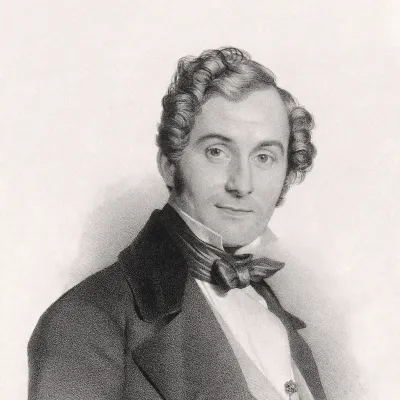
Albert Lortzing
Human Design Chart
Biography
Lortzing’s parents were actors, and he was largely self-taught as a musician. He produced a one-act vaudeville, Ali Pascha von Janina, in 1828; a play with music, Der Pole und sein Kind (1832; “The Pole and His Child”); and in 1832 wrote (but did not produce) Szenen aus Mozarts Leben (“Scenes of Mozart’s Life”), with music selected from the works of Wolfgang Amadeus Mozart. From 1833 to 1844 he sang as a tenor in Leipzig. His most successful opera was Zar (originally Czaar) und Zimmermann (1837; “Tsar and Carpenter”), based on an episode from the life of Peter the Great. Other operas include Undine(1845), a romantic opera in the style of Carl Maria von Weber and Heinrich August Marschner,Der Waffenschmied (1846; “The Military Blacksmith”), and Rolands Knappen (1849). His style derives from that of the German Singspiel and from the early 19th-century French opéra comique, which enjoyed a great vogue in Germany.
He died on 21 January 1851, Berlin.
Albert Lortzing as a Generator 4/6 in Human Design
Generator 4/6 — Design at a Glance
Albert Lortzing possessed an immense sacral energy foundation that presented him as an extremely enduring workhorse. His design suggested he had strength and perseverance if his activities aligned with his inner interest. However, this energy was not available for spontaneous initiatives but primarily unleashed through reactions to external impulses. The strategy of his type, the Generator, involved waiting until a signal from the environment came before responding from the gut.
This mechanism created two clear danger zones for Albert Lortzing. First, frustration or energy loss threatened if he undertook tasks that did not bring him inner joy – an energy drain through misalignment. Second, his potential suffered when prevented from working on heart projects despite having full strength available. Living in harmony with this reactive strategy rewarded him with a deep sense of fulfillment and satisfaction. However, going against this nature by trying to initiate rather than react likely led to persistent frustration. His strength thus lay not in pushing forward but in the powerful, sustainable response to what came from outside.
Emotional Authority
Albert Lortzing displayed a decision-making stance that did not solidify in the momentary affect but was characterized by conscious maturation of feelings. His inner authority resided in the defined emotional center. In Human Design mechanics, this means: The emotional wave with its constant ups and downs colors perception of the world. What appears inspiring at one moment can seem negative the next. This mood is merely a snapshot, not an ultimate truth. Quick, spontaneous decisions from such an emotional state often risked negative consequences due to incomplete inner clarity.
For Albert Lortzing, taking time was essential. He let decisions mature, slept on them multiple times and sought emotional distance. Only when intense feelings subsided did calmness set in. This process of patience and “deliberation” – asking oneself questions – was not an obstacle but the necessary strategy for recognizing deeper connections. Especially with long-term life decisions heavily influencing his life course, this method proved crucial. Through waiting, he gained clarity and avoided acting amidst a flood of transient moods. His authority only spoke clearly once the emotional wave had passed its peak and calmness reigned.
The 4/6 Profile — Opportunist / Role Model
Albert Lortzing revealed through his 4/6 profile as someone who intensely experimented in the first decades of life. Before the third decade, his energy resembled that of a 3-type: he sought connections and tested various roles in relationships and friendships. This phase served to gather necessary experiences before the deeper structure of his design could unfold.
Over time, an internal conflict emerged that shaped his entire life. On one side was the strong desire for belonging and building a social network (Line 4). On the other, it drew him into a distant, reflective stance to ponder the meaning of everything (Line 6). This contrast between heart and head often led to confusion. Line 4 brought the ability to carry values outward but was vulnerable to corruption if these values rested on weak foundations.
In later years, he was expected to serve as a wise role model through close cooperation with others rather than isolation. His Line 6 taught him caution and insight that expectations often disappoint. Trust or mistrust significantly determined his effectiveness. He learned that ideas only inspire others when lived authentically. His heart remained cautious to avoid opening up to the wrong people and getting hurt.
Split Definition — Defined & Open Centers
Albert Lortzing revealed himself as someone with a constant, trustworthy mental function and a steady expression. His defined Ajna Center ensured that he always created concepts in the same way; his mind was always active and served as an external authority for others. This mental energy flowed directly into his defined Throat Center, allowing him to articulate what he thought. His voice was the reliable pivot point that translated his ideas into communication and action.
As a Generator, Albert Lortzing had a defined Sacral Center, a massive source of vital energy. However, this power was only available to him when he reacted – waiting for questions or circumstances rather than initiating himself. His inner authority lay in the defined Solar Plexus Center: He needed to wait out the emotional wave until clarity emerged before making decisions. Impulsive actions driven by the heights or depths of his emotions would have plunged him into chaos; patience was his key to truth. Additionally, his defined Root Center propelled him forward with a steady pressure to move through the world and master existential challenges.
His open centers shaped his vulnerabilities. His open Head Center left him without constant inspiration; he tended to be influenced by others' mental monologues or preoccupied with doubts that were not his own problems. His open G Center meant he had no fixed identity. He adapted to his environment and sought the right place to find his direction; at the wrong place, he felt lost. His open Heart Center made him vulnerable to the pressure of proving his worth through promises or competitive behavior – a trap he could only avoid by trusting in his strategy and authority. Finally, his open Spleen Center made him sensitive to well-being and fears; spontaneous decisions here were risky as he easily developed unhealthy dependencies on others' security rather than relying on his own intuition.
Channels for clarity, change and intimacy.
Albert Lortzing showed an underlying disposition of evolutionary unpredictability. His design was marked by the Mutation Channel 60-3, connecting the Root Center with the Sacral. This connection generated a pulsating rhythm between chaos and order: Gate 60 accepted limitation as the pivot point for change, while Gate 3 tried to realize new possibilities. This process was accompanied by mechanical moodiness; internal tension arose in the pauses between impulses, often perceived as melancholy. Lortzing had to learn not to rationalize this state but rather patiently wait for the sacral reaction until the mutation took hold.
Simultaneously, he possessed the ability for deep fusion through the Pairing Channel 59-6. This flow connected the Sacral with the Solar Plexus and rooted intimacy in sexuality (Gate 59) as well as emotional wave (Gate 6). Here it was not just about romance but a fertile, penetrating connection that required patience. The emotional wave determined the timing of release; only by waiting could Lortzing gain clarity and channel his intensity correctly rather than misinterpreting it as flirting.
His intellectual expression followed the Structuring Channel 43-23. This connected the mind (Ajna) with the Throat Center. Gate 43 received spontaneous insights, which were then assimilated and clearly formulated through Gate 23. This allowed him to develop innovative perspectives that promoted efficiency. However, his thinking was often ahead of its time; if the timing did not match up, he risked rejection. He had to learn to trust his mind without having to plan in advance so that his unique ideas would be accepted by the collective.
Additionally, Gates like 50 (Protection Reflex, Tradition), 56 (mental storytelling) and 4 (logical formulas) contributed to complexity. Gate 35 demanded change through interaction, while Gate 33 required reflection to integrate experiences. Gate 55 brought extreme mood swings that promoted emotional awareness.
Individual Circuitry — Circuit Signature
Albert Lortzing revealed himself through his design as someone who swung between two distinct energetic poles. His Split Definition divided his experience into two non-directly connected groups: on one side, the life force from Sacral, Root and Solar Plexus Centers; on the other, expression through Throat and Ajna Centers. This division shaped his experience as parallel, coexisting forces.
In the Knowledge Circuit, he linked the Ajna with the Throat Center (Channel 43-23), fostering a capacity for structured communication. Parallel to this, Channel 3-60 between Sacral and Root Centers supported mutations and deviations from the known. These two segments of the circuit were energetically isolated in him; they did not form a continuous line from idea to spoken word through life force.
The Archer Circuit directly connected the Sacral with the Solar Plexus Center (Channel 59-6). This created an immediate connection between his life energy and emotions, driven by instinctive themes of pairing and protection. However, this primordial energy also stood without direct flow to the centers of his Knowledge Circuit. Albert Lortzing had to consciously integrate these different energies – emotional intuition on one side, structured communication on the other – as his design did not automatically merge them.
Right Angle Cross of Laws 3
Albert Lortzing's Human Design was marked by the right cross of Law 3. This configuration described an internal tension between the urge to follow one's impulses and the necessity to integrate into existing structures or communities. It often led him to direct his energy towards bringing order to his environment or establishing rules that were manageable for both himself and others.
In Human Design, this cross represents a specific kind of authority and action: The individual seeks ways to align their personal truth with the laws of their surroundings. For Albert Lortzing, this meant he did not simply react but actively worked on creating or adapting frameworks that enabled his ability to act. He was someone who valued clarity and defined boundaries to minimize conflicts between personal will and external expectations.
This mechanism influenced how he made decisions and interacted with others. Instead of acting chaotically or impulsively, he sought a logical embedding of his actions. The right cross of Law 3 promoted an attitude that was both disciplined and adaptable as long as the underlying principles were respected. Albert Lortzing used this energy to find stability in his life and clearly define his role within social or professional contexts.
Saturn Return · Uranus Opposition · Chiron Return — Life Cycles
Albert Lortzing's design showed a tendency towards structural anchoring followed by later career expansion. In 1828, at age 27, he composed the one-act vaudeville 'Ali Pascha von Janina'. This marked his first Saturn Return, a cycle in which years of groundwork often condenses into a viable result and sets initial professional milestones.
Later, his chart displayed the dynamics of the Uranus Opposition, a period of change and re-evaluation of authority. In 1844, at age 43, Lortzing became Kapellmeister at the City Theater in Leipzig. This event illustrated the typical effect of this aspect: an often unexpected shift in professional position or responsibility that built on previous developments and paved new paths.
The Chiron Return around ages 49 to 51 is a fulfillment cycle where one's incarnation cross unfolds and meaning becomes tangible if lived according to strategy and authority. In 1850, at age 49, Lortzing was appointed Kapellmeister at the newly opened Friedrich-Wilhelm-City Theater in Berlin. This appointment during his peak of activity showed a concrete manifestation of this cycle: Long-term work found its confirmation and the pinnacle of professional realization.
Generator · Emotional Authority — Synthesis
Albert Lortzing lived a Generator life path, characterized by a constant search for fulfilling work and the expression of creative energy (Sacral Center). His emotional authority required time for decisions, yet his connection to the knowledge circuit drove him repeatedly to explore new paths and transform knowledge. The profile as networker/role model points towards a development where he increasingly shared experiences and inspired others – a process that was always connected with the need for connection through Line 4 in the profile while Line 6 inclined him towards introspective reflection. Repeated professional changes (Saturn Return, Uranus Opposition, Chiron Return) reflected this internal conflict and showed his ability to realign himself repeatedly.
A central paradox in Lortzing's design lay in the interplay of emotional wave and the pulsating format of the knowledge circuit. On one hand, he needed time for feelings to mature – a process of inner melancholy (Channel 3-60) –, on the other hand, the energy of the circuit urged him towards creative expression and the articulation of new ideas. This tension between introspective maturation and the drive for innovation shaped his path, while he always tried to accept limitations to enable evolutionary change.
3 Defined Channels
Incarnation Cross - Right Angle Cross of Laws 3
Solar Return
The Solar Return shows the moment when the sun returns to its exact birth position - your personal solar year.
Life Cycles
Discover the life cycles with a detailed triple view (birth chart, cycle chart, composite).
Human Design Profile
- Type
- Generator
- Strategy
- To respond - wait for something to respond to
- Authority
- Emotional Authority
- Profile
- 4/6 - Opportunist / Role Model
- Definition
- Split Definition
- Incarnation Cross
- Right Angle Cross of Laws 3
- Date of Birth
- 23.10.1801 17:00
- Place of Birth
- Berlin, Germany
Frequently Asked Questions
What was Albert Lortzing's Human Design type?
What Profile did Albert Lortzing have in Human Design?
Which Authority guided Albert Lortzing?
What incarnation cross did Albert Lortzing have?
When was Albert Lortzing born?
Discover your own Human Design
Are you also a Generator? Find out in a personal reading how to use your sacral energy correctly and discover deep satisfaction.
More Personalities
Back to overviewAaliyah

Alexia

Alizée

Angèle

Anne-Marie

Arcángel
