
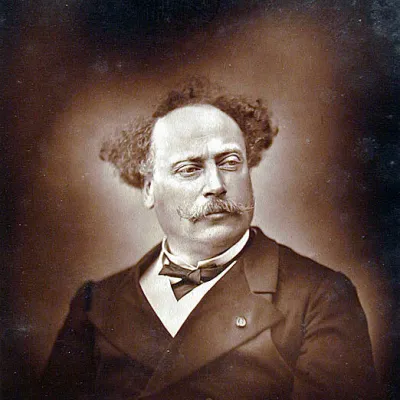
Alexandre Dumas fils
Human Design Chart
Biography
Dumas fils (French for "son") was the son of Alexandre Dumas père ("father"), also a well-known playwright and author of classic works such as The Three Musketeers and The Count of Monte Cristo. Dumas fils was admitted to the Académie française (French Academy) in 1874 and awarded the Legion of Honour in 1894.
What does Projector 3/5 mean for Alexandre Dumas fils?
Projector 3/5 — Design at a Glance
Alexandre Dumas fils appeared as someone who interacted with his environment through an intense, focused aura. His Human Design type was Projector, meaning he did not have constant intrinsic life energy but instead alternated between phases of high activity and fast work speed followed by periods of necessary rest. This structure inclined him to immediately recognize errors in systems or others—comparable to a bright flashlight shining directly into the dark.
However, this ability to identify weaknesses instantly could be perceived as unpleasant if addressed directly. Therefore, his design mechanics required an elegant approach: instead of openly criticizing problems, he worked best by setting an example of harmonious states. His strategy involved waiting for others' value-based and sincere invitations before offering advice or knowledge.
If Alexandre Dumas fils lived according to this principle of waiting and shining through personal example, he was rewarded with success. Ignoring this strategy and acting without invitation risked burning out due to lack of energy sources as well as developing bitterness as an expression of his non-self. His design thus shaped a life oriented towards resonance and targeted guidance of others rather than constant self-production.
Splenic Authority
Alexandre Dumas fils demonstrated decision-making based not on logical planning or emotional weighing but on an immediate, physical impulse. His design carried authority in the Spleen Center, meaning his inner knowledge acted as a spontaneous health and alarm system. Since both his Emotional and Sacral Centers were open—a prerequisite for this specific authority—he could not pursue long-term strategies or commit firmly. Instead, he had to act in each moment because only there was the first impulse reliable and directly serving his well-being. However, this fine signal tone was easy to overlook; it required high vigilance and often a short retreat to separate the pure instinct from external influences. His ability for rigorous demarcation against harmful environments depended directly on whether he recognized and followed this momentary impulse. Plans were less relevant to him than the flexibility of realigning in the here and now. By committing little and keeping space open, he effectively ensured his own health and protection. The structure of his design thus dictated a life of spontaneity: what was right could only be seen in the current moment, not in prior considerations.
The 3/5 Profile — Martyr / Heretic
Alexandre Dumas fils appeared as someone who learned through personal experimentation and then offered this knowledge to others. His Profile 3/5 marked him as an experimenter and hero: he initially believed little, had to test everything himself, and solved other people's problems with practical experience. This attitude made him attractive in his environment, which wanted to learn from his experiences. The Line 3 of the Adventurer drove him forward through trial and error, while the Hero Line 5 gave him the role of presenting solutions.
In leadership, there was a tendency towards sharp demarcation. The third line of Gate 31 emphasized that quality in followership was more important than quantity. He sought the right influences and possibly used opinion polls to assess complex situations. At the same time, he carried responsibility for resources. Gate 27, Line 5 described his ability to manage others' means effectively and offer practical solutions during crises. This created a basis of trust but harbored the risk of power loss or negative reputation if this responsibility was not fulfilled. Failing in front of others could be painful because the hero role was strongly tied to his own prestige. His design suggested that he learned from his mistakes and passed on this knowledge, making him a figure both admired and critically observed.
Split Definition — Defined & Open Centers
Alexandre Dumas fils revealed himself as someone with a constant, trustworthy mental function. His defined Ajna Center ensured that he created concepts and theories in the same way consistently; his mind was always active and served as an external authority for others. This mental energy flowed directly into his defined Throat Center, allowing him to express what he thought clearly and reliably. His voice became a focal point that transformed information and manifested it in the world.
At the same time, he had a defined Spleen Center, which stood for his body awareness and intuition. He tended to make spontaneous judgments in the present moment and listen to instinctive warning signals to protect himself and maintain well-being. His defined Root Center provided the firm pressure needed to materialize upwardly and nourish existential awareness; he possessed a constant way of handling stress to secure survival in the body.
In contrast, his Head Center was open. He did not have a consistent way to process mental inspiration and tended to get caught up in doubts or questions from others when he did not trust his inner authority. His open G Center meant that he did not possess a fixed identity; he was vulnerable to "borrowed" directions and had to wait for the environment to show him the correct place rather than seeking love or meaning himself.
Similarly, his Heart Center was also open. He lacked consistent willpower and was susceptible to temptation to prove himself through promises or competition, which often ended in self-doubt. His open Sacral Center made him sensitive to the energy of others; he could easily become exhausted when working on "borrowed" energy rather than respecting his own limits. Finally, his Solar Plexus was open, causing him to absorb and amplify emotions from the environment instead of owning them himself, making him vulnerable to emotional conditioning.
Channels for mental order, life purpose and ambitious transformation.
Alexandre Dumas fils exhibited a foundational stance based on logical order and the search for individual meaning. His design suggested that he structured information mentally to make it understandable. The Accepting Channel 17-62 connected the Ajna Center with the Throat Center. Gate 17 visualized patterns, while Gate 62 translated these into language and named details. This created an internal process of organization: only what he could fit into his mental system was understood by him. It gave him the gift to present complex connections as theories or formulas, provided that he waited for an invitation to speak to ensure clarity and avoid resistance.
At the same time, the Life Struggle Channel 38-28 propelled him forward. This channel connected the Root Center with the Spleen Center through Gate 38 (Fighter) and Gate 28 (Player). It endowed him with the determination to walk his own path, even against resistance. He found meaning in the struggles of his life and resisted expectations to preserve his integrity. This channel promoted individualization and saw evolution as an ongoing process that had to be stubbornly defended.
Additionally, the Transformation Channel 54-32 was at work. It connected Gate 54 (Ambition) with Gate 32 (Continuity). Here it was about the drive to rise through talent and effort. Alexandre Dumas fils was motivated to be seen and improve his position, often by dedicating himself to the "tribe" system. He instinctively knew when support was available to secure prosperity. His ambition served the transformation of his social status, dependent on recognition from others.
Individual Gates like Gate 31 (Transmission), Gate 41 (Evolutionary Development) and Gate 27 (Care) rounded out this Profile by bringing in aspects of identity, feeling, and sustenance.
Individual Circuitry — Circuit Signature
Alexandre Dumas fils revealed himself as someone whose inner drive systems operated in two clearly separated areas. His design featured a Split Definition: The Ajna and Throat Center groups formed a continuous flow, while the Spleen and Root Centers existed alongside but energetically isolated from them. This separation meant that his intellectual strategy was not directly fused with his instinctive survival mechanisms; they acted as parallel forces.
In the Understanding Circuit, Channel "Accept" connected the Ajna to the Throat Center. This created a line that translated logical strategies and visual future visions directly into articulated words. It was about sharing rational insights free from emotional coloring, allowing him to communicate complex thoughts in a structured manner.
Parallel to this, two additional circuits were active in the Spleen and Root Centers. The Knowledge Circuit used Channel "Life Struggle" (Gates 28-38) here. This connected the intuitive perception of the Spleen with the endurance drive of the Root. It was a pulsating energy aimed at forging one's own path through persistent struggle to uncover new knowledge.
Also situated in these centers was the Ego Circuit using Channel "Transformation" (Gates 32-54). This promoted a conservative, traditional approach to cooperation and resources. Since there was no connection to the Sacral Center, these activities required regular rest periods for regeneration. The combination of strategic communication on one hand and instinctive endurance as well as transformative collaboration on the other defined his actions as two separate but equally important life aspects.
Right Angle Cross of the Unexpected 2
Alexandre Dumas fils exhibited a basic attitude shaped by the right cross of the Unexpected. This configuration described a life task where seemingly random or surprising turns often occurred, yet these events held deeper meaning. For his design, this meant that he did not always take the most direct path but rather learned and grew through unexpected experiences. This trait influenced how he approached challenges: instead of resisting them, he embraced them as part of a larger pattern. The right cross of the Unexpected helped him find inner stability in moments of confusion or unpredictability. It was not passive acceptance but an active integration of surprises into his life. This ability allowed him to remain flexible even in difficult situations and adopt new perspectives. For Alexandre Dumas fils, this was no obstacle but a tool for self-actualization. He used this dynamic to continuously develop himself without losing control over his destiny. Thus, every unexpected event became an opportunity to delve deeper into himself and discover his own truth.
Saturn Return · Uranus Opposition · Chiron Return · 2nd Saturn Return — Life Cycles
Alexandre Dumas fils showed himself as someone whose life work was marked by clear cycles of condensation and public recognition. His design indicated a tendency for inner developments to lead to concrete, visible results that often came with societal appreciation. This became evident in 1853 at the age of 29 when he published “Diane de Lys”. For his chart, this was the first Saturn Return, a time when years of groundwork and internal maturity often condensed into a solid professional milestone.
Another turning point occurred in 1864 at the age of 40: Dumas married Nadeschda Naryschkina von Knorring and published “L’affaire Clémenceau”. This combination of private commitment and professional productivity coincided with his Uranus Opposition. This aspect often marks a phase of breaking free from old structures to establish new, more authentic life designs – here visible in the connection between partnership and artistic expression.
The peak of his incarnation purpose was evident in 1875 at the age of 51 during his Chiron Return. In this fulfillment cycle, one’s design unfolds increasingly in life if the strategy is followed. For Dumas, this phase culminated in his acceptance into the Académie française. This event underscores how his chart described a development towards highest societal and intellectual recognition as a natural consequence of his inner alignment.
Projector · Splenic Authority — Synthesis
Alexandre Dumas fils was a projector who through his defined Ajna Center and the Channel of Acceptance (Gate 17/62) possessed an acute ability to recognize patterns and translate these into understandable concepts. This talent, combined with that of an experimenter/hero Profile (3/5), led him to gather knowledge through life experiences and make it accessible to others – always in search of details and logical connections. His inner authority in the Spleen Center strengthened this tendency by giving him a keen sense for recognizing errors and imbalances, both within himself and his environment.
A central paradox shaped his life: the projection power that allowed him to shed light on darkness (and point out mistakes) clashed with the need to convey these insights gently. The knowledge and resulting judgments could be perceived as unpleasant, which required a constant balance between the urge for clarity and avoiding confrontation. This tension was evident in documented events where professional successes (1853, 1875) coincided with personal relationships that demanded new paths (1864).
3 Defined Channels
Incarnation Cross - Right Angle Cross of the Unexpected 2
Solar Return
The Solar Return shows the moment when the sun returns to its exact birth position - your personal solar year.
Life Cycles
Discover the life cycles with a detailed triple view (birth chart, cycle chart, composite).
Human Design Profile
- Type
- Projector
- Strategy
- Wait for the respectful invitation
- Authority
- Splenic Authority
- Profile
- 3/5 - Martyr / Heretic
- Definition
- Split Definition
- Incarnation Cross
- Right Angle Cross of the Unexpected 2
- Date of Birth
- 27.07.1824 18:00
- Place of Birth
- Paris, France
Frequently Asked Questions
What is the Human Design type of Alexandre Dumas fils?
Which Profile did Alexandre Dumas fils have?
What was the authority of Alexandre Dumas fils?
What incarnation cross did Alexandre Dumas fils have?
When was Alexandre Dumas fils born?
Discover your own Human Design
Are you also a Projector? Find out in a personal reading how to unfold your leadership qualities and recognize the right invitations.
More Personalities
Back to overviewSissy Spacek

Alain-Fournier

Anémone

Angeli

Ann-Margret

Bourvil
