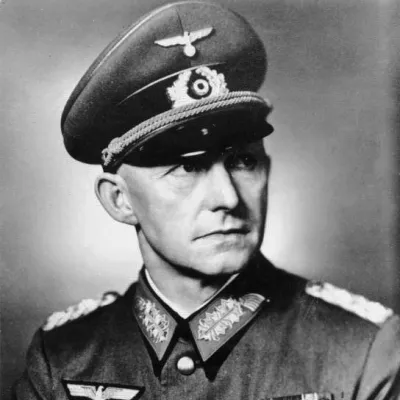
Alfred Jodl
Human Design Chart
Biography
On 16 October 1946 he was hanged as a war criminal at Nuremberg, Germany.
Alfred Jodl as a Manifesting Generator 1/3 in Human Design
Manifesting Generator 1/3 — Design at a Glance
Alfred Jodls design pointed towards a tendency for swift and hybrid energy application. As an Manifesting Generator, he possessed constant sacral energy, which granted him the ability to quickly draw things into his life while skipping steps in the process. This configuration combined the endurance of a Generator with the direct impact of a Manifestor.
However, this speed brought specific challenges. Jodl tended to tackle multiple projects simultaneously due to reacting to various impulses. When strategy and inner authority were not aligned, this creative drive quickly turned into frustration – the non-self theme of his type. Often he had to backtrack to complete skipped steps, which was perceived as a hindrance.
Effective use of this energy required a clear strategy: First react to impulses and check if the sacral center responded with a clear 'yes'. Only then should action be taken. With correct application, Jodl found deep satisfaction in creation. The advice to work sequentially did not suit him; instead, his energy flourished in play mode with variety and parallel activities as long as inner consent was maintained.
Emotional Authority
Alfred Jodls emotional wave significantly influenced his experience and judgments. His inner authority stemmed from the defined Solar Plexus Center. This mechanism always took precedence over all other defined centers in his design; regardless of any additional strategies or energies present, emotional clarity determined the decisive compass for his actions.
His perception of the world was colored by his current mood. He could be enthusiastic about something one moment and negatively assess the same situation the next. However, this up-and-down did not mean that the initial impression was true. Quick, spontaneous decisions based on immediate emotion carried the risk of negative consequences as they only reflected a fleeting snapshot.
Therefore, it was essential for Alfred Jodl to take time to let decisions mature. This process required patience and conscious reflection on important questions. Only when intense feelings subsided and emotional distance was gained did clarity and calmness set in. Through this waiting period, he underwent the necessary maturation process, particularly crucial for long-term decisions with significant influence on his life course. Only then could he ensure that his choice did not follow fleeting moods but rather deeper emotional truth.
The 1/3 Profile — Investigator / Martyr
Alfred Jodls design was characterized by a fundamental tension between theoretical preparation and practical experimentation. As a 1/3 profile, he was an Investigator who always wanted to learn more, paired with the urge to try things out. This configuration created an inner conflict: The energy of Line 1 often generated fear of implementation because there was a feeling of not having enough knowledge yet. Yet, Line 3 urged action to learn through mistakes. Self-discovered insights were therefore his central theme; if he believed something was right, it had stood the test both theoretically and practically.
The specific energies of his lines further shaped this dynamic. The first line brought authority in sharing new insights but could undermine established value systems and cause negative consequences when introducing new ideas into existing structures. This combined with an expansive force that could break rules. Simultaneously, Line 3 highlighted dissatisfaction and the oscillation between responsibility and irresponsibility. It drove confrontation with outdated principles whose destruction became possible once reservations fell away. This often led to a lack of sensitivity in destroying old orders and signaled a separation from earlier ties or group affiliations. Alfred Jodl thus lived in constant testing between the desire for secure knowledge and the necessary, sometimes destructive practice of experimentation.
Split Definition — Defined & Open Centers
Alfred Jodls design points towards a tendency for consequent, conceptual clarity. His defined Ajna Center generated constant mental processes; he thought all the time and was hard to influence from outside. These concepts flowed directly into his defined Throat Center, where he articulated what he thought. Thus, his communication was a direct transmutation of his mental structure into words and actions, reliable yet limited by his own perspective.
At the same time, he had a firm inner identity through his defined G Center. He knew his direction and radiated self-love without being dependent on others. This combined with the immense vital energy of his defined Sacral Center. As a Generator, he possessed a daily energy supply that could only be correctly utilized by reacting to external impulses. Initiating actions without this sacral approval inevitably led to frustration and exhaustion due to the lack of available energy.
His inner authority lay in his defined Solar Plexus Center. He was designed to wait for emotional waves before making decisions. Immediate reactions on an emotional high or low were impulsive and often wrong; true clarity only emerged after going through the cycle. This was supported by his defined Spleen Center, which provided intuitive momentary warning signals, as well as his defined Root Center, which supplied a constant pressure to deal with stress and move forward.
In contrast, his Head Center was open. He lacked consistent inspiration for mental problems that were not his own. He tended to get entangled in other people's questions or seek answers where none existed, which could confuse him. Similarly, his Heart Center was open; he lacked the constant energy for willpower and promises. He was vulnerable to the pressure of proving his worth through performance, a cycle of self-doubt when relying on his inner authority.
Channels for rhythm, presence, intuition, synthesis, clarity and structure.
Alfred Jodls design points towards a deep biological flow marked by Channel 5-15 (Rhythm). This mechanism connected his inner energy with a universal attraction force that propelled him forward continuously, independent of intellectual considerations or emotional waves. He moved in a natural timing that magnetically drew others into his life rhythm, where his actions were based on firm habits yet flexible enough to integrate extreme societal changes.
This intuitive foundation was complemented by Channel 19-49 (Synthesis), creating strong sensitivity towards tribal belonging and emotional principles. Here, there was a need for loyalty and the protection of shared resources, weighing acceptance of connections against rejection of what contradicted his highest ideals. This channel acted as an emotional glue for his environment, finely attuned to collective needs.
Additionally, Channel 43-23 (Structuring) enabled him to assimilate innovative insights from his mind and express them clearly. It gave him the ability to translate complex perspectives into efficient concepts, even if his thinking seemed years ahead of its time. Parallel to this, Channel 10-20 (Awakening) supported his presence in the moment by translating individual principles into concrete actions and radiating self-confidence through behavior that inspired others to live authentically.
Channels 57-10 (Perfect Form) and 57-20 (Flash of Insight) rounded out this profile, directly translating intuitive perception into spontaneous expressions. Alfred Jodl thus possessed the capacity to recognize deep inner truths in the moment and communicate them without hesitation, granting him a rare clarity and transformative effect on his environment.
Individual Circuitry — Circuit Signature
Alfred Jodls design points towards structured innovative expression capability. The Knowledge Circuit connected Ajna, Throat, and Spleen Centers for him, allowing intuitive flashes (Gate 20-57) to be directly translated into structured language (Channel 43-23). He was someone who not only gained new knowledge but also transformed it acoustically and in the present moment.
Parallel to this, two separate force fields were at work. One connected Identity and Sacral Centers (Understanding Circuit). Here, rhythmic life energy (Channel 15-5) flowed into logical, emotion-free ratio. Alfred Jodl used this connection to strategically focus on the future and share rational insights.
The other field connected Solar Plexus and Root Centers (Ego Circuit). Through the Synthesis Channel (49-19), he reacted impulsively to his environment. Since this group was separated from Sacral, he needed quiet pauses for regenerating emotional resources for tribal cooperation.
Additionally, the design integrated power from reacting to life. The Integration connected Throat, Identity, and Spleen Centers. Alfred Jodl channeled intuitive impulses (Gate 57) through correct behavior (Gate 10) and manifested them immediately in the present moment (Channel 20-10). This created a high individuality based on perfect form. Overall, these shared definitions shaped a profile that oscillated between impulsive reaction, strategic planning, and innovative expression without these areas energetically overlapping.
Right Angle Cross of Explanation 2
Alfred Jodl's design carried the imprint of the right cross of the Declaration. This configuration described an inner dynamics where the pursuit of clarity and truth was linked with a deep, often unconscious authority. In Human Design, this cross represents a specific energy aimed at deciphering complex issues and revealing their essence. It wasn't mere intellectualism but rather an impulse to explain things in such a way that their true nature becomes visible. Alfred Jodl showed himself through this structure as someone who needed a clear view of the situation before acting or judging. The energy of this cross often worked subtly in the background, shaping his way of processing and conveying information. It was about uncovering connections hidden from others and the ability to articulate these insights precisely. This mechanism suggested that Alfred Jodl took on a special role in situations where it was about clarifying facts or principles. His design promoted an attitude of analytical sharpness combined with the need to reduce things to their core. This wasn't a conscious strategy but a natural consequence of his energetic constellation, which inclined him towards seeking the underlying logic of events and ideas.
Saturn Return · Uranus Opposition · Chiron Return — Life Cycles
Alfred Jodl's design featured a structure that sought its full expression during the Chiron Return phase. This cycle did not mark a stage of wound healing in a psychological sense, but rather a fulfillment process: The individual's incarnation cross unfolds increasingly in life if strategy and authority are observed. Meaning and purpose become experiential; the inner configuration finds its external counterpart.
In 1939, at age 49, Alfred Jodl entered his first personal encounter with Adolf Hitler. This event fell exactly within the timeframe of the Chiron Return (approximately 49–51 years). It was a career-defining moment that can be interpreted as an expression of this bloom phase. The mechanics show: During this life stage, long-term orientation condenses into concrete reality. Alfred Jodl found himself in a period where his design reached its peak and his role within the larger framework became clearly defined. The Chiron Return functioned as a catalyst for making visible his destiny within the given structures. It was no coincidence that this decisive contact occurred precisely during this window; the design sought its completion and found it in this specific interaction.
Manifesting Generator · Emotional Authority — Synthesis
Alfred Jodl was a Manifesting Generator, whose life was marked by a constant interplay between the drive for rapid implementation and the necessity of emotional maturation. The defined sacral energy (Sacral Center) provided a constant driving force that, through connection to the Throat Center (Manifestor aspect), led to an impressive ability to initiate things quickly. However, this potential was always modulated by emotional authority – a process of weighing and inner clarification that required time and delayed impulsive actions. The Line 1/3 in his Profile reinforced this trait further, combining an insatiable thirst for knowledge with the need to gain insights through experimentation and independently verify them.
A central paradox in his design lay in the tension between this rapid energy and the need for emotional depth. He could seize opportunities and initiate processes (Rhythm Channel), but the emotional wave required a thorough engagement before decisions were truly grounded. This discrepancy might have led to an internal conflict between the desire for quick progress and the necessity of letting things mature – a pattern reflected in his Knowledge Circuit and Declaration Cross.
6 Defined Channels
Incarnation Cross - Right Angle Cross of Explanation 2
Solar Return
The Solar Return shows the moment when the sun returns to its exact birth position - your personal solar year.
Life Cycles
Discover the life cycles with a detailed triple view (birth chart, cycle chart, composite).
Human Design Profile
- Strategy
- To respond - wait for something to respond to
- Authority
- Emotional Authority
- Profile
- 1/3 - Investigator / Martyr
- Definition
- Split Definition
- Incarnation Cross
- Right Angle Cross of Explanation 2
- Date of Birth
- 10.05.1890 05:45
- Place of Birth
- Würzburg, Germany
Frequently Asked Questions
What Human Design type was Alfred Jodl?
Which Profile did Alfred Jodl have in Human Design?
Which Authority guided Alfred Jodl?
What incarnation cross did Alfred Jodl have?
When was Alfred Jodl born?
Discover your own Human Design
Are you also a Manifesting Generator? Find out in a personal reading how to unfold your multi-talents and direct your energy wisely.
More Personalities
Back to overviewAldair

Alizée

Angeli

Arletty
Artus
Balthus