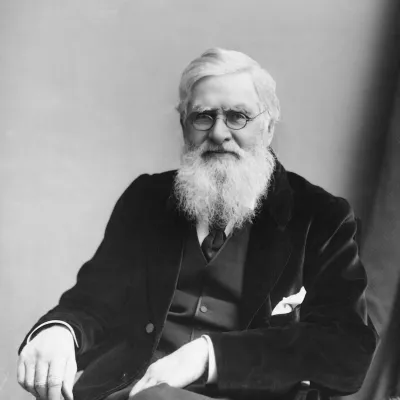
Alfred R. Wallace
Human Design Chart
Biography
Wallace died on 7 November 1913 near Bournemouth, England.
Alfred R. Wallace as a Manifesting Generator 3/5 in Human Design
Manifesting Generator 3/5 — Design at a Glance
Alfred R. Wallace showed himself to be someone who possessed the ability to quickly draw things into his life and skip steps in the process. As an Manifesting Generator, he had constant sacral energy, which gave him a hybrid configuration of Generator and Manifestor traits. This structure allowed him to act with great speed but also carried the risk of missing important stages or becoming overwhelmed by parallel processing of multiple projects.
His Life's Task was not to start initiatives on his own initiative but to respond to inner impulses. Only when his sacral center signaled a clear "yes" and his inner authority agreed could he effectively use his creative power. By correctly applying this strategy – that is, constantly checking whether the projects were still enjoyable – he managed to find himself in a productive play mode. This ensured deep satisfaction and fulfillment from his work rather than frustration over lost time or unfinished tasks. His speed thus became an advantage if he maintained the balance between impulse reaction and continuous confirmation by his inner self.
Sacral Authority
Alfred R. Wallace had sacral authority as a Generator, which simplified his decision-making process because strategy and inner guidance were the same. This configuration required an open emotional center so that he could not immediately react to external stimuli but instead needed to wait until his internal response became clear. His truth manifested physically: as gut feelings or bursts of energy, often audible through grunts, hums, or loud affirmations like "Mhm." Such signals marked the moment when his sacral motor kicked in. Then he felt vital and alive, with inexhaustible energy and great enthusiasm for the task at hand. He was born to walk through life with joy and immerse himself in his work without needing external purpose. The activation of the spleen center further supported this authority by giving him the ability to react quickly and spontaneously. Through direct access to his physical well-being and instinctive perception, he could reliably guide himself. This combination of sacral energy and spleen-supported intuition shaped how he navigated life: not through intellectual planning but through trusting in the immediate impulse of his body when there was resonance.
The 3/5 Profile — Martyr / Heretic
Alfred R. Wallace's design set a tendency towards heroic experimenting: He learned through personal trial and error, only to later use this practical knowledge to solve problems for others. As a 3/5 profile, he initially believed nothing given; the line of the adventurer urged him to test everything himself. The experience gained was then presented as treasure, attracting others and bringing him the role of rescuer or storyteller. This dynamic was painful, however, when public experiments failed.
His mechanics included secret interactions and the use of hidden means when official channels were blocked (Gate 54). Ambition strengthened through concealment; obstacles were charmed away. At the same time, he was driven by crisis situations to further development (Gate 57). Individual mutations served the collective to protect against new threats. New forms should enhance survival and be generalizable. This configuration described a life task of uncovering hidden connections and passing them on to others, where intuition in the second generation could become overwhelmed, leading to independent development.
Single Definition — Defined & Open Centers
Alfred R. Wallace revealed himself as someone with a deeply rooted inner direction and clear self-worth. His defined G Center gave him a constant identity and the confidence to feel loved without being dependent on others. This internal security was linked to his willpower: The defined Heart Center provided him with the strength to fulfill promises and exercise authority over resources and time. He tended to prove his worth through action and recognized the necessity of only taking on commitments he could keep.
His energy source was the defined Sacral Center, which provided him with a constant vital force. Wallace lived by the principle of reaction: He waited for life to pose questions to him so that he could respond clearly from the gut with yes or no answers. This protected him from exhaustion and ensured that he only used his energy on things that brought satisfaction. This was complemented by his defined Spleen Center, which gave him spontaneous intuition. He trusted these momentary warning signals and health instincts to protect himself in the present and maintain well-being.
At the same time, Wallace was exposed to certain external influences. His open Head and Ajna Centers meant that he did not have a constant mental inspiration but was open to the ideas of others. He tended to engage with foreign concepts or feel pressured to find answers to questions that were not his own. Additionally, his open Solar Plexus absorbed the emotions of his surroundings. Wallace had to learn not to personalize these feelings as his own but to observe them as passing waves in order to remain emotionally stable. His open Root Center made him vulnerable to external stress pressure, which he amplified but did not generate himself; he learned to recognize this pressure and withdraw when overwhelmed rather than blindly follow it.
Channels for inspired leadership, intuition and authentic expression.
Alfred R. Wallace revealed himself as someone who acted through authentic presence and intuitive awareness. His design combined the power of individual expression with a deep, bodily intuition for survival in the moment.
The Channel of Inspiration 1-8 shaped his way of drawing attention: not through words but by living his unique identity and thereby inspiring others to realize their own potential. This effect was based on an inner, authentic authority that allowed him to act as a role model. Parallel to this, the Channel of Alpha Animal 7-31 provided for logical, collective leadership. He sought his sphere of influence from which he showed the way but needed an invitation by the community to effectively fulfill his role as a leader.
His inner self was guided by the Channel of Research 34-10, driving him to follow his own convictions and practice self-love. This energy responded to the environment and promoted independence. Complementing this was the Channel of Perfect Form 57-10, which gave him intuitive insight into adapting his behavior moment-to-moment to secure his well-being and survival. This process was spontaneous and free from future anxieties, allowing him to existentially unburdened walk through the world.
The Channel of Initiation 25-51 brought competitive energy into play aimed at initiating individualization through shock experiences. Wallace was designed to survive such transformative moments and thereby strengthen others in their development. The foundation for all this was the Channel of Power 34-57, which linked his intuitive capacity with sacral life force. This kept him permanently alert to dangers and enabled quick, instinctive reactions to protect his well-being.
Additionally, prioritized Gates like Gate 54 (Success Enlightenment), Gate 53 (Pioneer Spirit) and Gate 27 (Care) contributed to his complex dynamics by linking worldly ambitions with mystical insight and a genetic role of care.
Individual Circuitry — Circuit Signature
Alfred R. Wallace's design laid a tendency towards inner centering and individual confirmation. As a Simple Defined, he possessed a coherent energetic flow connecting Identity, Heart, Sacral, Spleen, and Throat Centers. This unity shaped him as a person with firm self-worth and clear convictions, though often difficult to articulate in words due to the Throat Center not being directly connected to the central stream of willpower (Heart/Sacral).
The Centering Circuit linked his Identity, Heart, and Sacral Centers. This fostered a bold, individualistic stance: 'I am who I am,' which also made others feel their uniqueness. Parallel to this, the Knowledge Circuit worked through the Channel of Inspiration (Gates 1–8), connecting Throat and Identity Centers. This allowed him to express new insights through acoustic impulses and emotional waves, initiating transformation.
The Understanding Circuit contributed with the Channel 'The Alpha Animal' (Gates 31–7), linking Throat and Identity Centers. Here it was about sharing logical, rational insights for societal improvement, free from conditioning. Finally, the Integration Circuit secured survival by connecting Identity, Spleen, and Sacral Center (Channels 'Perfect Form' and 'Power'). This channeled power from intuitive knowledge and correct reactions into the present, thereby creating highest individuality and self-confirmation. All these streams worked together to shape Alfred R. Wallace as someone who walked his own path and brought new knowledge into the world.
Right Angle Cross of Penetration 4
Alfred R. Wallace's Human Design configuration indicated a tendency towards deep inner transformation characterized by the 'right cross of penetration.' This setup did not describe superficial adaptation but rather an essential process of letting go and reformation. It acted as a catalyst for fundamental changes, where old structures had to be abandoned to make room for new insights.
The mechanics of this cross suggested that Alfred R. Wallace went through periods of intense inner work, confronting what no longer served him. This was not just change but a penetration into the essential aspects of his being. The process challenged him to explore deeper truths and redefine his identity in the process. The energy of this configuration supported him in overcoming obstacles and focusing on the essentials.
Without specific external events mentioned in the raw content, the description remains limited to this structural dynamic. Alfred R. Wallace thus emerged as someone who propelled his development through such inner breakthroughs. This configuration emphasized the necessity of not clinging to the past but being open to new perspectives. It shaped his path towards a more authentic expression of himself, driven by the power of this specific Human Design constellation.
Saturn Return · Uranus Opposition · Chiron Return · 2nd Saturn Return — Life Cycles
Alfred R. Wallace's life was marked by physical losses and intellectual clarity. His first Saturn Return in 1852 signified a deep crisis: his entire collection was lost; he only managed to save diary entries and drawings. This cycle often condensed years of groundwork into solid results, but here it did so through the loss of material foundations.
The Uranus Opposition around age forty brought a sharp intellectual separation. In 1863, Wallace published a work that challenged Darwin's notes in *The Origin*. This phase promoted the need for individual truth and distancing from established systems, redirecting his career.
His Chiron Return around age forty-nine ushered in a period of fulfillment as his incarnation purpose increasingly unfolded in life. In 1872, Wallace built a concrete house on leased land in Grays, Essex. This was not just a new construction but the establishment of a stable base for further work, signaling that meaning and purpose were becoming tangible.
The second Saturn Return around age fifty-seven crowned this development. *Island Life* was published in 1880. This cycle confirmed the viability of his long-term research and solidified his reputation as an author who translated complex connections into enduring works.
Manifesting Generator · Sacral Authority — Synthesis
He was a Manifesting Generator whose life seemed marked by constant movement between inner impulse and external reaction. The sacral authority (paired with the defined Sacral Center) provided an inexhaustible energy source, which through the channel of inspiration (Gate 1/8) fueled a strong urge for expression and participation in public discourse. As an experimenter and hero (3/5 Profile), he actively sought new experiences to gain knowledge and share it – a process that showed itself repeatedly, from losing valuable collections (Saturn Return, 1852) to the publication of groundbreaking insights.
A central paradox lay in the combination of quick initiating power and the necessity to wait for sacral reactions. He could start things quickly but occasionally skipped important steps (as described in his design), forcing him into correction repeatedly. This dynamic also showed itself in cycles: career peaks (Uranus Opposition 1863, Chiron Return 1872, Saturn Return 1880) followed phases of crisis and new beginnings, a pattern of rapid progress and necessary reflection.
6 Defined Channels
Incarnation Cross - Right Angle Cross of Penetration 4
Solar Return
The Solar Return shows the moment when the sun returns to its exact birth position - your personal solar year.
Life Cycles
Discover the life cycles with a detailed triple view (birth chart, cycle chart, composite).
Human Design Profile
- Strategy
- To respond - wait for something to respond to
- Authority
- Sacral Authority
- Profile
- 3/5 - Martyr / Heretic
- Definition
- Single Definition
- Incarnation Cross
- Right Angle Cross of Penetration 4
- Date of Birth
- 08.01.1823 02:30
- Place of Birth
- Llanbadoc, UK
Frequently Asked Questions
What is Alfred R. Wallace's Human Design type?
What Profile did Alfred R. Wallace have in Human Design?
What Authority did Alfred R. Wallace have?
What incarnation cross did Alfred R. Wallace have?
When was Alfred R. Wallace born?
Discover your own Human Design
Are you also a Manifesting Generator? Find out in a personal reading how to unfold your multi-talents and direct your energy wisely.
More Personalities
Back to overviewAldair

Alizée

Angeli

Arletty

Artus

Balthus