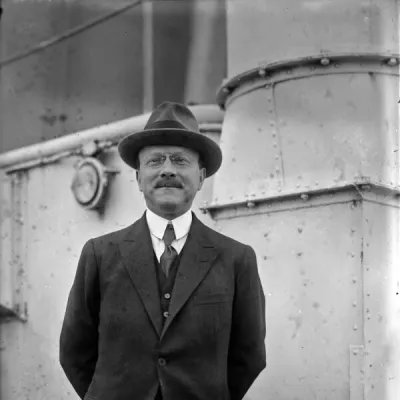
André Citroën
Human Design Chart
Biography
The Human Design of André Citroën: Projector 4/6
Projector 4/6 — Design at a Glance
André Citroën appeared as someone who, with a dense, focused aura, directly influenced his surroundings. His Projector design tended to immediately identify flaws in others' systems, much like a bright flashlight illuminating the dark. However, this ability to spot weaknesses instantly could be perceived as unpleasant or intrusive when he addressed these flaws directly.
The mechanics of his design required a subtle approach: instead of openly criticizing others' problems, he was most effective by embodying harmonious states himself. Through this inner radiance, he attracted people who would then seek his advice of their own accord. His strategy was to wait for a genuine, appreciative invitation before offering his knowledge or guidance.
With his undefined Sacral Center, he lacked a constant, intrinsic source of life energy. Instead, he experienced phases of high activity and rapid work speed, which inevitably had to be followed by necessary rest periods to prevent burnout. The conventional system, which expects continuous performance, often stood in opposition to these natural rhythms. Living according to this design and waiting for invitations led to success. Ignoring this strategy and acting independently eventually led to his non-self theme: bitterness.
Self-Projected Authority
André Citroën appeared as a Projector with the rare authority in Self. This configuration marked an extreme openness, making him vulnerable to distraction by external, motoric energies. The greatest danger lay in losing himself in this openness and constantly seeking external energy. His inner truth was anchored in his identity. Decisions arose through self-dialogues or dialogues when invited. Crucial was listening to himself and distinguishing whether his Self or his mind was speaking. Spontaneous, unconsidered statements expressed his true essence and made his uniqueness recognizable to others. Another decision-making source was a physical feeling that drew him geographically or thematically in a specific direction. By following this inner pull, he could become a guide for others. There lay his specific potential for success. This mechanism required that he did not actively seek confirmation but waited until his uniqueness became visible through spontaneous expression or physical resonance. The authority in Self thus defined a path of inner orientation based on distinguishing between authentic self-expression and mental construction.
The 4/6 Profile — Opportunist / Role Model
André Citroën appeared as someone who, in his youth, learned through diverse experiments in relationships and friendships before a deeper conflict developed later between the desire for community and the need for detached wisdom. His design as a 4/6 Profile, the 'Networker/Role Model', shaped this path: Line 4 drew him into social circles, while Line 6 propelled him to think about the meaning of life and establish himself as a role model.
This dynamic was influenced by specific energetic burdens. Line 4 in Gate 13 acted as a fatigue zone; it attracted people who told him stories and emotionally burdened him. This absorption of foreign energy led to exhaustion and the need for withdrawal for reflection. At the same time, Line 6 in Gate 1 enabled objectivity in dealing with creativity. It allowed distinguishing the true value of creative work from mere fashion trends. Yet, here too, the danger of disappointment lurked if subjective assessments were not confirmed. Wisdom required time to live authentic mutations and prove their worth. Thus, André Citroën moved between the emotional burden of listening and the clarifying distance of objective evaluation, always seeking a balance between heart and mind.
Split Definition — Defined & Open Centers
André Citroen was characterized by defined Head and Ajna Centers, which generated a constant mental pressure for inspiration and concept formation. However, this continuous thought process was without direct motoric energy, preventing hasty decisions and instead promoting the dissemination of questions. The connection to the defined Throat Center allowed him to reliably communicate these mental concepts and bring them into the world. Simultaneously, a defined G Center provided a firm sense of self-identity and a clear sense of direction, enabling him to show others new paths without needing their approval.
In contrast, his open centers revealed fields of conditioning. His open Heart Center tended to feel the pressure to prove his worth through willpower and promises, leading to a cycle of self-doubt when these could not be kept. His open Sacral Center absorbed the vital energy of the environment, leading to overexertion as he was not designed for a constant generative force. Additionally, he was vulnerable through his open Solar Plexus Center to amplify and personalize foreign emotions, generating emotional insecurity. The open Spleen Center amplified fears of survival, drawing him to false feelings of security, while the open Root Center took in external stress, pushing him to hyperactive behavior to escape this pressure. These mechanisms shaped his actions less through inner stability than through reactions to external stimuli and mental impulses.
Channels for inspired presence and logical formulation.
André Citroen was someone who, through his mere existence and authentic expression, drew public attention to himself. His design inclined him to act as a living example inspiring others to live their unique individuality. This effect was not achieved through explanatory words but through the exemplary living of his individual direction.
This trait was marked by the Channel of Inspiration 1-8. It connected the G Center with the Throat Center and served as a public outlet for creative potential. Through Gate 1, the individual entrance for mutative perspectives, and Gate 8, the Gate of Contribution, his identity was on display. It was an art to live as an individual and attract attention. His impact was based on an inner, authentic authority; he potentially changed others' perspectives by simply being and living his individuality. This required the development of communicative skills and patience to wait for the right timing, as there was no built-in social adaptability.
Parallel to this, the Channel of Logic 63-4, connecting the Head Center with the Ajna Center, was at work. Through Gate 63, the Gate of Doubt, and Gate 4, the Gate of Formulation, his mind continuously filtered patterns for their consistency. Doubt was essential here, as logic was only accepted if practically testable and consistent. This doubting mind sought recognizable patterns to make well-founded predictions and serve the collective. Fear manifested as skepticism, which could only be resolved through logical experimentation and proof.
Additionally, prioritized gates contributed to the structure: Gate 13 promoted meaning-finding through reflection in the context of time and cooperation. Gate 7 projected patterns for the future as a leadership figure, tested through experiments. Gate 2 defined receptivity as the foundation for evolutionary directions, while Gate 10 secured survival through the right timing, genetically predetermined behavioral rules.
Individual Circuitry — Circuit Signature
André Citroen was marked by two separate, parallel functioning power fields that did not flow into each other but acted as independent poles of his design. One pole connected the Throat with the Identity Center. This Channel of Inspiration promoted the ability to directly translate inner convictions and individuality into the world. It was a pulsating, acoustic energy aimed at following the true path and initiating change through the expression of unique personality.
The second, completely independent pole linked the Head with the Ajna Center. Here, the energy of logic was at work: focused, visual, and strategic. This connection served to structure information and develop rational insights free from emotional coloring. It drove the desire to lead society into a better future through clear-mindedness and planning.
As André Citroen had a split definition, these two systems - the emotional, creative expression of identity and the cool, logical strategy - existed side by side without forming a common energetic flow. He had to integrate these different forces in life rather than experiencing them as a cohesive experience. The Knowledge Circuit thus manifested in him as a tension field between the impulse to express new things through inspiration and the need to make this tangible through logical structuring.
Right Angle Cross of the Sphinx 1
André Citroen revealed himself through the right cross of the Sphinx 1 as someone whose life was marked by a profound, often unconscious search for the meaning behind the appearance. This configuration in Human Design describes a life task that does not exhaust itself in external achievements but rather in inner transformation and the pursuit of spiritual understanding. For André Citroen, this meant that his actions and decisions were always influenced by this inner orientation, even if they appeared rational or business-driven from the outside.
The right cross of the Sphinx 1 links the energy of the 1st Gate, which is associated with the power of manifestation and the ability to turn ideas into reality, with the profound wisdom of the 36th Gate, which deals with the understanding of the life cycle and the acceptance of fate. This combination led to André Citroen being able to develop great visions while simultaneously viewing them with a certain detachment regarding the outcome. He understood that the path itself was more important than the goal, and that every step, whether successful or not, contributed to his personal development.
Without a specific event in the raw content, the description is limited to this general characterization derived from the mechanics of the right cross of the Sphinx 1. André Citroen's design laid a tendency towards a deep, often introspective engagement with life, which led him to look beyond the obvious and seek hidden connections. This shaped his way of seeing and moving through the world, and gives his life a special depth and meaning.
Saturn Return · Uranus Opposition · Chiron Return · 2nd Saturn Return — Life Cycles
André Citroen revealed himself as someone whose fate was marked by extreme poles: on the one hand, through groundbreaking innovation, on the other hand, through a sudden, heavy end. This dynamic is reflected in the Uranus opposition, an aspect that often comes with sudden breaks and revolutionary changes. In 1919, at the age of 41, the production of the first mass-produced automobile, the Citroen Type A, marked a peak of this expansive energy. It was a moment of success that confirmed the disruptive power of this aspect - a time when old structures were replaced by new, more efficient models.
In contrast stood the second Saturn return, which stands for structure, responsibility, and often also for the end of cycles. In 1935, at the age of 57, André Citroen died of stomach cancer. This point fell exactly into the phase when Saturn completed its influence. While the Uranus aspect promoted explosive creativity and industrial breakthroughs, the Saturn return brought the necessary, though tragic, demarcation and finale. His life illustrated the tension between the unbridled power of the new and the unyielding reality of the end, as visible through these planetary influences in Human Design.
Projector · Self-Projected Authority — Synthesis
André Citroen lived a life path marked by a deeply rooted drive for exploration and the unveiling of new perspectives (Channel 1-8). He was destined to recognize the potential in others and through his inspiration (defined Head Center) show new paths, even if this came with a certain pressure (Projector Type). This ability to identify errors in the system and develop innovative solutions was particularly evident in the early years when he achieved successes through groundbreaking developments in automobile construction (Uranus opposition, 1919). The profile as a networker and role model indicates that over the course of his life he increasingly felt the expectation to share his visions with others and act as a pioneer (Line 4/6).
Central to André Citroen's design was a tension field between the desire for individuality and the need for recognition by a community. While the knowledge circuit promoted the development of unique ideas, the Line 6 in the profile pointed to an inner conflict between the striving for autonomy and the desire to be perceived as part of a larger whole. This dynamic led to a constant search for validation and the need to make an impact through his creative contributions (Channel 1-8), which ultimately manifested in his life's end (Saturn return, 1935).
2 Defined Channels
Incarnation Cross - Right Angle Cross of the Sphinx 1
Solar Return
The Solar Return shows the moment when the sun returns to its exact birth position - your personal solar year.
Life Cycles
Discover the life cycles with a detailed triple view (birth chart, cycle chart, composite).
Human Design Profile
- Type
- Projector
- Strategy
- Wait for the respectful invitation
- Authority
- Self-Projected Authority
- Profile
- 4/6 - Opportunist / Role Model
- Definition
- Split Definition
- Incarnation Cross
- Right Angle Cross of the Sphinx 1
- Date of Birth
- 05.02.1878 00:30
- Place of Birth
- Paris, France
Frequently Asked Questions
What was André Citroën's Human Design type?
What Profile did André Citroën have in Human Design?
What Authority did André Citroën have?
What incarnation cross did André Citroën have?
When was André Citroën born?
Discover your own Human Design
Are you also a Projector? Find out in a personal reading how to unfold your leadership qualities and recognize the right invitations.
More Personalities
Back to overviewSissy Spacek

Alain-Fournier

Anémone

Ann-Margret

Bourvil
Hergé