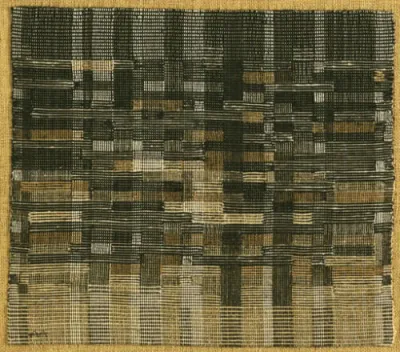
Anni Albers
Human Design Chart
Biography
In 1925, she married Josef Albers, who had rapidly become a "Junior Master" at the Bauhaus. In 1931, Anni Albers became Head of the Weaving Workshop, making her one of the few women to hold such a senior role at the school.
The Bauhaus at Dessau was closed in 1932 under pressure from the Nazi party and moved briefly to Berlin, permanently closing a year later in August 1933. Anni and Joseph Albers were invited by Philip Johnson to teach at the experimental Black Mountain College in North Carolina, arriving stateside in November 1933. Both taught at Black Mountain until 1949.
In 1949, Anni Albers became the first designer to have a one-person exhibition at the Museum of Modern Art in New York City. Albers's design exhibition at MoMA began in the fall and then toured the US from 1951 until 1953, establishing her as one of the most important designers of the day.
Following the MoMA exhibition, Albers spent the 1950s working on mass-producible fabric patterns, creating the majority of her "pictorial" weavings, and publishing a half-dozen articles and a collection of her writings, On Designing. Her second book, On Weaving, was published in 1965.
Anni Albers died on 9 May 1994, aged 94, in Orange, Connecticut.
Anni Albers — Manifesting Generator with Profile 5/1
Manifesting Generator 5/1 — Design at a Glance
Anni Albers revealed herself as an individual with a unique hybrid configuration of energy: the constant power of a Generator paired with the lightning-fast action of a Manifestor. Her design suggested that she could fully realize her potential not through pure initiation but by responding to internal impulses. This sacral energy source required a clear bodily response – an inner 'yes' – before she acted. At the same time, she possessed the ability to skip steps and achieve results faster than other types.
This speed carried risks, however. If Anni Albers rushed or pursued multiple projects simultaneously without internal consent, frustration could arise due to missing crucial intermediate steps. The success in her work thus depended decisively on whether she maintained her strategy of responding and her authority. Only when these conditions were met could she experience deep satisfaction. Her potential was particularly effective in the 'play mode', with variety and enjoyment of the process. In this state, parallel handling of various tasks was no obstacle but a source of her creative power as long as inner resonance was maintained.
Emotional Authority
Anni Albers exhibited an internal decision-making structure that did not rely on immediate clarity but rather on a necessary temporal process. Her design indicated that her inner authority lay in the defined Solar Plexus Center. This meant she was subject to an emotional wave that manifested in constant ups and downs of her feelings. The world appeared colored by her current mood; an object or idea could evoke total enthusiasm one moment, only to be perceived as negative the next.
This mechanism was crucial for her actions: the feeling at any given moment merely represented a snapshot, a first impression that did not necessarily reflect her deepest truth. Quick, spontaneous decisions stemming directly from this transient emotion carried the risk of negative consequences. Therefore, her decision-making required patience and time. Anni Albers utilized the process of multiple overnight considerations of an issue. She let herself be pondered over and repeatedly questioned until intense feelings subsided. Only then did she gain emotional distance, leading to clarity and calmness. This path was primarily relevant for long-term decisions that could have a significant impact on her life course. By waiting, she achieved deeper and more comprehensive insights rather than being led by the transient wave dynamics of her moods.
The 5/1 Profile — Heretic / Investigator
Anni Albers’ design established a fundamental tension between her magnetic presence as a problem solver and her deep private research drive. As a 5/1 profile – the Hero combined with the Investigator – she was almost magnetically sought out for their knowledge by others. Line 5 endowed her with natural authority in crisis situations; she was intuitively perceived as a leadership figure offering practical solutions. Yet, this external demand often clashed with the internal necessity of line 1: the quiet, thorough exploration of uncertainties and resistances.
Without clear boundaries, there was a risk of exhaustion. Others sought advice from her as if she were endlessly available, while her own energy was needed for deep engagement with complex issues. The challenge lay in saying 'no' to maintain this balance. Only through consciously setting limits on the constant external demand could Anni Albers preserve the beneficial dynamic between her role as a public problem solver and her private process of knowledge deepening. This allowed her to optimally utilize her gifts without being drained by excessive expectations.
Triple Split Definition — Defined & Open Centers
Anni Albers's design established a tendency towards immense internal stability and clear projection. Her defined centers – Sacral, Heart, Throat, G-Center as well as Spleen and Solar Plexus – created a profile of willpower and existential intuition. The defined Sacral Center provided a constant vital energy source that acted as the engine. This power was directed by her also defined Heart Center, which secured resource control and enabled her to determine her life and reliably fulfill promises. The connection of these engines to the defined Throat transmuted inner energy into clear communication and action; she spoke from a reliable source, not fleeting thoughts. The defined G-Center gave her a firm identity and sense of direction, while the defined Spleen Center allowed spontaneous, intuitive judgments in the present as an existential authority. Her emotional authority lay in the defined Solar Plexus Center, meaning that she did not find truth in the moment but through waiting for the emotional wave until clarity.
In contrast, her Head and Ajna Centers were open. This implied that mental clarity was not a constant trait. Anni Albers tended to be distracted by mental pressure or the search for intellectual answers when she did not trust her emotional and intuitive authority. The open Head Center made her vulnerable to doubt and confusion often stemming from others; she had to learn to let go of this mental monologue. The open Ajna Center meant that she could not hold concepts and theories as personal truth but needed to use the mind as a flexible instrument without getting caught in the illusion of understanding or controlling everything. Her strength lay in using the stability of her defined energy machine to navigate the uncertainty of an open mental space through patience and intuition.
Channels for self-assertion, focus, instinct, change and maturation.
Anni Albers was marked by a deep, calm tension that led her to hold back to logically assess details. This attitude stemmed from Channel 52-9 of Concentration, a format-energy between Root and Sacral Centers. It combined the passive drive of Gate 52 to keep distractions at bay with the ability of Gate 9 to maintain focus on facts. This channel required time for a step-by-step logical process to correct and perfect patterns; her energy only worked precisely when not spread across many things simultaneously.
Parallel to this, Channel 42-53 of Maturation drove a cyclical process forward. As another format-energy in the circuit of meaning-making, it connected Gate 53 (Beginnings) with Gate 42 (Growth). This mechanism required that experiences be fully run through and reflected upon before new cycles began. Thus, collective wisdom emerged from empirical history; she had to bring each cycle to a satisfying resolution to translate gained lessons into information for others.
Her personality complemented this through Channel 34-10 of Exploration, emphasizing self-love and authenticity as reactions to inner convictions. Situational effects were also seen in Juxta-Channels: Channel 44-26 of Devotion brought entrepreneurial instincts and vigilance, while Channel 35-36 of Transience fostered an emotional search for new experiences. These configurations marked her design by the necessity to focus on details with concentration and complete maturation through life cycles before moving forward.
Collective Circuitry — Circuit Signature
Anni Albers was revealed as someone with a deeply rooted inner stability through her design. This internal constancy resulted from the Centering Circuit, which directly connected her Sacral Center with the Identity Center in her. This channel created a powerful individual presence and strong self-worth, but these were inwardly directed. Since this circuit did not connect to the Throat Center, these firm convictions often remained verbally unexpressed; they acted more as silent authority than rhetorical performance.
Parallel to this was another separate energetic group connecting her Sacral Center with the Root Center. Here the Understanding Circuit brought logical structure and focus into her life energy. This connection fostered a need to share rational insights, separate from emotional wave movements.
A third completely independent power group included Throat, Solar Plexus, Sacral, and Root Centers. The Meaning-Making Circuit connected these centers and channeled the energy towards reflecting on past experiences. Emotional waves from the Solar Plexus were processed here to draw collectively shareable lessons. This stood in contrast to the cool logic of the other group; it was two coexisting but not directly linked processes: one rational future orientation, the other emotional learning from the past.
The last defined power group connected Heart and Spleen Centers through the Ego Circuit. This channel promoted cooperation and joint creation of resources through mutual support. Since there was no connection to the Sacral Center here, regular rest pauses were necessary to maintain energy for these social interactions. Anni Albers thus lived in a web of separate, parallel acting energetic systems: inner identity firmness, rational structuring, emotional meaning-making, and cooperative resource building.
Left Angle Cross of Confrontation 1
Anni Albers' design led to a tendency towards direct and unvarnished confrontation with reality. She was someone who did not avoid conflicts but used them as necessary motors for development and clarity. This attitude stemmed from the influence of her chart's left cross of Confrontation 1.
This cross marks an archetypal life path where inner tensions and outer resistances are consciously sought out or accepted to uncover deeper truths. It was not about destructive pursuit of conflict but rather the necessity to break through illusions. Anni Albers lived in a dynamic where friction served as a source of authenticity and growth. Confrontation was for her no obstacle, but the tool to penetrate to the essence of things.
Without this constant testing against reality, her inner structure would not have stabilized. The left cross of Confrontation 1 demanded an honest encounter with resistance, whether internal or external. This shaped her approach to tackling problems head-on and finding solutions through direct interaction with circumstances. It was a path of clarity through friction that led her to never settle in comfort zones but always accept challenges as teachers. This mechanism ensured that her answers to life's questions always sprang from direct contact with harsh reality.
Saturn Return · Uranus Opposition · Chiron Return · 2nd Saturn Return — Life Cycles
Anni Albers' life followed two clear structuring elements: the first Saturn Return and the Chiron Return. These cycles marked transitions from personal anchoring to public confirmation of her purpose.
At 26 years old, in 1925, she experienced her first Saturn Return. This cycle often condenses years of inner work into a solid life foundation. For Anni Albers, this was evident in her marriage to Josef Albers. It was a moment of stabilization where her private world strengthened and a partnership emerged that would shape her design over decades. The Saturn Return here acts as a foundational phase: the search for stability culminated in a binding relationship that gave her further development a secure framework.
Decades later, in 1949 at age 50, she experienced the Chiron Return. This cycle is not a healing process of old wounds but a blooming period of incarnation. Those who have lived according to their strategy and authority now experience that their life purpose fully unfolds. For Anni Albers, this was visible: she became the first designer with a solo exhibition at the Museum of Modern Art in New York City. This success was no coincidence but the result of a long path of self-truthfulness. The Chiron Return confirmed that her work was not only personally coherent but also broadly socially relevant. Meaning and purpose were experienced when her vision was publicly acknowledged. Both cycles together showed a clear arc: from private rooting in 1925 to public confirmation of life's work in 1949.
Manifesting Generator · Emotional Authority — Synthesis
Anni Albers' design reveals a central continuity in the connection between inner strength and outer manifestation. The defined Throat, Heart, and G Centers form a strong foundation for authentic expression and self-determination (defined). Enhanced by the sacral energy of the defined Root Center, this allowed for a consistent creative force that was always based on reaction – waiting for the right impulses rather than initiating steps. This combination of inner drive and outer responsiveness shaped her work approach and how she dealt with challenges. The Centering Circuit amplified this internal alignment while connections in the Understanding Circuit enabled a logical approach to creative processes.
A central paradox in Anni Albers' design lies in the interplay between emotional depth and rational focus. The defined Solar Plexus Center points to a strong, wave-like experience that required time for maturation (emotional authority). At the same time, Channel of Concentration highlights the ability for focused work and logical thinking (52/9). This apparent tension between feeling and mind allowed her to create both profound emotional expressions as well as precise, structured designs – an interplay that defined her unique artistic vision.
5 Defined Channels
Incarnation Cross - Left Angle Cross of Confrontation 1
Solar Return
The Solar Return shows the moment when the sun returns to its exact birth position - your personal solar year.
Life Cycles
Discover the life cycles with a detailed triple view (birth chart, cycle chart, composite).
Human Design Profile
- Strategy
- To respond - wait for something to respond to
- Authority
- Emotional Authority
- Profile
- 5/1 - Heretic / Investigator
- Definition
- Triple Split
- Incarnation Cross
- Left Angle Cross of Confrontation 1
- Date of Birth
- 12.06.1899 09:15
- Place of Birth
- Berlin, Germany
Frequently Asked Questions
What is the Human Design type of Anni Albers?
What Profile did Anni Albers have in Human Design?
What Authority did Anni Albers have?
What incarnation cross did Anni Albers have?
When was Anni Albers born?
Discover your own Human Design
Are you also a Manifesting Generator? Find out in a personal reading how to unfold your multi-talents and direct your energy wisely.
More Personalities
Back to overviewAlain-Fournier

Aldair

Alizée

Angeli

Arletty

Artus