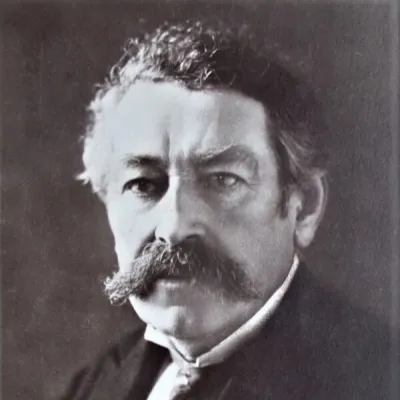
Aristide Briand
Human Design Chart
Biography
He was largely responsible for the peaceful separation of church and state in France in 1905. Briand shared the Nobel Peace Prize with Gustav Stresemann, the Foreign Minister of Germany, in 1926.
Died on 7 March 1932, Paris, France.
The Human Design of Aristide Briand: Projector 4/6
Projector 4/6 — Design at a Glance
Aristide Briand was someone who focused his energy on his environment. As a projector, he had a dense aura that he used like a bright flashlight to guide others. His design allowed him to immediately recognize where errors lay in systems or in others, or where things were left in the dark. However, this ability to quickly identify problems was a double-edged sword. When he addressed these weaknesses directly, it often felt like he was shining his light uncomfortably in others' faces, which could trigger reactions. The more effective approach for his design was to attract others through his own harmony and clarity, so that they would ask for his insights on their own. Therefore, his strategy was to wait for an honest and respectful invitation before taking on a leadership role. Additionally, his undefined Sacral Center meant that he did not have constant life energy. He moved through phases of high productivity followed by necessary rest periods to avoid burnout. Living by this rhythm and the strategy of invitation rewarded him with success. Ignoring these needs led to his non-self theme of bitterness sooner or later. Thus, his design marked him as someone who worked through targeted leadership and patience rather than constant self-initiated action.
Splenic Authority
Aristide Briand made decisions not through prolonged deliberation but through an immediate, bodily impulse. His inner authority lay in his defined Spleen Center, indicating that he possessed a pronounced survival intelligence. This intelligence manifested as spontaneous inner knowledge that signaled in each moment whether a situation or person was right for his health and well-being. Since both his Emotional and his Sacral Centers were open, this fine Spleen voice could take over as his guiding function.
This impulse was, however, very subtle and occurred only once in the moment. It therefore required a high level of awareness to not be overshadowed by external influences or excessive analysis. A brief retreat for decision-making could be helpful to recognize and follow this first, correct impulse. Since Aristide Briand could only know what was right for him in the concrete moment, his plans often changed at short notice. Long-term commitments were difficult for his design; instead, he needed a lot of space and flexibility to spontaneously engage with what proved healthy and appropriate in the given situation. This ability served to rigorously distance himself from harmful influences and to optimally protect himself.
The 4/6 Profile — Opportunist / Role Model
Aristide Briand showed in the first three decades of his life as someone who sought his identity through intense experimentation, particularly in the realm of relationships and friendships. His design as a 4/6 profile – the Networker or Role Model – set this early phase, in which the sixth line still appeared like a third and curiosity and trial and error dominated. Over time, as the sixth line became active, an inner conflict emerged: the desire for belonging and cooperation (Line 4) was strained against the urge to withdraw and ponder higher questions (Line 6). This caused confusion between the Heart, seeking connection, and the Head, needing distance. At the same time, he possessed the ability to recognize deeper motivations in others and to place them in an order – a trait that could be misunderstood as manipulative because it was set and single-minded. In his later years, he was expected to function as a wise role model that stood out through cooperation. His Heart remained cautious to avoid being hurt by false people, while he simultaneously set high standards for practical improvement and identity maintenance in his experiments.
Split Definition — Defined & Open Centers
Aristide Briand was characterized by a constant, internal mental pressure to question and understand connections. His defined Head and Ajna Centers created a trustworthy, yet uninterrupted mental activity. He was not destined to directly implement these inspirations into actions, as he lacked the necessary energy; instead, he acted as a catalyst, inspiring others to think. This mental process was his constant companion, which he had to accept to avoid frustration.
At the same time, he had a defined Spleen Center, which gave him spontaneous, intuitive bodily intelligence. This existential perception allowed him to act in the present and respond to subtle warning signals without having to rationalize them. His defined Root Center provided the necessary adrenaline-driven pressure to maintain this life impulse and move forward in the world, often in conjunction with his survival instinct.
In contrast, his Throat, G, Heart, Sacral, and Solar Plexus Centers were open. This openness made him susceptible to conditioning. He tended to orient himself outwardly to gain attention or find identity, rather than relying on inner confirmation. His open Heart Center led to him often having to prove himself, despite not having a constant willpower. His open Sacral Center meant that his energy fluctuated; he absorbed the vitality of others and risked exhaustion if he did not pause. His open Solar Plexus absorbed the emotions of the environment, making him emotionally vulnerable and causing him to experience foreign moods as his own. His wisdom lay in not personalizing these open areas but using them as mirrors for the world around him.
Channels for logical clarity and inspired inner truth.
Aristide Briand was someone who combined logical perfection with sudden insights. His design tended towards critical pattern analysis, paired with the ability to transform inspired thoughts into rational answers.
The Judgment Channel 58-18 connected his Root with his Spleen Center. Gate 58, the Gate of Vitality, drove an insatiable urge for 'better and more', while Gate 18, the Gate of Correcting, tempered this impulse. This mechanism functioned as a sentry, assessing whether perceptions disturbed collective well-being. Briand sought out flaws to perfect patterns and keep society moving by comparing what worked and what needed correction.
Parallel to this, the Awareness Channel 61-24, connecting his Head with his Ajna Center, was at work. Gate 61, the Gate of Secrets, provided auditory inspiration, which Gate 24, the Gate of Rationalizing, transformed into mutative knowledge. This created an individual thinker who learned not through discovery, but through Satori experiences. Briand could not control his thinking; knowledge emerged at its own pace, often supported by silence or music to escape mental pressure.
Additionally, prioritized gates shaped his approach. Gate 17 emphasized logical teaching for the future, rooted in human rights and the principle of serving leadership, with doubt as a healthy process. Gate 52 required self-imposed pauses to focus on pattern correction to avoid stress. On a personality level, Gate 63, the Gate of Doubt, propelled the mental process forward to gain security through resolving questions. Gate 47 helped to recognize meaning in past experiences and transform confusion into collective clarity by sharing distress.
Individual Circuitry — Circuit Signature
Aristide Briand was marked by two separate, parallel energetic streams that were not directly connected to each other. On one hand, the Knowledge Circuit connected his Head to his Ajna Center. Through the Awareness Channel (Gates 24–61), here a pulsating, auditory creativity emerged. This configuration promoted innovative flashes of insight and the ability to transform new knowledge by emphasizing his unique identity. It was an energy aimed at initiating change through the expression of this individuality.
Parallel to this, a second, independent stream was at work: the Understanding Circuit. Here, the Judgment Channel (Gates 18–58) connected his Spleen to his Root Center. This area stood for a focused, visual energy oriented towards logic, strategy, and structure. The goal was to share rational insights free from conditioning to lead society towards a better future. As Aristide Briand had a Split Definition, these two forces – creative transformation on one side and strategic rationality on the other – existed side by side without forming a common, continuous flow. They shaped his essence as two distinct yet equally important aspects of his inner mechanics.
Right Angle Cross of Service 1
Aristide Briand revealed himself as someone who defined himself through the principle of dedication and service to something greater than himself. His design carried the signature of the right service cross, a configuration that described a deep, often unconscious motivation to support others and maintain order through self-sacrifice. This was not merely a character trait but a fundamental energetic alignment that shaped his actions. He did not primarily seek individual accolades but found his affirmation in acting as a reliable support and taking responsibility for the common good. This attitude required a constant balance between his own will and the needs of the community he served. The right service cross implies a life task of creating stability through his own willingness to sacrifice and be loyal. Aristide Briand lived this dynamic by moving into roles that required him to step back to focus on the cause or the people he supported. His strength lay in his ability to gain trust through consistent service and serve as an integral foundation upon which others could build. This configuration described a path that found its deepest meaning not in the spotlight of individual honor but in the quiet work for the collective.
Saturn Return · Uranus Opposition · Chiron Return · 2nd Saturn Return — Life Cycles
Aristide Briand revealed himself as someone who condensed his professional substance through structural challenges. His design suggested that inner clarity often only formed through external resistance. In 1892, at the age of 30, he was readmitted to practice law after an acquittal. This first Saturn return marked a point where years of groundwork condensed into a solid result and re-established his professional identity.
However, his path was not linear. In 1905, at 43, he declined the offer of the office of Minister of Worship. This Uranus opposition signaled a phase of inner conflict, in which he turned away from a prescribed role to preserve his own integrity. It was a moment of breaking free from expectations that did not align with his core.
The true flowering of his design came with the Chiron return around the age of 49. In 1911, a mentally disturbed man attempted to shoot him in parliament. Instead of merely being a crisis, this event became a catalyst for the unfolding of his incarnation purpose. The Chiron return is a fulfillment cycle in which the meaning of the design unfolds increasingly in life if one follows the strategy. Briand's survival and continued work in this phase demonstrated the efficacy of this cycle.
Later, in 1922 at the age of 60, he stepped back when the security pact was not ratified. This second Saturn return brought another structural clarification: letting go of projects that no longer aligned with his values closed the circle of his professional development.
Projector · Splenic Authority — Synthesis
He was a projector who, through his ability to recognize and correct patterns (Channel 58-18), naturally exercised authority. This authority was based on a fine, instinctive knowledge of what was right and healthy, allowing him to effectively set boundaries. His profile as a networker and role model (4/6) suggests that he spent a lifetime oscillating between the need for community and the desire for independent reflection – a dynamic that intensified in his later years as he was expected to act as a wise mentor. This internal conflict between heart and head shaped his approach, as he constantly sought new connections while preserving his own unique perspective.
A central paradox in his design lay in the tension between the projection mechanism and the Spleen authority. He was destined to bring light into the darkness for others and point out errors, yet the Spleen urged him to heed his own inner impulses and protect himself from harmful influences. This led to a constant weighing between the need to engage and correct and the protection of his own energy, which was evident in key moments of his career when he declined offers or stepped down from offices (documented events).
2 Defined Channels
Incarnation Cross - Right Angle Cross of Service 1
Solar Return
The Solar Return shows the moment when the sun returns to its exact birth position - your personal solar year.
Life Cycles
Discover the life cycles with a detailed triple view (birth chart, cycle chart, composite).
Human Design Profile
- Type
- Projector
- Strategy
- Wait for the respectful invitation
- Authority
- Splenic Authority
- Profile
- 4/6 - Opportunist / Role Model
- Definition
- Split Definition
- Incarnation Cross
- Right Angle Cross of Service 1
- Date of Birth
- 28.03.1862 10:30
- Place of Birth
- Nantes, France
Frequently Asked Questions
What was Aristide Briand's Human Design type?
What Profile did Aristide Briand have?
What was Aristide Briand's Authority?
What incarnation cross was assigned to Aristide Briand?
When was Aristide Briand born?
Discover your own Human Design
Are you also a Projector? Find out in a personal reading how to unfold your leadership qualities and recognize the right invitations.
More Personalities
Back to overviewSissy Spacek

Alain-Fournier

Anémone

Ann-Margret

Bourvil

Hergé