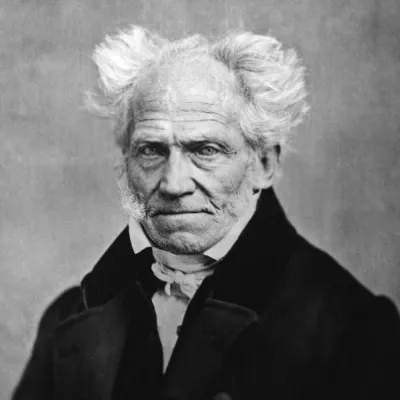
Arthur Schopenhauer
Human Design Chart
Biography
Schopenhauer was among the first philosophers in the Western tradition to share and affirm significant tenets of Indian philosophy, such as asceticism, denial of the self, and the notion of the world-as-appearance. His work has been described as an exemplary manifestation of philosophical pessimism. Though his work failed to garner substantial attention during his lifetime, he had a posthumous impact across various disciplines, including philosophy, literature, and science. His writing on aesthetics, morality and psychology has influenced many thinkers and artists.
Arthur Schopenhauer as a Manifesting Generator 4/6 in Human Design
Manifesting Generator 4/6 — Design at a Glance
Arthur Schopenhauer's Human Design inclines towards quick and efficient implementation paired with the necessity to respond to inner impulses. As an Manifesting Generator, he combined the constant energy of the Sacral Center with the ability to skip steps and achieve results swiftly. However, this configuration required strict discipline: Success only came when he did not initiate but responded to life's impulses and confirmed his actions through the internal approval of the Sacral Center.
Without this confirmation, his design tended to skip important steps or pursue multiple projects simultaneously without focus, leading quickly to frustration – the specific non-self theme of this type – if speed was not balanced by inner resonance. The mechanics showed: Only in 'play mode', with variety and continuous checking of internal approval, could he draw deep satisfaction from his work. Parallel work was no obstacle for him as long as the Sacral Center confirmed each endeavor as meaningful. His path lay in channeling his own dynamics through reaction rather than initiation to avoid frustration and productively use his natural efficiency.
Emotional Authority
Arthur Schopenhauer's Human Design inclines towards delayed decision-making, characterized by an inner wave movement of feelings. His internal authority stems from the defined Solar Plexus Center. This means he is always subject to an emotional dynamic that shows in constant ups and downs. The world appears colored by his current mood; one moment something deeply excites him, the next he evaluates it negatively. However, his immediate feeling is only a snapshot, a first impression that may not yet reflect his truth. Quick, spontaneous actions from such emotions could therefore have negative consequences.
The mechanics of his emotional authority require patience. The more time he takes to let decisions mature, the deeper and more comprehensive can he see. This requires consciously sleeping on decisions. He should take pride in questioning himself multiple times. Over time, intense feelings subside, he gains emotional distance, clarity sets in along with calmness. Only then has he gone through the process. This rule applies regardless of which other centers are defined: Whenever the Solar Plexus Center is activated, it functions as the primary internal authority. For Arthur Schopenhauer, this delay was no obstacle but rather the necessary path to mature insight, especially for long-term decisions with significant influence on his life course.
The 4/6 Profile — Opportunist / Role Model
Arthur Schopenhauer's Human Design sets a life dynamic revolving around the inner conflict between the emotional need for belonging and the intellectual drive for distance. In his first three decades, he intensely experimented in relationships and friendships. This corresponds to Line 4 of his Profile 4/6, which makes happiness dependent on others and inclines towards aligning with stronger forces. The heart remained cautious throughout, not wanting to open up to the wrong person and get hurt.
After Saturn's return, around age thirty, Line 6 emerged. It brought a desire to stand high on a mountain and contemplate the meaning of life. Here, the contradiction between the heart seeking community and the head striving for wisdom was evident. Arthur Schopenhauer learned early that power alone was not enough; instead, the integration of common sense became central. In his later years, his environment expected him to meet the high standards of a wise role model through cooperation with others. His development led from youthful searching for happiness through others to maturely exercising a role function while remaining authentic without constantly demonstrating power. This transition shaped his ability to adopt an integrating stance despite the initial confusion of conflict between heart and head.
Split Definition — Defined & Open Centers
Arthur Schopenhauer's Human Design profile suggests a tendency towards constant mental conceptualization. His defined Ajna Center provided an unceasing internal dialogue that generated concepts and theories without him being able to stop this activity. This mental energy flowed directly into his defined Throat Center, allowing him to articulate his thoughts consistently and reliably. He was mechanically designed to speak what he thought, making his communication a direct manifestation of his cognitive processes.
As a Generator, he had a defined Sacral Center, his vital motor. His strategy involved reacting rather than initiating. He possessed an enormous energy source that only became effective when he waited for external impulses and responded with an inner 'yes' or 'no'. Simultaneously, his defined Solar Plexus served as an emotional authority. Arthur Schopenhauer had to wait for the emotional wave to clear before taking decisive steps; spontaneous decisions in emotional highs or lows led to frustration and chaos. His defined Spleen Center gave him a momentary intuitive perception of survival in the present, independent of rational analysis. Additionally, his defined Root Center presented a set way of dealing with stress and pressure that propelled him forward.
In contrast, his openness revealed vulnerabilities through open centers. His open Head Center made him susceptible to situational mental pressure and doubt; he tended to get entangled in questions not originating from himself or desperately sought inspiration to fill inner emptiness. The open G Center meant a lack of consistent identity and direction. He relied on environment and relationships to initiate, lacking an internal compass needle. This led him often to seek a direction or love rather than simply receiving it. Finally, his open Heart Center mirrored the willpower of others; he lacked persistent energy for promises and ego assertion; instead, he tended to prove himself through excessive effort or breaking commitments, ending in cycles of self-doubt when not trusting his Sacral authority.
Channels for curious intuition, powerful impact and emotional depth.
Arthur Schopenhauer's Human Design profile generated a mechanism for immediate intuitive manifestation of inner truth in the present moment. This tendency resulted from the synthesis of Channel of Charisma 34-20 and Channel of Brainwave 57-20, both terminating in the Throat Center. The Channel of Charisma 34-20 connected the generative power of the Sacral Center with expression in the present; this required a reaction to external stimuli to direct charismatic power correctly and avoid obsession. Simultaneously, the Channel of Brainwave 57-20 provided penetrating self-knowledge from the Spleen, communicated as individual insight directly to strengthen others' survival intelligence.
This intuitive survival intelligence was linked with generative power through the Channel of Power 34-57. This archetype of an individuated human drew on mammalian memories and fight-or-flight instincts for spontaneous reaction to danger and securing personal well-being without mental restriction. The emotional depth of this profile was marked by the Channel of Emotion Release 39-55, creating a pulsating wave between melancholy and passion. Here it was about embracing moodiness and provoking the right spirit in oneself and others rather than rationalizing moods.
Finally, the Channel of Curiosity 11-56 rounded off the profile. It connected the search for new ideas with the ability to pass them on as instructive stories. Arthur Schopenhauer used this mechanism not for facts but to stimulate his audience's imagination and feelings through storytelling-based knowledge transfer and give them room for reflection.
Individual Circuitry — Circuit Signature
Arthur Schopenhauer's Human Design profile set a tendency towards pulsating, acoustic formative energy that shaped individual identity through emotions and intuition in the present. This configuration arose from his split definition: two energetically separate groups existed parallel to each other. The first group connected Throat, Spleen, Sacral, and Ajna Centers; the second included Solar Plexus and Root Center. There was no direct flow between these two blocks but they acted as side-by-side forces.
The Knowledge Circuit drove his innate path towards transformation. For Arthur Schopenhauer, it linked two separate parts: Throat with Spleen and Solar Plexus with Root Center. This allowed him to express new insights through flashes of insight (Channel 20-57) and the release of emotions (Channel 55-39). The energy was wave-like and melancholic, aiming at self-strengthening by using the right emotional wave movement from Solar Plexus to herald change.
Simultaneously, the Purpose Circuit dealt with emotions and experiences from the past. Here it connected Ajna with Throat Center (Channel 11-56). This promoted curiosity to share felt insights with the collective and learn together from the past. The energy was cyclic and visually marked.
Additionally, the Integration Circuit supported survival through self-strengthening. It linked Throat, Sacral, and Spleen Centers in a single group. Through Channels of Charisma (20-34) and Power (34-57), it channeled power from reacting to life, correct behavior, and intuitive knowledge in the present. This created highest individuality and acoustic presence by uniting the attributes of Gates into a greater whole.
Right Angle Cross of the Sleeping Phoenix 1
Arthur Schopenhauer's Design carried the archetypal imprint of the right cross of the sleeping Phoenix 1. This configuration marked a profound, often unconscious identification with this specific pattern. It was not a conscious choice or an intellectual concept but rather a fundamental structure that determined his life stance and perception from within.
The right cross of the sleeping Phoenix 1 acts as a strong background factor in Human Design. It represents a particular energetic alignment that shapes the individual without always being at the forefront of conscious awareness. Arthur Schopenhauer lived within this archetypal formula. It formed the framework within which his experiences took place and his personality developed. The emphasis was on the pure presence of this cross as a defining element of his design.
This classification described an essential quality of his existence. His Design suggested that his essence was permeated by this specific cross configuration. It was a fixed part of his inner architecture, significantly influencing his reactions and approach to the world. Without further mechanical details or complex channel descriptions, the identification with this archetype took precedence. Arthur Schopenhauer embodied this structure naturally as an expression of what his chart prescribed.
Saturn Return · Uranus Opposition · Chiron Return · 2nd Saturn Return — Life Cycles
Arthur Schopenhauer's publication history followed a clear rhythm of astrological cycles marking key career milestones. In 1816, at the age of 28 during his first Saturn return, he published "Über das Sehn und die Farben". This cycle often condensed years of preparatory work into substantial results. The Uranus opposition around the age of 42 brought out in 1830 the Latin version of his revised color theory, "Theoria colorum" – a moment of necessary adaptation and expansion of previous works.
Especially influential was his Chiron return at the age of 49 (1837). This fulfillment cycle allowed for the design of the complete edition of Kant's writings. Here it became evident how one's life work increasingly made sense and purpose tangible, provided that one lived according to their own strategy. It was not about healing old wounds but rather a bloom period in which the incarnation task crystallized. His second Saturn return at the age of 56 (1844) crowned this development with the publication of the second volume of "The World as Will and Representation". This cycle strengthened the structure and weight of his complete body of work by bringing earlier impulses into a final, stable form. Each of these points was no coincidence but an expression of an inner mechanics that synchronized external events with internal maturity.
Manifesting Generator · Emotional Authority — Synthesis
Arthur Schopenhauer was a Manifesting Generator whose life was marked by a profound tension between the urge for rapid implementation (sacral center, defined throat) and the necessity of emotional maturation. The emotional authority required time for decisions while the MG mechanics tended towards over-hasty action – a pattern that manifested in repeated phases of intense creative work (Channel of Curiosity) followed by burnout, as evidenced by professional events. This interplay between quick impulse and emotional wave formed the core of his working method.
The Profile as Networker/Role Model amplified this internal conflict between the need for connection (Line 4) and the search for independent knowledge (Line 6). He lived a duality that led him to constantly seek and transform knowledge (Knowledge Circuit), only to share it through expression. This inner tension between the desire for belonging and the necessity of forging his own path shaped his intellectual development, resulting in a unique perspective on the world.
5 Defined Channels
Incarnation Cross - Right Angle Cross of the Sleeping Phoenix 1
Solar Return
The Solar Return shows the moment when the sun returns to its exact birth position - your personal solar year.
Life Cycles
Discover the life cycles with a detailed triple view (birth chart, cycle chart, composite).
Human Design Profile
- Strategy
- To respond - wait for something to respond to
- Authority
- Emotional Authority
- Profile
- 4/6 - Opportunist / Role Model
- Definition
- Split Definition
- Incarnation Cross
- Right Angle Cross of the Sleeping Phoenix 1
- Date of Birth
- 22.02.1788 12:00
- Place of Birth
- Gdańsk, Poland
Frequently Asked Questions
What was Arthur Schopenhauer's Human Design type?
What Profile did Arthur Schopenhauer have in Human Design?
Which Authority guided Arthur Schopenhauer?
What incarnation cross did Arthur Schopenhauer have?
When was Arthur Schopenhauer born?
Discover your own Human Design
Are you also a Manifesting Generator? Find out in a personal reading how to unfold your multi-talents and direct your energy wisely.
More Personalities
Back to overviewAldair

Alizée

Angeli
Arletty
Artus

Balthus