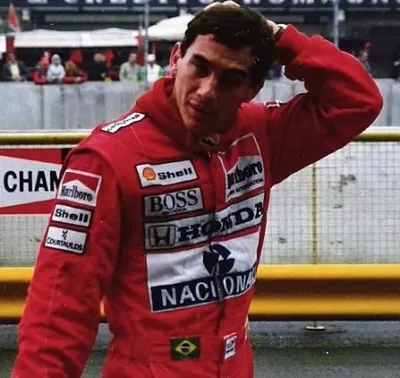
Ayrton Senna
Human Design Chart
Biography
Very private and reserved, Senna was married once in 1981 for eight months, no kids. Model Marcella Praddo claimed they had a brief affair and that her daughter Victoria is his child. (In 2000, DNA tests of hair and saliva samples given by Senna's parents conclusively proved that he was not the father of Praddo's child.) He also had a brief affair with Xuxa and Australian model Elle Macpherson.
On 1 May 1994 he drove the Imola Circuit in Italy, one of the fastest Formula One tracks. He lost control at over 280 km. and crashed into a wall at 2:17 PM MEDT, sustaining massive head injuries. He was taken to the hospital where he was declared dead at 7:05 PM, the 24th Formula One driver to die in a sanctioned Grand Prix event.
After his death, his sister Viviane Senna set up the Instituto Ayrton Senna in his honour. Bruno, his nephew (Viviane's son), born 15 October 1983 in Sao Paolo, is also a Formula One driver.
Human Design Analysis: Ayrton Senna as Generator 3/5
Generator 3/5 — Design at a Glance
Ayrton Senna had enormous endurance and functioned energetically like a strong workhorse. His design indicated a high capacity for continuous performance, due to the abundance of sacral energy. This power was not an inexhaustible reserve but reacted directly to internal impulses.
The central mechanics of his Generator type required responding rather than initiating. Success and deep satisfaction only arose when he responded to signals from his environment and gave a clear "yes" internally. Acting against this inner compass or suppressing his enthusiasm for a task quickly led to frustration and energy loss.
Especially critical were two pitfalls: First, performing tasks without internal resonance, which could lead to burnout despite his high potential. Second, holding back on his heart project when he was still full of power. His strategy involved acting from the gut. When he linked this reaction to external stimuli with his inner confirmation, nothing could stop him and he experienced a deep sense of fulfillment. Deviations from this pattern resulted in persistent frustration or a lack of energy.
Emotional Authority
Ayrton Senna's inner authority was the Defined Emotional Center. This established that his deepest truth did not lie in immediate reaction but rather in a cyclical emotional wave that showed through constant ups and downs of his feelings. His perception of the world was always colored by his current mood; what excited him for a moment could appear negative in the next. This fluctuating nature meant that an initial impression rarely represented his ultimate truth. Spontaneous decisions made directly from such a momentary mood carried the risk of proving wrong later on.
The mechanics of his authority therefore required patience and temporal distance. By letting decisions mature – often through multiple nights' sleep – he could allow intense initial feelings to subside. Only when this emotional distance was gained did clarity and calmness set in. This process was especially crucial for long-term life decisions, as they could shape the entirety of his life course. Senna had to learn to properly deliberate and ask himself repeatedly to ensure that he was not merely reacting to a passing wave but rather reaching the deeper, more comprehensive insight that only became visible after the initial emotion subsided.
The 3/5 Profile — Martyr / Heretic
Ayrton Senna was marked by his Profile 3/5, the Experimenter/Hero, characterized by a deep skepticism towards prescribed paths. He initially believed little and had to try everything himself to gain practical knowledge. This Line 3 challenged him to live authentically in the present moment, where success often became merely a byproduct of this attitude. However, this phase of individual learning went hand in hand with the necessity to endure shocks and failures, as innocent actions did not guarantee success.
This self-acquired knowledge was passed on to others through Line 5, the Hero's Line, making him attractive to his surroundings, which wanted to learn from his experiences. Yet, this public role as a problem solver also brought specific pressure: The necessary failure of Line 3 often occurred in full view of everyone. This could be painful because society expected him to exhibit heretical behavior that questioned norms. During crises, this mutated behavior was essential for progress and survival. The Heretic protested against established traditions, not their bearers. Thus, Senna acted as a Guardian who regulated necessary behavioral changes, even if it entailed the risk of public failure. His design described a path where private experimentation and public heroism were closely intertwined.
Split Definition — Defined & Open Centers
Ayrton Senna's Human Design profile featured a rare configuration with defined Head and Ajna Centers combined with a defined G-, Heart, and Sacral Center. This created an individual with immense internal energy and a specific, unchanging thought process. He was under constant mental pressure to understand things; however, since the Head and Ajna were not motorized, attempts to immediately implement these ideas often led to resistance. His strength lay in using this mental process as an inspiration source and waiting for the right timing before utilizing his enormous Sacral and Heart energy. The defined G-Center gave him a firm direction and identity, while the defined Heart Center provided willpower.
At the same time, his open Throat and Root Centers revealed specific vulnerabilities. His communication was situation-dependent; he tended to wonder how to get attention or if someone noticed him rather than speaking spontaneously. The open Root Center made him susceptible to external stress; he absorbed environmental pressure and often rushed or initiated new experiences to escape this unpleasant feeling, which frequently ended in an endless cycle of hyperactivity. The challenge lay in mastering the integration of mental pressure with physical execution without experiencing frustration through impatience or trying to directly release mental tension. His defined centers offered a reliable source for vitality and direction while he learned not to actively control open areas but to trust invitations and the right timing.
Channels for intimacy, doubt, rhythm, instinct and community.
Ayrton Senna's design showed a tendency towards analytical skepticism paired with a deep biological rhythm and entrepreneurial intuition. His mind operated through the Logic Channel 63-4, filtering patterns permanently; only what proved consistent was considered true by him. This doubting mind required practical verification rather than blind faith. Parallel to this, the Rhythm Channel 5-15 determined his inner sense of timing. It connected fixed habits (Gate 5) with a love for extremes (Gate 15), allowing him to effortlessly move through life as long as he listened to his sacral reaction.
In interpersonal dynamics, the Pairing Channel 59-6 influenced his behavior. It combined sexual energy (Gate 59) with the emotional wave of pleasure and pain (Gate 6). This created an intense aura that promoted intimacy but required patience since emotional clarity took time. In business, the Devotion Channel 44-26 shaped his actions. With instinctive alertness (Gate 44) and ego strength (Gate 26), he identified what the tribe needed before it was known. He was a natural salesman who used his gifts for fair compensation.
Social bonds were formed through the Community Channel 37-40. He sought recognition (Gate 37) and a place in the whole while understanding the need for breaks and rewards for his work (Gate 40). This created contracts based on mutual benefit and loyalty to the group.
Spiritual attitudes like innocence and centeredness (Gate 25), as well as engagement in the here and now (Gate 46), acted as background frequencies. The complex integration of beliefs (Gate 10) supported his ability to locate himself in various contexts, while emotional crisis management (Gate 36) and principled transformation (Gate 49) tested his inner stability. Leadership impulses (Gate 7) and traditional protective reflexes (Gate 50) rounded out his profile, as did the pursuit of individual insight and communication (Gate 43).
Tribal Circuitry — Circuit Signature
Ayrton Senna exhibited a divided energetic structure featuring two parallel but not directly connected power fields. The first field linked the Head with the Ajna Center along with Identity to the Sacral Center. This configuration promoted rational, future-oriented thinking that shared logical strategies for societal improvement – free from emotional coloring. Parallel to this, rhythmic energies operated between identity and life force.
The second, separate field included Heart, Solar Plexus, and Spleen Centers. Here cooperation was paramount: the ability to create resources for the tribe through devotion and community spirit. This area emphasized a balanced ratio of giving and taking as well as mutual support but required regular rest pauses due to the lack of direct sacral connection in this part for regeneration.
A third aspect connected the Sacral with the Solar Plexus Center via pairing energy. This endowed instinctive protective, nurturing, and preservation impulses with a strong emotional wave movement directed towards maintaining genetic lineage and family security.
Senna's design thus presented a duality: on one hand, the cool, strategic ratio of understanding; on the other, ego-oriented resourceful, emotional cooperation as well as primal protection instincts. These separate systems existed alongside each other without forming an uninterrupted energetic flow between all defined centers.
Right Angle Cross of the Vessel of Love 1
Ayrton Senna's Human Design profile carried the signature of the right cross of the Love Vessel 1. This configuration established a specific inner dynamics that shaped his experience of connection and intensity. The right cross of the Love Vessel 1 describes not superficial romance, but rather a deep, often instinctive search for resonant connection as a source of energy and validation. For Senna, this manifested as a strong internal drive to find relationships or situations where he felt seen and valued fully. This mechanism created a high sensitivity to the quality of interpersonal dynamics around him. It was less about the quantity of contacts than the depth and authenticity of exchange. The energy of this cross demanded a certain intensity to feel alive; shallow or superficial interactions could therefore quickly be perceived as empty or discouraging. Instead, his design sought moments of true resonance where his own existence was affirmed through others' reflections. This tendency created a strong dependence on external validation emotionally but also fueled passionate engagement where such connection actually occurred. The structure of this cross thus significantly determined how Senna sought closeness and which forms of affection he considered nourishing or exhausting for him. It was a fundamental architectural feature of his Human Design that structured his emotional needs and reactions to relationships without moral judgment.
Saturn Return — Life Cycles
Ayrton Senna's design showed a tendency towards structural consolidation, particularly around the age of 28 years. He emerged as someone who took responsibility and clearly defined his place within existing hierarchies. This development aligned with the first Saturn Return, a cycle where years of groundwork often condenses into tangible results that solidify one's position.
In 1988, at the age of 28, Senna moved to McLaren and won the world championship title. This event exemplified the mechanics of this period: The move marked not only a career step but also the consolidation of his role at the highest level of his field. Winning the title was the visible result of internal and external structuring. Through this phase, he established himself definitively within the hierarchy, which is characteristic of the Saturn Return – taking on both burden and power simultaneously. His actions in that year confirmed the need to find a clear, recognized place to effectively bring forth his potential.
Generator · Emotional Authority — Synthesis
He was a Generator who, through his defined sacral energy (Sacral Center) and the profile of the Explorer/Hero (3/5 Profile), possessed an inexhaustible driving force. This combination led to a life in which he constantly sought new experiences to expand his knowledge and then make it available to others. However, emotional authority required time for decision-making – an internal process that stood against the impulsive action of the Generator, forcing him to filter and understand his own feelings (Emotional Center). The constant mental pressure through defined Head and Ajna Centers further intensified this process by continuously seeking answers and analyzing patterns (Logic Channel).
A central paradox lay in the tension between his need for continuous activity and the emotional wave. He lived out the energy of the Generator fully, yet his inner compass required a mature engagement with his feelings before he could act. This led to an ongoing interplay of rapid experimentation (Line 3) and the need to process experiences and draw conclusions from them for others (Line 5). A notable event occurred in 1988 when transitioning into a new phase (Saturn Return) was associated with success.
5 Defined Channels
Incarnation Cross - Right Angle Cross of the Vessel of Love 1
Solar Return
The Solar Return shows the moment when the sun returns to its exact birth position - your personal solar year.
Life Cycles
Discover the life cycles with a detailed triple view (birth chart, cycle chart, composite).
Human Design Profile
- Type
- Generator
- Strategy
- To respond - wait for something to respond to
- Authority
- Emotional Authority
- Profile
- 3/5 - Martyr / Heretic
- Definition
- Split Definition
- Incarnation Cross
- Right Angle Cross of the Vessel of Love 1
- Date of Birth
- 21.03.1960 02:35
- Place of Birth
- São Paulo, BRAS
Frequently Asked Questions
What was Ayrton Senna's Human Design type?
What Profile did Ayrton Senna have?
What Authority did Ayrton Senna have?
What incarnation cross did Ayrton Senna have?
When was Ayrton Senna born?
Discover your own Human Design
Are you also a Generator? Find out in a personal reading how to use your sacral energy correctly and discover deep satisfaction.
More Personalities
Back to overviewAaliyah

Aldair

Alexia

Angèle

Anne-Marie

Arcángel