
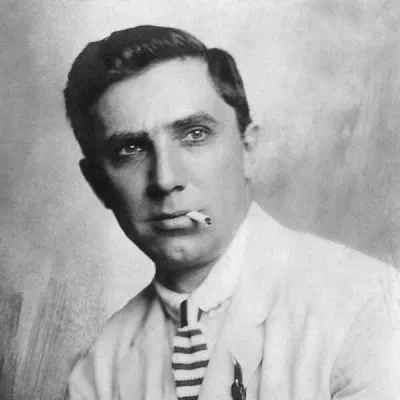
Bela Lugosi
Human Design Chart
Biography
Lugosi began acting on the Hungarian stage in 1902, appearing in more than 170 productions. Beginning in 1917, he performed in Hungarian silent films. During World War I, he served as an infantry officer in the Austro-Hungarian Army from 1914 to 1916. After the failed Hungarian Communist Revolution of 1919, Lugosi was forced to immigrate to Germany due to his Socialist party activities. He acted in several films in Weimar Germany, before arriving in New Orleans as a seaman on a merchant ship, then making his way north to New York City and Ellis Island.
In 1927, he starred as Dracula in a Broadway adaptation of Bram Stoker's novel, moving with the play to the West Coast in 1928 and settling down in Hollywood. He later starred in the 1931 film version of Dracula directed by Tod Browning and produced by Universal Pictures. Through the 1930s, he occupied an important niche in horror films, but his notoriety as Dracula and thick Hungarian accent greatly limited the roles offered to him, and he unsuccessfully tried for years to avoid typecasting.
Bela Lugosi as a Generator 1/3 in Human Design
Generator 1/3 — Design at a Glance
Bela Lugosi had immense physical endurance and high energetic potential, characterizing him as a Generator. His design suggested that he functioned like a strong workhorse: extremely durable and capable, provided he had energy for his tasks. This power was not an inexhaustible resource that could be activated merely by willpower. Instead, its effectiveness depended on how he interacted with external stimuli.
The mechanics of his design demanded the principle of reacting rather than initiating. His sacral energy became primarily free when it responded to impulses from the environment. The successful strategy involved waiting for a signal and then acting once his inner self clearly said "Yes! Let's get going!" When he acted in harmony with this internal compass, he was rewarded with a sense of deep fulfillment.
Deviation from this strategy, however, led to significant costs. If Bela Lugosi did things he had no desire to do or wasted energy on tasks that did not engage him, he tended to burn out and suffer frustration. Similarly problematic was being prevented from working on his heart projects when he still wanted to continue full of power. In such cases, or when he initiated rather than reacted, he encountered a lack of energy and persistent frustration. His success thus depended on making gut decisions and not fighting against his inner signal.
Sacral Authority
Bela Lugosi showed a joy in decision-making that did not stem from intellectual planning but rather from an immediate inner resonance. His design as a Generator established that his strategy – waiting for stimuli from the outside world – was identical to his inner authority. This fundamentally simplified his decision-making process: He didn't need to think, he just had to listen to the response of his body.
This sacral authority manifested physically as gut feelings or bursts of energy, often audible through grunts, hums, or a confirming "Mhm". Such signals only appeared in reaction to an external stimulus; they were not anticipatory but rather responses. When his sacral motor kicked in, Bela Lugosi felt vitality and enthusiasm. He then had inexhaustible energy and went about his activities with great joy without needing a specific purpose in mind.
The open Emotional Center was the prerequisite for this functioning; it prevented him from making decisions based on emotionality and redirected him to the physical truth of the Sacral Center. Through this system, Bela Lugosi lived in a state where he felt validated through appropriate activation. His well-being depended on waiting for these bodily signals rather than planning in his head. Thus, he found his way through life driven by the aliveness that his inner authority bestowed upon him with every correct response.
The 1/3 Profile — Investigator / Martyr
Bela Lugosi's Design set a tendency to accumulate knowledge not just theoretically but to validate it through direct, often harsh practice. His Profile 1/3, the Researcher-Experimentor, marked him as someone torn between an intense drive for preparation and the necessity of putting things into action. The energy of Line 1 (Gate 50) propelled him to build foundations and expand awareness through mental changes or even physical shifts like moving to foreign environments. This created an internal conflict: fear of insufficient knowledge often hindered his step towards implementation.
At the same time, Line 3 (in relation to Gate 56) required adaptation through trial and error. For Bela Lugosi, this meant that true wisdom did not lie solely in pure study but was gained only through practical mistakes and the resulting alienation or letting go of attachments. His judgment on things or paths gained authenticity because it was both intellectually grounded and empirically tested. When he believed something to be right, he had previously examined it thoroughly both theoretically and practically. This synthesis of careful planning and necessary experience through failure defined his way of understanding and navigating the world.
Split Definition — Defined & Open Centers
Bela Lugosi revealed himself as someone with a penetrating, constant inner voice and a clear self-image. His design was characterized by a fully defined structure in the Head, Ajna, Throat, G-, Sacral, and Root Centers. This created a persistent mental pressure to ask questions and find answers, which was discharged through reliable communication from his stable identity. His energy source was reactive: The defined Sacral Center delivered vital power only on correct stimuli, while the defined Root Center generated a steady survival drive and urge for forward movement.
At the same time, his chart revealed three central areas of receptivity. His open Heart Center meant that he was not designed for consistent willpower or competition; he tended to feel worthless if he could not keep promises and often sought external validation instead of inner authority. His open Solar Plexus absorbed the emotional climate of his environment like a sponge. He experienced others' moods as his own and avoided conflicts out of fear of rejection, leading to emotional confusion since he lacked a stable emotional wave of his own. Furthermore, his Spleen Center was open, bringing with it a fundamental uncertainty about health and well-being. Unconsciously, he sought the security of defined Spleen energies from others to quell existential fears and tended to cling to unhealthy situations just not to lose the feeling of safety. Spontaneous decisions were risky for him as he reacted on conditioned impulses rather than intuitive clarity. His challenge lay in enduring mental pressure without falling into hasty actions, and using his open centers as informative windows instead of identifying with absorbed stress or foreign emotions.
Channel 2-14: The Beat — Channels & Gates
Bela Lugosi revealed himself through a pulsating, mutative impulse that relied on inner tension and silent waiting periods. His design leaned towards profound directional shifts, which only became effective when extreme concentration on details was maintained.
The Beat Channel 14-2 connected the ability to handle material resources (Gate 14) with higher knowledge about identity and direction (Gate 2). As one of the tantric channels, this connection generated a powerful, generative life force that promoted innovation and uniqueness. Lugosi could strengthen new directions by trusting his reaction from his Sacral Center without forcing the mutative impulse intellectually. This energy was, however, unstable; it appeared in pulses followed by phases of melancholy.
This melancholic waiting period was marked by the Mutation Channel 60-3. It connected acceptance of limitation (Gate 60) with the drive to create order out of chaos (Gate 3). This channel generated an adrenalized pressure in his Root Center when the mutative pulse ceased. Lugosi had to learn not to dissipate this inner tension through rational justification but patiently wait for the next spontaneous mutation. The change happened unexpectedly, in the gaps between impulses, and required a surrender to the process of chaos turning into order.
To stabilize this mutative flow, the Concentration Channel 52-9 was crucial. It connected non-action (Gate 52) with focusing on facts and details (Gate 9). This formative energy created potential for precise attention that could only be fulfilled through stillness. Lugosi had to keep away from distractions and stay rooted like in a yoga pose so his focus could perfect the necessary patterns. Only by following this silent concentration, could the mutative energy of Channels 14-2 and 60-3 fully unfold.
Additionally, the Channel of Structuring 43-23 and the Channel of Abstraction 64-47 added a mental layer. Lugosi constantly searched for narrative meaning in his experiences (Gate 64-47), which could lead to mental confusion until clarity emerged. At the same time, he had to clearly structure and communicate his insights (Gate 43-23) so they could be received by others. The danger lay in using intellectual reasoning to fill gaps of melancholy or lack of focus, blocking mutative energy. Instead, it was about respecting the rhythm of mutation and concentration and waiting for the correct reaction from his Sacral Center.
Individual Circuitry — Circuit Signature
Bela Lugosi's design leaned towards separate, parallel operating energetic fields. His Split Definition separated logical strategy from inspired expression into two unconnected groups. One power connected the Sacral and Root Centers with the Identity Center; the other spanned Head, Ajna, and Throat Centers.
The Knowledge Circuit drove the urge for transformation through new knowledge acquisition. In Lugosi, this worked in two separate parts: The one linked Ajna to Throat Center, structuring thoughts acoustically and pulsing them for expression. The other part included Identity, Sacral, and Root Centers where mutations and rhythmic beat strengthened unique individuality. This promoted creative flashes of insight and emotional waves as impulses towards change.
The Understanding Circuit focused on rational future planning. His single channel linked Lugosi's Sacral and Root Centers. Here it was about concentrated visual thinking and sharing logical insights free from emotional influence. This energy served the strategic improvement of society through clear focus.
The Meaning-Making Circuit processed past experiences cyclically. Its channel connected Head and Ajna Centers, allowing an abstract, visual reflection on what had happened. Emotional waves crashed here to draw collective lessons from the past and share these insights further.
Together, these circuits shaped a blend of innovative identity discovery, cool rationality, and emotional reflection on the past. Lugosi sought hidden connections to express them as new truth or use them strategically.
Right Angle Cross of Laws 3
Bela Lugosi was marked by the archetypal structure of the right cross of Law 3. This configuration fundamentally determined his energetic orientation. The design established a specific inner order that structured his actions and being. It was a deeply rooted disposition, not arbitrary but arising from a firm mechanical basis. Laws 3 formed the foundation for this alignment. They created a framework within which Bela Lugosi operated. His energy consistently followed these patterns. This did not mean rigid constraint, but rather a clear definition of his natural tendencies. The right cross functioned as a compass for his life force. It determined how he received and processed impulses. This structure was an integral part of his Human Design. It influenced every interaction with the outside world. Bela Lugosi lived in accordance with these archetypal guidelines. His existence reflected the dynamics of this specific cross. Laws 3 were not just theoretical concepts but practical realities in his design. They shaped how he was and acted. This mechanical foundation offered stability and direction. Bela Lugosi followed this inner law system automatically. It was an invisible thread guiding his energetic decisions. His character bore the marks of this particular cross configuration.
Saturn Return · Uranus Opposition · Chiron Return · 2nd Saturn Return — Life Cycles
Bela Lugosi's life was marked by sudden breaks and a later, profound turning point. In 1921, at age 39, he emigrated to the United States and separated from his wife. This event marked the Uranus opposition: a moment of abrupt liberation and radical upheaval that broke old structures to create new space. It was not a gradual change but a sharp cut that fundamentally altered his life path.
Ten years later, he reached another critical point. In 1931, at age 49, he embodied Count Dracula in the eponymous film adaptation. This coincided with his Chiron Return. In Human Design mechanics, this cycle is not a stage of healing old wounds in a therapeutic sense but a phase of fulfillment and bloom. Here, one's incarnation cross unfolds increasingly; meaning and purpose become experiential if the person has followed their strategy. For Bela Lugosi, this inner development was visible through his identification with this iconic role. The portrayal served as a channel to express and realize his deepest creative essence. The early break prepared the ground; the later return brought the bloom. Both moments show how cyclical dynamics – once through sudden separation, once through deep identification – shaped his destiny without him having to consciously control these mechanisms. They occurred and imprinted his path.
Generator · Sacral Authority — Synthesis
Bela Lugosi was a Generator whose life was marked by an unstoppable urge towards activity and the need to learn through action. Sacral authority always guided him to activities that triggered an immediate physical reaction – a rumble, hum or inner surge of energy (Sacral Center). This principle of responsive energy flowed into the profile of the researcher and experimenter; he did not seek theoretical knowledge but had to test it through personal experience (Line 1/3) to be truly convinced. The Beat channel (Gate 14-2) points to a natural aptitude for innovation and the ability to set new things in motion with energy, evident in his willingness to take risks and explore new paths.
A central paradox lay in the connection of defined mental activity (Head Center) and sacral drive. While the open emotional center made him vulnerable to mental worry, sacral energy simultaneously allowed a deep immersion into activities that truly resonated with him. This tension was evident during periods of intense creative power (significant event 1931), followed by phases of inner unrest and the need for new inspiration – an ongoing interplay between mental pressure and physical vitality that shaped his life path.
5 Defined Channels
Incarnation Cross - Right Angle Cross of Laws 3
Solar Return
The Solar Return shows the moment when the sun returns to its exact birth position - your personal solar year.
Life Cycles
Discover the life cycles with a detailed triple view (birth chart, cycle chart, composite).
Human Design Profile
- Type
- Generator
- Strategy
- To respond - wait for something to respond to
- Authority
- Sacral Authority
- Profile
- 1/3 - Investigator / Martyr
- Definition
- Split Definition
- Incarnation Cross
- Right Angle Cross of Laws 3
- Date of Birth
- 20.10.1882 15:30
- Place of Birth
- Kisszállás, Hungary
Frequently Asked Questions
What was Bela Lugosi's Human Design type?
Which Profile did Bela Lugosi have?
What Authority guided Bela Lugosi?
What incarnation cross did Bela Lugosi have?
When was Bela Lugosi born?
Discover your own Human Design
Are you also a Generator? Find out in a personal reading how to use your sacral energy correctly and discover deep satisfaction.
More Personalities
Back to overviewSissy Spacek

Aaliyah

Alexia

Anémone

Angèle

Ann-Margret
