
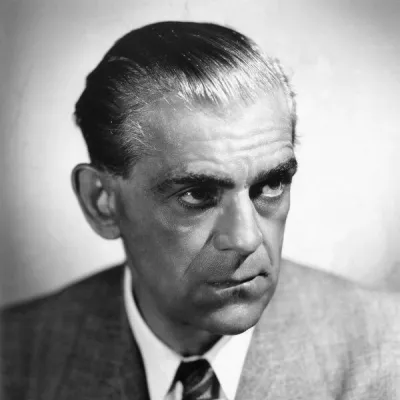
Boris Karloff
Human Design Chart
Biography
Aside from his numerous film roles (174 films), Karloff acted in many live stage plays and appeared on dozens of radio and television programs as well. For his contribution to film and television, Karloff was awarded two stars on the Hollywood Walk of Fame on 8 February 1960.
What does Manifesting Generator 1/3 mean for Boris Karloff?
Manifesting Generator 1/3 — Design at a Glance
Boris Karloff's design tended towards hybrid activity: As an Manifesting Generator, he had constant sacral energy, allowing him to quickly draw things into his life by skipping steps. This configuration described a life task where speed and efficiency were paramount, but with the risk of neglecting important stages. If he acted too quickly, he often had to backtrack to complete missed steps, which could quickly lead to frustration – the non-self theme of his type.
Furthermore, he tended to pursue multiple things at once, reacting to many impulses and starting various projects simultaneously. Without a clear strategy and inner authority, this creative drive could turn into frustration. To make his speed useful, it was advisable to react to life and only start when the sacral center agreed. Regular checks on ongoing projects helped ensure they continued to bring joy.
With proper application, Boris Karloff found deep satisfaction in his work. Variety and a 'play mode' were crucial for him to maintain his creative power. The advice to finish one thing before starting another did not suit his nature; instead, he benefited from the ability to work on different tasks simultaneously as long as they brought him joy and received his inner approval.
Emotional Authority
Boris Karloff's design tended towards emotional depth and wave-like mood swings. He perceived the world always through the lens of his current feelings – sometimes enthusiastically, sometimes negatively colored. This configuration stemmed from his emotional authority, present whenever the Emotions Center was defined, independent of other centers. His inner compass followed a constant up-and-down movement of feelings. However, an initial emotional impression was only a snapshot, not necessarily the final truth. Quick, spontaneous decisions based on emotion could therefore have negative consequences. Instead, his design required patience: decisions had to mature, often over several nights. Through delaying and re-evaluating, intense feelings subsided. Only then did he gain emotional distance, and clarity and calmness set in. This process of distancing was crucial for long-term life decisions that significantly shaped his life course. Only through this waiting period could he recognize the deeper, more comprehensive truth lying beneath the surface of the first reaction.
The 1/3 Profile — Investigator / Martyr
Boris Karloff's design tended towards intense, practical knowledge acquisition. As a person with Profile 1/3, the Researcher and Experimenter, he showed himself to be someone who had to validate theoretical knowledge (Line 1) through direct experience and errors (Line 3). His judgment was trustworthy, as he had tested things both intellectually and physically.
This configuration described a learning process through trial and error. Line 1 brought a need for deep understanding and planning, while Line 3 compelled the urge to experiment and adapt through experience. Conflicts arose when the fear of insufficient knowledge blocked implementation, yet the energy of Line 3 always demanded action to learn from mistakes.
Especially in the realm of connections and intimacy, this mechanism was at work. Here, it was about finding security through experience. Line 3 of Line 3 dealt with trial and error in the context of relationships, where self-confidence grew through lived experience. Similarly, Line 1 of Line 1 showed itself through the use of power as a survival mechanism – not out of principle, but to demonstrate strength and protection when intimidation was necessary. Boris Karloff's path was marked by this dynamic: he gathered knowledge, tested it against reality, and adapted through the consequences of his actions.
Split Definition — Defined & Open Centers
Boris Karloff lived as a Generator with immense, always available vitality that he utilized by responding to life. His defined Sacral Center generated daily energy that he used for tasks he inwardly agreed to. This powerful foundation contrasted with his open Heart Center. Without defined willpower, he tended not to prove himself through promises or competition. He could sense the integrity of others' egos and recognize who could keep commitments without falling into the trap of self-proving.
His mental system was characterized by defined Head and Ajna Centers. This created a constant pressure to ask questions and form concepts. He thought constantly but was not designed to directly put these thoughts into the world, as no motoric energy was associated with them. Instead, he inspired others to think. His voice, guided by the defined Throat Center, served as a channel to express his mental processes and his defined G Center's inner identity. He had a firm direction and a secure self-feeling that allowed him to show others new perspectives without wanting to control their paths.
Emotional depth and intuition rounded off his design. His defined Solar Plexus Center required patience; he waited for the emotional wave to pass before acting to gain clarity. His defined Spleen Center provided spontaneous, intuitive warning signals in the present, which he used for his well-being. The constant pressure of his defined Root Center propelled him forward, knowing the stress that arises when not following this energy with strategy. Thus, he combined mental inspiration, emotional maturity, and vital strength into a coherent expression.
Channels for intuitive power, expression, leadership and connection.
Boris Karloff's design inclined towards a powerful, intuitive presence, marked by a specific combination of survival instinct and generative energy. Central to this configuration was the Power Channel 34-57, linking the intuitive insight of the Spleen Center (Gate 57) directly with the sacral life force (Gate 34). This connection created an archetype of individualized survival: a permanent vigilance towards the environment, allowing him to react to dangers or opportunities in fractions of a second. This energy kept him physically fit and acoustically alert, showing him as someone who acted not through logical pondering but through spontaneous, physical resonance.
This intuitive foundation was expanded by the Charisma Channel 34-20, which channeled the sacral energy (Gate 34) into the immediate expressive capability of the Throat Center (Gate 20). This was not mere talking but a manifesting power that urged him to act in the present. The speed with which this generative energy entered the world could be impressive, yet required him to rely on his inner guidance to avoid obsession. His influence did not arise from planning but from the ability to immerse himself in activities that truly fulfilled him, serving as an unconscious inspirational example to others.
Parallel to this, the Brainwave Channel 57-20 led the deep intuition of the Spleen (Gate 57) also to the Throat Center (Gate 20). This gave his voice a penetrating quality of self-awareness. He did not just pass on information but articulated existential truths of the moment. This combination of power and brainwave meant that his statements often found the core of a matter faster than the rational thinking of others, giving him a transformative effect on his environment.
Another aspect was the Inspiration Channel 1-8, connecting the G Center (Gate 1) with the Throat Center (Gate 8). Here, his role as an individual role model was evident. He inspired not through instructions but by living and displaying his unique identity. His presence alone was a valve for creative potential, encouraging others to express their own uniqueness. This required patience and waiting for the right timing, as this channel did not bring social adaptability but relied on authentic, individual authority.
Additionally, the Synthesis Channel 19-49 shaped his attitude towards the collective. Connecting the Root Center (Gate 19) and the Solar Plexus Center (Gate 49), he sought belonging and principles that held the group together. He was sensitive to the emotional wave of acceptance or rejection within a group, urging him to find a balance between feasibility and fairness. This energy served as glue for relationships, based on loyalty and the protection of shared resources.
The Logic Channel 63-4 connected the Head Center (Gate 63) with the Ajna Center (Gate 4) and gave him a skeptical, probing mind. He constantly filtered patterns to see if they were consistent. Doubt was essential for him, as logic was only valid when confirmed through practical testing. This protected him from unfounded belief and helped him make well-founded predictions that could serve the collective.
The Alpha Channel 7-31 connected the G Center (Gate 7) with the Throat Center (Gate 31) and gave him the potential for collective leadership. He sought a 'pack' that he could lead through logical roles and tested patterns. His leadership did not rest on sole rule but on the trust of the majority, who had to invite him to represent them.
The Pairing Channel 59-6 connected the Sacral Center (Gate 59) with the Solar Plexus Center (Gate 6) and drove him towards intimacy. His emotional wave of pleasure and pain determined the timing of his relationships. He needed patience to recognize if a connection was fruitful and could quickly establish intimacy through his intensity if guided by his reaction.
Individual Gates like Gate 9 (detail work in the Sacral Center) supported his ability to perfect through repeated experiments, while Gate 43 (breakthrough) helped him communicate individual insights spontaneously. Gate 55 (emotional awareness) at the Solar Plexus Center caused genetic mutation and mood swings, shaping his emotional depth. Gate 33 (reflection) in his design allowed him to strengthen his position through withdrawal and memory. Gate 18 (correction) helped him distinguish between life-critical and insignificant corrections without taking authority conflicts personally. Gate 56 (stimulation) enabled the abstraction of mental processes into pictorial representations, and Gate 50 (protective reflex) nourished his body awareness through traditions and values. Gate 48 (depth) in the Ajna Center allowed him to recognize deeper connections, even if the implementation was frustrating.
Individual Circuitry — Circuit Signature
Boris Karloff's design inclined towards impulsive, creative expression, coupled with a strong, instinctive life force. His Knowledge Circuit connected the Throat, Identity, and Spleen Centers. This allowed him to translate innovative flashes of insight (Channel 20-57) and inspiration (Channel 1-8) directly into expression, driven by intuitive, acoustic perception. Parallel to this, his Understanding Circuit, which linked the Head and Ajna Centers as well as the Throat and Identity Centers as separate segments, was dominated by logic (Channel 63-4) and the Alpha Principle (Channel 31-7), promoting a focused, rational approach free from emotional conditioning.
Another aspect was his Ego Circuit, which in him only connected the Solar Plexus and Root Centers. The Synthesis Channel (49-19) linked emotional waves with the Root energy of stress and relaxation, shaping his reactions to external circumstances. His Protector Circuit connected the Sacral and Solar Plexus Centers through the Pairing Channel (59-6). This gave him a primal, protective energy aimed at survival and the preservation of his genetics. Finally, his Integration Circuit linked the Throat, Sacral, and Spleen Centers. The Charisma (20-34) and Power (34-57) Channels allowed him to draw strength from reacting to life and channel this in the present through intuitive knowledge and proper expression. This divided definition created parallel, non-directly connected energetic streams in Boris Karloff, feeding his actions from different, partly independent sources.
Right Angle Cross of the Sleeping Phoenix 4
Boris Karloff's design carried the signature of the right cross of the sleeping phoenix 4. This configuration shaped an inner attitude of patience and waiting for the right moment. Instead of acting through aggressive pushing forward, his nature was revealed through a deep, often silent endurance. The term 'sleeping phoenix' points to a potential that does not burn constantly but stores energy during resting phases. In the design, this means that great changes or rebirths often emerge from periods of apparent inactivity or 'sleeping'. The number 4 refers to a cyclical nature in which patterns repeat until inner maturity is reached for the next step. Boris Karloff lived this dynamic by not letting himself be rushed by external pressures but waiting for inner confirmation. His strength did not lie in immediate action but in the ability to endure through difficult phases and reform himself from them. This structure promoted a lifestyle in which pauses and retreats were not seen as failure but as necessary phases of regeneration and preparation. Through this patience, he could use moments of transformation to rise again, strengthened and with renewed clarity. The design supported him in going through inner processes without being overwhelmed by the outside world.
Saturn Return · Uranus Opposition · Chiron Return · 2nd Saturn Return — Life Cycles
Boris Karloff's design shaped an attitude that was evident in the handling of external expressions and the search for inner confirmation. His Uranus return around the age of 40 often marked a turning point where established structures broke down and new, unexpected paths opened up. In 1927, at the age of 40, he played the dark African character Ozawa in 'Tarzan and the Golden Lion'. This role fit the dynamic energy of the Uranus return, which often comes with sudden career changes or the assumption of unconventional roles to redefine one's identity.
The Chiron return around the age of 49 to 51 is a fulfillment cycle in which the incarnation cross unfolds and the purpose of life becomes tangible. It is not about healing but about blooming and the realization of one's true purpose. In 1936, at the age of 49, Boris Karloff took the lead role in 'Deadly Rays'. This step highlighted the intensification of his professional orientation, as he now took a central, pivotal role that brought his potential to full expression.
The second Saturn return around the age of 57 to 59 often brought a phase of consolidation and the review of one's achievements. In 1944, at the age of 57, he filmed 'Frankenstein's House'. This event reflected the saturnine energy, which puts structure, responsibility, and the long-term impact of one's work into the foreground. Through these cycles, Boris Karloff's development was shown from disruptive realignment over central fulfillment to stable anchoring of his work.
Manifesting Generator · Emotional Authority — Synthesis
He was a Manifesting Generator, equipped with a defined sacral center with constant energy, yet through emotional authority, he experienced an internal wave of decision-making. This combination shaped a character that was both driven to act and needed time to let emotions mature and thoroughly examine things – a researcher and experimenter (Profile 1/3), who validated insights through personal experience. The defined head center (with Channel 1-8) strengthened the urge to express inspiring perspectives and draw attention to himself, while the knowledge circuit enabled him to create something new through creative impulses and transformations.
A central paradox lay in the tension between the speed with which he could draw things into his life and the necessity not to skip important steps. The energy of the Generator challenged him to react to impulses, while the emotional authority and the line 1/3 of the profile required a deep examination and validation. This dynamic led to a lifestyle in which he both boldly experimented and carefully weighed options, with a tendency over time to show repeated career cycles.
8 Defined Channels
Incarnation Cross - Right Angle Cross of the Sleeping Phoenix 4
Solar Return
The Solar Return shows the moment when the sun returns to its exact birth position - your personal solar year.
Life Cycles
Discover the life cycles with a detailed triple view (birth chart, cycle chart, composite).
Human Design Profile
- Strategy
- To respond - wait for something to respond to
- Authority
- Emotional Authority
- Profile
- 1/3 - Investigator / Martyr
- Definition
- Split Definition
- Incarnation Cross
- Right Angle Cross of the Sleeping Phoenix 4
- Date of Birth
- 23.11.1887 10:30
- Place of Birth
- London, England, United Kingdom
Frequently Asked Questions
What was Boris Karloff's Human Design type?
What profile did Boris Karloff have in Human Design?
What authority did Boris Karloff have?
What incarnation cross did Boris Karloff have?
When was Boris Karloff born?
Discover your own Human Design
Are you also a Manifesting Generator? Find out in a personal reading how to unfold your multi-talents and direct your energy wisely.
More Personalities
Back to overviewSissy Spacek

Aldair

Alizée

Anémone

Angeli

Ann-Margret
