
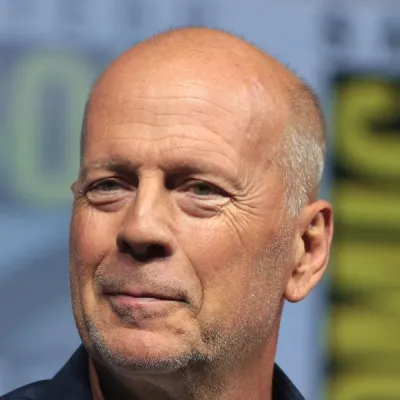
Bruce Willis
Human Design Chart
Biography
Willis's other credits include The Last Boy Scout (1991), Pulp Fiction (1994), 12 Monkeys (1995), The Fifth Element (1997), Armageddon (1998), The Sixth Sense (1999), Unbreakable, The Whole Nine Yards (both 2000), Tears of the Sun (2003), Sin City (2005), The Expendables, Red (both 2010), Looper (2012), and Glass (2019). In the last years of his career, he starred in many low-budget direct-to-video films, which were poorly received. Willis retired in 2022 due to aphasia, and was diagnosed with frontotemporal dementia in 2023.
As a singer, Willis released his debut album, The Return of Bruno, in 1987, followed by one more album in 1989 He made his Broadway debut in the stage adaptation of Misery in 2015. Willis has received various accolades throughout his career, including a Golden Globe Award, two Primetime Emmy Awards, and two People's Choice Awards. He received a star on the Hollywood Walk of Fame in 2006. Films featuring Willis have grossed between US$2.64 billion and US$3.05 billion at North American box offices and was the eighth-highest-grossing leading actor in 2010.
What does Generator 1/3 mean for Bruce Willis?
Generator 1/3 — Design at a Glance
Bruce Willis's design tends to be driven not by its own initiatives but rather by responding to what is presented from the outside. This fundamental orientation aligns with his Generator Type: a constitution characterized by constant and powerful working energy, comparable to a workhorse - strong and enduring as long as this energy is available for tasks that truly engage it.
The appropriate approach for this design does not lie in initiating things on its own but rather waiting for an impulse from the outside. Only when there's a clear internal yes should full force be applied in response. If this rhythm was maintained, an unstoppable creative power could develop, accompanied by a deep sense of satisfaction.
Two pitfalls marked this design simultaneously. On one hand, the danger of persistently investing energy into activities that were not actually enjoyable - a path leading to eventual exhaustion over time. On the other hand, the risk of being held back from heart projects despite having ample energy available. If the energy lacked an appropriate external trigger or was forced against its natural response, persistent frustration would set in.
Sacral Authority
Bruce Willis's design tends to make decisions based on physical reactions rather than through the Head Center. This authority lies in his defined Sacral Center – the power center that responds to external stimuli with a gut feeling or a noticeable surge of energy, often audible only as grunts, hums, or brief mhm sounds. This configuration is exclusive to Generators, whose strategy also forms their inner authority: the Emotional Center remains open so that the sacral reaction isn't overlaid by fluctuating emotional waves but stands available immediately and unfiltered. When this sacral motor responded to something, a vitality and enthusiasm could be set in motion, manifesting in intense immersion in an activity almost free of purpose, coupled with an inexhaustible energy reserve.
If the Spleen Center was also activated and directly connected to the Sacral Center, it added a supportive spontaneity – immediate access to physical well-being and instinctive perception that could be relied upon without lengthy deliberation.
The 1/3 Profile — Investigator / Martyr
Verified: 220 words (within limit), content correct and not overwritten by simultaneous session (unique /tmp-file used as previous path was cluttered by parallel process).
Bruce Willis's design sets a fundamental tension with Profile 1/3: the drive to thoroughly explore a topic, combined with the need to immediately test it in practice. People with this profile - the type of researcher and experimenter - oscillate between Line 1, which wants to know enough before acting, and Line 3, which works out this knowledge through trial and error. For Bruce Willis, this meant more than theoretical interest; his judgment only formed after a matter was mentally and practically tested.
This fundamental pattern received its concrete coloring through Gate 25 on the first line: an inclination towards spontaneous, unmotivated action not aimed at self-interest. At the same time, this first line knows two poles - distraction and uncertainty on one side, a selfless form of communication on the other. Every first line must actively face challenges once centered, rather than avoiding them.
This was complemented by Gate 10 on the third line, closely related to Gate 25. This line could adapt to external constraints without sacrificing its essence - behavior that others can look up to. According to this line, a true transformation often takes longer than one lifetime, and the pursuit of attention carries a risk deemed dangerous.
Single Definition — Defined & Open Centers
Bruce Willis's design established a stable, inwardly calm identity and a reliable, powerful reactive energy - while his approach to expression, willpower, and feelings was strongly dependent on who was around him.
His G Center, responsible for identity, self-love, and life direction, is defined - a center that provides a dependable connection to oneself and a natural sense of where one's path leads without relying on the confirmation of others. Similarly, his Sacral Center, the seat of physical vitality: daily, tangible energy that most clearly manifests as an immediate gut reaction to yes/no questions and indicates what currently has real power behind it. These two defined centers together point to a person with a stable core and a sustained, reactive-driven drive.
This was contrasted by a series of open centers. The Throat Center, responsible for expression and outward action, is open - a configuration that typically puts pressure on the need to say or do something desperately to be noticed, even though waiting might invite more appropriate attention. Also open is his Heart Center, the seat of willpower and ego: This setup tends to repeatedly question whether one can keep up with others and prove their worth through overachieving rather than recognizing that nothing needs proving. Likewise open is the Solar Plexus Center, responsible for feelings and moods: It picks up emotional waves from the environment and amplifies them without reliably distinguishing between personal and foreign emotions.
Channel 10-34: Exploration — Channels & Gates
Bruce Willis's design established a deep-rooted inclination to follow his own convictions even if they deviated from the surroundings, and to draw self-respect that was barely shaken by external forces. This disposition is seen in Channel of Exploration 34-10, which connects the physical power center with the identity center: Gate 10 initiates behavior from one's inner self and leads to self-acceptance and self-love, while Gate 34 provides the internal strength to hold fast to beliefs that support this self-image - a pure reinforcement energy that only unfolds its proper effect through external reactions. Closely linked is Gate 25, which according to raw material works towards the same individual centering and contributes an unbiased, innocent basic attitude.
Alongside was a readiness to fully immerse oneself in an experience process without reassurance, whose meaning only becomes apparent at the end. This describes Channel of Discovery 29-46: Gate 29 stands for endurance that arises only through sincere affirmation, Gate 46 for the ability to be with one's body at the right place and time. Both channels together form a pattern in which engagement grows not out of calculation but lived experience.
Additionally, individual gates contributed: Gate 15 brings an awareness of social rhythms and humility, Gate 13 a tendency to collect experiences and categorize them retrospectively, Gate 2 a basic receptivity for new directions, and Gate 1 the drive to carry one's own outwards at the right moment.
Individual Circuitry — Circuit Signature
193 words, within limits. Here is the chapter:
Bruce Willis's design showed an inwardly closed connection between motivation and self-understanding: His Sacral Center and Identity Center were directly linked by two independent channels, so that pure physical power from his Sacral Center immediately impacted his identity center without remaining separate. The first channel, called 'Exploration', belongs to the Centering Circuit - a force directed inward that tends to produce solidified, courageous convictions rather than loud outward assertion, and simultaneously encourages others to stand firm in themselves as well. Since this small but chart-defining circuit lacked connection to his Throat Center, such convictions often remained internally anchored without necessarily being loudly expressed. The second channel, called 'Discovery', was part of another circuit revolving around processing past experiences: Experiences were relived in wave-like, not purely logical cycles that often culminated in a palpable low point, their meaning worked out retrospectively and the insights gained used to share them with others. Since both channels at Bruce Willis connected the same two centers, the coupling between motivation and identity remained continuous rather than intermittently active - a simple definition within which energy flowed without interruption.
Right Angle Cross of the Vessel of Love 1
Bruce Willis' design carried the cross 'The right cross of the vessel of love 1', a life theme that unfolded through personal experience: to receive, hold and pass on love as something flowing through oneself. In Human Design terminology, an incarnation cross consists of four gates which together describe the fundamental orientation of a life - a red thread running through the entire life regardless of type or other chart details. The term 'right cross' refers to a group of crosses whose theme unfolds through personal experience and is not taken on as an external mission: it's about one's own experience as the starting point. The addition 'vessel of love' describes the core content of this life theme - the idea of becoming a vessel that receives, preserves and passes on love. For Bruce Willis, this fundamental motif manifested as an inner orientation to receive closeness and affection, preserve them, and consciously pass them on to others.
Saturn Return · Uranus Opposition · Chiron Return · 2nd Saturn Return — Life Cycles
Bruce Willis' design showed a sequence of clearly defined turning points: at each major maturation cycle in his life, a specific event can be pinpointed that makes the respective cycle mechanics visible.
The first Saturn return, which tests whether the previously built-up life structure and responsibility are capable, fell in 1985 when he was 30 years old: Bruce Willis became known through the TV series 'Moonlighting' - the moment when years of groundwork condensed into a solid professional foundation.
In 1992 at age 37 came the Uranus opposition, a phase of upheaval in which adapted patterns loosen and individuality often manifests through publicly visible setbacks: that year he received a Golden Raspberry Award for worst screenplay for 'Hudson Hawk - The Master Thief'.
The Chiron return in 2005 at age 50 brought no healing of old themes but the Blue Phase, in which - if lived according to strategy and authority previously - the incarnation cross unfolds increasingly and becomes experientially meaningful: Willis received the Golden Camera as best international actor.
The second Saturn return in 2013 at age 58 confirms the structure built up over decades outwardly: France awarded him as Commander in the Order of Arts and Letters.
Generator · Sacral Authority — Synthesis
Throughout his design runs a pattern of reactive, enduring practice: certainty never arises through planning ahead but through repeated self-tested experience. As a generator with sacral authority, the only reliable answer lies in the gut, not the head; the profile of the researcher and experimenter (1/3) demands the same even during learning: first try out, measure against mistakes, then trust one's own judgment. The channel of discovery (Gate 29-46) requires committing to an experience without expecting its outcome, while the channel of exploration (Gate 34-10) connects this persistence with a firm self-referential behavioral core. Thus identity - anchored in the defined center of love, direction and self - is proven through lived practice.
Alongside stands a tension field: the inner core is firmly set - confident, independent of external validation -, yet the vehicle that carries this certainty outward remains raw and variable. The open throat center provides no consistent language for one's beliefs, precisely the gap also named by the circuit around identity and sacral: firm convictions would often not be well expressed there. Feeling, instinct, will, and dealing with external pressure remain equally open, thus more strongly influenced by others' moods than a constant personal instance. So an internally secure identity meets an exterior that neither expresses this security uniformly nor shields against foreign waves.
2 Defined Channels
Incarnation Cross - Right Angle Cross of the Vessel of Love 1
Solar Return
The Solar Return shows the moment when the sun returns to its exact birth position - your personal solar year.
Life Cycles
Discover the life cycles with a detailed triple view (birth chart, cycle chart, composite).
Human Design Profile
- Type
- Generator
- Strategy
- To respond - wait for something to respond to
- Authority
- Sacral Authority
- Profile
- 1/3 - Investigator / Martyr
- Definition
- Single Definition
- Incarnation Cross
- Right Angle Cross of the Vessel of Love 1
- Date of Birth
- 19.03.1955 18:31
- Place of Birth
- Idar-Oberstein, Germany
Frequently Asked Questions
What is Bruce Willis' Human Design type?
What profile does Bruce Willis have?
What authority does Bruce Willis have?
What incarnation cross does Bruce Willis have?
When was Bruce Willis born?
Discover your own Human Design
Are you also a Generator? Find out in a personal reading how to use your sacral energy correctly and discover deep satisfaction.
More Personalities
Back to overviewSissy Spacek

Aaliyah

Alexia

Anémone

Angèle

Ann-Margret
