Buckethead
Human Design Chart
Biography
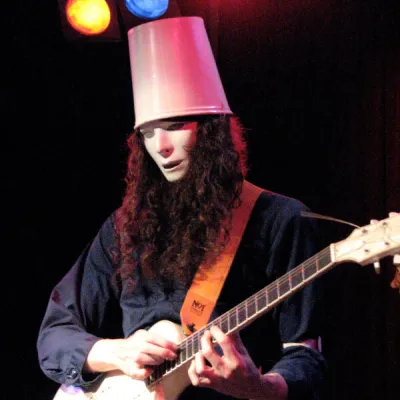
Buckethead is famous for wearing a KFC bucket on his head, emblazoned with an orange bumper sticker reading FUNERAL in capital black block letters, and an expressionless plain white mask, which, according to Buckethead, was inspired by his seeing Halloween 4: The Return of Michael Myers.
At one point, he changed to a plain white bucket that no longer bore the KFC logo, but subsequently reverted to his trademark KFC bucket. He also incorporates nunchaku and robot dancing into his stage performances.
The Human Design of Buckethead: Generator 5/1
Generator 5/1 — Design at a Glance
Buckethead's design established a tendency towards immense endurance as long as he responded to external impulses. His energy source was not in initiative but in the sacral center – an inner compass that answered with a clear 'Yes' signal. This mechanism meant: Not starting on his own, but waiting until life posed a question or set a trigger. Only then could Buckethead effectively deploy his strength.
As a Generator, he possessed the capacity to materialize things sustainably, but only under one condition: The action had to come from the gut. If he ignored this signal and initiated instead out of head or expectation, frustration and energy deficiency resulted. Conversely, consistently reacting to genuine interests led to deep satisfaction.
The danger lay in two extremes: Either Buckethead wasted his power on tasks without inner resonance – a path to burnout –, or he was hindered from pursuing his heart's project externally, even though the energy was still there. His success thus did not depend on willpower but on whether he learned to listen and respond to the internal signal instead of fighting against the current.
Sacral Authority
Buckethead's design established a decision-making stance that took place not in the head but deep within the body. He showed himself as someone who waited for external triggers and then acted through an immediate physical resonance – often audible as grunting or a deep 'Hmm'. This sacral authority, unique to the Generator type, simplified his process: Strategy and inner guidance were identical. Instead of intellectually analyzing, he relied on this gut feeling.
When his system was activated, vital energy rose within him. This endowed him with seemingly inexhaustible strength and great enthusiasm for the activity itself. Buckethead was born to immerse himself entirely in the act without an external goal or purpose being necessary. The joy of the process stood at the center.
Moreover, a supportive dynamic came into play: The spleen center was activated and possibly directly connected with the sacral center. This allowed him particularly quick, spontaneous reactions. He had immediate access to his physical well-being and instinctive perception. This combination enabled him to make decisions quickly and reliably, guided by a deep inner compass for health and intuition that always took precedence over rational deliberation.
The 5/1 Profile — Heretic / Investigator
Buckethead's design established a tendency towards deep, private collecting paired with a magnetic outward projection. As a Hero/Explorer (Profile 5/1), he instinctively sought security and inner peace through the intensive exploration of connections – the Line 1 of the Explorer demands this calmness as a foundation. Simultaneously, his Line 5, that of the Hero, projected these collected insights irresistibly into the collective. Others automatically sought him out for solutions to their problems, driven by the expectation that he would always be available as an expert.
This dynamic created a tension field: The inner drive towards safety in retreat collided with the external pressure of constant being called upon. Without clear boundaries, exhaustion threatened through uncontrolled querying of his knowledge store, similar to a scientist drained after long conferences and yet still being queried further. Buckethead showed himself in this configuration as someone who had to learn to say no to maintain balance between private development and targeted help. Only by setting limits could he optimally utilize his gifts without being swallowed up by the collective. The challenge lay in communicating individual insights so that they were accepted without fully conforming to collective expectations or losing one's own inner clarity.
Split Definition — Defined & Open Centers
Buckethead had a consistent internal infrastructure: defined Ajna, Throat, G Center, Sacral and Root Centers created mental clarity, reliable identity, and a strong energy motor. His thinking was constantly active; he generated concepts independently of external pressure. The connection between Ajna and Throat allowed him to directly translate his thoughts into speech and action without filters. His defined G Center gave him a firm direction and self-love, while the Sacral Center provided a daily supply of vital energy waiting for reaction. The Root Center supplied constant forward momentum.
At the same time, Buckethead was extremely permeable to the outside world through open Head, Heart, Solar Plexus, and Spleen Centers. He absorbed external inspiration, ego dynamics, emotional waves, and survival fears without owning them as his own identity. His open Head Center made him susceptible to mental pressure and doubt from others; he tended to get entangled in questions that were not his own. The open Heart Center led to the temptation to prove one's worth through promises or competition, often leading to exhaustion due to a lack of consistent willpower.
His open Solar Plexus Center allowed him to take on and amplify emotions from his environment; he could swing between happiness and depression when identifying with foreign feelings. His open Spleen Center carried fears of survival deficiency and drew him towards people or situations that provided a false sense of security, potentially leading to unhealthy dependencies. The challenge was not to personalize these external influences as personal reality but to use them as information while maintaining his inner authority and strategy. Thus, he served as a mirror for others without being taken over by their conditioning.
Channels for structure, evolutionary change and inner resolve.
Buckethead's design inclined towards pulsating, melancholic change paired with the ability to translate complex insights into clear structures. The Mutation Channel 60-3 connected the Root Center with the Sacral Center through Gate of Limitation (60) and Gate of Order (3). This channel brought evolutionary change through an unpredictable rhythm between chaos and order. It required acceptance of limitation as well as patience in the 'out' state when no energy flowed. The associated melancholy was not a deficit but part of the process to develop new things underground.
Parallel to this, Channel 7-43 enabled the translation of innovative insights (Gate 43) into efficient, understandable concepts (Gate 23). This connected Ajna Center with Throat Center. Here lay the challenge in precise timing: Only by waiting for inner authority could Buckethead convey his unique perspective without being perceived as an outsider. Letting go of control and trusting the natural flow of these mechanisms was crucial. Recognition only arose when these processes did not rationalize or force themselves but emerged from one's own rhythm.
Individual Circuitry — Circuit Signature
Buckethead exhibited a duality in creating new identity and reflecting past emotions. His design presented these two forces as separate, parallel existing streams since his definition is split – they do not flow into each other but work alongside.
In the Knowledge Circuit, he connected Ajna Center with Throat Center (Channel 3-60). This created an energy of mutation: deviations from the known became the basis for new expression. Simultaneously, the channel between Sacral and Root Centers structured these impulses through rhythmic, pulsating formats. The energy was acoustic and immediate, driving towards one's unique path.
Parallel to this, the Meaning Circuit worked. Here he connected Identity Center with Sacral Center (Channel 46-29). This focused on the past: emotions and experiences were cyclically processed to uncover deeper meaning behind events. This visual, wave-like energy served to share felt insights with the collective.
While the Knowledge Circuit initiated transformation through new expression, the Meaning Circuit promoted learning from history. Buckethead's design thus combined the acoustic urgency of innovation with the cyclical depth of emotional reflection – two independent mechanisms for collective growth and individual affirmation.
Left Angle Cross of Dedication 1
Buckethead's design showed a tendency towards deep dedication. His life strategy was marked by the 'Left Cross of Dedication', meaning that his drive often stemmed from aligning with something greater or someone higher. This configuration describes not just a passing interest, but a central identity factor: self-understanding formed through readiness to dedicate oneself to something larger.
In this context, dedication appears less as an arbitrary choice and more as a structural necessity of the design. It's about the dynamics where the individual invests their energy into a goal that transcends pure ego. This can manifest as willingness to sacrifice or unwavering loyalty to an ideal. For Buckethead, this orientation was not a peripheral theme but the core driving force defining him.
The mechanics of this cross demand clear focus. Without such a center of dedication, energy remains diffuse; with it, direction and intensity are gained. It's a pattern aimed at establishing a deeper connection to one's essence through complete dedication. Buckethead thus appeared as someone whose identity was inseparable from the act of dedicating himself – not out of compulsion but from the inner logic of his design. This structure shaped how he encountered the world and positioned himself within it.
Saturn Return · Uranus Opposition · Chiron Return · 2nd Saturn Return — Life Cycles
Buckethead's design set a tendency towards cyclical phases of maturation, where internal structuring met external realignment. This dynamic was realized in 1999: at age 30, he released *Monsters & Robots*, his best-selling album to date. This marked his first Saturn Return – a point where years of groundwork often condenses into a solid, public result and strengthens one's identity.
Development continued when the Uranus Opposition occurred in 2008. At age 39, Buckethead resumed regular concerts after a hiatus since 2006 and toured through the United States. This configuration signals a profound shift in external circumstances and self-understanding, often coupled with a sudden urge for freedom or new forms of expression. The tour was not merely a career event but a visible manifestation of an inner release from old patterns towards a newly defined presence. Both cycles show how Buckethead's chart foretold a sequence of consolidating success and disruptive renewal, each event serving as a milestone on the path to full realization of his individual design.
Generator · Sacral Authority — Synthesis
A central red thread in Buckethead's design is a dynamic tension between inner drive and necessity to respond to external impulses. His sacral center defined as Generator implies a constant energy flow that unfolds only through reaction to life (Design View). This responsiveness is amplified by the connection to G Center, suggesting deep internal direction and identity – a magnet for experiences aligning with the sacral 'yes' (Centers: G Center, Sacral). The Profile as Hero/Researcher (Profile Role) points towards the ability to deepen knowledge and offer solutions, yet this happens most effectively within the framework of his sacral authority. The Format Energy of Channel 3-60 (Circuit: Knowledge Circuit) intensifies this cycle of energy build-up, mutation, and need for expression manifesting in creative outbursts.
The central paradox lies in the interplay between his defined throat and open centers – especially solar plexus and spleen (Centers). The defined throat signals clear expressive power, yet openness to others' emotions and fears means he is constantly confronted with external influences. This leads to a tension between the need for authentic communication (Throat Center) and the risk of being overwhelmed by others' feelings and fears (open solar plexus, spleen). Knowledge from the Knowledge Circuit can then serve as a tool to filter these influences and maintain one's direction.
3 Defined Channels
Incarnation Cross - Left Angle Cross of Dedication 1
Solar Return
The Solar Return shows the moment when the sun returns to its exact birth position - your personal solar year.
Life Cycles
Discover the life cycles with a detailed triple view (birth chart, cycle chart, composite).
Human Design Profile
- Type
- Generator
- Strategy
- To respond - wait for something to respond to
- Authority
- Sacral Authority
- Profile
- 5/1 - Heretic / Investigator
- Definition
- Split Definition
- Incarnation Cross
- Left Angle Cross of Dedication 1
- Date of Birth
- 13.05.1969 15:22
- Place of Birth
- Newport Beach, CA, United States
Frequently Asked Questions
What is Buckethead's Human Design type?
What Profile does Buckethead have?
What authority does Buckethead have?
What is Buckethead's incarnation cross?
When was Buckethead born?
Discover your own Human Design
Are you also a Generator? Find out in a personal reading how to use your sacral energy correctly and discover deep satisfaction.
More Personalities
Back to overviewAaliyah

Alexia

Alizée

Angèle

Anne-Marie

Arcángel