
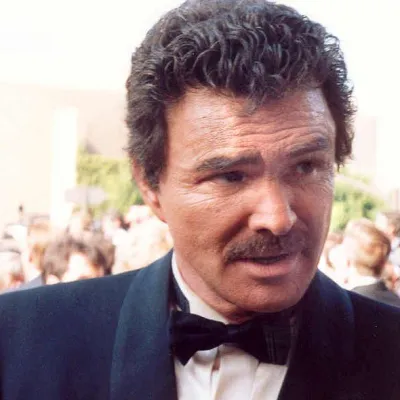
Burt Reynolds
Human Design Chart
Biography
He started with stage and TV bit roles while doing menial jobs in New York, slowly building his craft before signing a TV contract with Universal, playing in several TV series. He entered films in the early '60s and had his first impressive role in "Deliverance," 1972. He established himself as a sex symbol to the female audience and was popular with the men for his nonchalant toughness. Reynolds' films include "The Longest Yard," 1974, "Smokey and the Bandit," 1977 and "The Man Who Loved Women," 1983. In 1976, he directed his first of several films, "Gator."
Reynolds was married in 1962 to Judy Carne for three years. He had romances with Dinah Shore, 1971, and from 1976, Sally Field. In 1981 he began dating Lonnie Anderson, becoming a steady twosome in 1982; they married on 29 April 1988, at 2:15 PM, in Jupiter, Florida and adopted their son Quentin four months later. In January 1994, they had one of Hollywood's ugliest divorces, complete with bitter accusations and custody and money fights.
In January 1996, Reynolds confirmed that he and Pam Seals, his girlfriend of the past five years, had broken up.
In 1985, painful jaw problems and health woes led to the gossip that Reynolds had AIDS. Getting addicted to the prescription drug Halcyon and a few movie flops added to a tough few years. His financial problems seemed to stem from that time, even though he won an Emmy for Best Actor and a Golden Globe for "Evening Shade" in 1991. In 1994, he published his autobiography, "My Life." After their bitter breakup, Loni Anderson published her own tell-all memoirs, "My Life in High Heels," which was unflattering. With his divorce woes, he declared bankruptcy in 1996.
Burt Reynolds — Generator with Profile 4/6
Generator 4/6 — Design at a Glance
Burt Reynolds, as a Generator, possessed an immense, sacral energy source that shaped him into a figure of remarkable endurance. His design functioned like that of a workhorse: strong and steady as long as the energy for the task at hand was available. This power did not ignite through self-driven initiative but solely through reacting to impulses from the environment. The central strategy was to wait for signals and only act when the inner center gave a clear “yes”.
Living in harmony with this mechanism, by reacting from the gut to offers, his system rewarded him with deepest satisfaction and a sense of fulfillment. Conversely, two specific dangers loomed: either he spent his energy on tasks that did not resonate internally, leading to exhaustion, or he was held back from his true heart project, even though the energy was still available. If he constantly initiated without waiting for the inner signal, this often resulted in persistent frustration or a lack of energy. His path to effectiveness thus lay not in pushing forward but in precisely reacting to life that spoke to him.
Emotional Authority
Burt Reynolds showed himself to be someone who never made decisions based on a first, hot impulse. His design laid a tendency to emotional delay, as he possessed emotional authority. This authority is carried by the defined Emotional Center and always takes precedence over all other defined centers in Human Design mechanics, regardless of further configurations.
Thus, Reynolds was subject to a natural wave movement of feelings. His perception of the world was always colored by the current mood: what seemed inspiring in one moment could appear negative in the next. This up and down did not mean that the first impression was its truth. Quick, spontaneous decisions based on a fleeting emotion would often have negative consequences, as they were based on a mere snapshot.
Instead, his inner authority required patience. To gain clarity and calm, he had to allow time for the intense feelings to subside. This often happened through multiple nights of sleeping on a decision. Only when the emotional distance was large enough and the wave had ebbed did the deeper, more comprehensive insight set in. This process was central for long-term, life-defining decisions, as it ensured that the chosen path did not merely reflect a passing mood but was based on a stable inner truth.
The 4/6 Profile — Opportunist / Role Model
Burt Reynolds revealed himself in his youth as an experimental networker, seeking his identity through numerous relationships and friendships. This behavior matched the early phase of his 4/6 Profile, where Line 6 still acted like Line 3. He actively sought connection and tested various roles to find his place in the community.
With the return of Saturn and the activation of Line 6, his orientation fundamentally changed. An internal conflict arose between the desire to be part of a group and the need to withdraw to ponder higher questions. This contrast of heart and head shaped his later years. Simultaneously, he carried the energy of the fourth line of Gate 49, aimed at carrying principles outward and gaining support for revolutionary ideas. This aligned with the sixth line of Gate 43, which pointed towards breakthrough and mutation. Reynolds sought new knowledge that could establish a new order and engaged only where he felt this transformative support. In his later years, he became a role model that emerged through cooperation, yet always remained cautious of opening up to the wrong people and getting hurt. His design dictated that he swung between ground contact and transpersonal heights, always in search of the right balance between community and wise distance.
Triple Split Definition — Defined & Open Centers
Burt Reynolds revealed himself as someone whose mental processes and willpower exhibited a consistent, trustworthy structure. His defined Ajna Center provided a clear, specific form of conceptual thinking; he was not easily influenced by external factors and processed data and creativity in his own unique way. This mental stability directly affected his communication: Through his defined Throat Center, he reliably spoke what his mind conceptualized. His voice served as a focal point to transform these inner concepts into clear messages in the world.
Parallel to this, he possessed a strong willpower. His defined Heart Center gave him the energy to determine his life and resources for himself. He tended to make promises and keep them, which strengthened his self-esteem. He enjoyed being successful and competitive, using his ego strength to influence situations and gain recognition for his contribution.
These defined areas contrasted with his open centers. His open G Center meant that he did not have a fixed, unchangeable identity. He was prone to blending with his environment or adopting "borrowed" identities. He tended to question who he really was or where the right direction lay, and often sought confirmation from others to feel a sense of belonging. Additionally, his Head Center was open, making him susceptible to mental pressure and confusion from the environment. He could easily get entangled in the questions or doubts of others and felt the pressure to find answers that were not his own. This openness required him not to get caught up in the mental monologues of others but to trust his inner authority to maintain clarity.
Channels for change, insight, devotion and emotional release.
Burt Reynolds appeared as someone who was characterized by a powerful, pulsating energy that carried both melancholy and the potential for evolutionary change. This fundamental stance resulted from Channel 60-3, which connected the Root Center with the Sacral Center. He had to learn to accept limitations and move beyond the confusion of new beginnings to channel this mutative force.
Additionally, Channel 23-43 shaped his thinking. By connecting the Ajna and Throat Centers, he received spontaneous insights (Gate 43) and processed these into clear, efficient statements (Gate 23). His innovative thinking could change entire perspectives, but it required patience until his unique explanations were understood.
In the interpersonal realm, Channel 26-44 influenced his actions. As a connection between the Spleen and Heart Centers, it gave him an instinctive sense of what the tribe or audience needed. He used this awareness (Gate 44) and ego strength (Gate 26) to convincingly persuade and sell improvements, often as an entrepreneur or promoter at the forefront.
The emotional depth of his design was determined by Channel 39-55. This channel connected the Root and Solar Plexus Centers and generated a wave of moodiness that swung between ecstatic joy and melancholic uncertainty. Burt Reynolds thus provoked the minds of his surroundings and opened others to mutative qualities by authentically living his emotional range.
Further influences came from Gate 49, which promoted upheaval and principled loyalty, and Gate 4, which developed logical formulas for future security. Gate 54 linked worldly success with mystical insight, while Gate 22 stood for social openness and ease. Gate 37 supported organic community structures, Gate 62 provided precise logic, and Gate 34 brought individual power and integration. Gate 27 added nurturing warmth, Gate 56 enabled picturesque storytelling, and Gates 38 and 18 set boundaries and corrected collective processes.
Individual Circuitry — Circuit Signature
Burt Reynolds was characterized by three separate, seemingly parallel energetic poles. His design connected the Sacral, Root, and Solar Plexus Centers into a closed circuit. This created a pulsating, acoustic energy aimed at mutations and the transformation of knowledge. At the same time, there was a second, isolated connection between Ajna and Throat Centers, which controlled the expression of these ideas, as well as a third, independent line between Heart and Spleen Centers.
In the Knowledge Circuit, the channels for structuring, mutation, and the release of emotions were active in him. This configuration promoted the creation of new knowledge, which was carried outward through emotional waves from the Solar Plexus Center via the Throat Center. The mutations from Channel 3-60 supported his unique path. Since these centers were not connected to the Ego Circuit, these creative impulses existed as independent forces.
Reynolds' Ego Circuit consisted solely of the channel of Devotion (26-44) between Heart and Spleen Centers. This area belonged to the Stem Group and served cooperation and the joint creation of resources. Without a connection to the Sacral Center, this part of the design required necessary rest periods to regenerate energy for support and material security. The three definitions remained energetically separate, representing different, non-directly merging life areas.
Right Angle Cross of Explanation 1
Burt Reynolds revealed himself through the right cross of Explanation 1 as someone who carried his inner truth and intuition into the world. This configuration grants a deep connection to one's essence and enables the clear and understandable explanation of complex relationships. He lived with a natural gift to make the invisible visible and inspire others through his authenticity.
The right cross of Explanation 1 describes a life task of embodying one's truth and sharing it with others. It is not about fulfilling external expectations but following the inner voice and turning it into action. Burt Reynolds used this energy to express his personality and bridge the personal with the universal. His way of seeing the world was characterized by a clear view of the essential, which helped him succeed in various areas of life.
This configuration also supports the ability to encourage others to find their own truth. Burt Reynolds was an example of how one can take a positive influence on their environment through authenticity and clarity. His path was marked by a constant struggle with the question of how to align his identity with the external world. Through this balance, he created a connection that extended beyond himself and encouraged others to follow their own paths.
Saturn Return · Uranus Opposition · Chiron Return · 2nd Saturn Return — Life Cycles
Burt Reynolds' design laid a tendency towards cyclical phases of public recognition and necessary repositioning. His path was marked by prominent astrological transits that divided his career into clearly defined segments. In 1975, at the age of 39, a Uranus opposition became active. This aspect often brings sudden changes or breaks that disrupt established patterns. For Reynolds, this was evident in a Golden Globe nomination as Best Actor for "The Longest Yard". The energy of this transit fostered a visible confirmation of his talent in a new context, which distinguished him from earlier role patterns.
Later, in 1984 at the age of 48, he went through a Chiron Return. In Human Design mechanics, this period marks a fulfillment cycle in which the individual's incarnation cross unfolds and personal meaning becomes experiential, provided that strategy and authority are observed. It was not a healing but a bloom phase of self-realization. Paradoxically, this period coincided with Golden Raspberry nominations for "Cannonball Run" and "City Heat". Public criticism stood in contrast to the inner development task of the Chiron Return, which aims to live one's essence without external validation.
The second Saturn Return in 1993, at the age of 57, closed this arc. Saturn demands structure and responsibility. Reynolds received another Golden Globe nomination, this time for the series "Daddy's Little Girls". This transit condensed the groundwork of the previous decades into a sustainable result. The mechanics show how external events served as mirrors for inner developmental phases: from disruptive confirmation to identity testing to structural anchoring.
Generator · Emotional Authority — Synthesis
Burt Reynolds lived a profound inner conflict between the urge to be authentic and connect in relationships (Line 4 in Profile) and the need for independent reflection and understanding of larger contexts (Line 6). This tension shaped his path as he constantly moved between the desire for belonging and the drive for individual definition. As a Generator, he possessed immense work power and endurance (sacral energy), yet his emotional authority required time to mature decisions. This led to an inner dynamic where spontaneous impulses and deeper feelings were in a constant interplay.
A central red thread in his life was the ability to create new things and initiate changes through mutation and creative expression (Channel 3-60). This pulsating energy, combined with the knowledge circuit, drove him to cross boundaries and reinvent himself repeatedly. At the same time, his cycles showed moments of success and recognition (career events) as well as phases of crisis and self-reflection (Chiron Return), which highlighted his emotional depth and the need to constantly realign.
4 Defined Channels
Incarnation Cross - Right Angle Cross of Explanation 1
Solar Return
The Solar Return shows the moment when the sun returns to its exact birth position - your personal solar year.
Life Cycles
Discover the life cycles with a detailed triple view (birth chart, cycle chart, composite).
Human Design Profile
- Type
- Generator
- Strategy
- To respond - wait for something to respond to
- Authority
- Emotional Authority
- Profile
- 4/6 - Opportunist / Role Model
- Definition
- Triple Split
- Incarnation Cross
- Right Angle Cross of Explanation 1
- Date of Birth
- 11.02.1936 12:10
- Place of Birth
- Lansing, MI, United States
Frequently Asked Questions
What was Burt Reynolds' Human Design type?
What profile did Burt Reynolds have in Human Design?
What authority did Burt Reynolds have?
What incarnation cross did Burt Reynolds have?
When was Burt Reynolds born?
Discover your own Human Design
Are you also a Generator? Find out in a personal reading how to use your sacral energy correctly and discover deep satisfaction.
More Personalities
Back to overviewSissy Spacek

Aaliyah

Alexia

Anémone

Angèle

Ann-Margret
