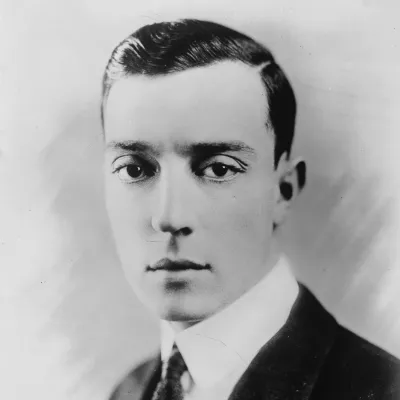
Buster Keaton
Human Design Chart
Biography
Human Design Analysis: Buster Keaton as Manifestor 2/4
Manifestor 2/4 — Design at a Glance
Buster Keaton revealed himself as someone with the energy of a Pioneer who wanted to lead the world into a new direction. His design as a Manifestor suggested him as an Emperor in ancient Rome: He possessed the vision of a great whole but did not fight and wage the necessary wars himself. Instead, he sent others out to conquer foreign lands for him. This structure brought with it a specific challenge: Since his plans often reached further than the understanding of those around him, he was easily misunderstood. His big dreams polarized people around him; some loved and followed him, while others hated or rejected him because of these visions. To minimize this friction and find the right following, it was crucial for him to inform others about his intentions in a timely and precise manner. This strategy of informing was the key to his inner balance. If he followed this path, he was rewarded with a feeling of inner peace. However, if he lived against this design, he felt instead a persistent, deep anger within himself. His life was thus characterized by the tension between his leading vision and the necessity to communicate it clearly in order to avoid misunderstandings and rejection.
Splenic Authority
Buster Keaton showed decision-making based on a fine, spontaneous inner impulse. His design carried authority in the Spleen center, meaning that his health and alarm system held the leadership. This configuration is only possible if both the Emotional and Sacral centers are open; thus, he was either a Projector or a Manifestor.
The Spleen endows with an acute survival intelligence. It signaled him immediately whether a situation, environment, or society was right and healthy for him. This first impulse served his immediate well-being and allowed him to rigorously distance himself from harmful influences and take good care of himself.
However, since this Spleen voice is very subtle and only appears once in the moment, its attention required high vigilance. It could easily be drowned out by other external or internal influences. A temporary retreat often helped him to clearly hear this fine impulse.
Since knowledge about what was right became available only at each moment, his plans frequently changed short-term. Long-term commitments were therefore difficult and often counterproductive. His design required a lot of freedom and flexibility. Instead of fixing himself, he acted spontaneously, which helped him stay in flow and adapt to changing circumstances.
The 2/4 Profile — Hermit / Opportunist
Buster Keaton revealed himself as someone who constantly oscillated between the need for withdrawal and the desire for community. His design laid out a tension that resulted from Profile 2/4: On one hand, it pushed him into his 'cave' to be alone; on the other hand, he sought contact with his favorite people. This duality required clear communication outward so that he could know when he wanted company and when he needed to be left alone. During times of solitude, Keaton immersed himself in internal processes, created clarity, and reflected the knowledge of his network. Only after this need for isolation was satisfied did he come out again to develop brilliant ideas based on this inner work.
This process was shaped by specific energetic configurations. Gate 48 brought a deep perspective that was perceived from the outside and included themes such as degeneration as well as an often misguided desire for harmony. Without the counterpart of Gate 16, however, there was no possibility to experiment or unfold this depth. Additionally, Gate 39 with its emphasis on timing and careful judgment before action came into play. This line exceeded the ordinary viewpoint and demanded moderation while the Sun in this position represented a strongly fixed character that could be provocative. Keaton used this mechanism to evaluate during his quiet phases and then act in social contexts, always swinging between the inner retreat space and the outer world.
Triple Split Definition — Defined & Open Centers
Buster Keaton lived with a constant internal pressure to ask questions and conceptually resolve connections. His defined Head Center and Ajna Center generated permanent mental activity, but lacked the direct energy for implementation. This led him to often experience inspiration as unresolved tension or confusion rather than immediately transforming it into action. Instead, his aura stimulated thinking processes in others; he was a source of conceptual clarity for his environment without himself carrying the motoric impulse to execute.
His defined G Center gave him a firm sense of self-identity and clear direction. He knew who he was and where he belonged, making him independent from external expectations. At the same time, his defined Heart Center had constant willpower. This allowed him to keep promises and use resources autonomously as long as he followed his inner guidance. The connection of these centers with his defined Throat created a reliable way of communication: He spoke from identity and will, making his statements authentic and binding.
In contrast, his Sacral Center was open. Here, he lacked his own constant vital energy for continuous work. Instead, he absorbed the life force of his surroundings, which made him vulnerable to exhaustion if he did not pause. He tended to question whether he had done enough or if he should continue despite his body needing rest. His open Solar Plexus Center also amplified the emotions of others. He picked up moods and often processed them as his own mood swings, making him emotionally vulnerable. To stay healthy, he needed to learn not to personalize these foreign feelings and regularly withdraw to find inner peace.
Channels for willpower, leadership, meaning-making and mental clarity.
Buster Keaton revealed himself as someone who sought logical leadership but only acted when invited by a community. This stemmed from the Alpha Animal Channel 7-31, which defined collective authority through verified patterns and trust; he was the "power behind the throne," not the sole ruler. Parallel to this, the Money Line Channel 21-45 shaped him with a strong will for material control and independence. Here, Gate 21 (Hunter) represented the drive to take responsibility, while Gate 45 (Collector) embodied the authoritative voice of the tribe – a tension between service and the need for absolute decision-making power over resources.
His inner drive came from the Life Struggle Channel 28-38, which pushed him to find deeper meaning in every conflict. Gate 38 (Fighter) protected his integrity against external pressure, while Gate 28 (Player) intuitively recognized which battles were worth fighting. This adrenaline-driven process served individualization and demanded stubborn resolve. Mentally, his design worked through the Abstraction Channel 47-64. Through the Gate of Confusion (64) and Understanding (47), he filtered experiences through a kaleidoscope of mental images to give life a narrative structure – often accompanied by temporary uncertainty until a coherent picture emerged.
Additionally, isolated gates were at work: Gate 48 promoted deep pattern recognition and expert knowledge, while Gate 39 released mutation energy through provocative analysis. In the Ego Center, the willpower of Gate 51 combined with the innovative adaptability of Gate 26, helping him to win the tribe over for new paths. The Design Gates 52 and 53 steered cycles of focused pause and pioneering freedom, supported by the conservative values of Gate 50. Mental doubt (Gate 63) drove the search for security forward, while Gate 1 emphasized creative uniqueness in the here and now and Gate 35 sought change through interaction.
Collective Circuitry — Circuit Signature
Buster Keaton was marked by three separate, parallel energetic streams. The Knowledge Circuit connected his Spleen Center with the Root Center through the Life Struggle Channel. This created a pulsating energy of individual identity aimed at deviation from the known and quick intuitive reactions in acute situations.
A second, independent stream flowed in the Understanding Circuit between Throat and Identity Centers via the Alpha Animal Channel. Here, a focused visual energy of the future was oriented towards strategically communicating logical insights and developing structures to improve society – free from emotional influence.
The third stream formed in the Meaning Circuit through the Abstraction Channel between Head and Ajna Centers. This connection linked sudden inspiration with analytical processing to cyclically reflect on past experiences and derive emotional meanings for the collective.
Additionally, there was a separate connection in the Ego Circuit between Throat and Heart Center via the Money Line. This promoted the accumulation of material resources and the communication of values based on a conservative, traditional understanding of giving and taking within a community. Since these four circuits were not connected to each other at Keaton, they acted as independent, coexisting potentials rather than forming a cohesive overall flow.
Right Angle Cross of Tension 3
Buster Keaton displayed a fundamental disposition marked by profound inner tension. His design carried the right cross of tension in position 3, indicating a life defined not by external tranquility but by intense internal processes. This configuration described a state where energy did not flow freely but was under pressure – similar to a tightly wound spring that is always waiting to be released.
For Buster Keaton, this meant that his actions and reactions often emerged from this inner tension field. He lived not in a world of effortless flow but in a reality demanding constant adaptation to internal demands. The mechanics of this cross show how energy builds up in the body when it cannot be immediately discharged, creating an atmosphere of anticipation and latent power that significantly influenced his way of being.
This was not aggression in the traditional sense but rather a structural property of his system: the ability to endure tension and use it as driving force. Thus, Buster Keaton moved within a field of high internal dynamics where calm often only represented the pause between two phases of intense inner activity. This specific architecture of his design shaped his entire existence as an ongoing confrontation with this fundamental tension.
Saturn Return · Uranus Opposition · Chiron Return · 2nd Saturn Return — Life Cycles
Buster Keaton revealed himself as someone whose creative expression was marked by a clear rhythm of buildup and transformation. In 1923, at age 28, he produced his first full-length comedy attempt “Three Ages.” This marked the first Saturn Return: a phase where years of groundwork condenses into a solid result and strengthens one’s structure.
Ten years later, in 1933 at age 38, MGM terminated his employment contract. This timing coincided with the Uranus Opposition, an aspect often bringing unexpected changes or breaks to established systems. Instead of a continuous line, here was a rupture that interrupted the previous path and created new, unforeseen conditions.
In 1952, at age 57, James Mason discovered forgotten copies of Keaton’s film classics in his former villa. This occurred during the second Saturn Return, a phase of maturation and affirmation. What had seemed lost or forgotten now returned to consciousness. This cycle affirmed the long-term significance of his work not through external noise but by rediscovering what endured. Thus, Keaton’s design revealed a path that did not follow a linear progression but unfolded in phases of consolidation, disruption, and later appreciation.
Manifestor · Splenic Authority — Synthesis
He was a Manifestor whose life was characterized by a constant oscillation between the need for isolation and the longing for community (Profile 2/4). This internal rhythm reflected in his work style, which encompassed both visionary pioneering role (Manifestor type, Channel 31/7) as well as fine perception of one’s own wellbeing and others’ boundaries (defined Spleen Center). The ability to react spontaneously to inner impulses allowed him to tread unconventional paths while always keeping health in mind – a trailblazer who also provoked misunderstandings.
A central paradox in his design lay in the tension between the Knowledge Circuit and mental fixation (defined Head Center). He was destined to generate new insights and initiate changes, yet this process came with constant internal pressure to question and understand things. The creative flashes from the knowledge circuit were complemented by the necessity of mental clarity, leading to a unique form of expression – a balance between innovation and introspective confrontation that manifested in certain career phases (Saturn Return 1923, Uranus Opposition 1933).
4 Defined Channels
Incarnation Cross - Right Angle Cross of Tension 3
Solar Return
The Solar Return shows the moment when the sun returns to its exact birth position - your personal solar year.
Life Cycles
Discover the life cycles with a detailed triple view (birth chart, cycle chart, composite).
Human Design Profile
- Type
- Manifestor
- Strategy
- To inform others before acting
- Authority
- Splenic Authority
- Profile
- 2/4 - Hermit / Opportunist
- Definition
- Triple Split
- Incarnation Cross
- Right Angle Cross of Tension 3
- Date of Birth
- 04.10.1895 03:00
- Place of Birth
- Piqua, KS, United States
Frequently Asked Questions
What is Buster Keaton's Human Design type?
Which profile did Buster Keaton have?
What authority did Buster Keaton possess?
What incarnation cross did Buster Keaton have?
When was Buster Keaton born?
Discover your own Human Design
Are you also a Manifestor? Find out in a personal reading how to use your initiation power peacefully and dissolve resistance.
More Personalities
Back to overviewSissy Spacek
Anémone

Ann-Margret
Arletty

Arno
Artus