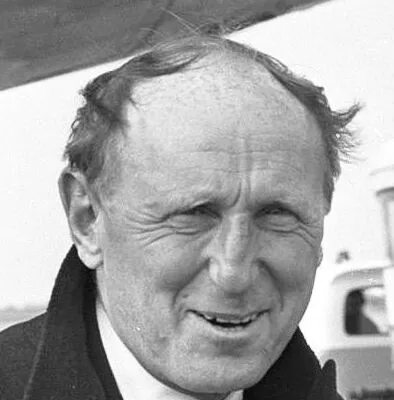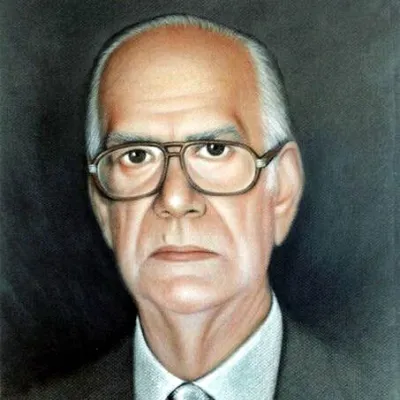
Camilo José Cela
Human Design Chart
Biography
He was awarded the 1989 Nobel Prize in Literature
He died on 17 January 2002.
Human Design Analysis: Camilo José Cela as Projector 3/5
Projector 3/5 — Design at a Glance
Camilo Jose Cela was someone who could instantly identify weaknesses in systems and people. His Human Design type is Projector, which brings with it a specific way of perceiving: his aura acts like a focused beam of light that points directly to problems others might overlook. However, this ability to pinpoint flaws can be counterproductive if he addresses these issues head-on; such direct interventions are often perceived as unpleasant or even aggressive by those around him, much like a bright light shining directly into someone's face.
His effective strategy was to wait for an honest and respectful invitation before offering advice. Instead of actively seeking attention or criticism, it was better to attract others through his own harmony. When people came to him on their own initiative and asked for guidance, he could share his knowledge effectively without causing resistance.
Since Projectors do not have a constant source of life energy, Camilo Jose Cela lived in phases of high activity followed by necessary rest periods. This up-and-down pattern was essential to avoid burnout. By following this strategy and waiting for invitations, he was rewarded with success. Ignoring this pattern and acting without an invitation or sufficient recovery led sooner or later to his Non-Self theme: Bitterness. His design thus suggested that his influence was greatest when he patiently waited for the initiative of others.
Emotional Authority
Camilo Jose Cela exhibited a fundamental disposition marked by strong emotional waves. His inner authority lay in the defined Emotional Center – a mechanism that always took precedence over other defined centers. This meant that his feelings were constantly fluctuating; he saw the world colored through his current mood. What excited him at one moment could seem negative the next. However, this immediate feeling was only a snapshot and not necessarily his deeper truth. Quick, spontaneous decisions based on such emotions often had negative consequences. Instead, his design required patience: he needed to take time for decisions to mature. Revisiting questions multiple times allowed him to let intense feelings subside. Over time, he gained emotional distance, leading to clarity and calmness. Only then was he through the inner process and could make a well-founded choice. This mechanism primarily affected long-term decisions with significant influence on his life path. Camilo Jose Cela learned to take proper pauses and ask himself multiple times before acting. Through this delay, the first impression transformed into a stable insight that aligned with his true inner truth.
The 3/5 Profile — Martyr / Heretic
Camilo Jose Cela was someone who learned through personal experimentation and then supported others. His Human Design Profile 3/5 combines the experimental Line 3 with the heroic Line 5. The third line pushed him to test things himself, make mistakes, and gain practical wisdom from them; it expressed his individuality boldly but could also evoke envy or suspicion. Only when absolutely necessary did this line attempt to explain itself. He then presented acquired knowledge to others who were drawn by his attractiveness and experience. This heroic role flattered him but was painful if attempts failed in public view. The fifth line focused him on practical solutions during crises, as well as organization and resource distribution. In revolutionary phases, others projected their expectations onto his structuring abilities. Power and authority were central themes here. Camilo Jose Cela learned from his failures and used this self-acquired knowledge to solve other people's problems. His life experience acted as a rich treasure he was happy to present. This interplay of trial and error followed by later application for the community shaped how he moved through and was perceived in the world.
Split Definition — Defined & Open Centers
Camilo Jose Cela was characterized by a constant, trustworthy mental function. His defined Ajna Center ensured that he always created concepts in the same way; his mind was consistently engaged in conceptual thinking. This inner stability combined with his defined Throat Center, which served as a pivot point to translate these mental contents and information from other centers into clear communication. Thus, his voice reliably spoke what he thought and conceptualized.
Parallel to this, he had a fixed sense of self through his defined G Center. This gave him a secure sense of direction and the ability to love himself without relying on others. He naturally showed others new ways but needed to learn not to drag everyone into this specific direction. His emotional landscape was shaped by his defined Solar Plexus Center, which acted as an inner authority. For him, truth revealed itself over time; he was designed to wait out the waves of his feelings before making decisions to achieve emotional clarity. Additionally, he had a fixed way of dealing with stress through his defined Root Center, providing the necessary pressure to move forward in the world and master existential challenges.
In contrast, his open Head Center revealed a vulnerability to mental pressure and confusion. He tended to be overwhelmed by doubts that belonged to others or got entangled in questions that were not his own. His open Heart Center made him susceptible to trying to prove his worth through willpower or promises, often ending in a cycle of self-disapproval if he failed. The open Sacral Center led to amplifying the energy of others and easily overexerting himself since he lacked a constant generative life force. Finally, his open Spleen Center carried a fundamental fear of survival; he was sensitive to well-being or its lack in the environment and tended to hold onto things that were not good for him just to feel secure.
Channels for insight, reflection and mystical synthesis.
Camilo Jose Cela showed himself as someone who did not merely passively experience experiences but patiently condensed them before formulating them linguistically. His design inclined towards deep reflection, coupled with a drive to translate these inner processes into clear, often innovative structures.
This attitude was rooted in the Lost Son Channel 13-33. Through Gate 13, which promotes listening and storing secrets, he gathered life stories and memories. Gate 33, the withdrawal, then allowed him the necessary retreat to sort through these impressions and recognize deeper truths before sharing them. This process created a continuity between personal experience and collective understanding.
Parallel to this, the Channel of Structuring 23-43 was at work. Here, Gate 43, spontaneous insight, connected with Gate 23, assimilation and expression. Cela received innovative perspectives in his mind and had to learn to process them through clear language so that others could take them up. His challenge lay in finding the timing of his utterances to effectively bring his unique knowledge into play.
Another defining aspect was the Channel of Synthesis 19-49. Gate 19, claims and a need for belonging, met with Gate 49, principles and emotional rejection or acceptance. This created a fine sensitivity towards social bonds and tribal dynamics. Cela sought balance between feasibility and fairness within his communities, where loyalty and emotional resonance were crucial.
Additionally, Gates like Gate 4 (Formulating), Gate 60 (Acceptance of Limitations) and Gate 52 (Focus on Pattern Correction) contributed to his ability to logically order complex connections and deepen them through targeted pauses. His energy was directed towards weaving coherent narratives out of the chaos of experience that were both individually and collectively significant.
Individual Circuitry — Circuit Signature
Camilo Jose Cela revealed himself as someone who translated inner clarity into concrete structure through his design. This tendency arose from the Knowledge Circuit, activated in him by Channel 43-23 ("Structuring"). This channel connected the Ajna Center with the Throat Center and enabled direct formulation of thoughts into orderly expression.
Parallel to this, the Meaning Circuit worked through the Channel 33-13 ("The Lost Son"), which linked the Throat Center with the Identity Center. This created an energy that reflected past experiences and culminated in deep emotional communication. Both circuits shared the Throat Center as their expressive organ, leading to structural clarity and emotional depth often working together.
A third aspect was the Ego Circuit, activated by Channel 49-19 ("Synthesis"). This connected the Solar Plexus Center with the Root Center. As Camilo Jose Cela had a split definition, these energies existed as two parallel, not directly connected systems: on one side, the connection of Head, Throat and Identity (Group 1), on the other side, the connection of emotionality and drive (Group 2). The groups did not flow in direct energetic exchange with each other. Instead, they shaped his life as coexisting forces: on one hand, the need for clear, structured communication and meaningful reflection, on the other hand, rhythmic interaction between emotional waves and the urge to act or rest. This configuration formed a personality that processed both intellectually structured and emotionally deeply rooted impulses, yet always with necessary pauses for regeneration, since no continuous life force connected all areas.
Right Angle Cross of Explanation 2
Camilo José Cela exhibited a fundamental stance characterized by clear boundaries and decisive positioning. His design featured the right cross structure of Statement 2, a configuration often associated with deep inner authority. This energy does not manifest as external loudness but rather as a quiet yet unshakable conviction in one's truth. Those who carry this energy tend to clarify their perspective not only for themselves but also convey it to others with a certain urgency and clarity – not to persuade rhetorically, but because the inner certainty is so strong that it radiates on its own. It is less about enforcing against resistance than about bringing an order into the world based on personal integrity. Camilo José Cela likely lived this dynamic as someone who knew his limits and did not tolerate others blurring them. His way of expressing or acting was marked by this inner firmness: He knew what he wanted and was rarely distracted by external noise. This energy does not demand agreement from all, but respects one's voice as authoritative – a trait that was always present in his life, even if it was not always spoken aloud.
Saturn Return · Uranus Opposition · Chiron Return · 2nd Saturn Return — Life Cycles
Camilo José Cela revealed himself as someone whose life path was marked by clear phases of condensation and public visibility. His design tended to shape internal processes into structured outcomes that then entered the world. This became particularly evident during his first Saturn return: in 1942, at age 26, he published his first novel "La familia de Pascual Duarte". This marked a transition for his system from inner maturation to external validation; years of groundwork condensed into a solid, public work. It was a moment of career consolidation when the chart potential became concrete.
Later, this pattern of structured opening repeated during his second Saturn return. In 1971, at age 55, he participated in a game scene in the film "Impromptu Balear", alongside other artists and prominent figures. This event underscores the mechanics of the later cycle: it was not just about professional achievement but also social embedding and relationship dynamics. His design promoted an attitude where personal presence and public role intertwined. The Saturn returns functioned as natural milestones that stabilized and made visible his development – initially through literary creation, later through cultural participation.
Projector · Emotional Authority — Synthesis
Camilo José Cela lived a process of continuous exploration and mediation. As a Projector with emotional authority (and the Channel of the Lost Son), he perceived the world intensely, recognized patterns and imbalances quickly (defined Ajna Center), but needed time to emotionally process these insights. This cycle of perception, reflection, and finally expression shaped his work; he gathered experiences through personal experimentation (Line 3) and then shared this knowledge as a ‘Hero’ (Line 5), who could enlighten others. The recurring Saturn Returns, marked by professional successes and social interactions, confirm this continuous cycle of experience, maturation, and dissemination.
Central to Cela was the tension between the need for independent thinking and emotional waves. His mental center allowed him to develop concepts and enforce his perspective, yet emotional authority required a temporal distance from immediate impressions. This discrepancy likely led him to act both as a sharp observer – recognizing flaws in the system – and to dwell in phases of emotional fluctuation before formulating and sharing his insights.
3 Defined Channels
Incarnation Cross - Right Angle Cross of Explanation 2
Solar Return
The Solar Return shows the moment when the sun returns to its exact birth position - your personal solar year.
Life Cycles
Discover the life cycles with a detailed triple view (birth chart, cycle chart, composite).
Human Design Profile
- Type
- Projector
- Strategy
- Wait for the respectful invitation
- Authority
- Emotional Authority
- Profile
- 3/5 - Martyr / Heretic
- Definition
- Split Definition
- Incarnation Cross
- Right Angle Cross of Explanation 2
- Date of Birth
- 11.05.1916 21:20
- Place of Birth
- Padrón, Spain
Frequently Asked Questions
What was Camilo Jose Cela's Human Design type?
What profile did Camilo Jose Cela have in Human Design?
Which authority determined Camilo Jose Cela's decisions in Human Design?
What incarnation cross did Camilo Jose Cela have in Human Design?
When was Camilo Jose Cela born?
Discover your own Human Design
Are you also a Projector? Find out in a personal reading how to unfold your leadership qualities and recognize the right invitations.
More Personalities
Back to overviewSissy Spacek

Alain-Fournier

Anémone

Angeli

Ann-Margret

Bourvil