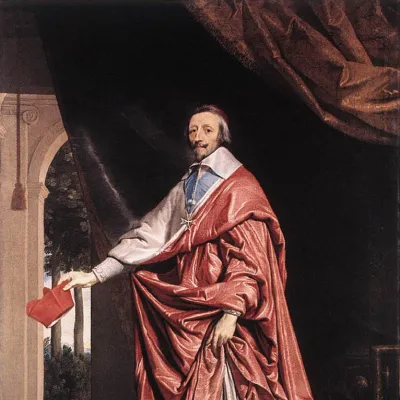
Cardinal Richelieu
Human Design Chart
Biography
Born Armand Jean du Plessis in Paris, he took the name Richelieu from the name of his family’s estate. His family origins were insignificant, but through intermarriage, they had achieved some prominence. His father, Francois du Plessis, was grand provost to Henry III, and his mother, Suzanne de la Porte, was the daughter of a councilor of the Parliament of Paris. When he was five years old, his father died, leaving estates ruined by mismanagement, and his childhood was marked by the looming threat of penury. His mother, left to raise the family of three boys and two girls on her own, worked to reorganize their resources. In order to save a grant from Henry III, a member of the family needed to be consecrated bishop, and the obligation fell to Armand-Jean, a student at the time. Thin and pale, sickly and frail, he was not displeased by a future career in the church. Intelligent, he was a natural at debating and seemed to like the idea of governing the lives of others. At age nine, he was sent to College de Navarre in Paris, and at age 17, he began a serious study of theology. Younger than the canonical age for consecration, he went to Rome and received a papal dispensation from Paul V. On 17 April 1607, at age 22, he was ordained a priest and consecrated to the see of Luçon.
Human Design Analysis: Cardinal Richelieu as Generator 6/2
Generator 6/2 — Design at a Glance
Cardinal Richelieu had immense and enduring sacral energy that presented him as a powerful workhorse. However, this strength was not initiated by himself but only in response to impulses from the environment. His life strategy involved waiting until his inner self gave clear approval before acting – often described as a gut feeling or an internal voice saying: "Yes! Let's get started!"
This Generator mechanism created a clear duality in his experience. When he responded to these inner signals and used his energy for tasks that truly mattered, he became unstoppable. He found deep satisfaction and a sense of fulfillment. The energy then flowed naturally and sustainably.
If he deviated from this path – for instance by initiating things he didn't really want to do or being hindered in working on his heart project when he was still full of power – another state would arise. Then, frustration, lack of energy, and eventually burnout could set in. The danger lay in wasting his strength on things not supported by his sacral approval. Thus, the key to his effectiveness always lay in reacting to life rather than trying to force it through personal initiative alone. Only this way could he fully unfold his potential without becoming exhausted.
Emotional Authority
Cardinal Richelieu showed a fundamental attitude that rejected spontaneous judgments and instead waited for emotional clarity. His design suggested that he did not make decisions based on emotion but took time to distinguish between transient mood and deeper truth. This resulted from his emotional authority: Since his Emotional Center was defined, he was subject to a constant wave of feelings coloring his perception of the world. Something could inspire him in one moment, appear negative in another. His immediate feeling was only a snapshot, not necessarily his truth. Quick, spontaneous decisions out of this emotional heat would often have had negative consequences for him. Instead, his inner compass required patience and multiple "overnights" to think through important questions. The longer he waited, the deeper he could see. Over time, intense feelings subsided, he gained emotional distance, and calmness set in. This process was crucial for long-term decisions as they significantly shaped his life path. Emotional authority always took precedence over other defined centers in his chart; regardless of further configurations, he had to follow this rhythm to act authentically. He learned to let himself be properly delayed and asked multiple times until clarity emerged through the emotional cycle.
The 6/2 Profile — Role Model / Hermit
Cardinal Richelieu was someone whose life path was marked by a clear dichotomy. In his youth, an experimental approach dominated: he sought paths through trial and error, withdrew after failures, and thus gathered early experiences. This phase of Line 2 of Profile 6/2 served to explore his position in the world, often accompanied by uncertainty but also the necessity to check for alignment with the environment.
Only after his thirtieth year did a fundamental turning point occur. The activation of Line 6 led him to increasingly distance himself to reflect on previously gathered data. This withdrawal was not isolation in a negative sense but a process of healing and deep self-knowledge. From this distance, he developed mental security and observed the unfolding with vigilance without imposing direct solutions.
The result of this long process was a figure perceived as wise by others. His ability to introspect became an example; others sought his advice to partake in his life wisdom. He offered inspiration based on a comprehensive inventory of his own path, without falling into conformity. His authority did not arise from mere instruction but from the power of a clearly structured, self-reflected stance that he made available to others.
Triple Split Definition — Defined & Open Centers
Cardinal Richelieu was characterized by a consistent mental structure and reliable expression. His defined Ajna Center ensured continuous conceptual thinking, while the connected Throat Center translated these ideas into clear communication. This connection allowed him to always express his thoughts without being distracted by external mental influences.
His identity and direction were set by a defined G Center, which gave him a deep sense of his own essence. This worked together with his emotional depth from the defined Solar Plexus Center. As an authority figure, he had to wait out the emotional wave to gain clarity rather than reacting impulsively to emotional impulses. His vital energy came from the defined Sacral Center; he had a constant source of power that could only be effectively utilized through reaction – not initiation. Intuitive security and survival instinct was provided by the defined Spleen Center, which allowed him to act in the moment. Additionally, a defined Root Center shaped his way of dealing with stress and turning pressure into constructive movement.
In contrast, Head and Heart Centers were open. The open Head Center meant that he did not have consistent inspiration from within but rather reacted situationally to mental impulses. He tended to be influenced by doubts or questions from others when he did not trust his inner authority. Similarly, lacking a constant willpower through the open Heart Center, he was vulnerable to the pressure of proving his worth and could get caught in spirals of promises that he could not keep due to a lack of consistent energy. This openness made him susceptible to ego dynamics in his environment while his defined centers provided stability in thinking, feeling, and acting.
Channels for care, inspiration, logic and emotional release.
Cardinal Richelieu was someone who did not just live creative visions but also articulated them precisely. His design connected the drive for individual inspiration with the ability for logical organization and acceptance. The Inspiration Channel 1-8 linked the G Center to the Throat Center through Gate 1 (Self-expression) and Gate 8 (Contributing). This allowed him to express a transformative perspective creatively and attract attention as an example. His impact did not primarily come from words but rather from living his unique identity exemplarily.
At the same time, the Acceptance Channel 17-62 structured his communication. It linked the Ajna Center with the Throat Center through Gate 17 (Opinions) and Gate 62 (Details). This gave him the ability to translate visual patterns into language and organize information mentally so that it could be understood. Logic served here as a tool for accepting his ideas.
The mechanics also included the Preservation Channel 27-50 (Sacral-Spleen), which connected care with traditional values, as well as the Emotion Release Channel 39-55 (Root-Solar Plexus), which controlled emotional moods and provocation. Individual Gates like Gate 64 (Clarity) or Gate 28 (Risks Now) supported this dynamics by structuring mental processes or enabling decisions in the here and now. Richelieu's design thus defined a tension between the drive to inspire through authenticity and the necessity of logically explaining complex connections to reduce resistance.
Individual Circuitry — Circuit Signature
Cardinal Richelieu’s design established a fragmented, situationally assembled identity. His energy consisted of three separate, parallel existing forces that did not have direct connections with each other. The Knowledge Circuit in him linked Throat Center with Identity Center as well as Solar Plexus Center with Root Center. This created a drive for individual transformation through emotional waves and the expression of new insights. Parallel to this, the Understanding Circuit, which connected Ajna and Throat Centers, provided a rational, emotionless strategy for the future. The Protector Circuit finally anchored primordial instincts for protecting genetics by linking Sacral and Spleen Centers. This configuration described a play between impulsive inspiration and clear mind, underpinned with instinctive protective need. Since no Sun was specified, his expression remained context-dependent: knowledge was only then expressed in a transformative way when emotional, rational energies as well as the protection instinct situatively found each other. The triple definition meant that these areas did not work as a continuous flow but rather as separate modules that were activated depending on the situation.
Left Angle Cross of Dominion 2
Cardinal Richelieu's design inclined towards a strategic orientation and influence in the realm of sovereignty and authority. He emerged as someone who pursued long-term visions and not only maintained but actively expanded power structures. This stance stemmed from the dynamics of his left cross within his Human-Design chart.
The left cross of Sovereignty Area 2 describes a specific way to perceive and exercise authority. It involves the ability to penetrate complex political or social systems and reorder them according to one's own principles. Richelieu lived this mechanism by always aligning his actions with securing and strengthening central power. His approach was less impulsive than calculating, focused on durability. The energy of this cross urged him not to accept authority as given but to establish it through consistent action. This shaped his entire life mission: the creation of stable sovereignty structures that would endure beyond his own efforts. His decisions were guided by a deeply rooted need for structural control and clear hierarchy, enabling him to be a decisive stabilizing force in turbulent times.
Saturn Return · Uranus Opposition · Chiron Return · 2nd Saturn Return — Life Cycles
Cardinal Richelieu's life followed a clear cyclical dynamic where astrological turning points structured career peaks and existential crises. This rhythmic sequence shaped his rise as well as the resolution of conflicts.
In 1624, at age 39, he became Prime Minister. This marked the time of his Uranus opposition, a cycle often characterized by sudden changes or breaking old structures, leading here to a significant expansion of power.
Ten years later in 1635, at age 50, he declared war on Spain. This coincided with his Chiron return, a fulfillment cycle of blooming. During this phase, one's incarnation cross unfolds increasingly; if lived according to strategy and authority, meaning and purpose become experiential. The declaration of war corresponded to the moment of full realization of his life mission.
The third turning point occurred in 1642 when the Cinq-Mars conspiracy was directed against him and he had Cinq-Mars executed. At age 57, Cardinal Richelieu was in his second Saturn return. This cycle often demands a harsh testing of previously established structures and identity. The conspiracy and its bloody suppression illustrated the intensity of this existential crisis where his position and actions were put to the test.
These three events illustrate how Uranus, Chiron, and Saturn acted as temporal markers for power shifts, self-actualization, and structural proof. They show not random episodes but the architectural logic of his design over time.
Generator · Emotional Authority — Synthesis
He was a Generator whose life was marked by deep sacral energy. This force, combined with emotional authority and the profile of a role model, led him to accumulate experiences that he later shared as wisdom. The defined Ajna channel points to a consistent way of thinking that shaped concepts and influenced others – a process amplified by the Inspiration Channel (Gate 1/8) to publicly express creative impulses. Recurring crises in his cycles (Uranus opposition, Chiron return, Saturn return) seem to repeatedly urge him towards new strategies and forms of expression that deepened his wisdom and gave him a defining role.
A central paradox lay in the tension between his need for profound emotional maturation – weighing decisions over time (emotional authority) – and public pressure from the knowledge circuit to share new insights and drive change. Thus, he lived a life where the inner world of feelings collided with the outer demand for leadership and creative expression, forcing him repeatedly to find a path between distance and engagement.
4 Defined Channels
Incarnation Cross - Left Angle Cross of Dominion 2
Solar Return
The Solar Return shows the moment when the sun returns to its exact birth position - your personal solar year.
Life Cycles
Discover the life cycles with a detailed triple view (birth chart, cycle chart, composite).
Human Design Profile
- Type
- Generator
- Strategy
- To respond - wait for something to respond to
- Authority
- Emotional Authority
- Profile
- 6/2 - Role Model / Hermit
- Definition
- Triple Split
- Incarnation Cross
- Left Angle Cross of Dominion 2
- Date of Birth
- 09.09.1585 09:28
- Place of Birth
- Chinon, France
Frequently Asked Questions
What was Cardinal Richelieu's Human Design type?
Which Profile did Cardinal Richelieu have?
What authority did Cardinal Richelieu possess?
Which incarnation cross was assigned to Cardinal Richelieu?
When was Cardinal Richelieu born?
Discover your own Human Design
Are you also a Generator? Find out in a personal reading how to use your sacral energy correctly and discover deep satisfaction.
More Personalities
Back to overviewAaliyah

Alexia

Angèle

Anne-Marie

Arcángel

Arno