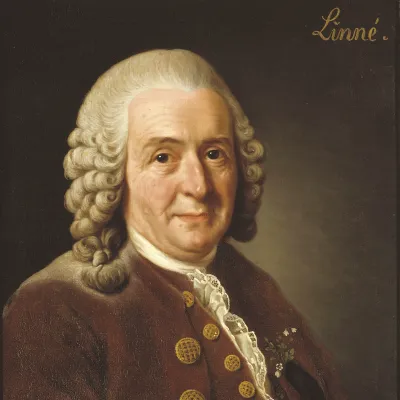
Carolus Linnaeus
Human Design Chart
Biography
As a child, he developed a love of flowers through the influence of his father, a clergyman and enthusiastic amateur botanist. A Christian, Linnaeus saw God’s work in every plant, and when he was eight years old, he was nicknamed "the little botanist." His parents wanted him to study theology, but he was encouraged by his teachers to study medicine instead, and in 1727, he enrolled at Lund University. He received his degree from the University of Uppsala where he was an assistant to Professor Rudbeck and supervisor of the botanical gardens.
In 1730, he began a series of botanical lectures, and two years later he was sent to Lapland by the Uppsala Academy of Sciences. The results of his explorations in that region were published in 1737 as the "Flora Lapponica" and firmly established his reputation as a naturalist.
From 1732 to 1738, Linnaeus traveled widely, spending time in Holland, England and France, before settling in Stockholm where he established a successful medical practice. He was instrumental in founding the Swedish Royal Academy of Sciences in 1739. In 1741, after turning down an appointment as the chair of medicine, he was appointed Head of Botany at the University of Uppsala, a position he held until his death. With his engaging personality, he was a popular teacher who easily and enthusiastically communicated his findings to his students. As a result, Uppsala soon became the center of the botanical world.
The Human Design of Carolus Linnaeus: Manifesting Generator 1/4
Manifesting Generator 1/4 — Design at a Glance
Carolus Linnaeus was characterized by hybrid dynamics: He possessed the constant, sacral energy of a Generator but also had the ability of a Manifestor to skip steps. This configuration allowed for lightning-fast action and enabled him to run multiple projects simultaneously. His design inclined towards multi-tasking joy, which created a central tension field. The natural speed could lead to skipping important stages or reacting to too many impulses at once. If these actions were not supported by his inner resonance, the initial creative enthusiasm quickly turned into frustration – his specific non-self-experience.
The mechanics of his Manifesting Generator therefore required a double strategy: He had to first react to external impulses and wait for his sacral center to respond with a clear “yes”. Only then should he act. Additionally, it was essential for him to regularly check if ongoing tasks still had his inner approval. Only when these conditions were met could he draw the depth of satisfaction from his work. In this state, variety was not an obstacle but necessary. He needed a playful mode to keep his energy flowing; the pressure to finish one thing before starting another would have contradicted his nature and slowed down his power.
Sacral Authority
Carolus Linnaeus showed decision-making based on inner, physical resonance. His inner authority was sacral authority, unique to the Generator type. This configuration simplified his process: strategy and authority merged. He did not react through intellectual analysis but responded to external stimuli with an immediate bodily signal – a gut feeling or surge of energy.
His design required trusting spontaneous signals like grunts, hums, or a clear “mmh”. These sounds were the language of his defined sacral center. When this motor kicked in, Carolus Linnaeus felt vital and alive. He seemed to have inexhaustible energy that enabled him to tackle tasks with great enthusiasm.
His life task was to go through life with joy and satisfaction. He found validation not in the purposefulness of actions but in immersing himself in activities themselves. This inner resonance served as a reliable compass. Instead of seeking logical justification, he oriented himself by the feeling of well-being and instinctiveness that flowed from this center. This created a direct line between stimulus and response without the detour through thought.
The 1/4 Profile — Investigator / Opportunist
Carolus Linnaeus was someone who sought deep, thorough knowledge but could only share it with a trusted circle of “beloved”. His design as an Investigator/Networker (Profile 1/4) combined the urgent desire for experience with the need for community. Line 1 drove him to intensively explore things while line 4 of great heart required transpersonal connection.
This configuration, however, created a central tension field: A deep fear of being exposed as unknowledgeable or inadequate in front of these trusted people. Such situations triggered intense heart pain because the emotional resonance of his environment was existential for him. Without a loving basis with deep trust, his potential remained blocked; the fear of rejection then prevented access to his inner authority.
Only in a safe environment could Carolus Linnaeus unfold his abilities and become an authority on his heart topics through his profound knowledge and networking skills. The mechanics underscore that for him, the quality of interpersonal bonds was the prerequisite for effectively applying acquired knowledge. His influence thus depended not only on content but significantly on whether he felt emotionally secure and accepted in his environment.
Single Definition — Defined & Open Centers
Carolus Linnaeus was characterized by a robust and constant energy foundation. His design featured four defined centers: Sacral, Root, G Center, and Throat. This configuration endowed him with vital endurance through the Sacral Center, persistent internal pressure for forward movement via the Root Center, clear identity and direction in the G Center, and reliable communication through the Throat Center. His energy was generated sacrally, propelled by the Root Center, directed through the G Center, and finally implemented into action through the Throat Center.
At the same time, Head, Ajna, Heart, Solar Plexus, and Spleen were open centers. These centers reflected their environment rather than being constant sources themselves. Carolus Linnaeus was susceptible to mental inspiration or confusion (Head/Ajna) as he lacked a consistent internal thought structure. He tended to question whether he needed to find answers, even though these questions often did not originate from him. In the Heart Center, he lacked a constant willpower; he was tempted to prove his worth through promises or competition rather than trusting in his inner authority. His open Solar Plexus absorbed the emotional climate of his environment, leading him to experience foreign moods as his own and avoid confrontation to maintain peace. With an open Spleen Center, he was sensitive to health signals and fears in the environment; he tended to make spontaneous decisions or cling to unhealthy situations just to gain a false sense of security.
The challenge lay in distinguishing his defined truth – the sacral reaction, inner direction, and root-driven pressure – from the absorbed fleeting impulses from open centers. By waiting for his sacral response instead of initiating mentally or emotionally, he could effectively utilize his energy without falling into conditioning such as a need for intellectual security or emotional comfort. His defined Throat allowed him to reliably express this clarity and identity, provided he was not distracted by fears or opinions of his environment.
Channels & Gates
Carolus Linnaeus exhibited an internal architecture carrying a tension-charged dynamic between evolutionary change and immediate implementation. His design was marked by the Channel of Mutation 60-3, connecting Root and Sacral Centers via the Gate of Limitation (60) and the Gate of Order (3). This channel generated a pulsing, often melancholic rhythm: energy burst in unpredictable waves followed by phases of silence. The key lay in accepting this limitation – not knowing when the next innovative insight would come – and patiently waiting for the sacral response rather than filling inner emptiness with mental acceleration.
Simultaneously, his personality was influenced by the Channel of Charisma 34-20, linking Sacral Center (Gate of Power, 34) to Throat Center (Gate of Now, 20). This endowed him with a powerful ability for immediate manifestation and self-reinforcement in the here and now. The drive of this energy was to become active and make results visible often so quickly that natural reaction time was bypassed.
The challenge lay in integrating both poles: the charismatic power of Channel 34-20 had to submit to the slower, melancholic pulse of Mutation in his design. Successful action did not arise from mental planning or forced pace but rather when sacral energy responded to external stimuli and found the right moment for expression. Thus, he avoided being carried away by his own momentum like a misdirected rocket and instead used his generative power purposefully to bring innovations into the world when his inner pulse allowed.
Circuit Signature
Carolus Linnaeus was marked by a constant, pulsing energy based on individual transformation and collective meaning-making. His design connected Sacral with Root Center through the Mutation Channel (3-60). This propelled him to deviate from the existing and create new knowledge – an inherent identity manifesting through deviation. Parallel to this, the Meaning-Maker Circuit linked his Throat with Identity Center via the channel “The Lost Son” (13-33), reflecting past experiences to unravel their deeper meaning and share these insights emotionally with others. These two streams – individual mutation and collective learning from the past – were integrated by the Charisma Channel (20-34). It connected Throat with Sacral Center, drawing strength from immediate reaction to life and expressing it in the now. Since all four centers (Sacral, Root, Throat, G Center) were defined, they formed a cohesive unit. Carolus Linnaeus thus lived in a dynamic allowing him not only to individually transform newly acquired knowledge but also to make it accessible to the collective through emotional resonance and charismatic presence in the here and now. His energy was neither purely logical nor isolated but a wave-like connection of innovation, reflection, and direct life engagement.
Right Angle Cross of the Sleeping Phoenix 2
Carolus Linnaeus was marked by the archetypal pattern of the 'Right Cross of the Sleeping Phoenix'. This configuration pointed to a profound inner tension arising from the desire for individual autonomy and simultaneous need for harmonious connection. His design suggested that he often oscillated between the urge to separate and be independent, and the longing for belonging and mutual respect.
This cross did not describe a linear progression but rather a cyclical process of internal transformation. The energy of this pattern called for questioning and reordering old identity structures without losing one's integrity. It was a life task of self-discovery through letting go of inauthentic expectations. Carolus Linnaeus had to learn that true freedom did not lie in isolation, but in the ability to shape relationships on equal footing without compromising himself. This archetypal imprint significantly shaped his inner stance and how he approached challenges by encouraging him to always seek a balance between independence and community.
Saturn Return · Uranus Opposition · Chiron Return · 2nd Saturn Return — Life Cycles
Carolus Linnaeus' professional development followed a clear rhythm where astrological cycles acted as turning points for social recognition and structural validation. His design showed a tendency for internal groundwork at these specific times to condense into external milestones.
In 1735, at the age of 28, he received his doctorate in Harderwijk. This marked his first Saturn return, a cycle often bringing long-term work to fruition and laying professional foundations. Ten years later, in 1747 at forty, the Uranus opposition occurred. It became active through his appointment as Archiater (court physician) to the king – a phase where established structures often need to be redefined or radically expanded, leading to significant role changes.
At age 49, he reached his Chiron return, a fulfillment cycle in which one's life purpose increasingly unfolds. This was concretely shown in 1756: The Swedish king Adolf Frederick ennobled him and gave him the name Carl von Linné. Here, the inner meaning of the design became outer reality and societal recognition.
His second Saturn return began in 1766 when he turned fifty by taking on the editing of the twelfth edition of Systema Naturæ. This cycle promoted consolidation and dissemination of what had already been achieved. Linnaeus' career illustrated how these recurring cycles structured critical phases for professional establishment and public validation, translating internal developments into concrete social positions.
Manifesting Generator · Sacral Authority — Synthesis
He lived a life deeply marked by an inner dynamic: the constant interplay between sacral reaction and manifesting initiative (Manifesting Generator). This combination drew him irresistibly to new explorations – driven by the need to grasp the world through observation (Line 1) and disseminate this knowledge in a network of relationships (Line 4). The defined Throat, fueled from the Sacral Center, gave him a powerful voice to express his insights, while Channel of Mutation (3-60) continually prompted him to question conventions and forge new paths. This energy was also evident in career events often associated with recognition and transformation.
A central paradox lay in being both a Generator who should react to impulses yet also tending towards skipping steps due to manifesting components (Sacral Authority & MG). This drive for rapid implementation clashed with his deep thirst for knowledge and fear of exposure, typical of his profile. He sought validation within the community while pursuing a unique vision – a tension field between belonging and individuality that shaped his life path and made him an indefatigable researcher.
3 Defined Channels
Incarnation Cross - Right Angle Cross of the Sleeping Phoenix 2
Solar Return
The Solar Return shows the moment when the sun returns to its exact birth position - your personal solar year.
Life Cycles
Discover the life cycles with a detailed triple view (birth chart, cycle chart, composite).
Human Design Profile
- Strategy
- To respond - wait for something to respond to
- Authority
- Sacral Authority
- Profile
- 1/4 - Investigator / Opportunist
- Definition
- Single Definition
- Incarnation Cross
- Right Angle Cross of the Sleeping Phoenix 2
- Date of Birth
- 23.05.1707 00:26
- Place of Birth
- Råshult, Sweden
Frequently Asked Questions
What Human Design type was Carolus Linnaeus?
What Profiles did Carolus Linnaeus have in Human Design?
Which Authority did Carolus Linnaeus possess?
What incarnation cross did Carolus Linnaeus have?
When was Carolus Linnaeus born?
Discover your own Human Design
Are you also a Manifesting Generator? Find out in a personal reading how to unfold your multi-talents and direct your energy wisely.
More Personalities
Back to overviewAldair

Alizée

Angeli

Arletty

Artus

Balthus