
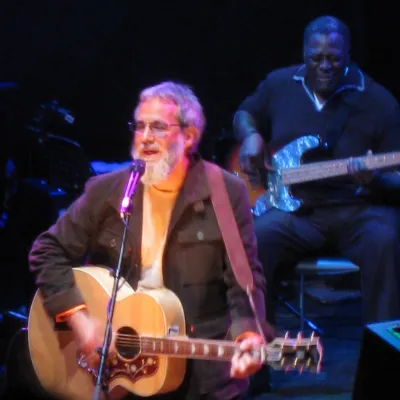
Cat Stevens
Human Design Chart
Biography
His spiritual conversion came after nearly drowning at a Malibu beach in 1976, making a deal with God, "Oh, God, if you save me, I'll work for you."
On 22 November 1979, he gave his last performance, giving up his music for the Muslim religion. Stevens changed his name to Yusuf Islam, married a Muslim woman, Fawzia Ali, in the formal tradition and had five children.
Residing in London with his wife of 19 years (as of 1998), Islam owns a hotel that caters to the Muslims.
At the age of 50, Yusuf Islam is promoting an album "I Have No Cannons That Roar" as a benefit to victims of the civil war in Bosnia. Some people see this as a comeback to music, but Islam states "but there is nothing about the music industry that interests me." At least 350,000 copies sold of his 1995 recording of "The Life of the Last Prophet."
Islam was robbed of $33,000 by Macedonian border guards when they were trying to enter the country with the funds to distribute to Kosovar refugees.
This musician returned to the Royal Albert Hall in London, the first time in over 25 years, to give one of his rare live concerts on October 20, 2003. The concert, a charitable event, was in celebration of the 20th anniversary of the Islamia Schools, which he founded. Earlier this year, Islam re-recorded his classic 'Peace Train' for a new album entitled "Hope," and he was nominated for the World Social Award for his humanitarian work with children.
Human Design Analysis: Cat Stevens as Generator 3/5
Generator 3/5 — Design at a Glance
Cat Stevens revealed himself as someone with immense inner endurance, comparable to a strong workhorse. His design showed a tendency towards great energy readiness as long as he engaged in activities that truly resonated with him. As a Generator, he possessed abundant sacral energy, which predisposed him for long-term projects and intensive creation. This power was not an automatic motor but responded to inner signals.
The key mechanism in his chart was the strategy of responding rather than initiating. His energy unleashed itself most effectively when he answered impulses from his environment and his gut feeling – the sacral center – clearly signaled a “yes”. Starting projects on his own initiative without waiting for this internal signal quickly led him to frustration or a lack of power. His design also revealed two specific pitfalls: either he depleted his substance on tasks that did not fulfill him, leading to exhaustion, or he was held back from his true heart project despite still being full of drive.
If Cat Stevens followed this logic and listened to his inner “go” before acting, his system rewarded him with a deep feeling of fulfillment. Deviations from it, particularly constant initiating against the gut flow, resulted in persistent dissatisfaction. His life energy was thus not an unlimited reserve but a responsive potential that only became sustainably effective through proper alignment with internal signals.
Sacral Authority
Cat Stevens possessed sacral authority, which made him a Generator type. This configuration fundamentally simplified his decision-making process as his strategy and inner guidance were identical: to react to life rather than actively initiate. A prerequisite for this clear orientation was his open emotional center, ensuring he was not guided by fleeting mood swings but waited for genuine physical resonance.
His inner voice manifested as a direct physical reaction to external stimuli – a surge of energy in the gut or intuitive sounds like grunting or humming. When his sacral motor kicked in, he felt vital and energized. This allowed him to tackle tasks with great enthusiasm and without compulsive purposefulness. He was geared towards living life joyfully and fully immersing himself in his activities.
Additionally, his activated spleen center acted as a supporting authority. Through the connection to the sacral center, Cat Stevens could act particularly quickly and spontaneously. This configuration gave him immediate access to his instinctual perception and physical well-being. He could reliably guide himself from these deep intuitive signals, sharpening his responsiveness and enabling decisions in the moment of occurrence without prolonged thinking or analysis.
The 3/5 Profile — Martyr / Heretic
Cat Stevens's design leaned towards heroic experimentation. He appeared as someone who initially made no assumptions and tested everything himself – a classic trait of Line 3 of Profile 3/5. This approach meant that he gained knowledge not through belief but through direct practical experience and the resulting mistakes. The mechanics describe this as a process of adapting to trial and error; from his failures, he learned to solve problems for others later (Line 5).
This configuration created a strong attraction in his environment. Other people projected the role of hero or savior onto him and wanted to learn from his experiences. For Cat Stevens, this recognition was flattering, yet it contained a risk: failing in public could be painful as Line 5 expects practical solutions and order out of confusion. The fifth line also demands patience with the timing of mutations; otherwise, immediate expectations led to aversion or the feeling of being a victim of others' opinions. His design thus balanced between self-sufficient adaptation through mistakes and the external expectation of always being wise and helpful.
Split Definition — Defined & Open Centers
Cat Stevens revealed himself as a person with a clear internal structure and strong will. His defined Heart Center gave him the ability to shape his life independently and control resources on his own terms. He tended to take promises seriously and preferred working under his own direction, seeking recognition for his contributions. This strength of will allowed him to find balance between work and rest as long as he listened to his inner guidance.
His defined Sacral Center generated a constant vital energy that drove him to engage with life through reaction. For Cat Stevens, it was crucial to trust this sacral response – an internal yes or no – to avoid burnout and find satisfaction in action. Additionally, his defined Spleen Center supported his intuitive perception of the moment. It helped him make spontaneous judgments about health and well-being and allowed protection through bodily intelligence. The also defined Root Center provided the necessary pressure to maintain existential awareness and material progress.
At the same time, Cat Stevens was influenced by several open centers for external influences. His open Head Center lacked consistent mental inspiration; he could easily get lost in doubts or seeking answers from others if he did not trust his authority. The open Ajna Center meant that his conceptual thinking was flexible but also prone to interpreting ideas and opinions as personal truth or pretending uncertainty.
His open Throat Center showed a tendency to force attention through speaking rather than waiting for invitations to express himself. The open G Center gave him no fixed identity; he tended to lose himself in relationships or environments and often sought direction and love from outside, instead of trusting initiation by his surroundings. Finally, his open Solar Plexus absorbed emotions from the environment, making him vulnerable to emotional waves of others and causing him to personalize foreign feelings or avoid confrontation.
Channels for instinctive devotion and evolutionary change.
Cat Stevens revealed an internal tension between sudden, deep transformation processes and an instinctive ability to convincingly convey these new impulses to others. His design tended towards unexpected creative leaps often accompanied by a melancholic base mood.
This dynamic was significantly shaped by the Channel of Mutation 60-3, connecting the Root Center with the Sacral Center through the Gate of Limitation (60) and the Gate of Order (3). The energy of this channel is pulsing and can be felt as internal restlessness or melancholy during phases of stillness until a sudden mutation discharges. Cat Stevens had to learn to accept these limitations and patiently wait for the right sacral response, rather than trying to steer the process with arguments.
Parallel to this, the Channel of Devotion 26-44 linked the Spleen Center with the Heart Center through the Gate of Alertness (44) and the Gate of Egotists (26). This channel allowed him a sharp sense for what was truly useful to his environment or audience. It enabled him to intuitively recognize historical patterns and package his messages in ways that were perceived as valuable improvements – an entrepreneurial creativity aimed at offering something to the tribe that it had not yet explicitly articulated as a need.
Additional facets emerged from the prioritized gates: Gate 56 promoted abstraction of mental processes into figurative storytelling, while Gate 50 protected traditional values and awareness. In the Personality field, Gate 41 contributed with its driving force to evolutionary experience, and Gate 52 demanded focused pattern correction through self-imposed pauses. This configuration shows a person who not only experiences change but instinctively markets it and brings it into structured, valuable forms.
Tribal Circuitry — Circuit Signature
Cat Stevens was marked by two separate yet parallel functioning energy areas. One area connected the Sacral with the Root Center via the Channel of Mutation (Gates 3–60). This connection created a pulsing power aimed at deviation from the known and new expression. The energy from the vitality of the Sacral met the pressure energy of the Root, leading to impulsive creative impulses demanding change.
Parallel to this was a second independent connection between Heart and Spleen Center via the Channel of Devotion (Gates 26–44). This area belonged to tribal energy and focused on cooperation as well as joint creation of resources. It was about mediation skills and balance in giving and taking. Since this group was not connected with the Sacral Center, there was no constant life flow; instead, this energy required rest pauses for regeneration before new efforts could be made.
As a person with split definition, these two systems did not function as one continuous stream but rather separate forces. The creative, mutative energy of the first area stood alongside the cooperative, resource-oriented dynamics of the second. Cat Stevens thus moved between the urge for individual transformation and the need for tribal support, where both areas had their own rhythms and demands without directly overlapping.
Right Angle Cross of Laws 2
Cat Stevens' design points towards a deep, almost mythical connection to nature and elemental forces. This configuration, known as the right cross of Law 2, describes more than just a preference for rural life; it represents an existential grounding in the cyclical patterns of birth, death, and rebirth. It is an energetic structure that encourages one to experience oneself as part of a larger natural fabric rather than feeling disconnected from it.
This mechanism acts like an inner compass seeking authenticity and originality. Those who carry this cross configuration tend not only to intellectually understand complex mental or spiritual truths but also validate them through direct experiences with the natural world. It is an energy that promotes calm, grounding, and a shamanic sensitivity towards the invisible laws of the universe.
For Cat Stevens, this meant that his creative expression and inner disposition were strongly influenced by his need to connect with the elemental. The energy of this cross supports a process of cleansing and renewal where old patterns are shed to make way for new growth. It is not passive surrender but active participation in the eternal cycles of nature, which can be both inspiring and challenging as they continuously demand authenticity and warn against superficial adjustments.
Saturn Return · Uranus Opposition · Chiron Return · 2nd Saturn Return — Life Cycles
Cat Stevens' life phases were marked by significant turning points that correlated with astrological cycles. His design indicated a tendency towards profound transformations when certain planetary influences became effective. In 1976, at the age of 28, he experienced his spiritual awakening after nearly drowning. This coincided with his first Saturn return, a period often triggering crises that can lead to denser personal identity and new life foundations. The crisis here served as a catalyst for fundamental inner reorientation.
Decades later in 1997 at the age of 49, he returned to performing under the name Yusuf after a seventeen-year hiatus on a public stage. This marked his Chiron return, a cycle of fulfillment and blooming. During this phase, one's incarnation cross increasingly unfolds; meaning and purpose become experiential if one has followed their strategy beforehand. For Cat Stevens, it was his re-emergence into the public eye accompanied by a new, mature presence.
In 2005 at age 57, the album 'Indian Ocean' was released as a download single with proceeds going to tsunami victims. This fell during his second Saturn return, often a phase of reviewing and affirming one's life structure. Here, it highlighted his ability to transform past experiences into concrete, community-oriented actions, underscoring the stability and maturity of this developmental stage.
Generator · Sacral Authority — Synthesis
A central thread in this design is the dynamic interaction between inner drive and the need for authentic expression. Sacral energy (Generator type) forms the foundation, a constant source of engagement and endurance as long as it responds to appropriate stimuli. This energy is amplified by the Channel of Mutation (3-60), implying continuous experimentation and acceptance of change – an ongoing process of trying out and letting go to find new paths. The defined Heart Center further emphasizes strong willpower that enables one to keep promises and live by their values, thereby promoting authenticity.
The central paradox lies in the tension between the desire for free experimentation (Line 3) and the responsibility to pass on acquired knowledge and take a heroic role (Line 5). Generator energy wants to unfold spontaneously while Line 5 creates an expectation pressure to offer solutions. This leads to a play between the wish for unbound exploration and the obligation to bring experiential wisdom into the world, with crises (recorded event in 1976) serving as transformative turning points.
2 Defined Channels
Incarnation Cross - Right Angle Cross of Laws 2
Solar Return
The Solar Return shows the moment when the sun returns to its exact birth position - your personal solar year.
Life Cycles
Discover the life cycles with a detailed triple view (birth chart, cycle chart, composite).
Human Design Profile
- Type
- Generator
- Strategy
- To respond - wait for something to respond to
- Authority
- Sacral Authority
- Profile
- 3/5 - Martyr / Heretic
- Definition
- Split Definition
- Incarnation Cross
- Right Angle Cross of Laws 2
- Date of Birth
- 21.07.1948 12:00
- Place of Birth
- London, UK
Frequently Asked Questions
What is Cat Stevens' Human Design type?
What profile does Cat Stevens have in Human Design?
What authority does Cat Stevens have in Human Design?
What is Cat Stevens' incarnation cross in Human Design?
When was Cat Stevens born?
Discover your own Human Design
Are you also a Generator? Find out in a personal reading how to use your sacral energy correctly and discover deep satisfaction.
More Personalities
Back to overviewAaliyah

Alexia

Angèle

Anne-Marie

Arcángel

Arno
